
Tag Archives: Naturalism

Stephen C. Meyer and Peter Atkins debate intelligent design

This dialog occurred in 2010 on the Unbelievable radio show.

I made a rough transcript, so please see below for that.

The MP3 file is here. (60 minutes)

Details:

The documentary film “Expelled” is presented by US Actor Ben Stein and makes the case that scientists who question Darwinian orthodoxy and support Intelligent Design are being “expelled” from academia.

As the UK edition of the DVD is released we ask “Is freedom of thought at stake or is Intelligent Design out of bounds when it comes to biological science?”

Stephen C Meyer is co founder of the Discovery Institute in the USA and a major proponent of Intelligent Design.

Peter Atkins is Professor of Chemistry at Oxford University and an outspoken atheist.

They both feature in “Expelled” and join Justin to debate the pros and cons of Intelligent Design theory.

Mark Haville who is bringing the film to the UK also joins the discussion.

Note: The transcript below is quite snarky and may include paraphrases of Dr. Atkins for the sake of humor.

My rough transcript of the Meyer-Atkins debate

Stephen Meyer:
– started researching on ID while doing his PhD at Cambridge
– the question is whether the information-bearing properties in DNA require a designer
– what cause is adequate to explain the digital code that in the simplest living cell
– alternative explanations like self-organization and RNA-first have failed
– so the best explanation for functional sequences of parts is an intelligent designer
– Darwinists have responded to this argument with insults and suppression of dissent

Peter Atkins:
– intelligent design is creationism
– there is no science at all in it
– information can emerge without an intelligent designer
– structures emerge spontaneously, no agent is needed to generate the structure
– information in DNA is also a structure

Stephen Meyer:
– structure and information are two different things
– many structures emerge spontaneously
– structure may be like the vortex that occurs when water goes down a drain

Peter Atkins:
– the vortex is information

Stephen Meyer:
– structures are different from functionally-specified digital information
– in DNA, there is a 4-digit alphabet that is used to create code sequences
– the thing to be explained is where do the functional sequences come from

Peter Atkins:
– information can grow without an agent
– the second law of thermodynamics
– the universe is falling into disorder
– but there are local abatements of chaos that create information
– evolution can cause the amount of information to grow

Stephen Meyer:
– that’s just an assertion
– I agree that energy flow through a system can produce spontaneous order
– but spontaneous order is not the same thing as information

Peter Atkins:
– spontaneous order is the same as information

Stephen Meyer:
– it’s not order that needs to be explained it’s specified complexity

Peter Atkins:
– what do you mean by specified complexity?

Stephen Meyer:
– the chemical bonds that connect to each letter do not determine the letter
– the chemical bonding sites will accept any letter as easily as any other
– any one of the 4 bases (letters) can attach at any place along the backbone

Peter Atkins:
– the selection of which letter comes next is determined by evolution

Stephen Meyer:
– that is just an assertion
– there is no physical process that sequences the letters to have a function

Peter Atkins:
– do you believe in evolution? YES OR NO!

Mark Haville:
– for him to answer the question you have to define the word
– do you mean macro or micro? biological or stellar? directed or undirected?

Peter Atkins:
– undirected molecules to man evolution by natural processes

Stephen Meyer:
– but even Dawkins doesn’t believe in evolution then
– you’re including the origin of life from non-living matter in evolution
– Dawkins says that there is no known naturalistic explanation for that

Mark Haville:
– you need to define your terms

[They discuss of the movie Expelled and the case of Richard Sternberg]

Stephen Meyer:
– the problem is people don’t want to talk about the science
– they denounce dissent as unscientific
– they will not debate about whther natural causes can explain the information
– I want to talk about the science

Peter Atkins:
– ID people raise interesting questions for naturalists to work on
– but you want to tell us what the answer is (intelligence) before we begin
– you start from the idea that an intelligence was involved

Justin Brierley:
– but you start with the idea that natural mechanisms can explain everything!

Stephen Meyer:
– for Dr. Atkins, only explanations based on material processes are valid

Peter Atkins:
– that is correct

Stephen Meyer:
– but we think that the activities of mind can explain some effects
– e.g. – the best explanation of the Rosetta stone is a mind

Peter Atkins:
– but we naturalists think of minds as material as well

Stephen Meyer:
– that’s a materialist pre-supposition on your part
– we would have to have a debate about mind and body

Mark Haville:
– I think that the materialist position is socially dangerous
– the problem with naturalism is that it is an ideology
– the ideology pushes absurdities, e.g. – the universe came from nothing uncaused
– and naturalists exert power over others to force them to believe nonsense

Stephen Meyer:
– science progresses as the result of scientists disagreeing
– both sides agree to the facts
– the debate is about the interpretation of those facts
– and one side is being ruled out a priori based on the pre-supposition of materialism

Peter Atkins:
– why do you say that an intelligence is involved in DNA but not general relativity

Stephen Meyer:
– it is always logically possible that intelligence can be invlved in any effect
– the main thing is that explanations based on intelligence should not be ruled out

Peter Atkins:
= well you can’t appeal to any non-material process in expaining anything
– those are the rules

Moderator:
– what does intelligent design have to do with religion?

Stephen Meyer:
– creationism is about understanding the istory of life using the Bible
– intelligent design is about using the same method of inquiry as Darwin
– we know that information arises from intelligent causes
– humans create information all the time by using intelligence to sequence parts

Moderator:
– are intelligent design proponents disreputable?

Stephen Meyer:
– what’s disreputable is shutting down debate by setting arbitrary rules

Peter Atkins:
– we are both interested in the same questions

Moderator:
– why won’t you let Stephen publish his papers then?

Peter Atkins:
– because it breaks the pre-suppositions of naturalism and materialism

Stephen Meyer:
– you’re shutting down inquiry by using an arbitrary definition of science

Mark Haville:
– we need to define the word science
– science should be based on what we can observe empirically
– we can observe micro-evolution empirically
– but Darwinism goes beyond what is observable to postulate macro-evolution

Peter Atkins:
– but paleobiology is replete with evidence

Stephen Meyer:
– paleobiology uses a method of inference that I think is valid
– but intelligent design uses the same mode of reasoning which is also valid

Peter Atkins:
= you’re intellectually lazy
– we’re smart, we’re using our brains

Moderator:
– you’re saying that appeals to intelligent causes ends science?
– is ID the view that some things are too complex to be explained with naturalism?

Peter Atkins:
– yes, and to teach children that materialism is false is child abuse

Stephen Meyer:
– let’s drop the insults and the rhetoric and focus on the arguments
– the ID argument is not based on what we don’t know, it’s based on what we DO know
– first, we can ask what undirected natural processes can and cannot do
– second, we can ask what we know about intelligent causes from our own experience
– what we do know seems to me to require an intelligent agent as a cause

Peter Atkins:
– GOD! Do you mean God!? Do you mean God!?

Stephen Meyer:
– I personally mean God, but all that the arguments proves is a generic intelligent cause
– and I am using the same method of investigation that Darwin used to get there
– what we know from our experience is that a mind is needed to create information

Peter Atkins:
– NONSENSE! ABSOLUTE NONSENSE!

Stephen Meyer:
– in my book, I list 10 predictions made by ID, so it’s not a science-stopper
– furthermore, the enterprise of science began with th goal of understanding God
– consider the earliest scientists, people like James Boyler and Johannes Kepler

Peter Atkins:
– that was 300 years ago, we’ve moved on

Mark Haville:
– what about Max Planck then?

Stephen Meyer:
– how about James Clark Maxwell?

Mark Haville:
– we need to focus on the facts

Peter Atkins:
– what do you mean by the facts?

Mark Haville:
– well the fact is that Darwinism has no mechanism to produce new information

Peter Atkins:
– well copying errors introduces beneficial mutations

Stephen Meyer:
– let’s focus on where we get the first information from the simplest organism
– you can’t account for the first organism by appealing to copying errors
– to add functionality to a program, you need new lines codes from an intelligence
– once you have life, you can generate some new information
– but you can’t generate macro-evolution either

Peter Atkins:
– if we give you your explanation for teh origin of life, will you give this up

Stephen Meyer:
– of course! I’m a former theistic evolutionist
– but right now the evidence is not there for it
– we have to decide these questions based on what we see with our own eyes today

Peter Atkins:
– but I pre-suppose materialism as the starting point of all explanations
– you’re just intellectually lazy to abandon my pre-supposition

Stephen Meyer:
– why is it is less intellectually lazy to insist that materialism is true
– we are making plenty of predictions, and isn’t that what science is about?
– consider Junk DNA – you guys said it had no use
– now we know it has a use

Peter Atkins:
– naturalists were open to the idea that junk DNA might have a use before ID

Moderator:
– Dr. Meyer, what about the wall that locks out intelligence as an explanation?

Stephen Meyer:
– if these are interesting questions, then we should allow freedom of inquiry
– that’s how science advances

Peter Atkins:
– for all their science-talk really they are just saying God did it
– people who don’t agree with me are not using their brains, like I do
– to give up on my pre-supposition of materialism is a denial of humanity

Mark Haville:
– there are important issues that are affected by our view of origins
– everyone who hasn’t seen Expelled movie should definitely see it

What are Boltzmann brains, and what challenge do they pose to the multiverse hypothesis?

Apologetics and the progress of science

I thought I would turn to the atheist theoretical physicist Sean Carroll, who has previously debated William Lane Craig, to explain to us what a Boltzmann brain is, and what threat it posts to the multiverse hypothesis.

Here is Sean Caroll, quoted by About.com:

Ludwig Boltzmann was one of the founders of the field of thermodynamics in the nineteenth century.

One of the key concepts was the second law of thermodynamics, which says that the entropy of a closed system always increases. Since the universe is a closed system, we would expect the entropy to increase over time. This means that, given enough time, the most likely state of the universe is one where everything is the in thermodynamic equilibrium … but we clearly don’t exist in a universe of this type since, after all, there is order all around us in various forms, not the least of which is the fact that we exist.

With this in mind, we can apply the anthropic principle to inform our reasoning by taking into account that we do, in fact, exist.

Here the logic gets a little confusing, so I’m going to borrow the words from a couple of more detailed looks at the situation. As described by cosmologist Sean Carroll in From Eternity to Here:

Boltzmann invoked the anthropic principle (although he didn’t call it that) to explain why we wouldn’t find ourselves in one of the very common equilibrium phases: In equilibrium, life cannot exist. Clearly, what we want to do is find the most common conditions within such a universe that are hospitable to life. Or, if we want to be more careful, perhaps we should look for conditions that are not only hospitable to life, but hospitable to the particular kind of intelligent and self-aware life that we like to think we are….

We can take this logic to its ultimate conclusion. If what we want is a single planet, we certainly don’t need a hundred billion galaxies with a hundred billion stars each. And if what we want is a single person, we certainly don’t need an entire planet. But if in fact what we want is a single intelligence, able to think about the world, we don’t even need an entire person–we just need his or her brain.

So the reductio ad absurdum of this scenario is that the overwhelming majority of intelligences in this multiverse will be lonely, disembodied brains, who fluctuate gradually out of the surrounding chaos and then gradually dissolve back into it. Such sad creatures have been dubbed “Boltzmann brains” by Andreas Albrecht and Lorenzo Sorbo….

In a 2004 paper, Albrecht and Sorbo discussed “Boltzmann brains” in their essay:

A century ago Boltzmann considered a “cosmology” where the observed universe should be regarded as a rare fluctuation out of some equilibrium state. The prediction of this point of view, quite generically, is that we live in a universe which maximizes the total entropy of the system consistent with existing observations. Other universes simply occur as much more rare fluctuations. This means as much as possible of the system should be found in equilibrium as often as possible.

From this point of view, it is very surprising that we find the universe around us in such a low entropy state. In fact, the logical conclusion of this line of reasoning is utterly solipsistic. The most likely fluctuation consistent with everything you know is simply your brain (complete with “memories” of the Hubble Deep fields, WMAP data, etc) fluctuating briefly out of chaos and then immediately equilibrating back into chaos again. This is sometimes called the “Boltzmann’s Brain” paradox.

[…]Now that you understand Boltzmann brains as a concept, though, you have to proceed a bit to understanding the “Boltzmann brain paradox” that is caused by applying this thinking to this absurd degree. Again, as formulated by Carroll:

Why do we find ourselves in a universe evolving gradually from a state of incredibly low entropy, rather than being isolated creatures that recently fluctuated from the surrounding chaos?

Unfortunately, there is no clear explanation to resolve this … thus why it’s still classified as a paradox.

Naturalists like to propose the multiverse as a way of explaining away the fine-tuning that we see, and explaining why complex, embodied intelligent beings like ourselves exist. But even if the multiverse hypothesis were true, we still would not expect to observe stars, planets, and conscious embodied intelligent beings. It is far more likely on a multiverse scenario that any observers we had would be “Boltzmann” brains in an empty universe. The multiverse hypothesis doesn’t explain the universe we have, which contains “a hundred billion galaxies with a hundred billion stars each” – not to mention our bodies which are composed of heavy elements, all of which require fine-tuning piled on fine-tuning piled on fine-tuning.

William Lane Craig answered a question about Boltzmann brains a while back, so let’s look at his answer since we saw what his debate opponent said above.

He writes:

Incredible as it may sound, today the principal–almost the only–alternative to a Cosmic Designer to explain the incomprehensibly precise fine tuning of nature’s constants and fundamental quantities is the postulate of a World Ensemble of (a preferably infinite number of) randomly ordered universes. By thus multiplying one’s probabilistic resources, one ensures that by chance alone somewhere in this infinite ensemble finely tuned universes like ours will appear.

Now comes the key move: since observers can exist only in worlds fine-tuned for their existence, OF COURSE we observe our world to be fine-tuned! The worlds which aren’t finely tuned have no observers in them and so cannot be observed! Hence, our observing the universe to be fine-tuned for our existence is no surprise: if it weren’t, we wouldn’t be here to be surprised. So this explanation of fine tuning relies on (i) the hypothesis of a World Ensemble and (ii) an observer self-selection effect.

Now apart from objections to (i) of a direct sort, this alternative faces a very formidable objection to (ii), namely, if we were just a random member of a World Ensemble, then we ought to be observing a very different universe. Roger Penrose has calculated that the odds of our solar system’s forming instantaneously through the random collision of particles is incomprehensibly more probable that the universe’s being fine-tuned, as it is. So if we were a random member of a World Ensemble, we should be observing a patch of order no larger than our solar system in a sea of chaos. Worlds like that are simply incomprehensibly more plentiful in the World Ensemble than worlds like ours and so ought to be observed by us if we were but a random member of such an ensemble.

Here’s where the Boltzmann Brains come into the picture. In order to be observable the patch of order needn’t be even as large as the solar system. The most probable observable world would be one in which a single brain fluctuates into existence out of the quantum vacuum and observes its otherwise empty world. The idea isn’t that the brain is the whole universe, but just a patch of order in the midst of disorder. Don’t worry that the brain couldn’t persist long: it just has to exist long enough to have an observation, and the improbability of the quantum fluctuations necessary for it to exist that long will be trivial in comparison to the improbability of fine tuning.

In other words, the observer self-selection effect is explanatorily vacuous. It does not suffice to show that only finely tuned worlds are observable. As Robin Collins has noted, what needs to be explained is not just intelligent life, but embodied, interactive, intelligent agents like ourselves. Appeal to an observer self-selection effect accomplishes nothing because there is no reason whatever to think that most observable worlds are worlds in which that kind of observer exists. Indeed, the opposite appears to be true: most observable worlds will be Boltzmann Brain worlds.

Allen Hainline explained some of the OTHER problems with the multiverse in a post on Cross Examined’s blog. I recommend taking a look at those as well, because I feel funny even talking about Boltzmann brains. I would rather just say that there is no experimental evidence for the multiverse hypothesis, as I blogged before, and leave it at that. But if the person you are talking to fights you on it, you can disprove the multiverse with the Boltzmann brains.

Information Enigma: 21-minute video explains intelligent design

Can random mutation and natural selection create new functional information?

The video is here:

I have read and listened and watched a lot of material on intelligent design, but I have never seen so much value packed into such a short lecture. I really hope you’ll watch this and that it’s helpful to you.

Summary:

  • the big question when discussing the origin of life: where did the information in living systems come from?
  • Until 530 million years ago, the oceans were largely devoid of life
  • In a 10 million year period, many new forms of animal life emerged
  • New biological forms of life require new information
  • the discovery of DNA shows that living systems work because cells have information that allows them to build the components of molecular machines: cell types, proteins, etc.
  • can random mutation and natural selection create new functional information?
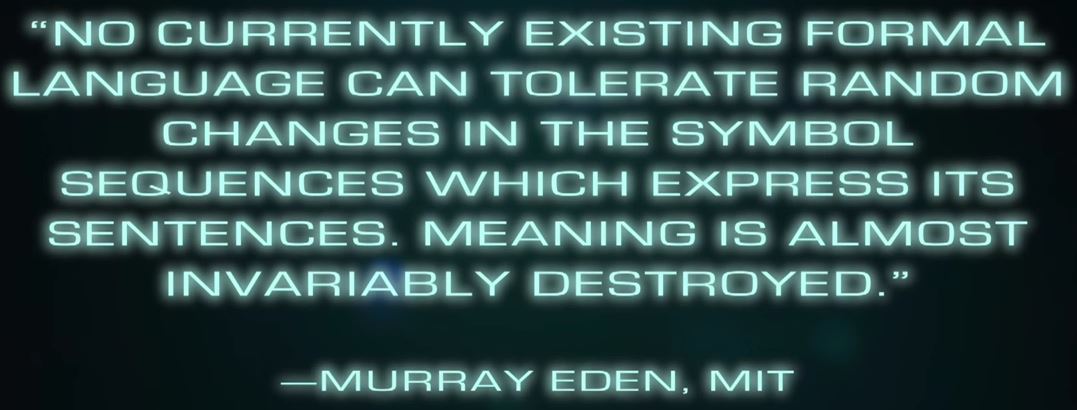
  • normally, random mutations tend to degrade the functionality of information, e.g. – randomly changing symbols in an applications code does not usually introduce useful new functions, it usually renders what is there non-functional
  • the majority of possible sequences will NOT have functions, so random mutations will more likely give you non-functional code, rather than functional code
  • example: a bicycle lock  with 4 numbers has many possible sequences for the 4 numbers, and only one of them has unlock functionality, the rest have no functionality
  • if you have lots of time, then you might be able to guess the combination, but if the lock as has 10 billion numbers, and only one combination that unlocks, you can spend your whole life trying to unlock it and won’t succeed
  • how likely is it to arrive at a functional protein or gene by chance? Is it more like the 4-dial lock (can be done with lots of time) or the 10 billion dial lock (amount of time required exceeds the time available)?
  • the probability is LOW because there is only one sequence of numbers that has unlock function
  • consider a short protein of 150 amino acids has 10 to the 195th power possible sequences
  • if many of these sequences of amino acides had biological function, then it might be easier to get to one by random mutation and selection than it is with a lock that only unlocks for ONE sequence
  • how many of the possible sequences have biological function?
  • Thanks to research done by Douglas Axe, we now know that the number of functional amino acid sequences for even a short protein is incredibly small…
  • Axe found that the odds of getting a functional sequence of amino acids that will fold and have biological function is 1 in 10 to the 77th power
  • Is that number too improbable to reach by chance? well, there are 10 to 65th atoms in the entire Milky Way galaxy… so yes, this is a very improbable outcome
  • can random genetic mutations search through all the sequences in order to find the one in 10 to the 77th power one that has biological function? It depends on how much guessers we have and how many guesses we get in the time available
  • even with the entire 3.5 billion year history of life on Earth, only about 10 to the 40th organisms have ever lived, which far smaller fraction of the 10 to the 77th total sequences
  • even with a very fast mutation rate, you would not be able to reach a functional protein even with all that time, and even with all those organisms

I was once having a discussion with a woman about the research that Axe did at the Cambridge University lab. He published four articles in the Journal of Molecular Biology. I held out one of the papers to her and showed her the numbers. She said over and over “I hate the Discovery Institute! I hate the Discovery Institute!” Well, yeah, but you can’t make the Journal of Molecular Biology go away with hating the Discovery Institute. JMB is peer-reviewed, and this was experimental evidence – not a theory, not a hypothesis.

We have been blessed by the Creator and Designer of the universe in this time and place with overwhelming evidence – an abundance of riches. For those who have an open mind, this is what you’ve been waiting for to make your decision. For the naturalists who struggle so mightily to block out the progress of experimental science, they’ll need to shout louder and shut their eyes tighter and push harder to block their ears. Maybe if they keep screaming “Star Trek” and “Star Wars” over and over to themselves, they will be able to ignore the real science a little longer.