
Tag Archives: Naturalism

Study by UCLA neuroscientist Jeffrey Schwartz falsifies materialist determinism

Apologetics and the progress of science

Here’s a summary of the research of UCLA professor Jeffrey Schwartz, authored by William Dembski.

Excerpt:

Schwartz provides a nonmaterialist interpretation of neuroscience and argues that this interpretation is more compelling than the standard materialist interpretation. He arrived at this position as a psychiatrist specializing in the treatment of obsessive-compulsive disorder (OCD). OCD sufferers recognize obsessive-compulsive thoughts and urges as separate from their intrinsic selves. For instance, after a few washings, the compulsive hand-washer realizes that his hands are clean and yet feels driven to keep washing them. It was reflection on this difference between the obvious truth (the hands are clean) and the irrational doubts (they might still be dirty) that prompted Schwartz to reassess the philosophical underpinnings of neuroscience.

From brain scans, Schwartz found that certain regions in the brain of OCD patients (the caudate nucleus in particular) exhibited abnormal patterns of activity. By itself this finding is consistent with a materialist view of mind (if, as materialism requires, the brain enables the mind, then abnormal patterns of brain activity are likely to be correlated with dysfunctional mental states). Nonetheless, having found abnormal patterns of brain activity, Schwartz then had OCD patients engage in intensive mental effort through what he called relabeling, reattributing, refocusing, and revaluing (the 4 Rs). In the case of compulsive hand-washing, this involved a patient acknowledging that his hands were in fact clean (relabeling); attributing anxieties and doubts about his hands being dirty to a misfunctioning brain (reattributing); directing his thoughts and actions away from handwashing and toward productive ends (refocusing); and, lastly, understanding at a deep level the senselessness of OCD messages (revaluing).

Schwartz documents not only that patients who undertook this therapy experienced considerable relief from OCD symptoms, but also that their brain scans indicated a lasting realignment of brain-activity patterns. Thus, without any intervention directly affecting their brains, OCD patients were able to reorganize their brains by intentionally modifying their thoughts and behaviors. The important point for Schwartz here is not simply that modified thoughts and behaviors permanently altered patterns of brain activity, but that such modifications resulted from, as he calls it, “mindful attention”-conscious and purposive thoughts or actions in which the agent adopts the stance of a detached observer.

So mind-brain interaction is not a one-way street. Everyone knows that you can alter your consciousness, beliefs, moods, sensations, etc. by changing your brain, e.g. – with drugs. But it turns out that you can also will to focus your thoughts on certain things in order to change your brain chemistry. So the causation is not just bottom-up, but also top-down.

Now mindfulness therapies – which are documented in the research papers published by Schwartz (like this one and this one and this one)- assume the existence of free will. Naturalists don’t like these scientific publications because naturalists don’t believe in free will, as the famous naturalist philosopher Alex Rosenberg explained in his debate with William Lane Craig.

This post from Uncommon Descent explains the naturalist conundrum.

Excerpt:

The issue, for Schwartz, turns on whether or not there is such a thing as free will. The assumption of free will is critical to mindfulness therapies for practical purposes.

Philosophies and religions have various opinions about ultimate free will. The therapist must ask, is my patient capable of carrying out a program that requires that he choose to focus his attention on A and not B? In practice, this turns out to be true for many patients, which makes the therapy useful. There is neuroscience evidence for brain reorganization as a result, showing that it is not merely an imagined effect.

Now, if someone wishes to claim, as many outspoken advocates of Darwinian evolution have, for example, that free will is impossible, the only thing that a mindfulness therapist can say is, go away. Either they are mistaken or the research results from mindfulness therapies are.

By the way, if you like this topic, and want a resource to show your friends, be sure and get a hold of the debate on mind vs. brain between Jeffrey M. Schwartz and Michael Shermer.
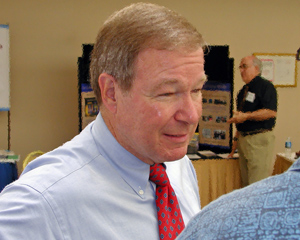
Walter Bradley lectures on the creation and design of the universe

Dr. Walter L. Bradley

This lecture is special to me, because I bought a VHS tape of it just after I started working full-time, and watched it a million times. It changed my life. The lecture was delivered at the University of California, Santa Barbara.

About the speaker:

Dr. Bradley received his B.S. in Engineering Science and his Ph.D. in Materials Science from the University of Texas in Austin.

Dr. Bradley taught for eight years at the Colorado School of Mines before assuming a position as Professor of Mechanical Engineering at Texas A&M University (TAMU) in 1976.

During his 24 years at Texas A&M, Dr. Bradley served as Head of the Department of Mechanical Engineering at Texas A&M University and as Director of the Polymer Technology Center, and received five College of Engineering Research Awards. He has received over $4,500,000 in research grants and has published over 140 technical articles and book chapters. He has also co-authored “The Mystery Of Life’s Origin: Reassessing Current Theories. He is a Fellow of the American Society for Materials and of the American Scientific Affiliation and serves as a consultant for many Fortune 500 companies.

He currently serves as Distinguished Professor of Engineering at Baylor University.

The lecture: (63 minutes lecture, 25 minutes audience Q&A)

Summary slide:

This slide summarizes the content of the lecture

Introduction:

  • At the beginning of the 20th century, people believed that the progress of science was pointing away from an intelligent Creator and Designer, and towards naturalism
  • A stream of new discoveries has shifted the support of science towards theism, and away from naturalism
  • Richard Dawkins, an atheist, says that nature only has the appearance of design, but that if you look closer, naturalistic mechanisms can account for the appearance of design
  • When deciding between design and apparent design (“designoid”), it matters whether you think there is an intelligence there to do the designing

Evidence #1: The Big Bang:

  • an eternal “steady state” universe is more compatible with naturalism, but a created universe is more compatible with a Creator
  • In 1929, Hubble used telescopes to observe that the light from distant galaxies was redshifted. The further away galaxies were, the faster they were moving away. Therefore, space is expanding in all directions, suggesting an explosive origin of the universe
  • In 1965, the discovery of the cosmic microwave background radiation matched a prediction of the Big Bang cosmology, and of the creation event
  • In 1992, the COBE space telescope allowed us to test four specific predictions of the Big Bang model, especially the predictions for light element abundances (hydrogen and helium), which matched the predictions of the creation model

Evidence #2: Simple mathematical structure of the physical laws

  • the simple mathematical structure of natural laws allows us to understand these laws, make discoveries, and engineer solutions to problems
  • early scientists saw the mathematical structure of the universe to mean that nature was designed by an intelligent to be understood
  • the fundamental equations of the laws of the universe can be easily written on one side of one sheet of paper
  • Eugene Wigner’s famous paper, “The Unreasonable Effectiveness of Mathematics in the Physical Sciences” makes the point that this simple structure is an unexpected gift that allows is to do science

Evidence #3: fine-tuning of the physical constants and quantities

  • in order for any kind of complex life to survive, we need stars that provide energy within specific ranges for long periods of time
  • in order for any kind of complex life to survive, we need planets with stable orbits that will not suffer from extreme temperature swings as it varies in distance from its star
  • in order for any kind of complex life to survive, we need stable atomic structure
  • in order for any kind of complex life to survive, we need to have chemical diversity and correct relative abundances of each element
  • organic life has minimum requirements: process energy, store information, replicate, and you can’t fulfill those functions if there is only one element, e.g. – hydrogen
  • the energy level from the photons from the sun have to match the energy levels of the different elements in order to drive the chemical bonding needed for life
  • These requirements for life of any imaginable type depend on the values of the constants and quantities. The constants and quantities cannot vary much from what they are, or the universe will lose the characteristics (above) that allow it to support complex life of any imaginable time
  • For example, ratio of strong force to electromagnetic force:
    – if 2% larger, then no stable hydrogen, no long-lived stars, no compounds containing hydrogen, e.g. – water
    – if 5% smaller, no stable stars, heavy hydrogen would be unstable, few elements other than hydrogen

Evidence #4: initial conditions for habitability

  • Universe: expansion rate of the universe must be fast enough to avoid a re-collapse, but slow enough to allow matter to clump together and form stars and planets for complex life to live on
  • Planet: right distance from the star to get the right climate
  • Planet: right mass to retain the right atmosphere

Evidence #5: origin of life and information theory

  • It’s possible to explain every process in an automobile engine using plain old naturalistic mechanisms – no supernatural explanation is necessary to understand the processes
  • But the existence of engine itself: engineering all the parts has to be explained by the work of an intelligence
  • Similarly, we can understand how living systems work, but the existence of the living systems requires an intelligence
  • Even the simplest living system has to perform minimal function: capture energy, store information and replicate
  • Living systems are composed of objects like proteins that are composed of sequences of components complex such that the order of the components gives the overall structure function
  • Developing the components for a simple living cell is very improbable – even given the large number of galaxies, stars and planets in the universe, it is unlikely that complex, embodied life would exist anywhere in the universe

Evidence #6: more initial conditions for habitability

  • Location within the galaxy: you need to be away from the center of the galaxy, because the explosions from dying stars, and excessive radiation will kill life
  • Location within the galaxy: you need to be close enough to the center in order catch the heavy elements you need for life from the explosions of other stars
  • Location within the galaxy: the best location is between two arms of  a spiral galaxy, where you can get the heavy elements you need from dying stars, but without being hit with explosions and harmful radiation
  • Star mass: determines rate at which the sun burns, determines the energy level of photons that are used to drive chemical bonding reactions, determines the length of time the star will be stable
  • Star mass: star mass must be the correct value in order to allow liquid water on the planet’s surface, while still preserving stable orbit

I wish there was more curiosity about science in churches, and young Christians understood how critical science is for grounding the rationality of the Christian worldview. We need to be training up more scientists who think about the big questions, like Dr. Walter Bradley.

Three logical prerequisites for biological evolution to work

Hummingbird in flight

Biologist, blogger and super-mom Lindsay has written a post that explains what supporters of Darwinian mechanisms have to prove in order to explain the origin and diversity of life.

Here are the three things that Darwinists must demonstrate:

  1. It is possible to add biological information.
  2. There are more upward steps than downward steps (or at least a way to get more upward steps than downward steps at least some of the time).
  3. There does exist a gradual genetic pathway that can be climbed in tiny, incremental steps.

So first of all, the main two arguments for intelligent design and against naturalism are the origin of life and the Cambrian explosion. Both involve massive infusions of new biological information. So Lindsay is right to focus on whether Darwinism can add new biological information. But I wanted to focus on number three, because I really think that her post is about the burden of proof on Darwinists more than it is about our burden of proof. And we do need to get used to asking Darwinists for the evidence for their view.

Take a look at the detail on number three:

In order for evolution to be true, not only does information have to be added over time, but each successive change must occur in a living organism and it must be conserved by being passed on to offspring. Thus, the change cannot kill the organism or seriously disable it, or the change will not be passed on. This must be the case for EVERY step in the entire evolutionary sequence, no matter how small. At every step you must have a functional organism. Thus, the changes must be gradual enough that the tiny upward steps (if they exist) can achieve each new level without killing or disabling the organism. To use a simplistic analogy, if one tries to change from one word to another by changing one letter at a time (cat to cot to dot to dog, for example), there must, at every step, be an actual word that can be reached by changing one letter. In the Mount Improbable analogy, this means that there can be no upward jumps in the trail. If the maximum possible upward step is 6 inches, then there can be no 6 foot cliffs along the trail, or even 7 inch steps. If ever there is a step which requires more information than unguided evolution can provide, then evolution is falsified in that instance. It cannot account for the change in information if that is the case.

Now I have never seen a gradual genetic pathway from one body plan (phyla) to another body plan (phyla) in any peer-reviewed paper. What I need to see to believe in the ability of Darwinian mechanisms to drive change from one body plan to another is that sequence of changes at the genetic level. And I don’t just need to see the steps, I need to see the probabilities of getting the correct sequence of changes at the genetic level within the time available by chance. That’s what Darwinists assert in their theory – that’s what they need to prove. Talking about how one creature looks like another creature is irrelevant. My car looks like my Dads car, because we drive the same model, but different model years – and both cars are designed.

When people ask our side for evidence for our claims, we are able to produce the evidence to substantiate our claims, e.g. – cosmic fine-tuning factors or protein sequencing probabilities. I would like to see the other side do the same, and not just tell me a story. When I question people in the arts who accept Darwinism, they seem to be terribly disinterested in the details, and just want to jump to the conclusion shared by the smart people without thinking hard about all the steps in between. That’s intellectually lazy. The same thing happens with global warming with the non-scientists – they are more concerned about jumping to the “smart people” position, so you think that they’re smart. They aren’t really interested in hearing both sides, or looking at the evidence. I think people need to take it slow and look at the evidence, instead of deciding what to believe based on how other people perceive them. No need to rush to agreement to build up your self-esteem without doing the hard work first.

If you are looking to understand what the other side has to prove, and in a concise way, read her post.