Tag Archives: Naturalism

Stephen C. Meyer: does the Big Bang cosmology disprove the existence of God?

Christianity and the progress of science

Here’s the 66-minute video featuring Dr. Stephen C. Meyer, who holds the Ph.D in philosophy of science from Cambridge University, and other degrees in the hard sciences.

The lecture starts really, really slowly. You can just fast-forward to the 12 minute mark, or you might die of boredom.

Topics:

  • Up until the the last 100 years or so, everyone agreed that the universe was eternal
  • This is at odds with the traditional Christian view that God created the universe
  • Materialism, the view that matter is all there is, requires eternally existing matter
  • Discovery #1: Hubble discovers that the universe is expanding (redshift observation)
  • The expanding universe was resisted by proponents of the eternal universe, like Einstein
  • Some naturalists even proposed speculative static models like the steady-state model
  • However, not of the speculative models fit with observations and experimental results
  • Discovery #2: Penzias and Wilson discover the cosmic microwave background radiation
  • Measurements of this background radiation confirmed a prediction of the Big Bang theory
  • The steady-state theory was falsified of by the discovery of this background radiation
  • The oscillating model was proposed to prevent the need for an absolute beginning
  • But the oscillating model is not eternal, it loses energy on each “bounce”
  • A paper by Alan Guth and Marc Sher from 1982 proved that our universe will not bounce
  • In addition, experiments reveal that the universe will expand forever, and not contract
  • The beginning of the universe is more at home in a theistic worldview than an atheistic one
  • The beginning of the universe fits in well with the Bible, e.g. – Genesis 1, Titus 1, etc.

In case you are wondering about what the evidence is for the Big Bang, here are 3 of the evidences that are most commonly offered:

Three main observational results over the past century led astronomers to become certain that the universe began with the big bang. First, they found out that the universe is expanding—meaning that the separations between galaxies are becoming larger and larger. This led them to deduce that everything used to be extremely close together before some kind of explosion. Second, the big bang perfectly explains the abundance of helium and other nuclei like deuterium (an isotope of hydrogen) in the universe. A hot, dense, and expanding environment at the beginning could produce these nuclei in the abundance we observe today. Third, astronomers could actually observe the cosmic background radiation—the afterglow of the explosion—from every direction in the universe. This last evidence so conclusively confirmed the theory of the universe’s beginning that Stephen Hawking said, “It is the discovery of the century, if not of all time.”

By the way, Dr. Meyer also does a great job of explaining the problem of proteins, DNA and the origin of life in this lecture. And you can hear him defend his views in this debate podcast with Keith Fox and in this debate podcast with Peter Atkins. He does a great job in these debates.

Positive arguments for Christian theism

Peter J. Williams lectures on the historical reliability of the gospel narratives

Investigation in progress

Here’s the main lecture: (54 minutes)

And here’s the Q&A: (9 minutes)

About Peter Williams:

Peter J. Williams is the Warden (CEO) of Tyndale House and a member of the Faculty of Divinity in the University of Cambridge. He received his MA, MPhil and PhD, in the study of ancient languages related to the Bible from Cambridge University.

Summary of the lecture:

  • What if the stories about Jesus are legendary?
  • were the gospels transmitted accurately?
  • were the gospels written in the same place as where the events happened?
  • do the gospel authors know the customs and locations where the events happened?
  • do the gospels use the right names for the time and place where the events took place?
  • do the gospels disambiguate people’s names depending on how common those names were?
  • how do the New Testament gospels compare to the later gnostic gospels?
  • how do the gospels refer to the main character? How non-Biblical sources refer to Jesus?
  • how does Jesus refer to himself in the gospels? do the later Christians refer to him that way?
  • how does Jesus teach? do later Christians teach the same way?
  • why didn’t Jesus say anything about early conflicts in the church (the Gentiles, church services)?
  • did the writers of the gospels know the places where the events took place?
  • how many places are named in the gospels? how about in the later gnostic gospels?
  • are the botanical details mentioned in the gospels accurate? how about the later gnostic gospels?

And here are the questions from the audience:

  • how what about the discrepancies in the resurrection narratives that Bart Ehrman is obsessed with?
  • what do you think of the new 2011 NIV translation (Peter is on the ESV translation committee)?
  • how did untrained, ordinary men produce complex, sophisticated documents like the gospels?
  • is oral tradition a strong enough bridge between the events and the writers who interviewed the eyewitnesses?
  • what does the name John mean?
  • why did the gospel writers wait so long before writing their gospels?
  • do you think that Matthew and Luke used a hypothetical source which historians call “Q”?
  • which gospel do critical historians trust the least and why?

I really enjoyed watching this lecture. He’s getting some of this material from Richard Bauckham’s awesome book “Jesus and the Eyewitnesses”, so if you aren’t familiar with it, you can get an idea of what’s in it. Peter Williams is a lot of fun to listen to – an excellent speaker.


Information Enigma: 21-minute video explains intelligent design

Can random mutation and natural selection create new functional information?

The video is here:

I have read and listened and watched a lot of material on intelligent design, but I have never seen so much value packed into such a short lecture. I really hope you’ll watch this and that it’s helpful to you.

Summary:

  • the big question when discussing the origin of life: where did the information in living systems come from?
  • Until 530 million years ago, the oceans were largely devoid of life
  • In a 10 million year period, many new forms of animal life emerged
  • New biological forms of life require new information
  • the discovery of DNA shows that living systems work because cells have information that allows them to build the components of molecular machines: cell types, proteins, etc.
  • can random mutation and natural selection create new functional information?
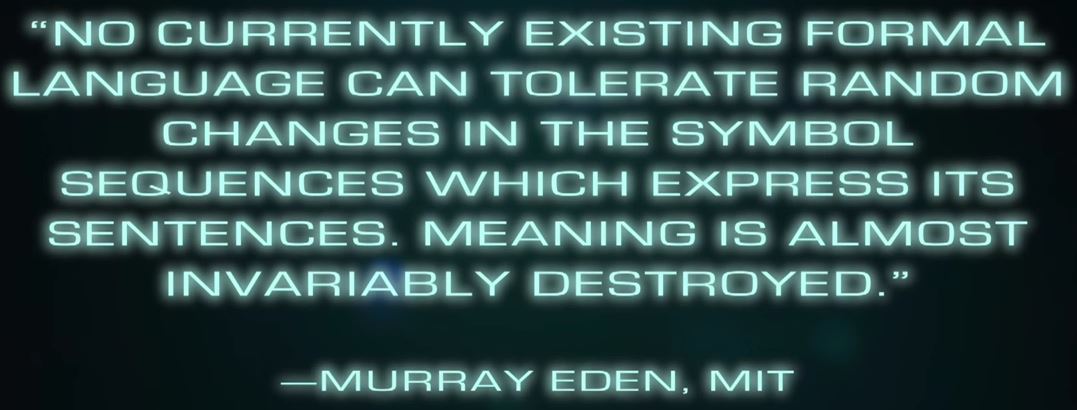
  • normally, random mutations tend to degrade the functionality of information, e.g. – randomly changing symbols in an applications code does not usually introduce useful new functions, it usually renders what is there non-functional
  • the majority of possible sequences will NOT have functions, so random mutations will more likely give you non-functional code, rather than functional code
  • example: a bicycle lock  with 4 numbers has many possible sequences for the 4 numbers, and only one of them has unlock functionality, the rest have no functionality
  • if you have lots of time, then you might be able to guess the combination, but if the lock as has 10 billion numbers, and only one combination that unlocks, you can spend your whole life trying to unlock it and won’t succeed
  • how likely is it to arrive at a functional protein or gene by chance? Is it more like the 4-dial lock (can be done with lots of time) or the 10 billion dial lock (amount of time required exceeds the time available)?
  • the probability is LOW because there is only one sequence of numbers that has unlock function
  • consider a short protein of 150 amino acids has 10 to the 195th power possible sequences
  • if many of these sequences of amino acides had biological function, then it might be easier to get to one by random mutation and selection than it is with a lock that only unlocks for ONE sequence
  • how many of the possible sequences have biological function?
  • Thanks to research done by Douglas Axe, we now know that the number of functional amino acid sequences for even a short protein is incredibly small…
  • Axe found that the odds of getting a functional sequence of amino acids that will fold and have biological function is 1 in 10 to the 77th power
  • Is that number too improbable to reach by chance? well, there are 10 to 65th atoms in the entire Milky Way galaxy… so yes, this is a very improbable outcome
  • can random genetic mutations search through all the sequences in order to find the one in 10 to the 77th power one that has biological function? It depends on how much guessers we have and how many guesses we get in the time available
  • even with the entire 3.5 billion year history of life on Earth, only about 10 to the 40th organisms have ever lived, which far smaller fraction of the 10 to the 77th total sequences
  • even with a very fast mutation rate, you would not be able to reach a functional protein even with all that time, and even with all those organisms

I was once having a discussion with a woman about the research that Axe did at the Cambridge University lab. He published four articles in the Journal of Molecular Biology. I held out one of the papers to her and showed her the numbers. She said over and over “I hate the Discovery Institute! I hate the Discovery Institute!” Well, yeah, but you can’t make the Journal of Molecular Biology go away with hating the Discovery Institute. JMB is peer-reviewed, and this was experimental evidence – not a theory, not a hypothesis.

We have been blessed by the Creator and Designer of the universe in this time and place with overwhelming evidence – an abundance of riches. For those who have an open mind, this is what you’ve been waiting for to make your decision. For the naturalists who struggle so mightily to block out the progress of experimental science, they’ll need to shout louder and shut their eyes tighter and push harder to block their ears. Maybe if they keep screaming “Star Trek” and “Star Wars” over and over to themselves, they will be able to ignore the real science a little longer.