Tag Archives: Naturalism

Stephen C. Meyer lectures on intelligent design and the origin of life

Christianity and the progress of science

A MUST-SEE lecture based on Dr. Stephen C. Meyer’s book “Signature in the Cell“.

I highly recommend watching the lecture, and looking at the slides. The quality of the video and the content is first class. There is some Q&A (9 minutes) at the end of the lecture.

Topics:

  • intelligent design is concerned with measuring the information-creating capabilities of natural forces like mutation and selection
  • Darwinists think that random mutations and natural selection can explain the origin and diversification of living systems
  • Darwinian mechanisms are capable of explaining small-scale adaptive changes within types of organisms
  • but there is skepticism, even among naturalists, that Darwinian mechanisms can explain the origin of animal designs
  • even if you concede that Darwinism can account for all of the basic animal body plans, there is still the problem of life’s origin
  • can Darwinian mechanisms explain the origin of the first life? Is there a good naturalistic hypothesis to explain it?
  • there are at least two places in the history of life where new information is needed: origin of life, and Cambrian explosion
  • overview of the structure of DNA and protein synthesis (he has helpful pictures and he uses the snap lock blocks, too)
  • the DNA molecule is composed of a sequence of bases that code for proteins, and the sequence is carefully selected to have biological function
  • meaningful sequences of things like computer code, English sentences, etc. require an adequate cause
  • it is very hard to arrive at a meaningful sequence of a non-trivial length by randomly picking symbols/letters
  • although any random sequence of letters is improbable, the vast majority of sequences are gibberish/non-compiling code
  • similarly, most random sequences of amino acids are lab-proven (Doug Axe’s work) to be non-functional gibberish
  • the research showing this was conducted at Cambridge University and published in the Journal of Molecular Biology
  • so, random mutation cannot explain the origin of the first living cell
  • however, even natural selection coupled with random mutation cannot explain the first living cell
  • there must already be replication in order for mutation and selection to work, so they can’t explain the first replicator
  • but the origin of life is the origin of the first replicator – there is no replication prior to the first replicator
  • the information in the first replicator cannot be explained by law, such as by chemical bonding affinities
  • the amino acids are attached like magnetic letters on a refrigerator
  • the magnetic force sticks the letters ON the fridge, but they don’t determine the specific sequence of the letters
  • if laws did determine the sequence of letters, then the sequences would be repetitive
  • the three materialist explanations – chance alone, chance and law, law alone – are not adequate to explain the effect
  • the best explanation is that an intelligent cause is responsible for the biological explanation in the first replicator
  • we know that intelligent causes can produce functional sequences of information, e.g. – English, Java code
  • the structure and design of DNA matches up nicely with the design patterns used by software engineers (like WK!)

There are some very good tips in this lecture so that you will be able to explain intelligent design to others in simple ways, using everyday household items and children’s toys to symbolize the amino acids, proteins, sugar phosphate backbones, etc.

Proteins are constructed from a sequence of amino acids:

A sequence of amino acids forming a protein

Proteins sticking onto the double helix structure of DNA:

Some proteins sticking onto the sugar phosphate backbone

I highly, highly recommend this lecture. You will be delighted and you will learn something.

Here is an article that gives a general overview of how intelligent design challenges. If you want to read something more detailed about the material that he is covering in the lecture above related to the origin of life, there is a pretty good article here.

There is a good breakdown of some of the slides with helpful flow charts here on Uncommon Descent.

Positive arguments for Christian theism

Is the presupposition of naturalism in science good for the pursuit of truth?

I have a key that will unlock a puzzling mystery

This topic came up recently in a discussion, and I wanted to be sure that all my readers were aware of how to think about the work that the presupposition of naturalism does in supporting naturalistic views of science. When I was little, way back in the 1990s, Phillip E. Johnson’s work on the definitions of science, evolution and creation were very important stuff. He was everywhere, doing lectures on university campuses and debates on the radio with Eugenie Scott. I was able to get a bunch of this audio from Access Research Network on AUDIO CASSETTES, but now that’s all obsolete.

Thankfully, I was able to find an old column written by Johnson in the Wall Street Journal, and preserved by Access Research Network.

Excerpt:

A Chinese paleontologist lectures around the world saying that recent fossil finds in his country are inconsistent with the Darwinian theory of evolution. His reason: The major animal groups appear abruptly in the rocks over a relatively short time, rather than evolving gradually from a common ancestor as Darwin’s theory predicts. When this conclusion upsets American scientists, he wryly comments: “In China we can criticize Darwin but not the government. In America you can criticize the government but not Darwin.”

That point was illustrated last week by the media firestorm that followed the Kansas Board of Education’s vote to omit macro-evolution from the list of science topics which all students are expected to master. Frantic scientists and educators warned that Kansas students would no longer be able to succeed in college or graduate school, and that the future of science itself was in danger. The New York Times called for a vigorous counteroffensive, and the lawyers prepared their lawsuits. Obviously, the cognitive elites are worried about something a lot more important to themselves than the career prospects of Kansas high school graduates.

The root of the problem is that “science” has two distinct definitions in our culture. On the one hand, science refers to a method of investigation involving things like careful measurements, repeatable experiments, and especially a skeptical, open-minded attitude that insists that all claims be carefully tested. Science also has become identified with a philosophy known as materialism or scientific naturalism. This philosophy insists that nature is all there is, or at least the only thing about which we can have any knowledge. It follows that nature had to do its own creating, and that the means of creation must not have included any role for God. Students are not supposed to approach this philosophy with open-minded skepticism, but to believe it on faith.

[…]All the most prominent Darwinists proclaim naturalistic philosophy when they think it safe to do so. Carl Sagan had nothing but contempt for those who deny that humans and all other species “arose by blind physical and chemical forces over eons from slime.” Richard Dawkins exults that Darwin “made it possible to be an intellectually fulfilled atheist,” and Richard Lewontin has written that scientists must stick to philosophical materialism regardless of the evidence, because “we cannot allow a Divine Foot in the door.”

So, if you’re having a discussion with a person who believes in naturalism – that everything in nature can be explained by material forces alone – then they will give you a stock response to all of your evidence for something outside of nature.

  • Origin of the universe? That’s not science
  • Cosmic fine-tuning? That’s not science
  • Origin of life? That’s not science
  • Cambrian explosion? That’s not science
  • Habitability-discoverability? That’s not science

It’s not that the people who did the science around these discoveries invoked God, and that’s why it’s not science. On the contrary, the mainstream scientists who made these discoveries scrupulously left God out of their microscopes and telescopes. These discoveries – which have only gotten worse for the naturalists as more details emerge – do not have easy naturalistic explanations. If you ask the naturalist for an explanation, they will resort to various sorts of speculations:

  • future science will undermine all our current knowledge
  • we are in an unobservable multiverse that exists eternally
  • aliens seeded the Earth with life, and THEY evolved
  • there are lots of fossils we haven’t discovered yet
  • there are lots of stars and planets we haven’t discovered yet

What’s the answer to this arguing from ignorance?

I think ridicule is best. You need to start by telling the full story about how these discoveries were made. Name the scientists, state the dates. Tell the whole story of how the science was done. Do this for each discovery. Then, at the end, ask them which of these scientific discoveries they deny. Ask them for naturalistic explanations of the ones they accept. Pretend to be confused, then concerned about their sanity. Finally, you should be as condescending as possible, and just explain that we can’t believe in fairies and unicorns. Explain things to them as if they were a child: we have to base our worldview on what science has revealed. We can’t hold out for Santa Claus to come down the chimney with new science that undermines all we have discovered. We have to go with the science we have today, and the science we have today says Creator and Designer. That is the best explanation of the what we know right now. And the trend is that these discoveries are becoming even MORE difficult for naturalism to account for. I guarantee you that the average rank-and-file atheist knows more about Star Wars and Star Trek lore than they do about actual scientific discoveries that threaten their beloved religion of naturalism.

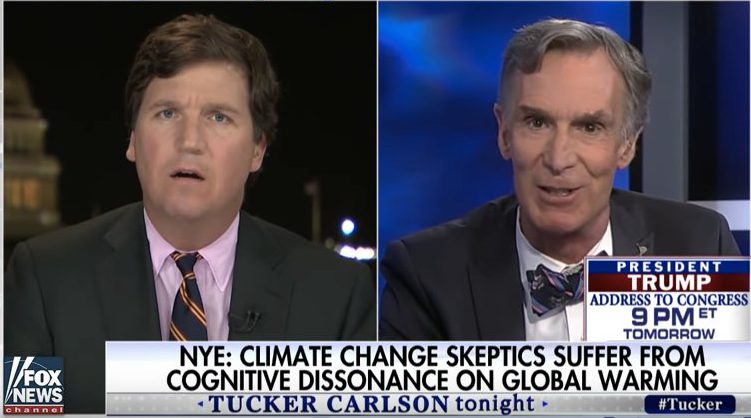
Try to make your face look like Tucker Carlson:

When dealing with a naturalist fundamentalist, make the Tucker Carlson face
The Tucker Carlson face conveys a mix of confusion, disappointment and horror

For God’s sake, even Richard Dawkins admitted in his debate with John Lennox that a good case can be made for a deistic God from the science we have now. If Dawkins can admit this, then you need to be extremely harsh to the village atheists.

If the word “naturalism” is all new to you, you should probably read the whole article and this longer article as well. The longer article really explains the different definitions of the words that are used in these debates. Johnson’s an excellent writer, and you will learn a lot.

Atheist Richard Carrier, who divorced his wife to go polyamorous, seeks new sex partner

Goodness Without God: is it possible?

Is atheism a rational worldview, or is it just rationalizing sexual misbehavior?

A while back, prominent atheist Dr. Richard Carrier explained how he was divorcing his wife – who supported him financially – in order to go polyamorous full-time.

The Yeti’s Roar, a libertarian atheist blog reacted to the news: (link removed)

In a recent blog post, entitled “Coming Out Poly + A Change of Life Venue”, the esteemed Dr. Richard Carrier PhD, discusses his “coming out” as polyamorous, an “orientation” that he just discovered at the young age of 47.

[…]Carrier claims that after 17 years of marriage, he cheated on his wife multiple times, for reasons that he won’t disclose.  In the midst of his infidelity, he suddenly “discovered” (as a middle aged man) that he was polyamorous.  Even though his wife attempted to make the marriage work by allowing him to see other women under the guise of an “open marriage”, Carrier still decided to kick her to the curb.   So in Carrier’s view, his affairs were not a mistake, but rather a fun new “lifestyle choice” that he will pursue, regardless of the past commitment to his wife.

What is even more despicable about Carrier’s behavior toward his wife is the fact that she supported him financially.

[…] The only reason he has been able to live a comfortable lifestyle while blogging and writing obscure books is due to his wife’s financial support.  The reason that he could afford to invest his time in getting graduate degrees from Columbia in subjects that will never land him a decent paying job is due to the support of his wife.  The reason he was able to travel around the country for low paying speaking engagements instead of having to get a real job is due to his wife’s financial support.  And how does he repay his wife for the support she has given him?  He cheats on her, waits until he is making enough money where he no longer needs her income, and kicks her to the curb.

So, whenever Richard Carrier was talking about morality without God, now we know what he meant. He even dedicated his book on morality without God to his now ex-wife. How ironic.

But the new polyamoratheism news is that Carrier is actually searching for a new “date”.

I am not linking to his blog post, but it says: (H/T The Yeti’s Roar)

I’ll start by making sure anyone considering this is up to speed. I am polyamorous. I currently have many girlfriends. All I consider my friends. Some are just occasional lovers. Some I am more involved with. They are also polyamorous, or near enough (not all of them identify that way, but all of them enjoy open relationships). And I will always have relationships with them, as long as they’ll have me in their life.

Many different things can be meant by the following terms, but just for the present purpose, if by a primary relationship is meant someone you live with or just about as good as live with, a secondary as someone you date regularly, and a tertiary as someone you date occasionally, all my relationships are tertiary, but only because of geography. I live just below Sacramento, California, where the rents are cheap, which means, where no one wants to live. And I’m unlikely to move anytime soon. So relationships with me, at best, are likely to be tertiary—long distance chatting with occasional being together throughout the year. Even so, I always take such friendships seriously.

[…]I’m 0.5 on the Kinsey scale. Not heavy into kink (but get along well with people who are). I have an unusual fetish or two but don’t expect any of my partners to share them. I’m pro sex worker, and though I personally find strip clubs and brothels uninteresting at best (uncomfortable at worst), I like partners who are or who have been sex workers. I also like women who have or pursue a lot of partners or who love to boast of their sexual exploits, especially over wine or whiskey or equivalent. I’m not going to get all butt-hurt or angsty over how high Your Number is. It very much has the opposite effect on me.

[…]I am also planning to have a hotel room, and am comfortable sharing it platonically. Certainly I would enjoy sharing it non-platonically, but I don’t expect it. I can’t believe (even though I know) there are still guys who assume the other sh*t buys them sex, thus necessitating I say this: if you are going to have sex with me, it has to be because it’s fun and you want to, not because it’s something you owe me. On the same understanding, if you have a place for me to crash in town (platonically or not), and are happy to have me over to spare me the cost of hiring a room, that would be lovely. And yes, if you are poly or open and live with a partner or two, I’m comfortable with that as well.

This also means you don’t have to live in the LA area to join me for this. If you can get to LA, and don’t mind sharing a room (at my expense), the opportunity remains.

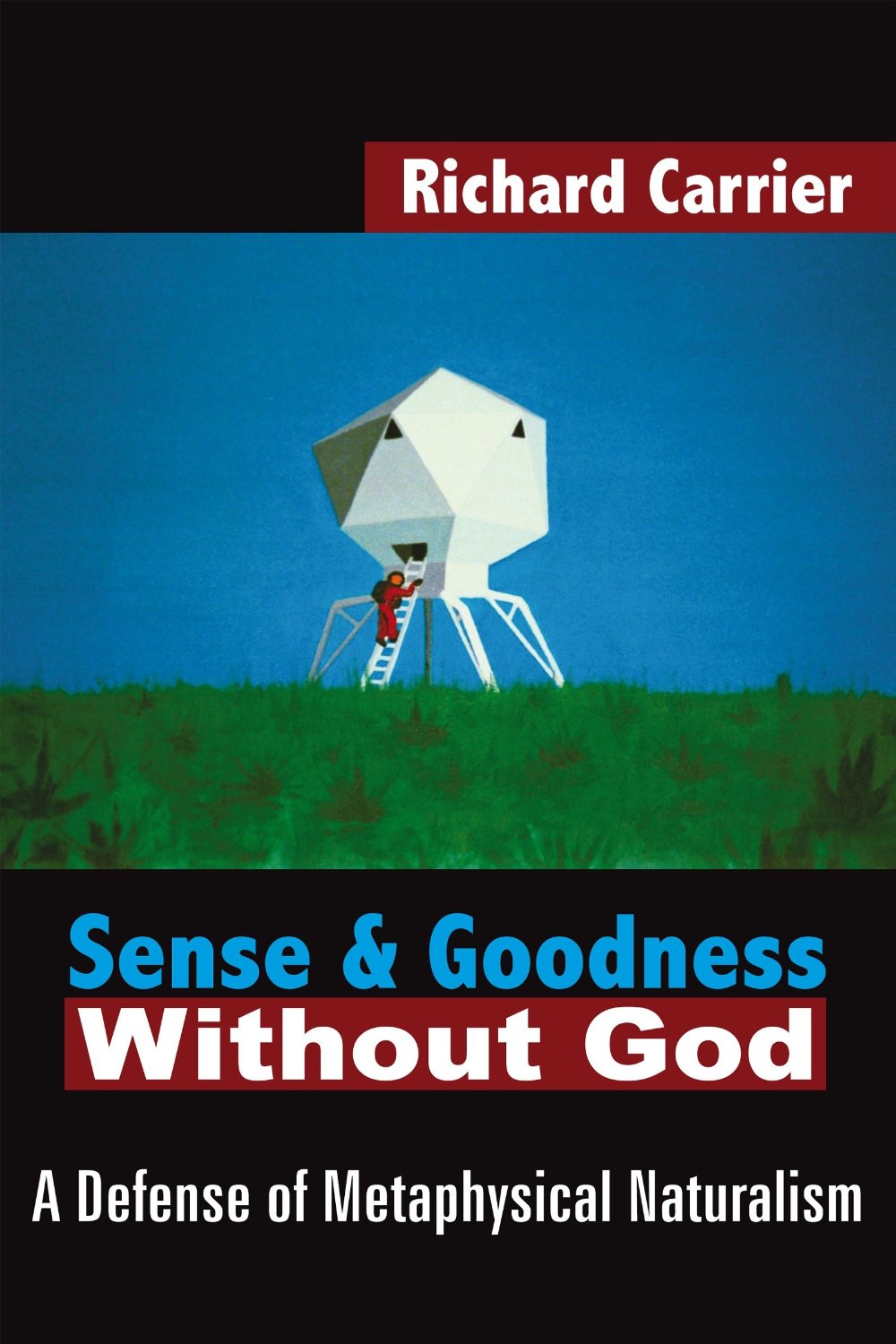
This is Richard Carrier’s book on morality without God:

Goodness Without God: Now we know what it looks like
Goodness without God: Now we know what he was talking about

And the book is dedicated to his wife, now ex-wife:

For Jen…

My buxom brunette
My wellspring of joy
My north star of sanity

Indeed.

I trust that everyone now understands what I was saying about the reasons why atheists jettison God and objective morality. Sexual freedom is definitely a big one, and probably the biggest. This is not a worldview, people, it’s not something that is derived from logic and evidence. It starts and ends with getting rid of moral accountability to the Creator. Period. End of issue.

Not that all atheists are as immoral as Carrier, and not all atheists are motivated by sexual perversion. But the primary motivation is always to be able to get God out of the morality business. There’s no denying that atheists look pretty normal in a society that is still running on the fumes of a declining Judeo -Christian value system. But if you look at how they vote, e.g. – for abortion, for gay marriage, against religious liberty, etc., it’s very clear that they want the society to move away from Judeo-Christian values. And it is this desire that more and more human beings not respect the moral oughts that God prescribes that is the real rebellion.

Romans 1:18-21 nails this:

18The wrath of God is being revealed from heaven against all the godlessness and wickedness of men who suppress the truth by their wickedness,

19since what may be known about God is plain to them, because God has made it plain to them.

20For since the creation of the world God’s invisible qualities—his eternal power and divine nature—have been clearly seen, being understood from what has been made, so that men are without excuse.

21For although they knew God, they neither glorified him as God nor gave thanks to him, but their thinking became futile and their foolish hearts were darkened.

What is expected in the Christian worldview is not to pick and choose a few moral behaviors here and there. Individual moral values are not the issue. When Christ calls a man, he call him to die to himself and his own self-interest, and to take up his moral positions and champion them. Have you ever tried to champion the pro-life cause in an increasingly secular society? How about championing the pro-marriage cause? In order to be a Christian, you don’t just accept the sacrifice of Jesus as atonement for sin, but you also let him lead. And one of those areas of letting him lead is in defining what is and is not moral. It’s very easy for a man to not murder unborn children himself, and to marry someone of the opposite sex, and congratulate himself on how moral he is. Personal morality is not the issue. Inventing your own arbitrary  moral code and then following it might make you feel good, but that is not what God requires. The real challenge of Christianity has to do with standing up for the truth claims, including the moral values, in the face of a society that will not approve of you.

What is required of a man on the Christian worldview is total abandonment to God’s calling and a 100% re-prioritization of his life. It’s not about doing X and Y, but not A and B, and getting a passing grade. It’s about putting Jesus Christ in as your commanding officer in every area of your life.