

Tag Archives: Misandry

Radical feminism changes men’s perceptions of women in the workplace

Radical feminists complain a lot about sexism, but damage is self-inflicted

Lately, we’ve seen an outburst of radical feminism as more women have been equating actual rape and sexual assault with sexist comments or clumsy passes. How does this change how women are perceived in the workplace?

Here’s an article from Medium (H/T Tracy) by an anonymous male feminist.

The first point is about how women handle disagreement, compared to men:

When James Damore was asked for feedback from his supervisor and internally circulated his google memo, it got leaked, he got fired and women stayed at home the next Day because “for emotional reasons”

A ten page summary of data and analysis from Damore was enough to “emotional distress” the women at the company.

This lack of resilience and self-control disrupts the workplace, and results in lost productivity. If it turns into a lawsuit, the costs are even higher. This is in addition to women having fewer STEM degrees than men, working fewer hours than men, and taking months leave for pregnancy. Not to mention affirmative action hiring and promoting in order to meet quotas of women.

Second point, is increased hostility to men.

Look at this tweet from a writer at Teen Vogue:
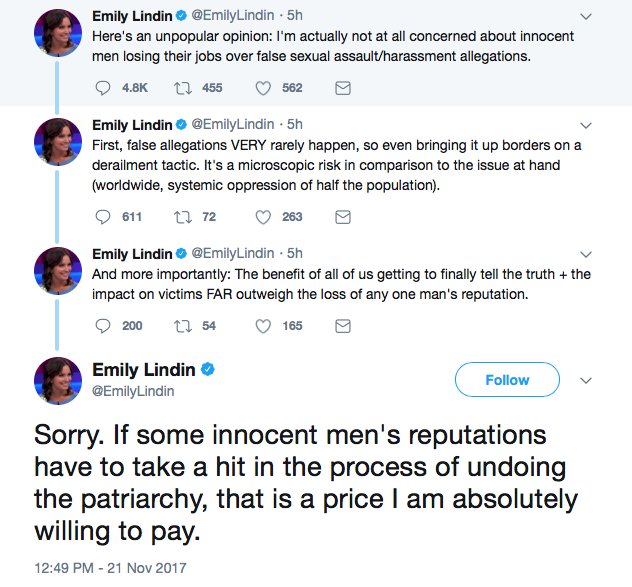
Emily Lindin, a mainstreatm writer with a degree in music history, tweets her hatred of men
Emily Lindin, a mainstream writer with a degree in music history, tweets her hatred of men

She has 23,000 followers on Twitter – this woman is mainstream. I looked into her background a bit. No mention of a father at home, and a self-confessed “slutty” lifestyle from her early teens onward. Her entire writing career seems to be to attack everyone who disagrees with her promiscuity.

Feminism, as an ideology, does not allow women to prefer men who exhibit traditional masculine characteristics: providing, protecting, moral and spiritual leadership, chastity, fidelity. That’s “sexist”. So what’s left? Get drunk and have sex with the hot bad boys, since evaluating a man’s character is “sexist”. Then promote false accusations and misandry to get revenge against the hot bad boys you freely chose. This will only get worse as more radical feminists waste their 20s on hot bad boys, and raise more fatherless girls when they become single mothers by choice, in their 30s.

Do men want to work with women who hate men and make false accusations with people they disagree with? I’m a conservative, Christian, pro-life virgin. I disagree with all premarital sex. If this woman worked with me and found out my views, she would almost certainly get me fired.

Another article from Medium (H/T Wes) makes a third point about how conservatives are treated by liberal women in the workplace. The article is written by a female senior software engineer, who promotes STEM to women and the elderly. She is a self-described “moderate conservative”.

Excerpt:

On September 27, 2017, I decided to attend the Atlanta Google Women Techmakers’ event “Idea Jam Session,” which was hosted at TechSquare Labs in Atlanta. At that time, I was still an active member of Women Who Code, the Atlanta GDG, and Google Women Techmakers and, perhaps naively, I just assumed that I had every right to attend the event like any other member of the group because I had not been banned.

Upon arriving at the event, Maggie immediately asked me to leave the room. At the door, she informed me that she would be extremely uncomfortable if I remained a member of the community because some of the views that I had expressed on Twitter are “very harmful to gender equality”. She then asked Daniel Sabeo, the event coordinator at TechSquare Labs, to escort me from the facility. I was deeply upset at being publicly humiliated, but left willingly without causing any disruption.

Two days later, I got an email from TechSquare Labs. Daniel had discussed the incident with Allen Nance, Paul Judge, and Rodney Sampson, the owners of the facility, and he informed me that they had collectively decided to ban me and my company from using their venue or attending any of their events because they were concerned about the “safety” of their members. I later learned from a fellow developer that Maggie had, in fact, told various people that I’d been stalking her.

[…]The following week, Martin Omander, GDG program manager for North America, formally banned me from the Google Developer Group and Google Women Techmakers and, again, declined to provide me with any details of the complaints against me or the rules that I’d allegedly violated.

How many women are likely to attack conservatives in the workplace?

Young, unmarried women voted 78% to 22% for Obama in 2008, according to exit polls.
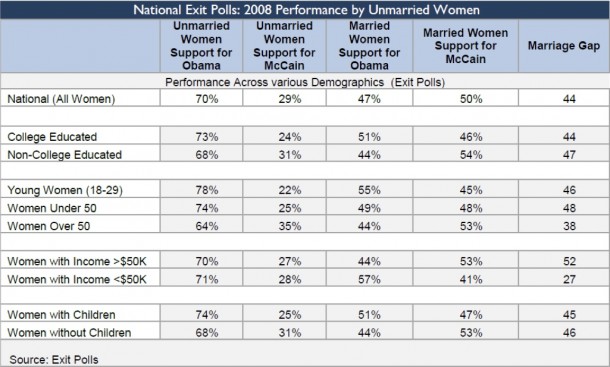
Exit polls from the 2008 Obama vs McCain election
Exit polls from the 2008 Obama vs McCain election: unmarried women voters only

Obama was a radical feminist president who voted against banning infanticide multiple times as a state senator in Illinois. 78% of young, unmarried women voted for him anyway. Women who graduate from college in non-STEM fields are especially progressive. In my experience, young, unmarried women typically form their views by adapting to the dominant views of their community, which is overwhelmingly liberal on campus. In my experience, men are more likely to construct a worldview through reasoning and evaluating evidence.

I’ve personally never met a young, unmarried woman who could answer basic political questions, like naming prior terrorist attacks against the United States, US allies, or US assets abroad, or telling me the amount of the national debt. In my experience, young unmarried women are not concerned with the plight of women in Iran, Pakistan or Afghanistan. They’re not concerned with spending money today that will be paid back by generations of taxpayers not yet born.

Instead, I usually hear that they are progressive because they want taxpayer-funded abortions, taxpayer-funded contraception, no-fault divorce, single mother welfare, student-loan forgiveness, etc. They want taxpayer-funded bailouts for problems caused by their own free choices. They feel that if society is paying for something, then it’s “normal” and they don’t have feel guilty about making poor choices. Their primary concern about politics is being able to do what they feel like without anyone disapproving. Everything bad that happens is “unexpected”, and so society should have to pay for it. It wasn’t their fault that their “follow-your-heart” plan didn’t work out.

I don’t even speak to young, unmarried women about religion and politics in the workplace. It doesn’t matter if we have the same views or not. Feeling offended and going full totalitarian is just too widespread. The rational choice for men is to disengage. I can have conversations safely about religion and politics with men, even if they disagree with me.

Stop telling women that God will give them husbands later if they delay marriage now

Man helping a woman with proper handgun marksmanship

Dalrock blogged a splendid post about people who claim that there is a shortage of “good men”. He says that if there really were a shortage of good men, then people who want women to actually get married would be telling women not to delay marriage, but to instead get serious about marrying early, when their ability to attract husband candidates is at its peak.

Dalrock writes:

We can see the same pattern in Dr. John Piper’s recent post Why Are Women More Eager Missionaries?*  Piper explains that missionary work has become a pink ghetto:

…the actual situation among most evangelical faith missions is that between 80–85% of all single missionaries are women. It is a rare thing, like two out of every ten, for a single man to make missions his life’s vocation, which results in the overall statistics being that one-third of those in evangelical world missions are married men, one-third are married women, and 80 percent of the last third are single women. Which means that something just less than two-thirds of the total missionary force are women.

Piper’s main concern with the post however is not that there aren’t enough single men doing missionary work, but that women who choose this field aren’t marrying as they would like.  Piper complains that the problem for husband hunting missionary women is really an exacerbated version of the same problem all Christian women have, and that is an overall lack of marriageable Christian men…

I’ll save you the quotation of Piper, but his reason why missionary women struggle to find husbands is – SHOCK! – that Christian men refuse to man up. I.e – Piper believes that women can’t find husbands because men are not ready and willing to marry.

More:

But if Piper actually believed… that there was a severe shortage of husband material men, he would focus his attention on helping the women reading navigate this incredibly difficult situation.  Overseas mission work may feel empowering for young women, but (according to Piper) single women going into the mission field are greatly handicapping their prospects in an already bleak field.  His advice to young women would be to choose which was truly more important to them, being a missionary or finding a husband.

If Piper really believed that there were a shortage of marriage-minded, marriage-capable Christian men, then Piper would be counseling women who genuinely want to marry to make marriage a priority when they are younger, prettier and more fertile. Some women say that they want to get married “some day”. But the hidden truth is often that they just want to delay marriage in order to have fun and thrills, until they get tired of it. And then they just expect a suitable man to show up right when they need one. But do men want to marry a 35-year-old woman when they are 40 as much as they want to marry a 23-year-old woman when they are 25?

More Dalrock:

Piper even tells a story which would be a perfect way to teach this lesson.  He describes a single woman named Gladys Aylward who went to a place where she found no marriageable men, and then blamed single men for not following her and proposing marriage:

“Miss Aylward talked to the Lord about her singleness. She was a no-nonsense woman in very direct and straightforward ways and she asked God to call a man from England, send him straight out to China, straight to where she was, and have him propose to me.” I can’t forget the next line. Elisabeth Elliot said, “With a look of even deeper intensity, she shook her little bony finger in my face and said, ‘Elisabeth, I believe God answers prayer. And he called him.’” And here there was a brief pause of intense whisper. She said, “‘He called him, and he never came.’”

Now, that experience, I would guess, is not unique to Gladys Aylward.

If Piper really believed that Christian husbands were scarce, he would be sharing this anecdote to warn young women of the foolishness of moving away from the pool of men they hope to choose a husband from and then expecting God to send the man of their choosing across the world to propose.  If we were in a culture of scarcity of good men, this would be the obvious lesson from this story.  But we live in an age with unshakable confidence that good men are not only available all around us, but will always be abundant.  If Piper believed that the husband Miss Aylward was praying for was surrounded by real life English women eager to win him as a husband, this story wouldn’t be complaining about why he didn’t drop everything, fly to China, and propose to a woman he had never met.  If Piper believed that the man was sought after as a husband in England, he would be pointing out the foolishness of Miss Aylward flying off to China and then wondering why a man she had never met didn’t show up to propose once she decided she wanted to marry.

Miss Aylward either needed to accept that being a missionary in a secular country meant not marrying, or she needed to focus on marriage first when she was attractive to men as a life partner. Many women are propositioned for sex after they hit their mid-30s, but few of them are asked to marry. This is because men need women more when they are just starting out in their careers than when they are established in their careers.

Many women have no appreciation of how investing in a husband early causes him to be loyal to her when she is older. Women think that a husband will show up when she is ready, and be loyal to her even though she was absent during the hardships of the first decade of his career. A woman can do a lot of good for a man when he is starting out in his career and trying to save money for a house. But when those years have passed, the man’s ability to work and save have been largely set – without anyone’s help. If he went through those years single, then he typically will have earned less and saved less than a married man, because he did it without a wife’s support. Men do better in their careers and finances when they have a wife’s support. Especially in the early career, which is more stressful because of the lack of work experience. If a woman wants a man to be faithful and loyal, then she needs to choose a man who needs her, and invest in him using her youth and beauty to support him during his critical 20s and early 30s. Men respond to support during the critical years with lifelong fidelity and loyalty.

By the way, for an explanation of why men prefer not to be missionaries, read this post on Deeper Strength blog.

And one last point. I have known 3 women missionaries, and many women who thought about becoming short-term missionaries. In every case the women had grown up as Christians, and then gone wild in their 20s with alcohol and promiscuity. And they saw missions work as a fun and thrilling way to “atone” for their wild past. Another reason for Christian men to be skeptical of women missionaries.

More and more women are asking why they can’t find a good man to marry

Do young women understand how to get to a stable marriage?

In the last few months, I’ve met 5 different Christian women in their 30s who all asked me the same question: where are all the good men who want to marry me?

Christian men’s rights blogger Dalrock had two different posts where he described the answer to this question.

Here is the first post from Dalrock that concisely illustrates the problem:

As I wrote in A very long season, feminists don’t want to waste a day more of their youth and fertility on their husbands than absolutely necessary. As if to prove this very point, 30 year old Mona Chalabi writes in the NY Times* I Want My 2.3 Bonus Years:

If I could prolong my time as a young adult by, say, 2.3 years, here is a list of things I would like to do:

• Go to more parties. Preferably wild parties that I can think about, years later, at mild parties.

[…]• Have more romantic partners.

[…]• Get a bit higher up the career ladder a bit earlier on. That would probably boost my earnings, giving me more financial security. I could use that money to go to more parties, get a membership to a fancy gym and maybe even meet a romantic partner on the ab machines.

To drive the message home, the image at the top of the article is a cartoon of a resentful Chalabi giving her future husband the side eye for her lost years of sampling penises!

Surely, this must be an isolated case just for New York Times feminists, right? It’s not widespread, is it?

Second post from Dalrock:

Margaret Wente at the Globe and Mail* asks where all the good men have gone.  Wente comes to the conclusion that women need a sex cartel:

…it’s up to us to make the rules. “Why buy the cow when you can get the milk for free?” my father used to say. It drove me crazy when he said that. Now, it’s dawned on me that he was right.

Since the women’s cartel collapsed, women’s bargaining power has seriously eroded. That’s why so many single women hate Tinder, which has further commodified sex for the benefit of men. Women are just another consumer good in the shop window.

The apex fallacy aside, Wente is partially right.  Women (as a group) have signaled to men that what they really want are exciting sexy badboys, not boring loyal dudes. It isn’t that women no longer want to marry beta providers, they just don’t want to waste a day more of their youth and fertility on their husband than absolutely necessary.

As a result, some up and coming boring loyal dudes aren’t knocking themselves out in their twenties while they wait for their future wife to tire of having sex with other men.

If you wonder why men are no longer performing in school, and exchanging careers for video games, the answer is simple. Men have realized that young women today, under the influence of feminism, are not interested in traditional husbands during their late teens and 20s. During these years, women are interested in travel, fun, drinking, hook-ups and cohabitation with amoral atheists. This is what I have personally observed. In the minds of young women, the highest value men are good-looking men who have no religion, and make no moral judgments, and are left of center politically – especially on abortion. There are many good men who are romantic about women from their youth, and want to get married. But when they see what young women really want, they just give up on school and work, since doing the traditional male roles has no value to young women. Many good men even give up on morality and Christianity because they want a relationship with a woman so badly.

More from second post:

What Wente doesn’t understand is that timing is everything.  From an economic point of view, women are dividing up sexual access that traditionally would have been reserved only for their husband into two blocks.  The first block contains their most attractive and fertile years, and it is dedicated to no strings sex with exciting badboys.  Then, once women reach what Rollo calls the epiphany phase, they want to bargain sexual access in their remaining (older and less fertile) years for maximum beta bucks.

The problem with this strategy is (generally speaking) not that the previously overlooked beta men will refuse to marry the suddenly reformed party girls.  The problem is that young men now look at the men 3-5 (and even 5-10) years older than them and don’t see an indication that signaling provider status will make them attractive to women.  They also see a society that holds married fathers in contempt**.  Most of these men are still working hard in their late teens and twenties to prepare to signal provider status in their 30s.  But a growing minority of young men are no longer doing so.  These men are instead working like women.  Once the reformed party girls are ready to find Mr. Beta Bucks, there is a shortage of 30 something men who fit the bill.  Even worse, no amount of complaining or shaming will cause the missing beta providers to go back in time and spend the prior decade preparing for this moment.

I’m one of the last men who followed the marriage-preparedness script for traditional men who wanted to marry and have four children and have a stay-at-home homeschooling mom to raise them from birth to graduate school. I find myself now in my early 40s, with a 6-figure income and a nearly 7-figure net worth. I declined to use those assets to play the field with hot bad girls, preferring instead to keep my sexual past completely clean for my eventual wife. However, what I observed in my late teens and 20s and even early 30s was a complete lack of interest in marriage ability, from non-Christian women and Christian women alike. Christian women aren’t learning to value early marriage from their married parents or their evangelical churches. None of the traditional husband skills are valued by young women, i.e. – chastity, gapless resume, alcohol abstinence, undergraduate and graduate STEM degrees, experience nurturing and mentoring others, stewardship of earned income.

I recently caused an uproar on my Facebook page by saying that even if the perfect woman showed up right now to marry me, I would not pursue her because the critical time where the woman could have applied maximum youth, beauty and fertility as a wife to make an impact on my education, early career, health, and finances has passed. A younger woman develops value to her husband precisely by applying herself to him and to her family in these critical early years. Men who have experienced this self-sacrificial love and support are loyal to their wives even after their wives lose their youth and beauty. Why? Because the men know that they are much better than they could have been, having enjoyed that early investment of value made by their young wives.

Young women very supportive of premarital sex

As Christian writer Matt Walsh notes in a recent article at the Daily Wire, this “follow your heart” focus on happiness in women is lethal to marital stability, and men know it.

Excerpt:

There was an article in Cosmo this week with a title that summarizes all that’s wrong with Cosmo and modern society as a whole: “I eloped at 25, divorced at 26, and dated my way across Europe all summer.” Of course, by “dated my way across Europe” she means that she slept with half the continent.

The author, Elise, says she “started fighting” with her husband and within a few months they both decided that their differences were irreconcilable. Despite counseling, she says, “neither of us was happy.” So, exhausted from 12 whole months of marriage, Elise embarked on a voyage of self-discovery and STD cultivation. She met random dudes in half a dozen countries and had sex with them, learning quite a lot as she went, though she can’t really explain what exactly she learned or why sex was a necessary component in learning it. Finally, she came home and started dating some other guy. The end.

Well, not really the end. 20 years from now I’m sure we’ll get the follow up article: “I’m alone and miserable and it’s everyone’s fault but mine.” After all, you may be able to fill the emptiness in your soul with frivolous sex when you’re young and physically desirable, but that phase is fleeting. People who don’t want to “waste” their beauty and youth on a spouse, so they waste it instead on strangers who don’t love them or even care what happens to them tomorrow, will be shocked when a tomorrow comes where even strangers aren’t interested anymore. This is where the single-minded, utterly selfish pursuit of “happiness” at all costs inevitably leads: to rejection, despair, and a quiet, unnoticed death on a lonely hospital bed.

As Elise helpfully demonstrated, “do what makes you happy” is poison in a marriage. Many a vow has been broken because one or both partners decide to chase “happiness” instead of commitment, fidelity, and love. “I deserve to be happy,” reports the legion of serial divorcees, as they drift on to the next spouse, and the next, and the next, and the next, looking for the one — the one, finally — who might cure the misery they’ve inflicted on themselves. Increasingly unhappy, yet increasingly convinced that they deserve to be.

And this follow your heart to happiness situation is alive and well in the church today. Marriage-minded Christian men who have prepared for husband roles are surprised to find that there is often little or no difference between Elise and the Christian women the church produces. Christian men who desire to invest in a marriage that is stable, productive and influential have nowhere to turn for a wife who is able and willing to help. In my experience, the problem with happiness-focused women who delay marriage is never discussed in churches from the pulpit. The “good men to marry” that today’s 30-something women are looking for were plentiful back when those same women were in their early-to-mid 20s.