Tag Archives: Marriage

A lesson about men for marriage-minded women from the movie “High Noon”

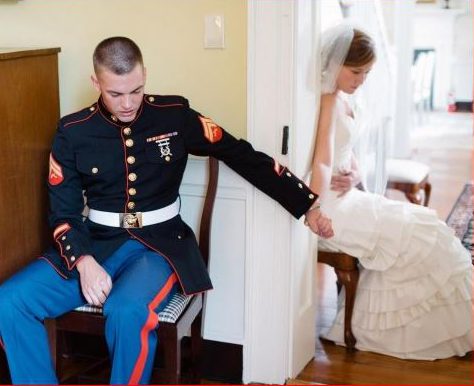
Marine prays with his wife on their wedding day

One of my favorite movies for explaining the differences between men and women is “High Noon” (1952).

Here’s the summary from IMDB:

Former marshal Will Kane (Gary Cooper) is preparing to leave the small town of Hadleyville, New Mexico, with his new bride, Amy (Grace Kelly), when he learns that local criminal Frank Miller has been set free and is coming to seek revenge on the marshal who turned him in. When he starts recruiting deputies to fight Miller, Kane is discouraged to find that the people of Hadleyville turn cowardly when the time comes for a showdown, and he must face Miller and his cronies alone.

The main theme of the film concerns Amy’s decision to break her wedding vows the very day that she makes them. She tells her new husband that he must bow to her will, and give up his male role as protector. When he explains his reasons for standing his ground to her practically (Miller will hunt them down) and morally (he has a duty protect the town), she dismisses both. She tells him that if he doesn’t run away from Miller and his gang with her, that she will get on the train and leave town by herself.

The intro of film shows the member’s of Miller’s gang assembling, and the words of the song explain the central conflict between husband and wife:

Here’s the part of the lyrics we care about:

The noonday train will bring Frank Miller.
If I’m a man I must be brave
And I must face that deadly killer
Or lie a coward, a craven coward,
Or lie a coward in my grave.

O to be torn ‘twixt love and duty!
S’posin’ I lose my fair-haired beauty!
Look at that big hand move along
Nearin’ high noon.

He made a vow while in State’s Prison,
Vow’d it would be my life or his’n
I’m not afraid of death, but O,
What will I do if you leave me?

Do not forsake me O my darlin’
You made that promise when we wed.
Do not forsake me O my darlin’
Although you’re grievin’, I can’t be leavin’
Until I shoot Frank Miller dead.

What’s interesting is that his new wife Amy apparently does not understand the meaning of wedding vows or the natural roles of good men as protectors of the weak, and fighters against evil. Although she vowed to stick by him and help him, the minute anything threatening appears that makes her feel unhappy, she abandons her vows and abandons her man. Let’s break down her mistakes now, using actual conversations from the movie.

First, she doesn’t understand or respect the man she married as a man:

Kane: [while riding out of town] It’s no good. I’ve got to go back, Amy.

Amy: Why?

Kane: This is crazy. I haven’t even got any guns.

Amy: Then let’s go on. Hurry.

Kane: No, that’s what I’ve been thinkin’. They’re making me run. I’ve never run from anybody before.

Amy: I don’t understand any of this.

Kane: [after looking at his vest watch] Well, I haven’t got time to tell ya.

Amy: Then don’t go back, Will.

Kane: I’ve got to. That’s the whole thing. [He turns the buggy around and rides back into town]

Her feelings and her desires for the world to be a happy place for her are so strong that they cloud her judgment.

Second, she doesn’t understand the threat posed by evil men:

More:

Kane: I sent a man up five years ago for murder. He was supposed to hang. But up North, they commuted it to life and now he’s free. I don’t know how. Anyway, it looks like he’s coming back.

Amy: I still don’t understand.

Kane: He was always wild and kind of crazy. He’ll probably make trouble.

Amy: But that’s no concern of yours, not anymore.

Kane: I’m the one who sent him up.

Amy: Well, that was part of your job. That’s finished now. They’ve got a new marshal.

Kane: He won’t be here until tomorrow. Seems to me I’ve got to stay. Anyway, I’m the same man with or without this. [He pins his badge on his vest]

Amy: Oh, that isn’t so.

Kane: I expect he’ll come lookin’ for me. Three of his old bunch are waiting at the depot.

Amy: That’s exactly why we ought to go.

Kane: They’ll just come after us, four of ’em, and we’d be all alone on the prairie.

Amy: We’ve got an hour.

Kane: What’s an hour?…What’s a hundred miles? We’d never be able to keep that store, Amy. They’d come after us and we’d have to run again, as long as we live.

Amy: No we wouldn’t, not if they didn’t know where to find us. Oh Will! Will, I’m begging you, please let’s go.

Kane: I can’t.

Amy: Don’t try to be a hero. You don’t have to be a hero, not for me.

Kane: I’m not trying to be a hero. If you think I like this, you’re crazy.

Instead of recognizing how her feelings are deceiving her about the threat and trusting her husband, she tries to force him to accept her mistaken view of reality by threatening to abandon him.

One of Kane’s ex-girlfriends has a talk with Amy, which helps her to understand who Kane is, and what is expected of her:

Amy: That man downstairs, the clerk, he said things about you and Will. I’ve been trying to understand why he wouldn’t go with me, and now all I can think of is that it’s got to be because of you…Let him go, he still has a chance. Let him go.

Helen: He isn’t staying for me. I haven’t spoken to him for a year – until today. I am leaving on the same train you are…What kind of woman are you? How can you leave him like this? Does the sound of guns frighten you that much?

Amy: I’ve heard guns. My father and my brother were killed by guns. They were on the right side but that didn’t help them any when the shooting started. My brother was nineteen. I watched him die. That’s when I became a Quaker. I don’t care who’s right or who’s wrong. There’s got to be some better way for people to live. Will knows how I feel about it.

Helen: I hate this town. I always hated it – to be a Mexican woman in a town like this.

Amy: I understand.

Helen: You do? That’s good. I don’t understand you. No matter what you say. If Kane was my man, I’d never leave him like this. I’d get a gun. I’d fight.

Amy: Why don’t you?

Helen: He is not my man. He’s yours.

Helen understands the need for a wife to stand by her man. But Amy’s response to evil is to shut her eyes and focus on feeling good and being happy. Notice that her “better way” is unspecified – it’s just a feeling she has that pacificism and no-violence will somehow “work” to stop evil. But in reality, pacifism is not a “better way” of dealing with evil – it does not work. Her pacifist response not only does not make evil go away, it actually encourages more evil. Weakness emboldens evildoers, and laying down your arms provokes them to do more evil. Will Kane knows this, but she won’t listen to him.

You can watch the final gunfight here, as well as Amy’s final decision:

So, this is why I really recommend this movie as a discussion-starter when you like a girl and are thinking of marrying her. It clarifies the essential problem with many young women today not being ready for marriage. To be fair, most women come around to respect their husbands and his different roles after they get married. However, the risk of divorce is so dangerous that it makes sense to bring it up for discussion before the marriage happens. Marriage is supposed to be an engine to serve God, and the success of that enterprise cannot be left to chance. You can’t just rely on the fact that she says the words of the vow, you have to check to see if she has a habit of keeping her promises when it goes against her own self-interest.

Ask yourself: Who are you, as a man? And does your woman accept that you have obligations to stand up to evil and do good ? Will she support you in your battle against evil, or will the marriage just be about her feelings and desires? I would especially beware of women who think that God is speaking to them through their feelings and desires. Look at her friends: are they practical and successful? Or are they irresponsible, unaccountable and reckless? Look at her father: does he have a plan for her, and does he lead her to be practical, frugal and hard-working? If you are not going to get an ally and a supporter in a wife, then you will not be able to serve God well, as a married man. Think about it.

Why social conservatives should support free market capitalism

The free enterprise system should not be adopted simply because it is the best system for creating wealth. The best reason to support free market capitalism is a moral reason. Arthur Brooks, President of the American Enterprise Institute, and a Christian, describes the moral argument for free market capitalism.

Excerpt:

It might seem that the best case for free enterprise is the material one. Free enterprise lets people make more money, buy more and nicer stuff, and have a greater degree of comfort. The freer our economy is, the more competitive the US economy is vis-à-vis the rest of the world. And so on.

But these aren’t our best arguments. There is another reason, a transcendent reason, for which free enterprise matters most—and this is the case we all must be able to make today.

We all learned early on in school that the Declaration of Independence claimed for each of us the unalienable right to “life, liberty, and the pursuit of happiness.” Note that the founders didn’t assert a right to be happy; such is the domain of tinpots and crackpots, of 1984’s “Ministry of Plenty” and Josef Stalin’s aggrandizing self-description as the Soviet Union’s “Constructor of Happiness.” So what, in practice, does this right to pursue happiness mean?

It means the right to define and earn our happiness through our ideas, hard work, and gumption, to earn our success by creating value honestly, in our own lives and in the lives of others. It doesn’t mean the pursuit of a big lottery win or an inheritance. Those bring money, but not happiness. And a mountain of evidence shows that after a fairly low threshold, more money doesn’t make us happier. The best case for free enterprise has nothing at all to do with money or material goods or wealth. Those are just icing on the cake. We must stop talking about free enterprise as just an engine of wealth creation. It’s much more than that.

In short, the secret to the pursuit of happiness is earning our own success; creating value with our lives and in the lives of others. This earned success is the fruit of hard work and just rewards in a system built on merit. Only in a free enterprise system is effort and innovation rewarded over connections and predation. (And this means that we have to draw a distinction between free enterprise, which is based on opportunity and competition between ideas, and corporate cronyism, which is just another form of statism masquerading as free enterprise.)

Here are 3 reasons why I think that social conservatives should support free market capitalism.

1) Right to work

It’s very important for Christians to have an economic system in place that allows them to work without having to promote anti-Christians ideas. But when government gets too big, what happens is that Christians are no longer free to take any job they want, and still keep a clear conscience. In some states, you have to join a union which uses your union dues to elect Democrats, who very often are liberal on social issues. Or, you have big government forcing Christians to perform abortions against their consciences. Or, you have big government forcing Christian organizations to provide health insurance plans that cover abortions and contraceptives. That’s why Christians need to vote against big government regulations on employment – we need the freedom to work at a job that does not violate our consciences.

2) Right to earn

It’s very important for Christians to keep what they earn so that they have the maximum amount of money to make decisions that make sense for them, according to their consciences. Take the example of day care and education. The big government statist is constantly trying to to create more and more government-run day care and public schools. Why? They want to take money away from families so that they cannot afford individualized private and parochial schools, and lump them all into government run schools that are more “equal”. The problem is that this is bad for Christians who want more oversight into what their children learn. For example, what sense does it make for a Christian man to pay for day care and public schools when he marries a teacher who becomes a stay at home homeschooling mother for his children? He has to pay for day care and public schools he will never use, and it eats into the money he has to afford a stay-at-home homeschooling mom. Christians should oppose a day care and education system run by a secular leftist government. They will never reflect the values of Christian parents.

3) Right to spend

It’s very important for Christians to have the freedom to purchase products and services that make sense in their worldview. Take the example of health care. Secular leftists would love to force private medical insurance companies to cover things like abortion and contraception as health care. In some states, these things are specified as mandatory for every health care plan. That means that Christians who purchase health care are being forced to pay for services like abortion which they will never use themselves. This is nothing more than the redistribution of wealth in order to lower the cost of abortions for people, in order to encourage them to be sexually active before they are able to accommodate children. Christians need to oppose this – we do not want to have to pay for things that go against our consciences.

So, in addition to the reasons that Brooks mentioned (the happiness of earning your own way and serving others), it’s important for Christians to understand how free market capitalism fits into their plans. We do not want to support big government, especially when big government so often is not compatible with Judeo-Christian values. In the free market, it is much harder for ALL the businesses to conspire together to block Christians from working, earning and spending according to their consciences. We must resist top-down control of the free market so that we have the liberty to do what we ought to do in order to be virtuous.

Men on strike: the social changes that caused men to opt out of marriage

Painting: "Courtship", by Edmund Blair Leighton (1888)
Painting: “Courtship”, by Edmund Blair Leighton (1888)

I read and enjoyed Dr. Helen Smith’s book “Men on Strike” a few years back. The book explains a few of the developments that have led to men underperforming in school and in the workplace, and opting out of marriage and fatherhood.

Dr. Helen comes to this problem as a secular libertarian, not as a Christian conservative.

A review of Dr. Helen’s book appeared in Salvo magazine. The review is written by Terrell Clemmons, who has the best Christian worldview of any woman I know – I frequently rely on her advice.

Terrell writes:

While the feminist movement may originally have been about equal respect for both sexes, what it has morphed into, she argues, is female privilege. From rape laws that empower women but not the men they may falsely accuse, to divorce laws tilted in favor of the wife, to the feminization of the U.S. education system, men have become the sex under the gun, while women enjoy the status of a protected class.

But unlike their mothers or grandmothers, men today are not taking to the streets burning their undergarments and shrieking demands (thank God). They’re doing just the opposite, which is far worse. They’re going on strike. The strike zones are manifold:

Higher Education.In addition to the enrollment imbalance, which is approaching a 60/40 ratio of women to men, college has become, in the words of one professor, “a hostile working environment [in which] males increasingly feel emasculated.” Smith quotes a student named John, who had this to say about his college experience: “I had already been cautious around women, having grown up with Tawana Brawley in my backyard and daily stories of sexual harassment; I played it safe and passive every time. But it doesn’t matter. The only way not to lose is to not play. So I’m out.”

Work,including community involvement. With higher female graduation rates and salaries, men today are falling behind their fathers economically and professionally. Consequently, their efforts to prove themselves worthy mates through hard work and higher earnings don’t win female attention the way they used to. Discouraged, too many retreat to a man cave, and inertia sets in from there.

Marriage.Marriage rates are down, and honest men opting out will tell you why. Smith cites a Rutgers University study of single heterosexual men which turned up the top reasons they hadn’t married. They can get sex and the companionship of cohabitation without marriage more easily than in times past, and they don’t want to open themselves up to the risk of divorce and financial loss. It really isn’t that complicated a decision. In fact, it’s often not an actual decision at all. It just happens.

The simplest explanation for the difficulties that boys face in an education system that is dominated by women (teachers and administrators) is discrimination. And in the workplace, the government requires employers to report on male and female head counts, and promote women who are not qualified. I have seen receptionists with tattoos and no college degrees promoted to six-figure manager jobs in companies where I worked.

There is one more which to me was the most surprising one in the book – paternity fraud, and the laws that support paternity fraud:

Take the following cases of nonconsensual insemination: Nathaniel from California, age 15, had sex with 34-year-old Ricci, which, due to his age, was legally considered nonconsensual. Emile from Louisiana was visiting his parents in the hospital when a nurse offered him oral sex, if he wore a condom, which she conveniently offered to dispose of for him afterward. S. F. from Alabama passed out drunk at the home of a female friend and awoke undressed the following morning. In all three cases, including the one involving the minor, a woman got sperm and, nine months later, a child, and the man got ordered by a court of law to pay support for eighteen years.

Less devious, but similarly amiss, are those cases in which a man, having been betrayed by his wife or girlfriend, was nevertheless held financially responsible for a child genetically proven to be another man’s offspring. While not as sensational as sperm-jacking, it is another form of paternity extortion.

In each of those cases, the man was found liable to pay child support – including the case of the 15-year-old boy, who was forced to pay child support to his statutory rapist when he turned 18. This is how the court system works, and more and more men are understanding the risks.

I often encounter “pro-marriage” people while gathering stories for the blog. These pro-marriage people come in two varieties.

On the one end of the spectrum are people like Terrell Clemmons and Jennifer Roback Morse, who understand marriage, but who also understand the social changes that have made marriage unattractive for men. Both Clemmons and Morse have a background in STEM fields, so they are able to understand incentives and tradeoffs. They understand that society has to rollback the changes to education, divorce laws, etc. if they expect men to be interested in marriage again. They understand that men are not just accessories of women, but instead have their own desires, feelings and reasons for marrying.

On the other end of the spectrum are feminist men, who are not able to understand the changing incentives that face men in a world that has evolved under the influence of radical feminism. It is just simpler (less thinking) for these men to accept the radical feminism as a given, and then urge men to “man up”. I think a much better idea would be for the “man up” crowd to realize how marriage has changed, and how the schools and the workplace have changed, then make all of these things more attractive to men. It doesn’t do any good to try to “dare” men into jumping off a cliff. Men aren’t stupid, and they do what is in their own best interests. If the man-up crowd wants younger men to marry, then they need to change the incentives offered to men. And that means changing women first.