Tag Archives: Marriage

Should Christians be motivated by the fear of missing out (FOMO)?

Theology that hits the spot

Dina was off from her stressful job last week, so we spent some time talking over some articles that we found on the culture. We specifically talked about what is motivating young people, so I wanted to write something about that.

FOMO: Fear Of Missing Out

Here’s a leftist New York Times article explaining where FOMO comes from:

It’s known as FOMO, or “fear of missing out,” and refers to the blend of anxiety, inadequacy and irritation that can flare up while skimming social media like Facebook, Twitter, Foursquare and Instagram. Billions of Twitter messages, status updates and photographs provide thrilling glimpses of the daily lives and activities of friends, “frenemies,” co-workers and peers.

[…]When we scroll through pictures and status updates, the worry that tugs at the corners of our minds is set off by the fear of regret, according to Dan Ariely, author of “Predictably Irrational” and a professor of psychology and behavioral economics at Duke University. He says we become afraid that we’ve made the wrong decision about how to spend our time.

[…]A friend who works in advertising told me that she felt fine about her life — until she opened Facebook. “Then I’m thinking, ‘I am 28, with three roommates, and oh, it looks like you have a precious baby and a mortgage,’ ” she said. “And then I wanna die.”

It’s like they want to run a race to do fun and exotic things with their peers, and not finish last.

Anyway, I want to begin this post with examples of FOMO behavior I have personally encountered.

FOMO Travel

Dina and I read and discussed this article by Alain de Botton in The European – notice the emphasis on travel and having fun, sophisticated experiences:

We’re continually being bombarded with suggestions about what we might do (go jet skiing, study in Colorado, visit the Maldives or see the Pyramids). We’re always hearing of the amazing things friends have done or are going to do: ‘there was this great bar we all went to …’; ‘she’s getting married in a little country church, then we’re having a picnic…’; ‘the sun was glinting on Sydney Harbour…’ There are endless hints of the allure of life in other places: an article about family-friendly restaurants in Brooklyn, a crime novel set in Trieste, the departure board at the airport with its list of places only a plane trip away: Moscow, Bangkok, Addis Ababa… The modern world makes sure we know at all times just how much we’re missing. It is a culture in which intense and painful doses of FOMO (Fear Of Missing Out) are almost inevitable.

What’s interesting is this – how does FOMO travel affect young, unmarried Christians?

Travel through missions work seems to be the FOMO activity of choice for at least a few young, unmarried Christians. One of my best friends who is married to another of my best friends told me about her missions trip to a European country. I asked her why she did it, since it meant lost savings, lost earnings, lost work experience, etc. (She gave up a year of earnings, and she had a great job in engineering). Her answer was that she did it for the adventure. I have a hard time hearing Jesus say that he was going to do something because he was bored and wanted an adventure. Especially when it’s $30,000 in costs, $60,000 of lost income, and lost work experience – per year. This was before the time of the Internet, though, when missionary work actually made sense. I just don’t think it’s worth spending that kind of money for the impact you make. The people I know who went on missionary trips just wanted to feel spiritual, look spiritual, and have a fun “life experience” vacation. One missionary told me that she was desperate to get away from her boring mid-Western roots.

If you really want to share Christ effectively with people in other countries, then you can start a blog and pay the tiny costs for it out of your earnings from your day job – that’s what I do. I get more people from Europe reading my blog than I could contact in a year of missionary work. I Skype with the people who are interested in Christianity from these countries (Scotland, Northern Ireland, England, Canada, etc.), as well. Meanwhile, I keep working my not-exciting job, so my savings increase, and my resume remains gap-less. This is good stewardship of finances, and self-denial prepares your character for the hard work of marriage and parenting. The Bible says that those who do not work should not eat. And Paul says that he built tents so that no one could accuse him of taking on missionary work for financial gain.

You can tell whether a person is sincere in their missionary intentions by looking at how responsible they’ve been in their decision-making. If a person has gone into debt paying for fun, thrilling activities like skydiving, ziplining, surfing, etc., then it’s FOMO travel. We must look past the spiritual smokescreen, and tell young people to grow up.

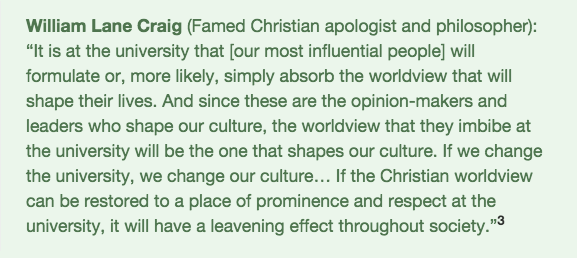
After all, if defending God’s honor was the missionary’s main goal, then the real battlefield would be the university.

Bill Craig puts it best:
If serving God is your goal, look to the university

There is already a perfectly fine university right next door – no need to fly to Europe to find one! Remember, the university that took your faith away, or maybe the faith of someone you cared about? Yeah, it’s still there in your home town! And it’s still ruining the lives of thousands of young people. It seems to me that it’s better stewardship to stay here and work, then give money to groups like Reasonable Faith. And you can start a blog, teach in church and invite scholars to the local university, too. That costs almost nothing, and it produces better results.

What about Jesus?

Sometimes, it’s a good idea to look beyond the words of the Bible and reflect on the overall message of it at a higher level. When I look in the Bible, I see that Jesus went through a lot of suffering in obedience to God in order to secure the salvation of people who did not even like him. And it’s from this sacrifice on our behalf that his claim on our obedience comes. There are things that I don’t like to do that I do anyway because they work to serve God. Jesus life’s ambition was not to do things that were easy, or that made him happy. Experienced Christians do things that are not fun, because these things are right and because they solve the real problem.
A friend from Ireland reports on their referendum on same-sex marriage

Ireland 2015 Same-Sex Marriage Referendum

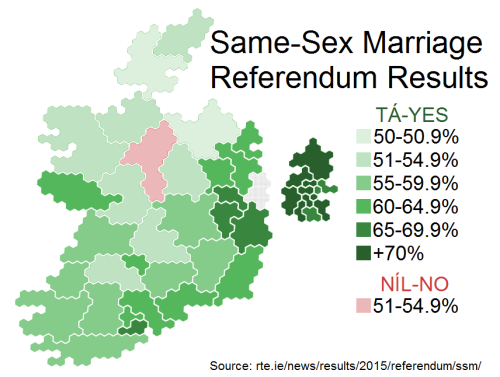
I got an e-mail from a friend in Ireland about the referendum they just had where the pro-marriage side lost by a margin of 62-38.

He writes:

Hope you don’t mind the link suggestions but I’ve listed some interesting articles from the marriage referendum in Ireland. I’m from the North part of Ireland so I couldn’t vote but some of the vitriol and hatred from the so-called “tolerant” left was absolutely vile. From “all the no voters should be murdered” to “why don’t all you no voters jump into a well”, it was fairly clear to see just what the true colours were.

The slogans all around the country were “marriage equality for all”. By hijacking the term “equality”, this effectively suggested that any naysayers are just vile, intolerant bigots. It wouldn’t be like the secular left to shut down discussion now would it?

[…]What I think you may be interested in is the sheer scale of the bullying that went on here. “Vote No” posters were ripped down, eggs were thrown at no campaigners and a young child was even hurt at a demonstration. Virtually all discussion was closed and no debate was allowed with respect to the politicians. All parties were enforcing the whip and any dissenters would no doubt be expelled from the party. Then you have to throw in the huge corporations that have offices in Ireland like Google, Microsoft and Twitter. They all have policies which promote diversity and inclusion so how would any no-voters who happen to be employees of these companies feel when their employer takes a political stance?

He understands the problem with the redefinition of marriage so that it is based on “love” rather than a lifelong commitment centered around producing and raising children:

What frustrates me about this slogan is that they absolutely were not about “marriage equality for all”. They still place limits on marriage such as close relatives, young children or indeed other topologies of relationship such as polyamory.

It seems to be that marriage in Ireland from this point forward is just some genderless institution for the purposes of validating love. Perhaps the government will introduce some means-testing to ensure that the love of those involved really is valid!

Yes, that’s the problem with love, it comes and goes. And that’s why male-male and female-female relationships are so short lived. If marriage is about feelings of love and self-fulfillment, rather than the needs of the children you make to have a mom and a dad who love them and care about them, then it does not last. Period. (Aside: and that’s why you never marry a woman who rejects responsibilities, expectations, and obligations for fun and thrills!)

Here are his three links:

  1. Ireland’s ‘tolerant’ elite now demonise anyone who opposes gay marriage
  2. Ireland’s gay marriage vote was never an equal contest
  3. Asking questions about funding for referendum campaign

I had already read the first two, but not the third. I really recommend reading the first one, so you can reflect on where your money is going when you choose to patronize big corporations, and when you vote for parties on the secular left, as many Christians do.

Just briefly from the first:

The president, Michael D Higgins, and the prime minister, Enda Kenny, back gay marriage. So does virtually every politician. Indeed, the main parties are enforcing the party whip on gay marriage, meaning any Senator or TD who votes against it is likely to be expelled from his or her party. According to the Irish Independent, even politicians who harbour ‘reservations about this major legislative change’ are not speaking out, ‘for fear of disobeying the party whip’.

[…]The public sector also backs gay marriage. It’s apparently being strongarmed to do so. According to one dissenting politician — the only one — ‘agencies who receive state funding are being pressured [by officials] into supporting a Yes vote’.

Silicon Valley is fully behind Yes: Twitter, Google and eBay have all come out for gay marriage. Twitter’s Irish boss says a Yes victory will enhance ‘Ireland’s international reputation’ — another way of saying that if you vote No, you are damaging your own country. Even the police are saying Yes: the Garda Representative Association caused a stir by calling on its members to support gay marriage, leading some to wonder if it’s right for coppers to stick their truncheons into politics.

So, the armed wing, political wing and chattering wing of the Irish elite is behind Yes.

The second article mentions that U.S.-based gay activist groups bankrolled the Yes side effort:

I suppose it is possible that the vote would have been quite as conclusive – roughly 60:40 – if the debate had not been both staggeringly one-sided and the Yes campaign had not been bankrolled so overwhelmingly by US pressure groups. Certainly the youth vote would have gone that way anyway.

[…]But one of its in-house dissidents – the impression of balance is desirable – is Breda O’Brien, a Catholic commentator, who rather put the cat among the pigeons with a piece on 9 May on the funding for the Gay and Lesbian Equality Network (Glen) and other lobby groups by a US organisation called Atlantic Philanthropies. The striking thing about the donations was not just their size – $4.7 million to Glen in 2005-11, nearly $475,000 to Marriage Equality; some $11.5 million to the Irish Council for Civil Liberties, 2001-213 – but that they refer to years before the referendum debate got under way. I can’t wait to see the actual figures for the campaign itself. By comparison the No campaign got by, I gather, on a shoestring budget of about 200,000 euros.

So when friends of mine found that when they entered a shopping centre in Limerick by one entrance on Thursday and left from the other, they were bombarded with leaflets from the Yes campaign, there was a reason for it besides spontaneous enthusiasm. One side could afford a PR campaign; the other couldn’t, though the papers heroically made the most of the tiny-by-comparison sums that US Christians put the way of the No campaign. The motives of Google for entering the fray are probably similar to those that made it take sides on the issue in the US; the referendum was on Friday, and you couldn’t open their bloody homepage without being told it was in favour of marriage equality.

The third article he mentioned talks about how well gay activist organizations were funded. While Christians are giving away billions to feed the hungry and help the poor, our freedom to speak and practice our religion was being removed by groups with very different priorities.

My friend writes, in a second e-mail:

If I was a blogger here I’d be asking three things this morning…
  1. If marriage is now a genderless institution focused only on adult love, is the government going to propose a new institution that is solely focused on children?
  2. If marriage is now purely about a validation of love then wouldn’t it be wise of the government to consider investigating the depth and sincerity of this love before before handing out marriage licences? They surely wouldn’t want to validate a relationship where the two parties weren’t really in love. Some sort of means-test perhaps? /irony
  3. Given the slogans aiming for marriage equality for all, at which point does the government plan to remove the current limits that restrict marriage to two persons?

My question would be this: when will Christians realize that they are under attack and start redirecting funds to pro-marriage groups rather than anti-poverty groups and big government? That money could have been used to fight back in Ireland, but instead Christians just seem to have their heads in the sand on how the world really works.

And finally, I want to add one more article to his list, about a baker in Northern Ireland who was fined for refusing to bake a cake that celebrated same-sex marriage.

Two Jennifer Roback Morse lectures on love, sex, economics and marriage

Dr. Jennifer Roback Morse

Here’s a quick bio of the person who is in the image above:

Dr. Jennifer Roback Morse, Senior Fellow in Economics at the Acton Institute and regular contributor toNational Review Online and The National Catholic Register, received her Ph.D. in economics from the University of Rochester. Until recently, she was a Research Fellow at the Hoover Institution. She has been on the faculty of Yale University and George Mason University, and is the author of Love and Economics: Why the Laissez-Faire Family doesn’t work.

And here are two lectures from the great Dr. Jennifer Roback Morse. One of my favorite scholars to listen to, and a great debater, as well.

Lecture one: Love and Economics

(June 13, 2014) Dr J traveled to Phoenix to participate in Alliance Defending Freedom’s Blackstone Legal Fellowship, where she gave two talks. This is the first one, “Love and Economics,” on what marriage is and why we need it–stay tuned for the next one!

The MP3 file is here.

Lecture two: Defending Marriage

(June 13, 2014) Dr J traveled to Phoenix to participate in Alliance Defending Freedom’s Blackstone Legal Fellowship, where she gave two talks. This is the second one, “Defending Marriage,” on why marriage matters and what has happened and will happen as it gets more and more redefined by the progress of the sexual revolution.

The MP3 file is here.

I was listening to these late at night, and when she said “you know Catholics aren’t good with Bible verses” at the beginning of lecture two, I howled with laughter. I’m sure the property manager is going to let me know not to howl with laughter after midnight. Oh well – it was hilarious. She is Catholic. I howled again when made a comment about chaste people over the age of 30, like me. It’s just FUN to listen to, but these are serious subjects.

By the way, she debates on these issues as well. And she’s really good at it.

Or something to read?

For those who prefer to read something, here is an article by marriage-defender Dr. Jennifer Roback Morse about how divorce courts challenge marriage.

Excerpt:

Easy divorce opens the door for an unprecedented amount of government intrusion into ordinary people’s lives. This unacknowledged reality is the subject of Taken Into Custody, by Stephen BaskervilleWith penetrating insight, the political scientist exposes the truly breathtaking consequences of no-fault divorce for the expansion of state power and the decline of personal autonomy.

First, no-fault divorce frequently means unilateral divorce: one party wants a divorce against the wishes of the other, who wants to stay married. Kim Basinger dumped Baldwin for no particular reason, unleashed the power of the Los Angeles Family Court system to inflict pain on him and, in the process, inflicted untold damage on their child. Second, the fact that one party wants to remain married means that the divorce has to be enforced. Baldwin wanted to stay married and to continue to be a husband and father. Yet, the coercive and intrusive machinery of the state must be wheeled into action to separate the reluctantly divorced party from the joint assets of the marriage, typically the home and the children.

Third, enforcing the divorce means an unprecedented blurring of the boundaries between public and private life. People under the jurisdiction of family courts can have virtually all of their private lives subject to its scrutiny. If the courts are influenced by feminist ideology, that ideology can extend its reach into every bedroom and kitchen in America. Baldwin ran the gauntlet of divorce industry professionals who have been deeply influenced by the feminist presumptions that the man is always at fault and the woman is always a victim. Thus, the social experiment of no-fault divorce, which most Americans thought was supposed to increase personal liberty, has had the consequence of empowering the state.

Some might think the legacy of no-fault divorce is an example of the law of unintended consequences in operation. That assumes its architects did not intend for unilateral divorce to result in the expansion of the state. But Baskerville makes the case in this book—as well as his 2008 monograph, “The Dangerous Rise of Sexual Politics,” in The Family in America—that at least some of the advocates of changes in family law certainly have intended to expand the power of the state over the private lives of law-abiding citizens.

It’s important for people to understand the real reasons why people are not getting married, so that we can do something to encourage them to marry that really fixes the problem. If you don’t understand the threats that men are seeing with respect to marriage, it might be a good idea to take a look at this essay by Stephen Baskerville, hosted by the Christian Touchstone magazine. It’s a summary of the book that Dr. Morse reviewed. I consider that book “Taken Into Custody” to be a must-read for anyone contemplating marriage.