Tag Archives: Love

Why doesn’t God make his existence more obvious to people?

Have you ever heard someone say that if God existed, he would give us more evidence? This is called the “hiddenness of God” argument. It’s also known as the argument from “rational non-belief”. You have have seen Dr. Theodore Drange use the argument in his debate with Dr. William Lane Craig.

Basically the argument is something like this:

  1. God is all powerful
  2. God is all loving
  3. God wants all people to know about him
  4. Some people don’t know about him
  5. Therefore, there is no God.

In this argument, the atheist is saying that he’s looked for God real hard and that if God were there, he should have found him by now. After all, God can do anything he wants that’s logically possible, and he wants us to know that he exists. To defeat the argument we need to find a possible explanation of why God would want to remain hidden.

What reason could God have for remaining hidden?

Christian scholar Dr. Michael Murray has found a reason for God to remain hidden.

His paper on divine hiddenness is here:
Coercion and the Hiddenness of God“, American Philosophical Quarterly, Vol 30, 1993.

He argues that if God reveals himself too much to people, he takes away our freedom to make morally-significant decisions, including responding to his self-revelation to us. Murray argues that God stays somewhat hidden, so that he gives people space to either 1) respond to God, or 2) avoid God so we can keep our autonomy from him. God places a higher value on people having the free will to respond to him, and if he shows too much of himself he takes away their free choice to respond to him, because once he is too overt about his existence, people will just feel obligated to belief in him in order to avoid being punished.

But believing in God just to avoid punishment is NOT what God wants for us. If it is too obvious to us that God exists and that he really will judge us, then people will respond to him and behave morally out of self-preservation. But God wants us to respond to him out of interest in him, just like we might try to get to know someone we admire. God has to dial down the immediacy of the threat of judgment, and the probability that the threat is actual. That leaves it up to us to respond to God’s veiled revelation of himself to us, in nature and in Scripture.

(Note: I think that we don’t seek God on our own, and that he must take the initiative to reach out to us and draw us to him. But I do think that we are free to resist his revelation, at which point God stops himself short of coercing our will. We are therefore responsible for our own fate).

The atheist’s argument is a logical/deductive argument. It aims to show that there is a contradiction between God’s will for us and his hiding from us. In order to derive a contradiction, God MUST NOT have any possible reason to remain hidden. If he has a reason for remaining hidden that is consistent with his goodness, then the argument will not go through.

When Murray offers a possible reason for God to remain hidden in order to allow people to freely respond to him, then the argument is defeated. God wants people to respond to him freely so that there is a genuine love relationship – not coercion by overt threat of damnation. To rescue the argument, the atheist has to be able to prove that God could provide more evidence of his existence without interfering with the free choice of his creatures to reject him.

Murray has defended the argument in works published by prestigious academic presses such as Cambridge University Press, (ISBN: 0521006104, 2001) and Routledge (ISBN: 0415380383, 2007).

Positive arguments for Christian theism

Why do men prefer to marry younger women instead of older women?

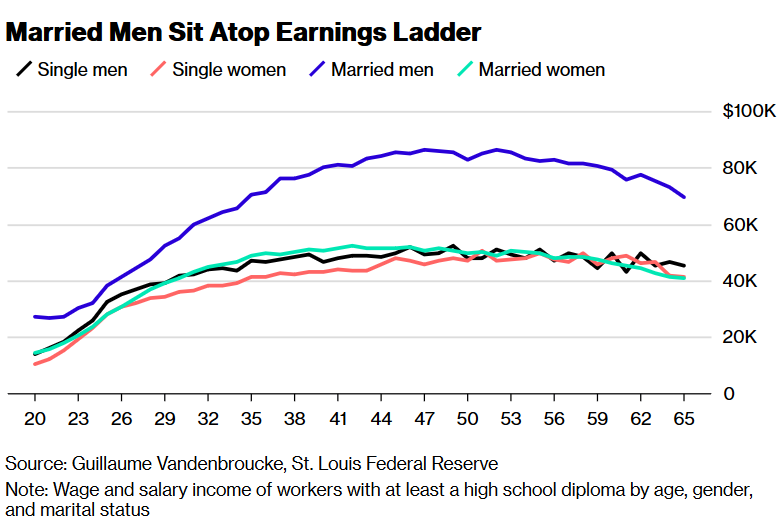
Married men seem to enjoy a boost in earnings from age 23-43
Married men seem to enjoy a boost in earnings between age 22-45

I saw a bunch of pro-marriage friends were tweeting about this article from the St. Louis Federal Reserve which talks about how well married men do financially compared to single men, and using it as a reason to argue that men should get married. The article from the St. Louis Reserve doesn’t have much commentary, but this article from the far-left Washington Post by Brad Wilcox has a lot to say.

Excerpt:

Marriage has a transformative effect on adult behavior, emotional health, and financial well-being—particularly for men.

[…]Men who get married work harder and more strategically, and earn more money than their single peers from similar backgrounds. Marriage also transforms men’s social worlds; they spend less time with friends and more time with family; they also go to bars less and to church more.

[…]Our research, featured in a recent report, “For Richer, For Poorer: How Family Structures Economic Success in America,” indicates that men who are married work about 400 hours more per year than their single peers with equivalent backgrounds. They also work more strategically: one Harvard study found that married men were much less likely than their single peers to quit their current job unless they had lined up another job.

This translates into a substantial marriage premium for men. On average, young married men, aged 28-30, make $15,900 more than their single peers, and married men aged 44-46 make $18,800 more than their single peers.

That’s even after controlling for differences in education, race, ethnicity, regional unemployment, and scores on a test of general knowledge. What’s more: the marriage premium operates for black, Hispanic, and less-educated men in much the same way as it does for men in general.

For instance, men with a high-school degree or less make at least $17,000 more than their single peers.

So, what about these differences between married men and single men? Are men able to earn more if they have a wife to support them and care for their needs? Or is it just that women prefer men who are already able to take care of themselves?

Well, in most cases, it’s the former:

2. Married men are motivated to maximize their income. For many men, this responsibility ethic translates into a different orientation toward work, more hours, and more strategic work choices. Sociologist Elizabeth Gorman finds that married men are more likely to value higher-paying jobs than their single peers.

This is partly why studies find that men increase their work hours after marrying and reduce their hours after divorcing. It’s also why married men are less likely to quit a current job without finding a new job. Indeed, they are also less likely to be fired than their single peers.

3. Married men benefit from the advice and encouragement of their wives. Although there is less research on this, we suspect that men also work harder and more strategically because they are encouraged to do so by their wives, who have an obvious interest in their success. One study appears to buttress this point, finding that men with better-educated wives earn more, even after controlling for their own education.

4. Employers like married men with children. There is evidence that employers prefer and promote men who are married with children, especially compared to their childless male peers and to mothers. Married men are often seen as more responsible and dedicated workers and are rewarded with more opportunities by employers. While illegal bias and long-held stereotypes appear to play a role in this historic preference, it nonetheless helps explain why married family men get paid more.

Now what’s the purpose of me writing this? Well, I’m actually NOT writing this to pressure men to get married. Why not? Because although marriage was a pretty good deal 100 years ago, it’s not as good of a deal under the current laws and policies, e.g. – no-fault divorce, the threats of false accusations, the Sexual Revolution, etc. The institutions of society are not doing as good of a job to prepare women for wife and mother roles as they used to do. Men have a much harder time finding someone who is prepared for marriage today. Men have to choose women more carefully.

But I am writing this to women who are being told by the culture to delay marriage, and especially to delay marriage to use your youth and beauty to “have fun” with boys who won’t commit to marriage. If a woman loves a marriage-focused man and really wants to take care of him and support him, then early marriage is one of the very best ways to really help him during the years (22-45) when it really makes a difference. Marrying a man who wants marriage when you’re still young means that he will have many, many measurable benefits. It’s hard to attract a man who is already rich, because so many women are competing for him. It’s much easier to marry a young man and build him up into a rich man, by supporting him.

Men know that a woman’s support has value. It’s important for women to marry when the marriage has the potential to do the most good for a man in areas like health, career, finances and children. Men typically don’t want to marry women who are older, because those women tend to have more sexual experience. They get used to giving a man sex in order to get him to do what she wants. They get used to breaking up instead of making things work. Once a woman gets used to doing this, it becomes much harder to trust a good man to lead, and to give a man respect as a leader.

So, what I would like to see is women understand that part of loving a man is committing to him early, and staying with him to build him up. Instead of trying to wasting your youth on hot bad boys, why not build up a good man into the fit, wealthy husband you want? It seems to me that building up a man into what you want is a lot easier than wasting your youth on bad boys, then trying to attract a good man when your attractive years are already behind you.

New study: the majority (69%) of divorces are initiated by women

Is it OK to tell women they are wrong?
Is this “I’ll do what I want” attitude compatible with life-long married love?

This new report from Live Science gives us some numbers about who initiates divorces most frequently.

It says:

Women are more likely than men to initiate divorce in the United States, but they are no more likely than men to initiate breakups in a dating relationship, a new study finds.

“The breakups of nonmarital heterosexual relationships in the U.S. are quite gender-neutral and fairly egalitarian,” study author Michael Rosenfeld, an associate professor of sociology at Stanford University, said in a statement. “This was a surprise because the only prior research that had been done on who wanted the breakup was research on marital divorces.”

Previous research had found that women are more likely to initiate divorce, at least in the United States, Europe and Australia. In the new study, Rosenfeld compared divorces to nonmarital breakups, in an effort to understand the driving forces behind each type of breakup.

To investigate, he looked at data from the 2009 to 2015 waves of How Couples Meet and Stay Together, a nationally representative survey spearheaded by Rosenfeld and his colleagues. The new study includes 2,262 adults, ages 19 to 64, who reported having opposite-sex partners in 2009. By 2015, 371 of the participants had broken up or gotten divorced.

Women initiated 69 percent of the 92 divorces, Rosenfeld found. But there was no statistically significant difference between women and men when it came to nonmarital breakups, regardless of whether they were living together, he said.

The Ruth Institute reports on a few studies:

Female unions seem to have the highest divorce rates, followed by male unions, followed by opposite sex unions.

“For Sweden, the divorce risk for partnerships of men is 50% higher than the risk for heterosexual marriages, and that the divorce risk for female partnerships is nearly double that for men.”

“For Norway, divorce risks are 77% higher in lesbian partnerships than in those of gay men.”  (The Norwegian data did not include a comparison with opposite sex couples.)

In California, the data is collected a little differently. The study looks at couples who describe themselves as partners, whether same sex or opposite sex. The study asks the question, how likely is it that these couples live in the same household five years later. Male couples were only 30% as likely, while female couples were less that 25% as likely, as heterosexual married couples, to be residing in the same household for five years.

It really seems as if there is something about women in particular that causes them to be unable to keep to commitments in their actions, despite what they might say with their words.

So I am seeing a couple of problems in young, unmarried women that might explain this.

Feminism is bad

First, there is the feminism. Feminism was the driving force behind no-fault divorce. Today, young unmarried women are being taught to view marriage as stifling to their freedom. So if they do get married, they are often resolved that marriage should not affect their freedom in any way. That is just not the way marriage works, though – both spouses need to be equally ready to have their freedom infringed upon by things that HAVE TO GET DONE. Lots of things that have to get done will not be fun, thrilling or amusing – and that’s why it’s good to be prepared to do them before you marry.

My friend Dina says that she only knows one happily married couple from among her friends. The most frequent case she sees is wife is working in order to pay for big house, two cars, etc. and wife is denying husband sex, which makes him disengage from the marriage. A working wife tends to not be as responsive to the needs of husband and kids as a non-working wife, probably in part due to work stress. There is an epidemic of sex-withholding by women, and it causes men to disengage from marriage because they feel unloved. Although women tend to rebel against the idea that the man’s bad behavior is their fault, and that there is a “contractual” nature to marriage, that is how marriage works. You cannot stay married, women, by just doing whatever you feel like, and NOT doing whatever you DON’T feel like. Men will disengage when their needs are not supplied, and that’s no fault of theirs. It’s your fault. Denying relationship obligations causes men to underperform.

Feminism is often linked closely to “independence”. There is a lot of confusion over what the word independence means among young, unmarried women. A man uses that word to mean “lack of financial dependence on parents, the state, etc. because of good decisions in education, career and finances”. But a woman means “not having to care about the needs of a man and the leadership of a man, or the needs of children while still getting what I want from men and children”. That attitude is not compatible with life-long married love.

Emotions are bad

Second, emotions. In my experience, young, unmarried women are less likely to have reasoned out their own life plan in a practical step-by-step manner. Instead, they tend to do whatever makes them feel good moment-by-moment without any realistic plan. One Christian woman was recently telling me how attracted she was to an atheist moral relativist who had been promiscuous from the age of 15. She explained that her emotions were kindled by his GQ looks, 6-pack abs, mysterious European accent, seductive manner and witty conversations. Although she is apparently a Christian, she doesn’t take Christianity seriously in her decisions about relationships and marriage.

Peer-approval and culture play a large part in determining what women think is attractive in a man, as well as their life goals, and women are driven by these cultural standards more than men who focus on honoring their commitments regardless of their emotions. In my experience, women struggle to make their day-to-day actions match their socially-acceptable goal of getting married “some day”. Marriage is for “some day” for today’s busy women, but fun and thrills is for today. “Live in the moment”, they often tell me. If you try to talk to them about roles and responsibilities in a marriage, they will withdraw and rebel. But marriage is about each spouse doing his or her job, and feeling content about what the couple is building together. You can’t make life-long married love from emotional craziness and pursuing fun and thrills with seductive promiscuous moral relativist atheists.

How to pick a woman who won’t divorce you

Young men, I advise you to choose wives who have had to do things that they did not feel like doing. That can involve things like getting a STEM degree, getting a job in STEM, moving out of her parents’ house, getting a “boring” job that helps her pay off her debts, keeping commitments when she doesn’t feel like it, and caring for other people and even animals.

Basically, the more the woman has ground down any narcissism and hedonism she may have, by having to do nasty calculus and horrid lab work, the better. The more accustomed she is to constraints, responsibilities, expectations and obligations, the less likely it is that she’ll divorce you for unhappiness. And all of this goes for men, as well. STEM degree, STEM job, save money, serve others, give to charity.

Marriage is not the time for people to be carried away by their emotions. It’s an enterprise, and it works when both people are rational, practical, hard-working and self-controlled.