Tag Archives: Logic

William Lane Craig debates Peter Atkins: Does God Exist?

Apologetics 315 posted the video of a debate from the Reasonable Faith speaking tour in the UK:

This is a must-see debate. It was extremely fun to watch.

Details:

On Wednesday 26th October 2011 William Lane Craig debated Peter Atkins on the topic: Does God Exist? This debate took place at the University of Manchester  as part of the UK Reasonable Faith Tour with William Lane Craig. The debate was chaired by Christopher Whitehead, Head of Chemistry School at the University. Post-debate discussion was moderated by Peter S Williams, Philosopher in Residence at the Damaris Trust, UK.

Dr. William Lane Craig:

William Lane Craig (born August 23, 1949) is an American analytic philosopher, philosophical theologian, and Christian apologist. He is known for his work on the philosophy of time and the philosophy of religion, specifically the existence of God and the defense of Christian theism. He has authored or edited over 30 books including The Kalam Cosmological Argument (1979), Theism, Atheism and Big Bang Cosmology(co-authored with Quentin Smith, 1993), Time and Eternity: Exploring God’s Relationship to Time (2001), and Einstein, Relativity and Absolute Simultaneity (co-edited with Quentin Smith, 2007).

Craig received a Bachelor of Arts degree in communications from Wheaton College, Illinois, in 1971 and two summa cum laudemaster’s degrees from Trinity Evangelical Divinity School in Deerfield, Illinois, in 1975, in philosophy of religion and ecclesiastical history. He earned a Ph.D. in philosophy under John Hick at the University of Birmingham, England in 1977 and a Th.D. underWolfhart Pannenberg at the University of Munich in 1984.

Dr. Peter Atkins:

Peter William Atkins (born 10 August 1940) is a British chemist and former Professor of Chemistry at the University of Oxford and a Fellow of Lincoln College. He is a prolific writer of popular chemistry textbooks, including Physical Chemistry, Inorganic Chemistry, and Molecular Quantum Mechanics. Atkins is also the author of a number of science books for the general public, including Atkins’ Molecules and Galileo’s Finger: The Ten Great Ideas of Science.

Atkins studied chemistry at the University of Leicester, obtaining a bachelor’s degree in chemistry, and – in 1964 – a PhD for research into electron spin resonance spectroscopy, and other aspects of theoretical chemistry. Atkins then took a postdoctoral position at the UCLA as aHarkness Fellow of the Commonwealth fund. He returned to Oxford in 1965 as fellow and tutor of Lincoln College, and lecturer in physical chemistry (later, professor of physical chemistry).

You can get the audio of the debate here, along with links to their previous debate from 1998. This debate is accessible and understandable to novice-level Christians.

I am happy when debates like this come out. I have friends who are Christians who doubt the importance of apologetics in evangelism, because they don’t think that apologists can prove anything or win arguments. I have friends who are skeptical of using arguments that assume a 14-billion year old universe, because they think that the Big Bang is compatible with atheism (!). I have friends who think that philosophical arguments have no persuasive force. I have friends who think that nothing can be proven from history, beyond a reasonable doubt. I have co-workers who ask me whether anyone wins these debates. I think that this debate answers all of those questions.

This debate clearly shows why Christians should not shy away from studying science, philosophy and history. We will not discover anything that harms Christian theism by thinking logically and by looking at the evidence. To the contrary, it is the atheist who makes war on the progress of science, and who is forced to resist the clear experimental evidence, and to resort to baseless speculations and blind faith. If you want to see a good debate with an intelligent atheist, I recommend watching the debate between William Lane Craig and Peter Millican instead. But if you want to see a really, really overwhelming defeat for atheism, watch this debate. It is very clear at the end of this debate why Richard Dawkins refused to debate William Lane Craig at Oxford.

SUMMARY OF THE OPENING SPEECHES

I only had time to summarize the first two speeches. Keep in mind that Dr. Craig always shines in his rebuttals, and this debate is no different. So you’ll want to watch those rebuttals. Dr. Atkins literally says in this debate in his first rebuttal “There was nothing here originally. There is nothing here now. But it is an interesting form of nothing which seems to be something.” And the audience laughs nervously. This debate is like that. You will see a clear winner and clear loser in this debate. This fight is decided by knockout.

William Lane Craig opening speech:

1. the origin of the universe
2. the moral argument
3. the resurrection of Jesus

Peter Atkins opening speech:

1. Dr. Craig is stupid, lazy and evil:
– Dr. Craig’s arguments are old: from the 11th century! Old arguments can’t be true
– Dr. Craig is just asserting that “God did it” because he is lazy
– Dr. Craig feels pressured to agree with the theistic majority
– Dr. Craig needs a psychological crutch to comfort him
– Dr. Craig is fearful of death
– Dr. Craig is just wishing for an eternal life of bliss
– Dr. Craig is driven by his heart, and not by his head

2. Origin of the universe:
– Maybe the universe is eternal and has no beginning – we don’t know
– Maybe mommy universes can give birth to daughter universes
– It is naive to think that a cause is needed to cause the creation of the universe from nothing
– Science is just about to show how it is possible that something appears out of nothing without cause
– Some scientists have already begun to speculate about about how something can come into being out of nothing
– Maybe nothing is not really nothing, but it is actually something
– It would be admitting defeat to say that God created the universe out of nothing

3. Fine-Tuning:
– It could be the case that the fundamental constants are not variable
– It could be the case that the fine-tuning of the cosmic constants is a happy accident
– It could be the case that there are billions of billions of unobservable universes that are not fine tuned
– It could be the case that the cosmic constants in these billions and billions of unobservable universes are all random so that some are fine-tuned
– Anyone who infers that an intelligence is the best explanation of a finely-tuned set of life-permitting cosmic constants is lazy

4. Purpose:
– Philosophers and theologians are stupid
– I don’t think that there is purpose in the universe
– I think that the universe is more grand if there is no purpose, so there is no purpose

5. Miracles:
– I don’t think that miracles happen
– The resurrection is a fabrication
– It could be the case that Jesus didn’t exist
– It could be the case that Jesus wasn’t really crucified
– It could be the case that Jesus didn’t  really die after being crucified
– It could be the case that the disciples stole his body
– It could be the case that the women went to the wrong hole in the ground
– the gospels are political propaganda written long after the events they are reporting on

6. Theodicy:
– God has no morally sufficient reason for allowing humans to perform actions that result in suffering
– God has no morally sufficient reason for allowing nature to cause suffering

7. Morality:
–  customs and conventions emerges arbitrarily in different times and places based on an awareness of the consequences of actions, as well as various anecdotes and experiences
–  these customs and conventions are decided based on the goal for survival, in much the same way as politeness and manners emerge for decorum and to avoid offense
– it is childish to presume that there is an umpire God who decides moral values and duties

8. Religious believers are stupid, lazy and evil:
– the notion of God has arisen because people are stupid and want to be comforted
– there are no arguments or evidences for belief in God
– people who believe in God do not think, but instead take refuge in incomprehensible nonsense
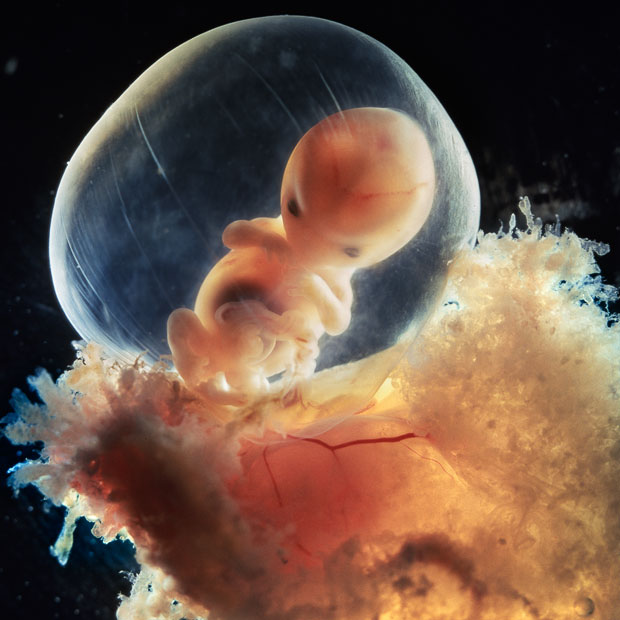
Philosopher Doug Groothuis explains the logic of the pro-life position

I'm Scheming Unborn Baby, and I approve this study
I’m Scheming Unborn Baby, and I approve this message

At Christian Post, an article by Douglas Groothuis. (H/T Mary)

Here’s the most useful bit:

When we separate personhood from humanity, we make personhood an achievement based on the possession of certain qualities. But what are these person-constituting qualities? Some say a basic level of consciousness; others assert viability outside the womb; still others say a sense of self-interest (which probably does not obtain until after birth). All of these criteria would take away humanity from those in comas or other physically compromised situations.4 Humans can lose levels of consciousness through injuries, and even infants are not viable without intense and sustained human support. Moreover, who are we to say just what qualities make for membership in the moral community of persons?5 The stakes are very high in this question. If we are wrong in our identification of what qualities are sufficient for personhood and we allow a person to be killed, we have allowed the wrongful killing of nothing less than a person. Therefore, I argue that personhood should be viewed as a substance or essence that is given at conception. The fetus is not a lifeless mechanism that only becomes what it is after several parts are put together—as is the case with a watch or an automobile. Rather, the fetus is a living human organism, whose future unfolds from within itself according to internal principles. For example, the fertilized ovum contains a complete genetic code that is distinct from that of the mother or father. But this is not a mere inert blueprint (which is separable from the building it describes); this is a living blueprint that becomes what its human nature demands.

Yet even if one is not sure when personhood becomes a reality, one should err on the side of being conservative simply because so much is at stake. That is, if one aborts a fetus who is already a person, one commits a deep moral wrong by wrongfully killing an innocent human life. Just as we do not shoot target practice when we are told there may be children playing behind the targets, we should not abortion fetuses if they may be persons with the right not to be killed. As I have argued, it cannot be disputed that abortion kills a living, human being.

Many argue that outside considerations experienced by the mother should overrule the moral value of the human embryo. If a woman does not want a pregnancy, she may abort. But these quality of life considerations always involve issues of lesser moral weight than that of the conservation and protection of a unique human life (which considers the sanctity or innate and intrinsic value of a human life).6 An unwanted pregnancy is difficult, but the answer is not to kill a human being in order to end that pregnancy.

I think that the real question in the abortion debate right now is whether a living organism with a human nature and a human genetic code that is distinct from its mother and father deserves the right to life, or whether it needs to develop some other capability in order to be worthy of protection from violence.

Consider something from philosopher Francis J. Beckwith.

Excerpt:

Some argue that personhood does not arrive until brain waves are detected (40 to 43 days).11Others, such as Mary Anne Warren,12 define a person as a being who can engage in cognitive acts such as sophisticated communication, consciousness, solving complex problems, self-motivated activity and having a self-concept. This would put the arrival of personhood at some time after birth. Still others, such as L. W. Sumner, 13 hold a more moderate position and argue that human personhood does not arrive until the fetus is sentient, the ability to feel and sense as a conscious being. This, according to Sumner, occurs possibly as early as the middle weeks of the second trimester of pregnancy and definitely by the end of that trimester.

Although these criteria differ from each other in important ways, they all have one thing in common: each maintains that if and only if an entity functions in a certain way are we warranted in calling that entity a person. Defenders of these criteria argue that once a human being, whether born or unborn, acquires a certain function or functions–whether it is brain waves, rationality, sentience, etc.– it is then and only then that a person actually exists. Those who defend these personhood criteria typically make a distinction between “being a human” and “being a person.” They argue that although fetuses are members of the species homo sapiens, and in that sense are human, they are not truly persons until they fulfill a particular set of personhood criteria.

Although functional definitions of personhood may tell us some conditions that are sufficient to say that a being is a person, they are not adequate in revealing to us all the conditions that are sufficient for a particular being to be called a person. For example, when a human being is asleep, unconscious, and temporarily comatose, she is not functioning as a person as defined by some personhood criteria. Nevertheless, most people would reject the notion that a human being is not a person while in any of these states. In other words, while personhood criteria, such as the ones presented by Warren can tell us that a being is a person, these criteria are not adequate to declare a being a non-person: The exercise of rational thought tells us that a being is a person; when that person is sleeping, and thus is not exercising rational thought, that lack of exercise of the thought function does not make her a non-person at that time. Consequently, it seems more consistent with our moral intuitions to say that personhood is not something that arises when certain functions are in place, but rather is something that grounds these functions, whether or not they are ever actualized in the life of a human being. Thus, defining personhood strictly in terms of function is inadequate.

If you are pro-life because of your feelings, or because someone told you to be, you ought to know that being pro-life is quite rational and supported by medical evidence. People who are pro-abortion are pro-abortion because they want recreational sex without the complications of having to care for the consequences (babies!) of their own actions. Even if they do not engage in the sex and the abortions themselves, they advocate for abortion rights, and they are guilty of encouraging a culture where 57 million unborn children have died since 1973. We’re long past Stalin numbers with this thing now.

We ought to care about not hurting other people. If grown-up’ selfish pursuit of happy feelings conflicts with another person’s right to life, then maybe we need to take a step back from being happy and start trying to be good instead.

If unborn babies don’t have consciousness or don’t feel pain, may we kill them?

Unborn baby scheming about pro-life apologetics

Was having a conversation by e-mail yesterday with a pro-abortion atheist, and he gave two reasons why he supported abortion in the first and second trimester. First, he said that unborn babies can’t feel pain, so it’s OK to kill them. Second, he said that unborn babies don’t have consciousness, so it’s OK to kill them. I thought it might be useful to link to something that answers both of these objections.

Frank Beckwith is the author of “Defending Life: A Moral and Legal Case Against Abortion Choice“. He wrote that book for Cambridge University Press, a top academic press. But before Cambridge University Press, Beckwith wrote four easy-to-understand essays for the Christian Research Journal. Part IV is the one that has the response to the two questions raised by my atheist friend.

Part I. The Appeal to Pity

Part II. Arguments from Pity, Tolerance, and Ad Hominem

Part III. Is The Unborn Human Less Than Human?

Part IV. When Does a Human Become a Person?

Excerpt:

Some ethicists argue that the unborn becomes fully human sometime after brain development has begun, when it becomes sentient: capable of experiencing sensations such as pain. The reason for choosing sentience as the criterion is that a being that cannot experience anything (i.e., a presentient unborn entity) cannot be harmed. Of course, if this position is correct, then the unborn becomes fully human probably during the second trimester and at least by the third trimester. Therefore, one does not violate anyone’s rights when one aborts a nonsentient unborn entity. [13]

There are several problems with this argument. First, it confuses harm with hurt and the experience of harm with the reality of harm. [14] One can be harmed without experiencing the hurt that sometimes follows from that harm, and which we often mistake for the harm itself. For example, a temporarily comatose person who is suffocated to death “experiences no harm,” but he is nevertheless harmed. Hence, one does not have to experience harm, which is sometimes manifested in hurt, in order to be truly harmed.

Second, if sentience is the criterion of full humanness, then the reversibly comatose, the momentarily unconscious, and the sleeping would all have to be declared nonpersons. Like the presentient unborn, these individuals are all at the moment nonsentient though they have the natural inherent capacity to be sentient. Yet to countenance their executions would be morally reprehensible. Therefore, one cannot countenance the execution of some unborn entities simply because they are not currently sentient.

Someone may reply that while these objections make important points, there is a problem of false analogy in the second objection: the reversibly comatose, the momentarily unconscious, and the sleeping once functioned as sentient beings, though they are now in a temporary state of nonsentience. The presentient unborn, on the other hand, were never sentient. Hence, one is fully human if one was sentient “in the past” and will probably become sentient again in the future, but this cannot be said of the presentient unborn.

There are at least three problems with this response. First, to claim that a person can be sentient, become nonsentient, and then return to sentience is to assume there is some underlying personal unity to this individual that enables us to say that the person who has returned to sentience is the same person who was sentient prior to becoming nonsentient. But this would mean that sentience is not a necessary condition for personhood. (Neither is it a sufficient condition, for that matter, since nonhuman animals are sentient.) Consequently, it does not make sense to say that a person comes into existence when sentience arises, but it does make sense to say that a fully human entity is a person who has the natural inherent capacity to give rise to sentience. A presentient unborn human entity does have this capacity. Therefore, an ordinary unborn human entity is a person, and hence, fully human.

Second, Ray points out that this attempt to exclude many of the unborn from the class of the fully human is “ad hoc and counterintuitive.” He asks us to “consider the treatment of comatose patients. We would not discriminate against one merely for rarely or never having been sentient in the past while another otherwise comparable patient had been sentient….In such cases, potential counts for everything.” [15]

Third, why should sentience “in the past” be the decisive factor in deciding whether an entity is fully human when the presentient human being “is one with a natural, inherent capacity for performing personal acts?” [16] Since we have already seen that one does not have to experience harm in order to be harmed, it seems more consistent with our moral sensibilities to assert that what makes it wrong to kill the reversibly comatose, the sleeping, the momentarily unconscious, and the presentient unborn is that they all possess the natural inherent capacity to perform personal acts. And what makes it morally right to kill plants and to pull the plug on the respirator-dependent brain dead, who were sentient “in the past,” is that their deaths cannot deprive them of their natural inherent capacity to function as persons, since they do not possess such a capacity.

These four essays are a very good introduction to common responses to pro-abortion arguments. I recommend that people get familiar with this, as once you look into it, you will see that the abortion issue can be debated with as much confidence as William Lane Craig defends Christian theism. You will have the same access to scientific evidence and rational arguments on this topic, and so you will have the upper hand. And that’s fun.

The best introductory book on the abortion / right to life issue is “The Case for Life” by pro-life debater Scott Klusendorf. The best comprehensive book is a tie between “The Ethics of Abortion” by Christopher Kaczor, and Frank Beckwith’s “Defending Life: A Moral and Legal Case Against Abortion Choice“.