Tag Archives: Life

What is intelligent design? Dr. Stephen C. Meyer explains the theory

A MUST-SEE lecture based on Dr. Stephen C. Meyer’s book “Signature in the Cell“. (H/T Chris S.)

You can get an MP3 of the lecture here. (30 MB)

I highly recommend watching the lecture, and looking at the slides. The quality of the video and the content is first class. There is some Q&A (9 minutes) at the end of the lecture.

Topics:

  • intelligent design is concerned with measuring the information-creating capabilities of natural forces like mutation and selection
  • Darwinists think that random mutations and natural selection can explain the origin and diversification of living systems
  • Darwinian mechanisms are capable of explaining small-scale adaptive changes within types of organisms
  • but there is skepticism, even among naturalists, that Darwinian mechanisms can explain the origin of animal designs
  • even if you concede that Darwinism can account for all of the basic animal body plans, there is still the problem of life’s origin
  • can Darwinian mechanisms explain the origin of the first life? Is there a good naturalistic hypothesis to explain it?
  • there are at least two places in the history of life where new information is needed: origin of life, and Cambrian explosion
  • overview of the structure of DNA and protein synthesis (he has helpful pictures and he uses the snap lock blocks, too)
  • the DNA molecule is composed of a sequence of proteins, and the sequence is carefully selected to have biological function
  • meaningful sequences of things like computer code, English sentences, etc. require an adequate cause
  • it is very hard to arrive at a meaningful sequence of a non-trivial length by randomly picking symbols/letters
  • although any random sequence of letters is improbable, the vast majority of sequences are gibberish/non-compiling code
  • similarly, most random sequences of amino acids are lab-proven (Doug Axe’s work) to be non-functional gibberish
  • the research showing this was conducted at Cambridge University and published in the Journal of Molecular Biology
  • so, random mutation cannot explain the origin of the first living cell
  • however, even natural selection coupled with random mutation cannot explain the first living cell
  • there must already be replication in order for mutation and selection to work, so they can’t explain the first replicator
  • but the origin of life is the origin of the first replicator – there is no replication prior to the first replicator
  • the information in the first replicator cannot be explained by law, such as by chemical bonding affinities
  • the amino acids are attached like magnetic letters on a refrigerator
  • the magnetic force sticks the letters ON the fridge, but they don’t determine the specific sequence of the letters
  • if laws did determine the sequence of letters, then the sequences would be repetitive
  • the three materialist explanations – chance alone, chance and law, law alone – are not adequate to explain the effect
  • the best explanation is that an intelligent cause is responsible for the biological explanation in the first replicator
  • we know that intelligent causes can produce functional sequences of information, e.g. – English, Java code
  • the structure and design of DNA matches up nicely with the design patterns used by software engineers (like WK!)

There are some very good tips in this lecture so that you will be able to explain intelligent design to others in simple ways, using everyday household items and children’s toys to symbolize the amino acids, proteins, sugar phosphate backbones, etc.

Proteins are constructed from a sequence of amino acids:

A sequence of amino acids forming a protein

Proteins sticking onto the double helix structure of DNA:

Some proteins sticking onto the sugar phosphate backbone

I highly, highly recommend this lecture. You will be delighted and you will learn something.

Here is an article that gives a general overview of how intelligent design challenges. If you want to read something more detailed about the material that he is covering in the lecture above related to the origin of life, there is a pretty good article here.

UPDATE: You can see Dr. Stephen C. Meyer debate Dr. Peter Ward as well.

Related posts

Book review of “Creating Life in the Lab”

I saw that Brian Auten posted this book review by Luke Nix.

Introduction:

Creating Life In The Lab: How New Discoveries in Synthetic Biology Make A Case For The Creator is Dr. Fazale Rana’s latest contribution to Christian apologetic literature. The goal of the book is to provide a case for God’s existence from the controversial efforts of scientists to “play God” by creating life. He has written the book with the backdrop of Franenstein to provide some cultural connection. The book has thirteen chapters plus an appendix that includes a short refresher on biochemistry. The book, though not officially, is divided into two parts: the first examining the quest to create artificial life and the second investigates scientists research behind the origin of life.

Here are a couple of chapter summaries:

Chapter 6—A Scientist’s Splendor 
In Chapter 6 Dr. Rana goes yet another level with the attempts to create artificial life in the lab. In Chapter 4 he described an approach that takes existing components and moves them around to create new organisms. In Chapter 5 he described an approach that creates the components and assembles them. In this chapter, Rana describes the efforts to create novel proteins and information-containing molecules (DNA in natural life)—both the basic components of the components used in the previous approaches. Rana goes over the attempts to create proteins from scratch and the complications involved with such an endeavor. He also explains the intricate and tedious processes that are required to produce enzymes that don’t come close to being as efficient as those found in nature. He uses both to not only show the immense intelligence required to create the building blocks of life, but to also provide a critique of the evolutionary paradigm. In the previous chapters, Rana showed that putting life together from preexisting building blocks required great intelligence and resources; in this chapter Rana adds to that by showing what is required to create the building blocks themselves. This adds yet another level of power to his argument for a Creator.

Chapter 7—The Particulars of Life’s Formation 
Dr. Rana now switches the focus slightly. He moves from discussing the approaches to creating life in the lab to the relationship between it and those researching the origin of life. He begins with Chapter 7 describing the connections advantages that both research projects offer the other. He then goes over a short history of origin-of-life research. He describes the most popular models and where some fail but have been replaced by newer models. He discusses the prebiotic soup, the DNA/protien world, the RNA world, and others. He refers the reader to his earlier work “Origins of Life”, co-authored with Dr. Hugh Ross, for more details on the strengths and weaknesses of the particular models.

Luke does a chapter-by-chapter review of the book. I will definitely be getting this book to understand this stuff. It’s always good to be familiar with the details of cosmology, fine-tuning and origin of life.

New study on tidal heating strengthens stellar habitability argument

Circumstellar Habitable Zone

Note: If you need a refresher on the habitability argument, click here.

Here’s an article entitled “Tidal heating shrinks the ‘goldilocks zone’: Overlooked factor suggests fewer habitable planets than thought”. It appeared in Nature, the most prestigious peer-reviewed science journal.

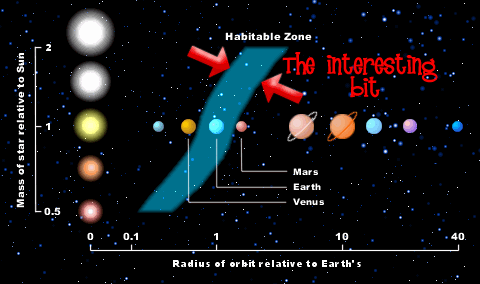
The gist of it is that tidal forces can alter orbits so that planets don’t spend all of their orbit in the habitable zone. If planets go outside the habitable zone, it damages their supply of liquid water, and any life chemistry going on in there is disrupted.

Excerpt:

A previously little-considered heating effect could shrink estimates of the habitable zone of the Milky Way’s most numerous class of stars — ‘M’ or red dwarfs — by up to one half, says Rory Barnes, an astrobiologist at the University of Washington in Seattle. That factor — gravitational heating via tides — suggests a menagerie of previously undreamt-of planets, on which tidal heating is a major source of internal heat. Barnes presented the work yesterday at a meeting of the American Astronomical Society’s Division on Dynamical Astronomy in Timberline Lodge, Oregon.

The habitable zone is the orbital region close enough to a star for a planet to have liquid water, but not so close that all of the water evaporates. For our Sun, the zone extends roughly from the inner edge of the orbit of Mars to the outer edge of that of Venus. For smaller, cooler stars, such as M-class dwarfs, the zone can be considerably closer to the star than Mercury is to the Sun. And because close-in planets are easier to spot than more distant ones, such stars have been a major target for planet hunters seeking Earth-like worlds.

There’s just one problem with finding habitable planets around such stars, says Barnes. Because tidal forces vary dramatically with the distance between a planet and its star, closer orbits also result in massively larger tidal forces.

Since planets do not have perfectly circular orbits, these tidal forces cause the planet to flex and unflex each time it moves closer to or further from its star; kneading its interior to produce massive quantities of frictional heat. Substantial heat can be produced, he added, with even slight deviations from a perfectly circular orbit. And, Barnes notes, other factors — such as the rate of the planet’s rotation and its axial tilt — can also influence heat production.

A similar tidal process makes Jupiter’s moon Io the most volcanic body in the Solar System. “I’m just scaling that Io–Jupiter system up by a factor of 1,000 in mass,” Barnes said at the meeting. “It’s the same process, on steroids.”

So, stars that are smaller and cooler will have a habitable zone that is closer to the star, exposing them to more tidal forces. More tidal forces makes their orbits less likely to stay circular – within the habitable zone around the star. These variations cause an increase in heat production on the planet. Too much heat means that the planet is unable to support liquid water on the surface, making it inhospitable for life. Therefore, solar systems with less massive stars can be ruled out as possible sites for life, because of these tidal forces.