Tag Archives: Life

Stephen C. Meyer lectures on intelligent design and the origin of life

A MUST-SEE lecture based on Dr. Stephen C. Meyer’s book “Signature in the Cell“.

You can get an MP3 of the lecture here. (30 MB)

I highly recommend watching the lecture, and looking at the slides. The quality of the video and the content is first class. There is some Q&A (9 minutes) at the end of the lecture.

Topics:

  • intelligent design is concerned with measuring the information-creating capabilities of natural forces like mutation and selection
  • Darwinists think that random mutations and natural selection can explain the origin and diversification of living systems
  • Darwinian mechanisms are capable of explaining small-scale adaptive changes within types of organisms
  • but there is skepticism, even among naturalists, that Darwinian mechanisms can explain the origin of animal designs
  • even if you concede that Darwinism can account for all of the basic animal body plans, there is still the problem of life’s origin
  • can Darwinian mechanisms explain the origin of the first life? Is there a good naturalistic hypothesis to explain it?
  • there are at least two places in the history of life where new information is needed: origin of life, and Cambrian explosion
  • overview of the structure of DNA and protein synthesis (he has helpful pictures and he uses the snap lock blocks, too)
  • the DNA molecule is composed of a sequence of bases that code for proteins, and the sequence is carefully selected to have biological function
  • meaningful sequences of things like computer code, English sentences, etc. require an adequate cause
  • it is very hard to arrive at a meaningful sequence of a non-trivial length by randomly picking symbols/letters
  • although any random sequence of letters is improbable, the vast majority of sequences are gibberish/non-compiling code
  • similarly, most random sequences of amino acids are lab-proven (Doug Axe’s work) to be non-functional gibberish
  • the research showing this was conducted at Cambridge University and published in the Journal of Molecular Biology
  • so, random mutation cannot explain the origin of the first living cell
  • however, even natural selection coupled with random mutation cannot explain the first living cell
  • there must already be replication in order for mutation and selection to work, so they can’t explain the first replicator
  • but the origin of life is the origin of the first replicator – there is no replication prior to the first replicator
  • the information in the first replicator cannot be explained by law, such as by chemical bonding affinities
  • the amino acids are attached like magnetic letters on a refrigerator
  • the magnetic force sticks the letters ON the fridge, but they don’t determine the specific sequence of the letters
  • if laws did determine the sequence of letters, then the sequences would be repetitive
  • the three materialist explanations – chance alone, chance and law, law alone – are not adequate to explain the effect
  • the best explanation is that an intelligent cause is responsible for the biological explanation in the first replicator
  • we know that intelligent causes can produce functional sequences of information, e.g. – English, Java code
  • the structure and design of DNA matches up nicely with the design patterns used by software engineers (like WK!)

There are some very good tips in this lecture so that you will be able to explain intelligent design to others in simple ways, using everyday household items and children’s toys to symbolize the amino acids, proteins, sugar phosphate backbones, etc.

Proteins are constructed from a sequence of amino acids:

A sequence of amino acids forming a protein

Proteins sticking onto the double helix structure of DNA:

Some proteins sticking onto the sugar phosphate backbone

I highly, highly recommend this lecture. You will be delighted and you will learn something.

Here is an article that gives a general overview of how intelligent design challenges. If you want to read something more detailed about the material that he is covering in the lecture above related to the origin of life, there is a pretty good article here.

There is a good breakdown of some of the slides with helpful flow charts here on Uncommon Descent.

Positive arguments for Christian theism

Fine-tuning the habitable zone: tidal-locking and solar flares

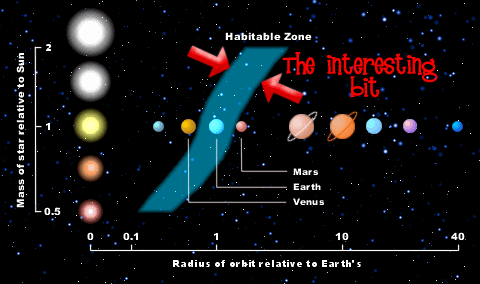
Circumstellar Habitable Zone

Here’s an article from Evolution News that talks about liquid water and tidal locking, but it has even more factors that need to be fine-tuned for habitability.

Excerpt:

Stars with masses of 0.1-0.5 solar mass make up 75 percent of the stars in our Milky Way galaxy.6 These represent the red dwarfs, the M class. But these stars have low effective temperatures, and thus emit their peak radiation at longer wavelengths (red and near-infrared).7 They can have stable continuously habitable zones over long time scales, up to 10 billion years, barring other disruptions. It is also easier to detect terrestrial sized planets around them.8 But a serious problem with red dwarf stars in the K and M classes is their energetic flares and coronal mass ejection events. Potentially habitable planets need to orbit these stars closer, to be in these stars’ habitable zones. Yet the exposure to their stellar winds and more frequent and energetic flares becomes a serious issue for habitability. Because of these stars’ smaller mass, ejections get released with more violence.9 Any planet’s atmosphere would be subject to this ionizing radiation, and likely expose any surface life to much more damaging radiation.10 The loss of atmospheres in these conditions is likely, but the timescales are dependent on several factors including the planet’s mass, the extent of its atmosphere, the distance from the parent star, and the strength of the planet’s magnetic field.11 To protect its atmosphere for a long period, like billions of years, a planet with more mass and thus higher gravity could hold on to the gases better. But this larger planet would then hold on to lighter gases, like hydrogen and helium, and prevent an atmosphere similar to Earth’s from forming.12 Another consequence is that the increased surface pressure would prevent water from being in the liquid phase.13

So again, you need to have a huge, massive star in order to hold the planet in orbit over LONG distances. If it’s a short distance, you not only have the tidal-locking problem, but you also have this solar activity problem (flares, coronal ejections).

But wait! There’s more:

Another stellar parameter for advanced life has to do with UV (ultra-violet) radiation. The life-support star must provide just enough UV radiation, but not too much. UV radiation’s negative effects on DNA are well known, and any life support body must be able to sustain an atmosphere to shield them. Yet the energy from UV radiation is also needed for biochemical reactions. So life needs enough UV radiant to allow chemical reactions, but not so much as to destroy complex carbon molecules like DNA. Just this flux requirement alone requires the host star have a minimum stellar mass of 0.6 solar masses, and a maximum mass of 1.9 solar masses.14

So the ultra-violet radiation that is emitted has to be finely-tuned. (I’m guessing this assumes some sort of chemical origin-of-life scenario)

Still more:

Another requirement for habitable planets is a strong magnetic field to prevent their atmosphere from being lost to the solar winds. Planets orbiting a red dwarf star are also more affected by the star’s tidal effects, slowing the planet’s rotation rate. It is thought that strong magnetic fields are generated in part by the planet’s rotation.15 If the planet is tidally braked, then any potential for a significant magnetic field is likely to be seriously degraded. This will lead to loss of water and other gases from the planet’s atmosphere to the stellar winds.16 We see this in our solar system, where both Mercury and Venus, which orbit closer to the Sun than Earth, have very slow rotation rates, and very modest magnetic fields. Mercury has very little water, and surprisingly, neither does Venus. Even though Venus has a very dense atmosphere, it is very dry. This is due to UV radiation splitting the water molecules when they get high in the atmosphere, and then the hydrogen is lost to space, primarily, again, by solar wind.17

You have to hold on to your umbrella (atmosphere), or you get hit with dangerous rain (solar winds).

So a few more factors there, and remember, this is just the tip of the iceberg when it comes to circumstellar habitability constraints.

Six reasons why you should believe in non-physical souls

This podcast is a must-listen. Please take the time to download this podcast and listen to it. I guarantee that you will love this podcast. I even recommended it to my Dad and I almost never do that.

Details:

In this podcast, J. Warner examines the evidence for the existence of the mind (and inferentially, the soul) as he looks at six classic philosophical arguments. Jim also briefly discusses Thomas Nagel’s book, Mind and Cosmos and discusses the limitations of physicalism.

The MP3 file is here. (67 MB, 72 minutes)

Topics:

  • Atheist Thomas Nagel’s latest book “Mind and Cosmos” makes the case that materialism cannot account for the evidence of mental phenomena
  • Nagel writes in this recent New York Times article that materialism cannot account for the reality of consciousness, meaning, intention and purpose
  • Quote from the Nagel article:

Even though the theistic outlook, in some versions, is consistent with the available scientific evidence, I don’t believe it, and am drawn instead to a naturalistic, though non-materialist, alternative. Mind, I suspect, is not an inexplicable accident or a divine and anomalous gift but a basic aspect of nature that we will not understand until we transcend the built-in limits of contemporary scientific orthodoxy.

  • When looking at this question, it’s important to not have our conclusions pre-determined by presupposing materialism or atheism
  • If your mind/soul doesn’t exist and you are a purely physical being then that is a defeater for Christianity, so we need to respond
  • Traditionally, Christians have been committed to a view of human nature called “dualism” – human beings are souls who have bodies
  • The best way* to argue for the existence of the soul is using philosophical arguments

The case:

  • The law of identity says that if A = B’ if A and B have the exact same properties
  • If A = the mind and B = the brain, then is A identical to B?
  • Wallace will present 6 arguments to show that A is not identical to B because they have different properties

Not everyone of the arguments below might make sense to you, but you will probably find one or two that strike you as correct. Some of the points are more illustrative than persuasive, like #2. However, I do find #3, #5 and #6 persuasive.

1) First-person access to mental properties

  • Thought experiment: Imagine your dream car, and picture it clearly in your mind
  • If we invited an artist to come and sketch out your dream car, then we could see your dream car’s shape on paper
  • This concept of your dream car is not something that people can see by looking at your brain structure
  • Physical properties can be physically accessed, but the properties of your dream care and privately accessed

2) Our experience of consciousness implies that we are not our bodies

  • Common sense notion of personhood is that we own our bodies, but we are not our bodies

3) Persistent self-identity through time

  • Thought experiment: replacing a new car with an old car one piece at a time
  • When you change even the smallest part of a physical object, it changes the identity of that object
  • Similarly, your body is undergoing changes constantly over time
  • Every cell in your body is different from the body you had 10 years ago
  • Even your brain cells undergo changes (see this from New Scientist – WK)
  • If you are the same person you were 10 years ago, then you are not your physical body

4) Mental properties cannot be measured like physical objects

  • Physical objects can be measured (e.g. – use physical measurements to measure weight, size, etc.)
  • Mental properties cannot be measured

5) Intentionality or About-ness

  • Mental entities can refer to realities that are physical, something outside of themselves
  • A tree is not about anything, it just is a physical object
  • But you can have thoughts about the tree out there in the garden that needs water

6) Free will and personal responsibility

  • If humans are purely physical, then all our actions are determined by sensory inputs and genetic programming
  • Biological determinism is not compatible with free will, and free will is required for personal responsibility
  • Our experience of moral choices and moral responsibility requires free will, and free will requires minds/souls

He spends the last 10 minutes of the podcast responding to naturalistic objections to the mind/soul hypothesis.

*Now in the podcast, Wallace does say that scientific evidence is not the best kind of evidence to use when discussing this issue of body/soul and mind/brain. But I did blog before about two pieces of evidence that I think are relevant to this discussion: corroborated near-death experiences and mental effort.

You might remember that Dr. Craig brought up the issue of substance dualism, and the argument from intentionality (“aboutness”), in his debate with the naturalist philosopher Alex Rosenberg, so this argument about dualism is battle-ready. You can add it to your list of arguments for Christian theism along with all the other arguments like the Big Bang, the fine-tuning, the origin of life, stellar habitability, galactic habitability, irreducible complexity, molecular machines, the Cambrian explosion, the moral argument, the resurrection, biological convergence, and so on.