Tag Archives: Liberty

Should government get out of the marriage business?

Dr. Jennifer Roback Morse

Here are three articles by Jennifer Roback Morse posted at The Public Discourse. The articles answer the charge from social liberals and libertarians that government should “get the government out of marriage”.

Here’s the first article which talks about how government will still be involved in marriage, even if we get rid of the traditional definition of marriage, because of the need for dispute resolution in private marriage contracts. She uses no-fault divorce as an example showing how it was sold as a way to get government out of the divorce business. But by making divorce easier by making it require no reason, it increased the number of disputes and the need for more government intervention to resolve these disputes.

Here’s the second article which talks about how the government will have to expand to resolve conflicts over decisions about who counts as a parent and who gets parental rights. With traditional marriage, identifying who the parents are is easy. But with private marriage contracts where the parties are not the biological parents, there is a need for the state to step in and assign parental rights. Again, this will require an expansion of government to resolve the disputes.

Here’s the third article which talks about how marriage is necessary in order to defend the needs and rights of the child at a time when they cannot enter into contracts and be parties to legal disputes.

The third article was my favorite, so here is an excerpt from it:

The fact of childhood dependence raises a whole series of questions. How do we get from a position of helpless dependence and complete self-centeredness, to a position of independence and respect for others? Are our views of the child somehow related to the foundations of a free society? And, to ask a question that may sound like heresy to libertarian ears: Do the needs of children place legitimate demands and limitations on the behavior of adults?

I came to the conclusion that a free society needs adults who can control themselves, and who have consciences. A free society needs people who can use their freedom, without bothering other people too much. We need to respect the rights of others, keep our promises, and restrain ourselves from taking advantage of others.

We learn to do these things inside the family, by being in a relationship with our parents. We can see this by looking at attachment- disordered children and failure-to-thrive children from orphanages and foster care. These children have their material needs met, for food, clothing, and medical care. But they are not held, or loved, or looked at. They simply do not develop properly, without mothers and fathers taking personal care of them. Some of them never develop consciences. But a child without a conscience becomes a real problem: this is exactly the type of child who does whatever he can get away with. A free society can’t handle very many people like that, and still function.

In other words I asked, “Do the needs of society place constraints on how we treat children?” But even this analysis still views the child from society’s perspective. It is about time we look at it from the child’s point of view, and ask a different kind of question. What is owed to the child?

Children are entitled to a relationship with both of their parents. They are entitled to know who they are and where they came from. Therefore children have a legitimate interest in the stability of their parents’ union, since that is ordinarily how kids have relationships with both parents. If Mom and Dad are quarreling, or if they live on opposite sides of the country, the child’s connection with one or both of them is seriously impaired.

But children cannot defend their rights themselves. Nor is it adequate to intervene after the fact, after harm already has been done. Children’s relational and identity rights must be protected proactively.

Marriage is society’s institutional structure for protecting these legitimate rights and interests of children.

I recommend taking a look at all three articles and becoming familiar with the arguments in case you have to explain why marriage matters and why we should not change it. I think it is important to read these articles and to be clear that to be a libertarian doctrine does not protect the right of a child to have a relationship with both his or her parents.  Nor does libertarianism promote the idea that parents ought to stick together for their children. Libertarianism means that adults get to do what they want, and no one speaks for the kids.

The purpose of marriage is to make adults make careful commitments, and restrain their desires and feelings, so that children will have a stable environment with their biological parents nearby. We do make exceptions, but we should not celebrate exceptions and we should not subsidize exceptions. It’s not fair to children to have to grow up without a mother or father just so that adults can pursue fun and thrills.

Republicans introduce new federal legislation to expand school choice

If I were giving advice to the Republican party about how to win in 2020, I would advise them to focus on three priorities. Lowering unemployment, reforming the criminal justice system, and expanding school choice. They should also paint the Democrats as the party of infanticide, Green New Deal and elimination of private health insurance.

So far, Trump has done an excellent job of encouraging private sector job creators to create millions of new jobs. Unemployment is at a record low, and that’s important for persuading Black and Hispanic voters to vote for smart policies instead of tribal identity and envy. I don’t agree with with reforming criminal justice to favor criminals, but that will help with minority voters as well. But what we really need to do is provide Black and Hispanic voters with a way to get their children out of failing public schools. Public schools are filled with lazy, unionized Democrat teachers and administrators who care more about indoctrinating kids with Democrat propaganda than teaching them job skills that will make them independent, self-sufficient adults.

The Republican party knows that school choice is a win for them, and they are doing something about it.

Here’s the latest from the American Enterprise Institute, a think tank that promotes fiscally conservative policies:

Today, Secretary of Education Betsy DeVos joined Senator Ted Cruz (R-TX), and Rep. Bradley Byrne (R-Ala.), to announce new federal legislation that would establish a federal tax-credit expanding school choice. The proposal would give dollar-for-dollar tax credits to individuals and corporations who donate to state designated scholarship granting organizations (SGOs). While its particulars bear scrutiny, the “Education Freedom Scholarship” (EFS) proposal’s overall design is a solid attempt to walk a tightrope of backing state efforts at school choice while protecting against federal meddling now and in the future. Unfortunately, a number of critics on the right are too quick to react on their fears, and too slow in remembering what is holding back school choice.

Some conservatives and libertarians worry that solving the problem of underforming schools from the top down is a political overreach, but the AEI policy analyst writing the article says that the Republican bill doesn’t have that problem:

As I wrote back in 2017, backing state developed tax-credit scholarships is the best, and probably only, way the federal government could support state efforts without overreaching.  It would not be a federal program, but a tax credit that supports programs where states are explicitly responsible for policy particulars.

[…]No doubt, the bill would need to be explicitly structured to ensure the states’ primary role, and durably prevent federal overreach; fortunately defending states’ role is a paramount feature of the bill’s design.

School choice is a nice issue for Republicans, because it allows them to point out the hypocritical nature of Democrat politicians. Democrat politicians are essentially hypocritical. They want to ban guns for you, but they have armed security to protect themselves. It’s the same thing for education. They want to ban private schools for your children, but their own children all attend private schools.

Top Political Contributors in 2016 election cycle
The top Political Contributors in 2016 election cycle includes two teacher unions

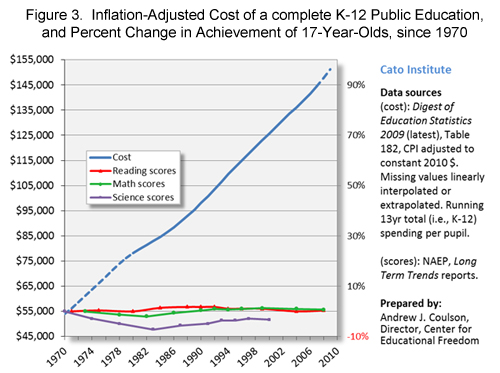
Democrats are obligated by teacher unions, (e.g. – the National Education Association and the American Federation of Teachers), to vote against parents who want their children to get a better education. That’s because teacher unions are some of the biggest Democrat donors. Teacher unions just want more salary and bigger benefits, despite the evidence that clearly shows that more education spending doesn’t produce better student achievement.

Education spending has tripled since 1970

Here’s a study from 2012 published in the journal “Education and Urban Society“. It says:

The possibility is examined that school choice programs could be a means to reducing the achievement gap. Data based on meta-analytic research and the examination of nationwide data sets suggest that school choice programs that include private schools could reduce the achievement gap by 25%. The propounding of this possibility is based on research indicating that the achievement gap in faith-based schools is generally 25% narrower than one finds in public schools. Results of these studies suggest that both the racial achievement gap and the socioeconomic achievement gap are reduced by the same degree (25%). The significance of these results is discussed, especially as it pertains to the attitudes that people frequently have toward school choice.

Not only do children do better in non-public schools, but the competition forces public schools to focus less on leftist indoctrination, and more on reading, writing and math.

This study from the on-partisan National Bureau of Economic Research (NBER) explains why.

It says:

A school that is more productive is one that produces higher achievement in its pupils for each dollar it spends. In this paper, I comprehensively review how school choice might affect productivity. I begin by describing the importance of school productivity, then explain the economic logic that suggests that choice will affect productivity, and finish by presenting much of the available evidence on school choice and school productivity. The most intriguing evidence comes from three important, recent choice reforms: vouchers in Milwaukee, charter schools in Michigan, and charter schools in Arizona. I show that public school students’ achievement rose significantly and rapidly in response to competition, under each of the three reforms. Public school spending was unaffected, so the productivity of public schools rose, dramatically in the case in Milwaukee.

School choice makes public schools perform better because competition between providers always lowers the cost and increases the quality of services and products being provided to the consumers. Consumers always suffer when there is a monopoly. This is why people are more satisfied purchasing goods from Amazon and Netflix than they are lining up at the post office or the department of motor vehicles. The free market serves the consumer.

I was raised in a poor background, and I am a visible minority. If Republicans want to get the votes of people in my community, it makes sense to put in place policies that allow people like me to get a good education so we can get good jobs and do better than our parents did. Republicans should be all about equipping people to be independent and self-sufficient. These are conservative goals.

Did Australia’s ban on guns lower violent crime rates and lower suicide rates?

Gun ownership up, gun violence down

Someone asked me about what I thought of Australia’s experience banning the use of handguns for self-defense against criminals, and so I thought I would link to an article from The Federalist, then explain what peer-reviewed studies say about the issue.

Let’s start with The Federalist.

It says:

The argument, as Vox’s headline puts it, is “Australia confiscated 650,000 guns. Murders and suicides plummeted.”

The piece, along with many gun control advocates, cites a Harvard University study whose conclusion begins with this line: “It does not appear that the Australian experience with gun buybacks is fully replicable in the United States.” Not a great start for Vox’s angle, but I digress.

The study doesn’t conclude that “murders and suicides plummeted” in Australia after the 1996 gun ban, as Vox claims in its headline. Instead, it focuses solely on firearm-related murders and suicides.

After the gun ban, violent crime rates were up:

Yes, as with the gun-happy United States, the murder rate is down in Australia. It’s dropped 31 percent from a rate of 1.6 per 100,000 people in 1994 to 1.1 per 100,000 in 2012.But it’s the only serious crime that saw a consistent decline post-ban.

In fact, according to the Australian government’s own statistics, a number of serious crimes peaked in the years after the ban. Manslaughter, sexual assault, kidnapping, armed robbery, and unarmed robbery all saw peaks in the years following the ban, and most remain near or above pre-ban rates. The effects of the 1996 ban on violent crime are, frankly, unimpressive at best.

It’s even less impressive when again compared to America’s decrease in violent crime over the same period. According to data from the U.S. Justice Department, violent crime fell nearly 72 percent between 1993 and 2011. Again, this happened as guns were being manufactured and purchased at an ever-increasing rate.

So although you have fewer firearm-related deaths when you disarm law-abiding civilians, violent crime increases, because there is now NO deterrence to criminals. Even a criminal with a knife can rob, rape and murder someone who is unarmed.

What about suicide rates?

Look:

The Australian gun ban’s effect on suicide in the country isn’t any better. While Vox repeats the Harvard study’s claim that firearm-related suicides are down 57 percent in the aftermath of the ban, Lifeline Australia reports that overall suicides are at a ten-year high. The Australian suicide prevention organization claims suicide is the leading cause of death for Australians 15 to 44 years old. So, while Australians kill themselves with firearms less often, it seems they don’t actually take their own lives any less often than before the ban.

So, overall suicides are not down, people simply found other ways to kill themselves. So the gun ban had no effect on the overall suicide rate. But it did raise the violent crime rate. Should we be surprised by this? Actually, this is consistent with peer-reviewed research.

Gun crime also skyrocketed after the 1996 gun ban. The Washington Free Beacon reports.

Excerpt:

Australia has seen a rise in gun crime over the past decade despite imposing an outright ban on many firearms in the late 1990s.

Charges for crimes involving firearms have increased dramatically across the island nation’s localities in the past decade according to an analysis of government statistics conducted by The New Daily. It found that gun crimes have spiked dramatically in the Australian states of Victoria, New South Wales, South Australia, and Tasmania. In Victoria, pistol-related offenses doubled over the last decade. In New South Wales, they tripled. The other states saw smaller but still significant increases.

Experts said that the country’s 1996 ban on most semi-automatic firearms has actually driven criminals to those guns. “The ban on semi-automatics created demand by criminals for other types of guns,” professor Philip Alpers of the University of Sydney told The New Daily. “The criminal’s gun of choice today is the semi-automatic pistol.”

[…]Regardless of the reasons for the jump in gun crime, the numbers reveal the true size of Australia’s illegal gun market. “Taken together, the data suggests that despite our tough anti-gun laws, thousands of weapons are either being stolen or entering the country illegally,” The New Daily said. “The fourfold rise in handgun-related charges in NSW in the past decade points to the existence of a big illegal market for concealable firearms that seems to have been underestimated in the past.”

If you take guns away from law-abiding people (which is what Australia did), then only criminals will have guns. And that means that the criminals will become bolder in the face of their disarmed victims.

The peer-reviewed research

Whenever I get into discussions about gun control, I always mention two academic books by John R. Lott and Joyce Lee Malcolm.

I think that peer-reviewed studies should be useful for assessing gun control vs gun rights policy. The book by economist John Lott, linked above,compares the crime rates of all U.S. states that have enacted concealed carry laws, and concludes that violent crime rates dropped after law-abiding citizens were allowed to carry legally-owned firearms. That’s the mirror image of Dr. Malcolm’s Harvard study, which shows that the 1997 UK gun ban caused violent crime rates to MORE THAN DOUBLE in the four years following the ban. But both studies affirm the same conclusion – more legal firearm ownership means less crime.

One of the common mistakes I see anti-gun advocates making is to use the metric of all “gun-related deaths”. First of all, this completely ignores the effects of hand gun ownership on violent crime, as we’ve seen. Take away the guns from law-abiding people and violent crime skyrockets. But using the “gun-related deaths” number is especially wrong, because it includes suicides committed with guns. This is the majority (about two thirds) of gun related deaths, even in a country like America that has a massive inner-city gun violence problem caused by the epidemic of single motherhood by choice. If you take out the gun-related SUICIDES, then the actual number of gun homicides has decreased as gun ownership has grown.

For a couple of useful graphs related to this point, check out this post over at the American Enterprise Institute.