
Tag Archives: Left

Moody’s downgrades credit rating of 26 Italian banks, Spain is next

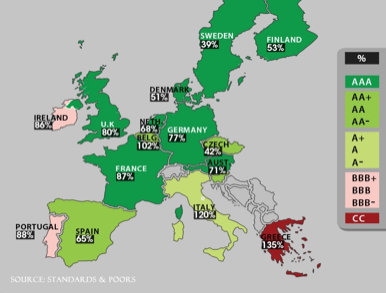
European Debt to GDP and Credit Rating

From Yahoo News.

Excerpt:

Moody’s Investors Service has downgraded the ratings on 26 Italian banks as they struggled with the effect of government austerity measures.

The rating agency said Monday that the banks are suffering because Italy is back in recession and government austerity measures are cutting demand for loans.

The banks are struggling with more loan losses, limited access to funding and weaker profits.

Moody’s noted that support of the European Central Bank lowered the default risk of many banks.

Its outlook for all 26 banks is negative.

From the Wall Street Journal.

Excerpt:

The ratings for Italian banks are now among the lowest within advanced European countries, reflecting these banks’ susceptibility to the adverse operating environments in Italy and Europe, Moody’s said in a statement. Two of the country’s largest institutions, UniCredit SpA (UCG.MI, UNCFF) and Intesa Sanpaolo SpA (ISP.MI, ISNPY), were included.

Moody’s move came hours after the firm raised an alarm on Spain, arguing the country’s banks remain vulnerable even after Madrid moved to increase the banks’ cushions against potential losses from real-estate loans.

[…]Italy, saddled with EUR1.9 trillion ($2.44 trillion) debt, has signed onto the EU’s fiscal compact that sets strict limits on the country’s deficit levels. In recent weeks, Mr. Monti has begun pressing Germany to give Italy more fiscal slack to stimulate its economy and create jobs. Mr. Monti has recently proposed that the EU create special exemptions to the budget rules when countries target their public spending on projects like broadband investments and infrastructure.

Moody’s downgrades come after the ratings firm in February placed various ratings of 114 financial institutions in 16 European countries on review for possible downgrade, highlighting the region’s banks’ vulnerability to the euro-zone sovereign debt crisis.

Moody’s is expected to follow the downgrade of Italian banks by cutting the ratings of Spanish banks. By the end of June, more than 100 European banks, as well as Wall Street giants like Bank of America Corp. (BAC) and Citigroup Inc. (C), are likely to have ratings that are at least one notch lower.

[…]Moody’s also alluded to J.P. Morgan Chase & Co.’s (JPM) recent disclosures of more than $2 billion in trading losses as a reminder of potential problems lurking at some European banks.

“Recent events highlight the risks for creditors from potential weaknesses in governance, controls and risk management, especially at some smaller, privately-held banks,” Moody’s said in its news release.

Moody’s says it will conclude its reviews by the end of June. In coming weeks, major U.S. financial institutions, Bank of America Corp., Citigroup Inc., Goldman Sachs and Morgan Stanley are likely to face downgrades.

Banks in Austria and Sweden are expected to see downgrades after Spain.

Italy’s debt is $2.44 trillion, ours is nearly $16 trillion.

Alberta judge rules that it is legal to disagree with homosexuality

Political map of Canada

Good news in Alberta.

Excerpt:

Alberta Court of Queen’s Bench Justice Paul Jeffrey has dismissed a Crown appeal of a decision from a lower court that acquitted Bill Whatcott of trespassing charges for distributing “Truth about homosexuality” pamphlets at the University of Calgary in 2008.

On Friday, March 30, Jeffrey upheld the November 2011 ruling by provincial court Judge John D. Bascom that stated the University of Calgary infringed on Whatcott’s Charter rights to freedom of expression when campus security arrested and detained him for distributing a pamphlet that addressed the “harmful consequences” of homosexuality.

The university had argued that the Charter only applied to “government actors and government actions,” not to the university itself since it was a private entity.

Bascom ruled, however, that the Canadian Charter of Rights and Freedoms applies to the University of Calgary since “the University is not a Charter free zone,” in that it carried out “specific” governmental work by providing post-secondary education to the public in Alberta, making its actions subject to scrutiny under the Charter.

“Mr. Whatcott entered the university property with a purpose to distribute his literature to students, staff and public,” said the judge, adding, “His activity was peaceful and presented no harm to the university structures or those who frequented the campus. … Although Mr. Whatcott’s pamphlet is not scholarly, freedom of speech is not limited to academic works.”

Bascom concluded that “the means used by campus security halted Mr. Whatcott’s distribution of these flyers and violated his right of free expression.”

The judge also lifted the University’s ban against Whatcott that would have indefinitely prohibited him from setting foot on the campus again, stating that the ban was “arbitrary and unfair.”

Do you all remember that the University of Calgary is one of the ones that harassed pro-lifers with armed policemen? That’s still better than Carleton University, which actually had pro-lifers arrested by armed policemen.

This Alberta ruling dovetails nicely with a 2010 ruling from the province of Saskatchewan:

In 2010 Whatcott won an appeal in Saskatchewan when Justice Darla Hunter of Saskatchewan’s Court of Appeal overturned a 2006 Saskatchewan Human Rights Tribunal ruling that found him guilty of violating the province’s human rights code by publicly criticizing homosexuality through a series of flyers he distributed in Saskatoon and Regina in 2001 and 2002.

The tribunal had ordered Whatcott to pay $17,500 and imposed a “lifetime” ban on his freedom to publicly criticize homosexuality.

In her decision Justice Hunter ruled that Whatcott did not violate section 14(1)(b) of the Saskatchewan Human Rights Code by distributing flyers to oppose the teaching of homosexuality in Saskatoon’s public schools.

“It is acceptable, in a democracy, for individuals to comment on the morality of another’s behaviour. … Anything that limits debate on the morality of behaviour is an intrusion on the right to freedom of expression,” Justice Hunter had remarked.

Alberta and Saskatchewan are the two most conservative provinces in Canada. Let’s hope that other provinces move in the same direction.

Low-income households spend 9% of their money on lotteries and gambling

J Warner Wallace of Please Convince Me tweeted this story from the Atlantic.

Excerpt:

The Mega Millions jackpot makes this the week to talk about lottery economics, so here’s a whopper: Households earning less than $13,000 a year spend a shocking 9% of their money on lottery tickets, Henry Blodget relays from a PBS report.* Are they clueless? Are they desperate? Are they economical? Maybe, probably, and possibly.

For the desperately poor, lotteries perform a role not unlike the obverse of insurance. Rather than pay a small sum of money in exchange for the guarantee of protection that you’ll need in the future, you pay a small sum of money in exchange for the small probability that you’ll win money to help your lot right away. It is, for lack of a better term, a kind of aspirational insurance.

So often, everyone acts as if low-income people are necessarily more virtuous than other for earn more, such that we should automatically redistribute wealth from frugal people to wasteful people. Instead of redistributing wealth, though, maybe we should be redistributing character and wisdom and restraint. Maybe the reason that the poor are poor is because although they have every advantage living in the prosperous west, that they just make poor decisions.

Black economist Walter Williams explains:

Avoiding long-term poverty is not rocket science. First, graduate from high school. Second, get married before you have children, and stay married. Third, work at any kind of job, even one that starts out paying the minimum wage. And, finally, avoid engaging in criminal behavior. If you graduate from high school today with a B or C average, in most places in our country there’s a low-cost or financially assisted post-high-school education program available to increase your skills.

Most jobs start with wages higher than the minimum wage, which is currently $5.15. A man and his wife, even earning the minimum wage, would earn $21,000 annually. According to the Bureau of Census, in 2003, the poverty threshold for one person was $9,393, for a two-person household it was $12,015, and for a family of four it was $18,810. Taking a minimum-wage job is no great shakes, but it produces an income higher than the Bureau of Census’ poverty threshold. Plus, having a job in the first place increases one’s prospects for a better job.

In fact, the number one cause of poverty is the decision by individual people not to marry before having children. That’s not caused by “corporate greed” or other bogeymen. It’s an uncoerced decisiojn that each person makes. If anyone is causing poverty, it’s the anti-marriage left which subsidizes and glamorizes single motherhood by choice and divorce.

Instead of making poverty more comfortable so that the poor can continue to make bad decisions, maybe we should be encouraging them to do the things that will life them out of poverty. Let’s pay the poor to finish school, get married, stay married, get a job, and wait before having children. And let’s support them by giving them school choice and other freedoms that allow them to escape the underperforming public schools. Fixing poverty doesn’t just mean handing people money – there are deeper issues.

What I also like about this story is that it was tweeted by a Christian apologist. Arguing about philosophy and science and history is good, but if we aren’t concerned about issues like abortion, marriage, poverty and freedom, then that’s not a good sign. Wallace should be commended for his concern for the poor.