
Tag Archives: Job

U.S. GDP growth slows to 1.5% in second quarter

Remember, Democrats took the House and Senate in 2007
Democrats took the House and Senate in January 2007

From CBS Marketwatch.

Excerpt:

The U.S. economy slowed sharply in the second quarter, growing just 1.5% as consumers slashed spending and businesses grew more cautious about hiring and investing, underscoring that an already wobbly recovery is losing even more steam.

In the U.S., though, new government figures showed that growth in gross domestic product, the broadest measure of goods and services churned out by the economy, slowed sharply from the first quarter’s 2% annual rate and the fourth quarter’s 4.1%.

That downward slope in growth is worrisome to economists. As the economy loses steam, a pullback can become self-reinforcing as businesses and consumers worry about the future.

The slowing economy, along with government data showing the recovery has been weaker than thought, raises the specter that a sudden shock—such as an escalation of Europe’s crisis, or next year’s looming tax increases and spending cuts—could shove the U.S. back into recession.

[…]One of the biggest obstacles to recovery is a dearth of consumer spending, which accounts for two-thirds of demand in the economy.

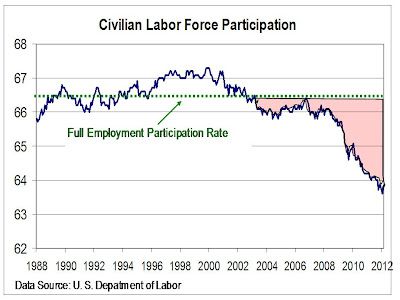
Spending rose 1.5% in the second quarter, lower than 2.4% in the first, reflecting weaker demand for cars and big-ticket items. A big reason is the stagnant labor market. Employers added fewer jobs in the second quarter than they have since the labor market began recovering in 2010.

“The economy is kind of being strangled,” said Bob Baur, chief global economist at Principal Global Investors. “We underestimated how much uncertainty may have contributed to a lack of desire to expand and hire.” Mr. Baur expects 2% to 2.5% growth in the second half of the year but has “grown more cautious,” he said.

[…]Businesses, meanwhile, appear to have grown more cautious about spending. The new GDP report showed that nonresidential fixed investment expanded 5.3% in the second quarter, less than the 7.5% in the first, though spending on equipment and software was healthy. Joseph Carson, an economist at Alliance Bernstein, said: “Uncertainty surrounding U.S. tax laws has created confusion and concern among companies, which has probably depressed investment spending.”

Remember, the Obama administration thinks that higher government dependency “stimulates” the economy:

House Minority Whip Steny Hoyer (D-Md.) said Tuesday that food stamps and unemployment insurance are the two “most stimulative” things you can do for the economy.

During a pen and pad briefing with reporters on Capitol Hill, Hoyer was asked if any Democrats are “reconsidering the wisdom” of letting the Bush tax cuts expire at year’s end for the top income earners given the still struggling U.S. economy.

“I haven’t talked to any who are of that mind,” said Hoyer. “If you talk to economists, they will tell you there are two things that are the most stimulative that you can do — one’s unemployment insurance, the other’s food stamps, okay?”

Of course, all that spending on unemployment and food stamps costs money, so they just borrowed that money from future generations of Americans – your children. The national debt is nearly $16 trillion, but they just keep borrowing. They don’t know what else to do, because they have no idea how jobs are created in the first place.

Republicans think that the best way to stimulate the economy is to create jobs by encouraging businesses to risk their capital in business ventures. But the Republicans aren’t in charge, so we are following the Democrat playbook. Many companies have responded to the Democrat plan to punish “the rich” by expanding their businesses in other countries that are less hostile to job creators. When you introduce burdensome regulations (EPA, Obamacare, Dodd-Frank, etc.) and high corporate taxes (35% – highest in the world!), that means that businesses can hire fewer people at home, and they are forced to expand elsewhere.

A look at homeschooling and alternatives to college

I do think that college can still be a good deal as long as you are careful to choose a major that will re-coup the costs of your education in a timely fashion. That will probably mean a STEM degree in something like computer science or petroleum engineering. I myself have the BS and MS in computer science, and I think that those are excellent choices for a man to deliver on his obligation to provide for a family. But it was a much better deal back when tuition was very low, and salaries were very high. Plus, public schools used to me much better at preparing you to go to school to learn STEM subjects. These new problems: underperforming public schools, college debt, and a weak job market, it makes sense to consider alternatives to the mainstream education system.

Here’s an article about homeschooling – an alternative to brick-and-mortar schools – that was posted in the Wall Street Journal.

Excerpt:

Today in the U.S., some two million children are home schooled, growing at an annual rate of 7% to 15% for over a decade, according to the president of the National Home Education Research Institute. The term “home schooler” once implied “isolationist religious zealot” or “off-the-grid anarchist who makes her own yogurt.” Today, it also means military parents who hate to see their kids keep changing schools; or the family with a future Olympian who ice skates five hours a day; or your cousin whose daughter is gifted but has a learning disability. The average home schooler is no longer a sideshow oddity.

“I could never ever teach math,” more than a few parents told me in horror at the very idea of home schooling. Or science. Or a foreign language. But mostly, it was math. Here’s my secret: I can’t teach math either. Once they start calling them integers instead of numbers, I recoil as from a fat, angry snake, which is why Alice takes an online math class, with great lashings of help from her father.

But the biggest thing people want to talk about is socialization. Everyone is worried that I keep my child in a crate with three air holes punched in it and won’t let her have friends until she gets her AARP card. There’s a long answer, of course, but I’ll sum it up this way: Homo sapiens have walked the Earth for at least 130,000 years and, in this time, they learned to be human from their elders, not from their peers. Mandatory education in the U.S. is less than 150 years old. Learning to be a productive adult human by spending a third of every day with other kids might be a good idea, but it’s too soon to tell. I’m still unsure that the people best equipped to teach a 14-year-old boy how to be a man are other 14-year-old boys.

In fact, home-schooled kids are just as socialized as other children. They certainly seem to grow up to be, and feel, fully engaged. One study, by a Canadian home-schooling group, found that 67% of formerly home-schooled adult respondents said they are “very happy,” as opposed to the general population’s 43%. Another study, published in the Journal of College Admission, found that home-schooled students perform better on their ACTs, have higher college GPAs and are more likely to graduate in four years.

So how far would you go with alternatives to mainstream education? Well, the smartest engineer I know doesn’t even have a college degree in computer science – or the student loans that often go with them.

Just look at these numbers: (links removed)

Across the nation, graduates are tossing their caps into the air and investing their hopes of success in their sheepskins. Not since the Magna Carta has so much faith been put into a piece of paper; indeed, belief in the college diploma seems these days to outpace belief in the document that binds a man and a woman. For the past couple of generations, conventional wisdom has said that a college degree is the golden ticket to a great job. For a time, because of the simple laws of supply and demand, this was true.

In 1947, when just 5 percent of Americans age 25 and over held at least a bachelor’s degree, the supply was low, making demand for degreed employees higher. However, with easier access to college through taxpayer-funded student loans, today’s bachelor’s degree has become yesterday’s high-school diploma. Now that over 30 percent of Americans 25 and over have a college degree—and the President has called for that figure to grow to 60 percent—the supply is up, which might help explain why 53 percent of recent graduates are unemployed or underemployed.

What’s more, the burgeoning cost of college means that even for those who do land good jobs after graduation, payoff on their investment will be diminished and take more time. The graduation rates tripled between 1980 and 2010, rising 37 percent between 1999 and 2010. Two-thirds of bachelor’s degree recipients graduated with debt in 2008, compared with less than half in 1993. The average debt for last year’s college was $24,000, while the total outstanding national student debt has passed $1 trillion, more than the nation’s credit card debt. Not surprisingly then, the national student loan default rate is on the rise, too, hitting 8.8 percent for the 2009 budget year. Even the number of Ph.D. holders on public assistance has made recent headlines.

College still works for people, but you have to choose your major more carefully – or just choose to focus on practical skills and then attend a trade school. It’s probably a good idea to put more emphasis on getting work experience at an early age, no matter what you do after high school. Work experience is very important for getting a job, which is why the liberal fixation on higher minimum wage rates hurts younger workers. Sometimes, online degree options can be more cost effective than regular school, but again work has to be done to see where the jobs are and what skills are required before you make a decision.

People sometimes ask me whether this is it for civilization, and I point to new discoveries and feedback mechanisms like these alternatives to government-run or government-regulated schools as an example of how we can get things turned around. What taxpaying parents need to realize is that they have to start thinking practically about laws and policies that promote freedom in education. We have to vote for more choice and competition, and lower taxes, so that we can buy what we want instead of letting an ideologue who has spent his or her entire life in a bubble decide for us.

Democrat Steny Hoyer: unemployment checks and food stamps stimulate the economy

Why are we in a recession? Maybe it’s because the people running the country believe that unemployment checks and welfare are better than earned paychecks for “stimulating” the economy.

Here’s CNS News to explain what Democrats are trying to achieve:

House Minority Whip Steny Hoyer (D-Md.) said Tuesday that food stamps and unemployment insurance are the two “most stimulative” things you can do for the economy.

During a pen and pad briefing with reporters on Capitol Hill, Hoyer was asked if any Democrats are “reconsidering the wisdom” of letting the Bush tax cuts expire at year’s end for the top income earners given the still struggling U.S. economy.

“I haven’t talked to any who are of that mind,” said Hoyer. “If you talk to economists, they will tell you there are two things that are the most stimulative that you can do — one’s unemployment insurance, the other’s food stamps, okay?”

“Why is that?” he said.  “Because those folks who receive those resources must spend them. And they’ll spend them almost upon receipt. Most economists with whom I talk believe that those with significant discretionary income, that that’s not the case.”

Unless action is taken by Congress, the Bush tax cuts will expire on Jan. 1, 2013.  Originally enacted in 2001 and 2003, President Barack Obama and Congress renewed the cuts for all income-brackets for two years in 2010.

[…]The Congressional Budget Office (CBO has projected that if the Bush tax cuts are allowed to expire at the end of 2012, coupled with the defense cut sequester, it will lead to a 1.3 percent contraction in GDP after Jan. 1, 2013.

If the Bush tax cuts are allowed to expire, it is expected that 710,000 people will lose their jobs. This will achieve the Democrats goal of “stimulating the economy” with higher unemployment and more food stamps. This continues the Democrat plan of increasing the record number of people on welfare and food stamps. They will pay for this “stimulus” by adding more debt to the $8 trillion they have already run up since January 2007. The debt will be paid by young people and children. The real plan behind making millions of people dependent on government is, of course, to be able to buy their votes and to control them. Democrats are the anti-freedom party. You have too much freedom when you have a job. It leads to “inequality”. If everyone received their daily bread from the government, and rode on mass transit to labor camps instead of driving in cars, and slept in identical apartments with identical furniture and identical television programs to watch, then the world would be more equal. And equality is what Democrats want most.

So what is the Republican alternative plan for the economy? To let job creating businesses keep their own money and hire people to do work. Republicans want to stop taxing and regulating job creating businesses so that people can be put back to work, and have the confidence to spend money. That’s how you stimulate the economy – we know this because it has worked for Reagan and Bush before. Obama’s approach has never worked. The Democrats have been running the show since January 2007. And that’s why we are down 5 million jobs since Steny Hoyer became the House Whip in January of 2007. This is not going to end until the Democrats are voted out.