Tag Archives: Information

Does intelligent design theory require that the designs be perfect?

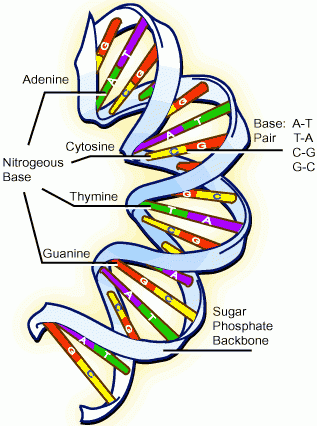
Structure of DNA
Structure of DNA

From Evolution News.

Excerpt:

By the word “intelligent,” ID proponents simply mean to indicate that a structure has features requiring a mind capable of forethought to design the blueprint. Thus, ID proponents test ID by looking for complex and specified information, which is an indicator that some goal-directed process, capable of acting with will, forethought, and intentionality, was involved in designing an object.

We do not test ID by looking for “perfect design” or “undesirable design,” because minds don’t always make things that are “perfect,” and sometimes they make things that are “undesirable” (to other minds, at least). Holding biological systems to some vague standard of “perfect design” where they are refuted by “undesirable design” is the wrong way to test ID. Examples like broken machinery, computer failures, and decaying buildings all show that a structure might be designed by an intelligent agent even if it subsequently breaks or shows flaws. Intelligent design does not necessarily mean “perfect design.” It doesn’t even require optimal design. Rather, “intelligent design” means exactly what it sounds like: design by an intelligent agent.

“Undesirable design” arguments share three general problems, some or all of which can be found in each of Gilmour’s 130 examples. Here are the three main problems:

  1. An object can have imperfections and be undesirable, but still be designed.
  2. Critics’ standards of perfection are often arbitrary.
  3. “Bad design” arguments don’t hold up under their own terms, as the objects often turn out to be well designed when we inspect them more closely.

Problem (1) applies to every single example Gilmour gives. Problems (2) and (3) apply to many, though not all, of his examples. In fact, some of them are legitimate examples of undesirable design. I mean, who likes “easily worn out knees” or hernias — both examples of how our bodies break down? Objectively speaking, those are flaws or imperfections. But as much as you might not like “undesirable design,” they don’t refute ID because ID is a scientific argument that isn’t concerned with the moral value, perfection, or desirable/undesirable quality of a structure. Computers break down but were still intelligently designed. In the same way, the fact that our bodies break down doesn’t mean they weren’t intelligently designed.

If you would like  quick introduction to intelligent design, click here. The best introductory book on the subject is “The Politically Incorrect Guide to Darwinism and Intelligent Design” by Dr. Jonathan Wells, and the best complex book is “Signature in the Cell: DNA and the Evidence for Intelligent Design” by Dr. Stephen C. Meyer.

Related posts

List of peer-reviewed papers supporting intelligent design now up to 50

Ann Gauger working away in her lab
Molecular biologist Ann Gauger working in her lab

From Evolution News.

Excerpt: (links removed)

While intelligent design research is a new scientific field, recent years have been a period of encouraging growth, producing a strong record of peer-reviewed scientific publications. New publications continue to appear, now listed at our updated page.

The current boom goes back to 2004, when Discovery Institute senior fellow Stephen Meyer published a groundbreaking paper advocating ID in the journal Proceedings of the Biological Society of Washington. There are multiple hubs of ID-related research.

Biologic Institute, led by molecular biologists Doug Axe and Ann Gauger, is “developing and testing the scientific case for intelligent design in biology.” Biologic conducts laboratory and theoretical research on the origin and role of information in biology, the fine-tuning of the universe for life, and methods of detecting design in nature. That’s Dr. Gauger at the Biologic lab pictured above.

Another ID research group is the Evolutionary Informatics Lab, founded by senior Discovery Institute fellow William Dembski along with Robert Marks, Distinguished Professor of Electrical and Computer Engineering at Baylor University. Their lab has attracted graduate-student researchers and published multiple peer-reviewed articles in technical science and engineering journals showing that computer programming “points to the need for an ultimate information source qua intelligent designer.”

Other pro-ID scientists around the world are publishing peer-reviewed pro-ID scientific papers. These include biologist Ralph Seelke at the University of Wisconsin Superior, Wolf-Ekkehard Lönnig who recently retired from the Max Planck Institute for Plant Breeding Research in Germany, and Lehigh University biochemist Michael Behe.

Researchers have published their work in a variety of relevant technical venues, including peer-reviewed scientific journals, peer-reviewed scientific books from mainstream university presses, trade-press books, peer-edited scientific anthologies, peer-edited scientific conference proceedings and peer-reviewed philosophy of science journals and books.

These papers have appeared in scientific journals such as Protein ScienceJournal of Molecular BiologyTheoretical Biology and Medical ModellingJournal of Advanced Computational Intelligence and Intelligent InformaticsQuarterly Review of BiologyCell Biology InternationalRivista di Biologia/Biology ForumPhysics of Life ReviewsAnnual Review of Genetics, and many others. At the same time, pro-ID scientists have presented their research at conferences worldwide in fields such as genetics, biochemistry, engineering, and computer science.

This body of research is converging on a consensus: complex biological features cannot arise by unguided Darwinian mechanisms, but require an intelligent cause.

My favorite area of ID research is the area of protein formation. I like to read about the research done by Doug Axe and Ann Gauger in that area. Research performed by Doug Axe at Cambridge University, and published in the peer-reviewed Journal of Molecular Biology, has shown that the number of functional amino acid sequences (ones that can form functioning proteins) is tiny:

Doug Axe’s research likewise studies genes that it turns out show great evidence of design. Axe studied the sensitivities of protein function to mutations. In these “mutational sensitivity” tests, Dr. Axe mutated certain amino acids in various proteins, or studied the differences between similar proteins, to see how mutations or changes affected their ability to function properly. He found that protein function was highly sensitive to mutation, and that proteins are not very tolerant to changes in their amino acid sequences. In other words, when you mutate, tweak, or change these proteins slightly, they stopped working. In one of his papers, he thus concludes that “functional folds require highly extraordinary sequences,” and that functional protein folds “may be as low as 1 in 10^77.”

The problem of forming DNA by sequencing nucleotides faces similar difficulties. And remember, mutation and selection cannot explain the origin of the first sequence, because mutation and selection require replication, which does not exist until that first living cell is already in place. I think that this very valuable research, indeed.

You can read more about the problem of protein synthesis in this previous post.

Bad news for believers in naturalistic explanations of the Cambrian explosion

Before we see the new discovery, let’s review what the Cambrian explosion is all about.

Video 1:

Video 2:

Casey Luskin explains the new discovery at Evolution News.

Excerpt:

A recent article in Science begins by observing that the lack of evolutionary ancestors for the animal phyla that appear abruptly in the Cambrian explosion has been troubling to many evolutionary scientists:

Ever since Darwin there has been a disturbing void, both paleontological and psychological, at the base of the Phanerozoic eon. If his theory of gradualistic evolution be true, then surely the pre-Phanerozoic oceans must have swarmed with living animals — despite their conspicuous absence from the early fossil record.

(N. J. Butterfield, “Terminal Developments in Ediacaran Embryology,” Science, Vol. 334:1655-1656 (December 23, 2011).)

The articles goes on to explain that in 1998, tiny fossil animal embryos were reported that offered “palpable relief” to those evolutionary scientists worried about the lack of Precambrian ancestors.

However, new analyses of these microfossils now strongly suggest that they were not multicellular animals, and thus could not be Precambrian multicellular metazoa that have long been the holy grail for evolutionary paleontologists. Rather, they likely represent single-celled amoeba-like organisms.

[…]A Science Daily article on the study explains that many Darwinian scientists will be dismayed by the results of this study:

Professor Philip Donoghue said: “We were very surprised by our results — we’ve been convinced for so long that these fossils represented the embryos of the earliest animals — much of what has been written about the fossils for the last ten years is flat wrong. Our colleagues are not going to like the result.”

How did the investigators determine the nature of these ancient organisms? The fossils were exceptionally well preserved, such that, as the lead author on the paper stated, “the fossils are so amazing that even their nuclei have been preserved.” These allowed the authors to determine that these were in fact eukaryotic organisms, but not multicellular animals.

Casey goes on to answer the response by naturalists that “the fossil record is incomplete”.

I think it’s important, when deciding whether naturalistic evolution happened, to be aware of these problem areas. So often when discussing Darwinian evolution, people like journalists and philosophers and economists, etc. will just accept the theory because they trust in what experts tell them. There can be a lot of pressure in the university to not be seen as a dumb person, so that people will just go along with whatever their professor tells them to believe. And, that’s not necessarily a bad policy when time is short. However, that is taking evolution on blind faith. It’s a good thing, as we get older, to go back and revisit these things to see if they are really true.

For example, a really educated Darwinian should be able to finish a sentence like this: “People who doubt fully naturalistic evolution do so because of the following pieces of scientific evidence…” If you meet someone who cannot finish this statement, but who still espouses Darwinian evolution, then you know that you are dealing with someone who has jumped to the answer without really working through the problem by themselves. It can be very tempting, especially for artsy types, to just try to jump to the answer that all the smart people believe without really working through the problem. But that’s not a good way to decide what’s true. Everyone has to work through these problems themselves, and listening to the best people on both sides is the way to do that. People who question evolution nowadays don’t question that the universe is billions of years old or that scientific methods have to be used to answer scientific questions. By all means, let’s decide how we got here by appealing to science.

If you would like to see a nice hour-long video on the Cambrian explosion, then click here.

By the way, if you missed my previous post on the new discovery of oxygen in the early Earth’s environment, and the challenge it represents to naturalistic scenarios for the origin of life, then do check that out.