Tag Archives: Happiness

British woman has sex with strangers in order to get fatherless child

Story here in the UK Sun. (H/T The Other McCain)

Excerpt:

LARA CARTER has slept with 20 strangers in the past year – in a desperate and reckless bid to get pregnant.

[…]Lara, an assistant office manager, says: “This is absolutely the right time for me to have a baby and nothing is going to stand in my way.

All my friends have babies and I desperately want to be a mum.

“I don’t have a steady boyfriend and feel my time to have a baby is running out. I only need a man to provide his sperm – I would have no interest in seeing him again. That is why I’m a sperm hunter.”

Her obsession with getting pregnant started a year ago, when she attended the birth of a friend’s baby.

She says: “The moment I saw my friend hold her newborn child, I had a huge desire to feel that love too.

[…]She says: “First, I check if I’m ovulating… I meet some friends at a bar and instantly start looking for potential sperm donors.

“When I find a potential sperm donor, I get their first name and ask if they have any STDs. If they haven’t and we end up spending the night together, I’ll sneak out in the morning.

“When I don’t want to spend the whole night with a man, I’ll get the deed over and done with before I go home. I’ve had sex in some unusual places, including a car and even nightclub toilets.

“Obviously, I encourage them to have unprotected sex, but some men want to use a condom.

“If they do, I always have one that I have pre-pricked in my handbag. That way the sex isn’t a waste of time.”

[…]Most people are very honest when asked if they have an STD. I trust my instincts.”

Lara has already spent hundreds of pounds on baby clothes.

She says: “Whenever I see a lovely baby outfit, I have to buy it for my future child.

“I’ve also chosen the names my children will have. They will be Tilly and James or Matthew. I also take pregnancy vitamins, even though they are expensive.

Lara admits her yearning for a baby is made worse by her circle of 20 close female friends – 17 of them have had children.

She says: “I look at my friends with envy and know I would make such a good mum. They know about my quest to be a mother and support what I’m doing.

“However, I haven’t told my family, and am worried about their reaction. I’m happy to be a single mother and I wouldn’t want anything to do with the father.

“My parents are still together, so I didn’t grow up in a single-parent family, but plenty of people do it these days. I have plenty of savings to give a baby a loving, well-rounded home and lots of friends close by who can babysit. I have it all planned out.”

She adds: “When I do get pregnant after a one-night stand, I won’t contact the father… I want a baby, not a man.

The UK has generous welfare benefits for single mothers.

Excerpt:

Single mother Tracey Turner, 26… currently receives £136.50 a week in benefits, which includes £42.50 income support and £94 child tax credit.

On top of this, her local council pays all of her £161-a-week rent and gives her a hefty discount on local rates.

A British pound is worth about $1.60 USD. 300 pounds a week x 52 weeks = 15500 pounds = about $25000 USD per year in benefits, not including the “hefty discount on local rates”. Local rates = local tax rates.

I think what is the most interesting is analyzing the parts of the first article that I have bolded. It tells a story about what is causing this woman to act this way, and what she thinks about herself, her relationships with others, and about the purpose of her life. Keep in mind that this is not unusual – the out-of-wedlock birth rate in the United States is 40%.
Greg Koukl comments on the decline of shame and personal responsibility

Here is the commentary on the Stand to Reason web site.

Read the whole thing, and take note of this part:

But there’s one necessary requirement for someone ever to feel ashamed for his behavior, and the resistance to shame is really a resistance to this necessary requirement. This requirement is: he must feel responsible for the behavior. If you were forced to do something or it was an accident, there is no reason to feel ashamed. It is when you choose to do something that is patently immoral, and you reflect on it, there is a sense of shame associated with that because you chose to do it. But this is currently one of the deep, deep flaws in the American moral character–the loss of a sense of personal responsibility.

One of the reasons for the plethora of legal cases now is because everybody is saying it’s somebody else’s fault. I trimmed my hedges with a Sears lawnmower. I fell and it cut me. That’s not my fault for doing something stupid. It is Sears fault for not telling me that I shouldn’t have used their lawnmower to trim the hedges with. By the way, that’s a real story and the person collected for that. There are abundant examples of those kinds of crazy things because more and more people are saying that they are not the ones who are really responsible. Everybody is a victim, and if you are not responsible then there is no reason to feel shame about what you are not responsible for. Ergo, no shame and no guilt. The two go hand in hand.

I think it would be great if one phrase was restored to the language of our moral discourse. It would be great if we would have the moral fortitude to say with conviction, Shame on you. You ought to be ashamed of yourself. It feels kind of awkward even to say that. It sounds so rude. Of course, this cuts across the grain of the cult of self-love and self-esteem, which exists not only in our culture but even in the church.

[…]Nowadays we go way out of our way not to act as if there is anything even marginally questionable about any of those things. It’s as if we’re desperately trying to make people who do bad things feel good, or at least feel neutral when they should be feeling very bad about what they’ve done.

It’s as if people have the idea that if we can get rid of shame, we can get rid of the moral offense that is at its root. To say that you ought to be ashamed is like saying that you ought to feel something about your genuine guilt.

The idea seems to be that if we can change our feeling about guilt–I’m speaking here of true moral guilt, not the emotion of guilt, which I would consider much like shame itself–then the guilt itself will disappear. It’s like saying that if we can get rid of the symptoms that sickness causes, then we can get rid of sickness, too. If we can take away the pain that causes the sickness, the sickness is gone. It doesn’t work that way.

If a sinner harms another person, they need to not gloss over the sin and just try to be friends with the victim again, without any real effort to treat the sin as a serious failure. The sinner needs to claim responsibility, to understand how the victim felt, to make it up to them with some actions, and to take steps to change their character so that the mistake won’t happen again.

Without growth, the same selfish mistakes are made over and over again. And saying “I’m sorry – are we friends now? are we friends now?” doesn’t fix the problem with the victim of the sin, and it doesn’t prepare  sinner for real relationships with real self-sacrifice and real moral obligations. It’s OK to make a mistake, but you don’t learn from it unless you listen to the other person and then come up with things to do to change who you are and how you treat them. Creating sympathy through deliberately selected experiences can change how you feel. For example, I’m very selfish and arrogant, so I should probably do more volunteer work and spend more time helping other people with ordinary stuff. Reading about issues to create empathy and understanding is also good.

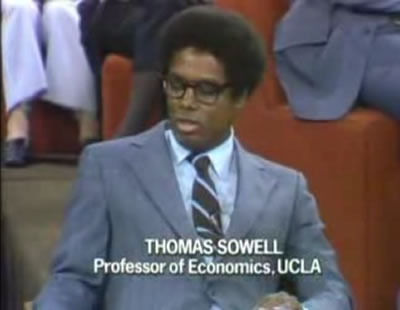
Thomas Sowell explains the concept of “moral hazard”

Young Thomas Sowell

From Real Clear Politics. (H/T Jojo)

Excerpt:

One of the things that makes it tough to figure out how much has to be charged for insurance is that people behave differently when they are insured from the way they behave when they are not insured.

In other words, if one person out of 10,000 has his car set on fire, and it costs an average of $10,000 to restore the car to its previous condition, then it might seem as if charging one dollar to all 10,000 people would be enough to cover the cost of paying $10,000 to the one person whose car that will need to be repaired. But the joker in this deal is that people whose cars are insured may not be as cautious as other people are about what kinds of neighborhoods they park their car in.

[…]Although “moral hazard” is an insurance term, it applies to other government policies besides insurance. International studies show that people in countries with more generous and long-lasting unemployment compensation spend less time looking for jobs. In the United States, where unemployment compensation is less generous than in Western Europe, unemployed Americans spend more hours looking for work than do unemployed Europeans in countries with more generous unemployment compensation.

People change their behavior in other ways when the government pays with the taxpayers’ money. After welfare became more readily available in the 1960s, unwed motherhood skyrocketed. The country is still paying the price for that– of which the money is the least of it. Children raised by single mothers on welfare have far higher rates of crime, welfare and other social pathology.

San Francisco has been one of the most generous cities in the country when it comes to subsidizing the homeless. Should we be surprised that homelessness is a big problem in San Francisco?

[…]We also hear a lot of talk about “the uninsured,” for whose benefit we are to drastically change the whole medical-care system. But income data show that many of those uninsured people have incomes from which they could easily afford insurance. But they can live it up instead, because the government has mandated that hospital emergency rooms treat everyone.

And here’s another Tom Sowell column making a related point.

Excerpt:

Much has been made of the fact that families making less than $250,000 a year will not see their taxes raised. Of course they won’t see it, because what they see could affect how they vote.

But when huge tax increases are put on electric utility companies, the public will see their electricity bills go up. When huge taxes are put on other businesses as well, they will see the prices of the things those businesses sell go up.

If you are not in that “rich” category, you will not see your own taxes go up. But you will be paying someone else’s higher taxes, unless of course you can do without electricity and other products of heavily taxed businesses. If you don’t see this, so much the better for the Obama administration politically.

This country has been changed in a more profound way by corrupting its fundamental values. The Obama administration has begun bribing people with the promise of getting their medical care and other benefits paid for by other people, so long as those other people can be called “the rich.” Incidentally, most of those who are called “the rich” are nowhere close to being rich.

[…]There was a time when most Americans would have resented the suggestion that they wanted someone else to pay their bills. But now, envy and resentment have been cultivated to the point where even people who contribute nothing to society feel that they have a right to a “fair share” of what others have produced.

The most dangerous corruption is a corruption of a nation’s soul. That is what this administration is doing.

Republicans prefer private voluntary charity as the best way to provide a safety net. Just because people on the left give less to charity than people on the right, it doesn’t mean that no one one gives to charity. Europe has the highest taxes, and they give the least in charity. Why not LOWER taxes for people who want to give MORE in charity? When government hands out money, it encourages people to be more dependent. But when a person in trouble has to go to a neighbor or a charity in their own community, it sends the right message – “this should be temporary – don’t let this become a habit”. It’s not GOOD for someone to depend on the government. People need to work in order to be happy.

Having the government take over the role of provider in the home is an insult to men. It’s not government’s job to replace men. They ought to stay right out of it. Leave money in the pockets of the working man so he can save for a rainy day himself. If you subsidize a behavior, you get more of it. If you tax a behavior, you get less of it. It makes no sense to subsidize irresponsible lifestyle choices and tax productive and moral lifestyle choices. You don’t want to make the rescue from bad decisions an anonymous and automatic affair. You want people to worry, so that they won’t want to make risky and irresponsible choices. Everybody goes through though times, but we shouldn’t make it normal. People ought to know that it’s not normal.

You may want to read about how government dependence makes people less happy than having a job. Don’t make people depend on government by taxing businesses and investment. We need more companies hiring – not less. And that means letting the profit motive provide an incentive for entrepreneurs to engage in more risk-taking and enterprise.