Tag Archives: Gay Marriage

Wayne Grudem defends what the Bible says about same-sex marriage

The thing I love about Wayne Grudem is that every time I read his view on some issue, I find that he does two things well. First, he does a lot of research to know what the Bible says, and I always learn something new about the Bible from his analysis. Second, he confirms and applies what the Bible says using real world evidence, especially statistics. It seems to me that the role of the pastor/theologian, which almost no pastors and theologians do well, is to link what the Bible says to the way the world really is. Pastor/theologians should be concerned with explaining what the Bible and then taking the next step to persuade people to act on what the Bible says by engaging their intellects with arguments and evidence.

Here’s how Wayne Grudem does exactly that in this San Francisco Examiner interview about same-sex marriage.

Question to Dr. Grudem:

…is the subject and practice of Gay Marriage and Same Sex Blessings no longer a controversy and of public and Christian debate and discussion? Is it a done-deal in our society given the success of the “Gay Agenda” in the Military, American Foreign Service, California Courts, Massachusetts, other States in America and even in the present Presidential and Federal Administration’s practice of no longer supporting the federal law known as the Defense of Marriage Act?

Part of his answer:

The main thing I want to emphasize in this discussion is this: The primary question in this controversy is what kind of intimate, cohabiting, potentially child bearning relationship does society want to encourage and reward and protect? Up to this point, American society has decided to encourage and promote marriage as a relationship between one man and one woman, because it gives immeasurable benefits to a society that no other relationship can provide. This relationship is better for raising children, better for protection against domestic violence and abandonment, better for encouraging lifelong companionship and care, better for encouraging sexual faithfulness, and better in many other ways, that I explain in my book Politics—According to the Bible.

But homosexual relationships do not give these benefits. Male homosexuals experience a 25 to 30 year decrease in life expectancy, and much higher incidence of many chronic diseases.

Sexual faithfulness is far different among married heterosexuals: 90 percent of heterosexual women, and over 75 percent of heterosexual men have never engaged in extramarital sex. But among male homosexuals the rate of sexual faithfulness is around 2 percent, even when “faithfulness” is generously defined as ten or fewer lifetime partners. Such statistics are seldom reported in the mainstream media. The question is, is this the kind of relationship we as a society want to encourage, reward, and promote by giving it the status of “marriage” and all the societal encouragement and endorsement that that status carries?

I don’t think any society today should criminalize homosexual conduct (as some legislators in Uganda are now attempting to do), any more than I think society should criminalize adultery or fornication, because these are private acts between individuals that government should not intrude into. But I also don’t think society should encourage and promote such relationships by calling them “marriage” and giving them all the benefits that go with marriage. And so the issue is not whether homosexual couples can get married, but rather, do we as a society wish to redefine marriage in its entirety so that it is no longer a relationship between one man and one woman? The homosexual agenda is attempting to redefine what marriage is, and I think that would be a terrible mistake for our society.

Wow. I’ll bet you that nobody was expecting the conservative evangelical to bring the evidence on a moral issue. But that’s just what Grudem did.

You may recognize many of the points Grudem makes from the research-laden posts that I have written before about same-sex relationships. He is basically saying 1) let’s look at what the Bible says, and then 2) let’s try to see the evidence that proves or disproves what the Bible says. Basically, if you believe the Bible is true, then you should be able to look out at the world and see that… the Bible’s true! And in order to convince Christians and non-Christians to accept the correct position on controversial issues, then you need to approach the issues like Wayne Grudem approaches them. (See the related posts for a few more examples of Grudem in action)

When Wayne Grudem uses evidence, it makes it a lot easier for people who listen to him to do what the Bible says, because he gives them reasons and evidence that they can accept even if they don’t accept the Bible. It’s like if I told you how an automobile works by explaining the internal mechanisms that make the car go, with experiments and statistics to prove each point. After you listened to me explain, then you would understand that gas goes in the gas tank and not in the radiator. “I sincerely believe” is not a reason to believe that I know what I am talking about. I have to show you evidence. My investment advisor may have sincere beliefs about my teeth, but I’m not letting him poke drills into my mouth. We need to be careful that our own natural tendency to be lazy doesn’t cause us to miss the method of persuasion that is taught in the Bible: reason and evidence.

But back to the same-sex marriage issue… If one of the public purposes of marriage is to give children a stable, lasting environment to grow up in, in which they can be nurtured by two parents who have biological inventives to nurture them, then it is clear that same-sex marriage cannot do this as well as traditional marriage, in most cases. The environment of a same-sex relationships is just not the same – and the differences undermine the stability that children need. Obviously, there is more we could do legislatively to help children, such as giving tax breaks for stay-at-home parents, by offering school choice, by cutting income taxes, by making no-fault divorce illegal, and so on. And when we talk about the issue, we need to put the needs of children front and center. This is the reason why marriage exists in the first place. If we focus on the needs of adults who want their “rights”, then we lose. We need to focus on the rights of children – the right of a child to have a mother and a father, in the home with them, nurturing and guiding them to maturity.

Wayne Grudem knows how to make his case

More posts about same-sex marriage

Jennifer Roback Morse lectures on marriage at Stanford University

Dr. Jennifer Roback Morse

Stanford University is one of the top 5 universities in the United States.

Details:

Dr J gave this talk at Stanford University’s Anscombe Society on the reasons for marriage, and the ways in which it shapes society and the next generation. After Dr J’s talk at Stanford University, she took questions and answers from the students in attendance.  They had quite the lively discussion…  Please be advised–some of these questions may be overly explicit for very young listeners.

The files:

Here’s her biography:

Jennifer Roback Morse, Ph.D. is the founder and President of the Ruth Institute, president of the Ruth Institute a project of the National Organization for Marriage to promote life-long married love to college students by creating an intellectual and social climate favorable to marriage.

She is also the Senior Research Fellow in Economics at the Acton Institute for the Study of Religion and Liberty.

She is the author of Smart Sex: Finding Life-long Love in a Hook-up World, (2005) and Love and Economics: Why the Laissez-Faire Family Doesn’t Work (2001), recently reissued in paperback, as Love and Economics: It Takes a Family to Raise a Village.

Dr. Morse served as a Research Fellow for Stanford University’s Hoover Institution from 1997-2005. She received her Ph.D. in economics from the University of Rochester in 1980 and spent a postdoctoral year at the University of Chicago during 1979-80. She taught economics at Yale University and George Mason University for 15 years. She was John M. Olin visiting scholar at the Cornell Law School in fall 1993. She is a regular contributor to the National Review Online, National Catholic Register, Town Hall, MercatorNet and To the Source.

Dr. Morse’s scholarly articles have appeared in the Journal of Political Economy, Economic Inquiry, the Journal of Economic History, Publius: the Journal of Federalism, the University of Chicago Law Review, and the Harvard Journal of Law and Public Policy, Social Philosophy and Policy, The Independent Review, and The Notre Dame Journal of Law Ethics and Public Policy.

[…]Her public policy articles have appeared in Forbes, Policy Review,The American Enterprise, Fortune, Reason, the Wall Street Journal, Vital Speeches, and Religion and Liberty.

She currently lives in San Diego, CA. She and her husband are the parents of a birth child, an adopted child. From March 2003 to August 2006, Dr. Morse and her husband were foster parents for San Diego County. During that time, they cared for a total of eight foster children.

Her talent is to apply the economic way of thinking to social issues like marriage, family and parenting.

NDP leader Jack Layton wants consumers to pay higher prices for lower quality goods

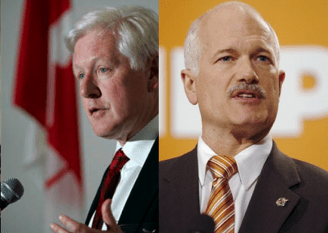
NDP leaders Bob Rae and Jack Layton

Jack Layton is opposed to free trade with other nations, and Jack Layton supports the imposition of tariffs on imported goods. Stephen Harper favors free trade and opposes tariffs, and has pushed through numerous free trade deals during his terms in office. So now we have to ask the questions: is free trade good for Canada? Is free trade good for Canadian consumers? Is free trade good for Canadian companies? Is free trade good for the poor in other countries?

Let’s start by noting that free trade is supported by virtually ALL economists, regardless of their political persuasion. Moderate economist Gregory Mankiw of Harvard University lists the policies that are accepted by virtually all economists.

Here’s Greg’s list, together with the percentage of economists who agree:

  1. A ceiling on rents reduces the quantity and quality of housing available. (93%)
  2. Tariffs and import quotas usually reduce general economic welfare. (93%)
  3. Flexible and floating exchange rates offer an effective international monetary arrangement. (90%)
  4. Fiscal policy (e.g., tax cut and/or government expenditure increase) has a significant stimulative impact on a less than fully employed economy. (90%)
  5. The United States should not restrict employers from outsourcing work to foreign countries. (90%)
  6. The United States should eliminate agricultural subsidies. (85%)
  7. Local and state governments should eliminate subsidies to professional sports franchises. (85%)
  8. If the federal budget is to be balanced, it should be done over the business cycle rather than yearly. (85%)
  9. The gap between Social Security funds and expenditures will become unsustainably large within the next fifty years if current policies remain unchanged. (85%)
  10. Cash payments increase the welfare of recipients to a greater degree than do transfers-in-kind of equal cash value. (84%)
  11. A large federal budget deficit has an adverse effect on the economy. (83%)
  12. A minimum wage increases unemployment among young and unskilled workers. (79%)
  13. The government should restructure the welfare system along the lines of a “negative income tax.” (79%)
  14. Effluent taxes and marketable pollution permits represent a better approach to pollution control than imposition of pollution ceilings. (78%)

Now let’s drill down to the research on free trade in particular.

Here’s an article from the  libertarian Cato Institute, a respected think tank.

Excerpt:

There are three important reasons voluntary exchange is good not only for the contracting parties but the world as a whole:

(1) Trade improves global efficiency in resource allocation. A glass of water may be of little value to someone living near the river but is priceless to a person crossing the Sahara. Trade delivers goods and services to those who value them most.

(2) Trade allows partners to gain from specializing in the producing those goods and services they do best. Economists call that the law of comparative advantage. When producers create goods they are comparatively skilled at, such as Germans producing beer and the French producing wine, those goods increase in abundance and quality.

(3) Trade allows consumers to benefit from more efficient production methods. For example, without large markets for goods and services, large production runs would not be economical. Large production runs, in turn, are instrumental to reducing product costs. Lower production costs lead to cheaper goods and services, which raises real living standards.

Evidence supports the idea nations more open to trade tend to be richer than those that are less open. Columbia University economist Arvind Panagariya wrote in a paper “Miracles and Debacles: Do Free-Trade Skeptics Have a Case?”: “On the poverty front, there is overwhelming evidence that trade openness is a more trustworthy friend of the poor than protectionism. Few countries have grown rapidly without a simultaneous rapid expansion of trade. In turn, rapid growth has almost always led to reduction in poverty.”

According to the Cato Institute’s 2004 report on Economic Freedom of the World, which measures economic freedom in 123 countries, the per capita gross domestic product in the quintile of countries with the most restricted trading was only $1,883 in 2002. That year’s per capita GDP in the quintile of countries with the freest trading regimes was $23,938.

Harper holds the B.A. and the M.A. in economics from the University of Calgary. He knows this stuff cold.

Here’s an article from The Heritage Foundation, another think tank. This article outlines five reasons why free trade is the best economic policy.

Here is an excerpt from one reason from the list of five:

REASON #1: Higher Standard of Living

The most compelling reason to support free trade is that society as a whole benefits from it. Free trade improves people’s living standards because it allows them to consume higher quality goods at less expensive prices. In the 19th century, British economist David Ricardo showed that any nation that focuses on producing goods in which it has a comparative advantage will be able to get cheaper and better goods from other countries in return. As a result of the exchange, both trading parties gain from producing more efficiently and consuming higher quality goods and services at lower prices.

Trade between nations is the same as trade between people. Consider what the quality of life would be if each person had to produce absolutely everything that he or she consumed, such as food, clothing, cars, or home repairs. Compare that picture with life as it is now as individuals dedicate themselves to working on just one thing–for example, insurance sales–to earn a salary with which they can freely purchase food, a car, a home, clothing, and anything else they wish at higher quality and lower prices than if they had done it themselves.

It simply makes sense for each person to work at what he or she does best and to buy the rest. As a nation, the United States exports in order to purchase imports that other nations produce more skillfully and cheaply. Therefore, the fewer barriers erected against trade with other nations, the more access people will have to the best, least expensive goods and services in the world “supermarket.”

Producers benefit as well. In the absence of trade barriers, producers face greater competition from foreign producers, and this increased competition gives them an incentive to improve the quality of their production while keeping prices low in order to compete. At the same time, free trade allows domestic producers to shop around the world for the least expensive inputs they can use for their production, which in turn allows them to keep their cost of production down without sacrificing quality.

In the end, the results benefit both producers–who remain competitive and profitable–and consumers–who pay less for a good or a service than they would if trade barriers existed.

There is no loser to free trade exchanges, otherwise the participants to the trade would not make the trade at all. Both parties gain – that’s why they choose to make the trade.

NDP candidates are not economists

NDP candidates are not known for their demonstrated knowledge and experience in economics, unlike Stephen Harper.

Excerpt:

Usually an election call means all bets are off for politicos wanting to take a Vegas vacation.

But, if you’re a New Democrat, you can be in Sin City with just days to go in the federal election campaign.

That’s where the party’s long shot candidate for the Quebec riding of Berthier-Maskinonge, Ruth Ellen Brosseau, finds herself.

Ruth works in the campus pub at Carleton University. She is not an economist.

But there’s more:

Some NDP candidates in Quebec could prove to be wild cards if they end up winning on May 2.

Several are still university students.

Charmaine Borg in Terrebonne-Blainville and Sherbrooke candidate Pierre-Luc Dusseault are both studying political science.

Actress and former camp counsellor Marie-Claude Morin in Saint-Hyacinthe-Bagot is working on a degree in social work.

Others have off-beat political backgrounds.

Alexandre Boulerice, the NDP candidate in Rosemont-La Petite-Patrie, is a member of the left-wing separatist party Quebec Solidaire.

In the Pontiac riding, the New Democrats have nominated Mathieu Ravignat. He was a Communist Party candidate in the Montreal area in 1997.

You can watch a video report on some of the NDP candidates here at Blazing Cat Fur.

How did former NDP leader Bob Rae govern in Ontario?

If you want to know what New Democrats do to an economy, you can read about how NDP leader Bob Rae wrecked the Ontario economy in the 1990s.

Excerpt:

The Liberal government had forecast a small surplus earlier in the year, but a worsening North American economy led to a $700 million deficit before Rae took office. In October, the NDP projected a $2.5 billion deficit for the fiscal year ending on March 31, 1991.[40] Some economists projected soaring deficits for the upcoming years, even if the Rae government implemented austerity measures.[41] Rae himself was critical of the Bank of Canada’s high interest rate policy, arguing that it would lead to increased unemployment throughout the country.[42] He also criticized the 1991 federal budget, arguing the Finance Minister Michael Wilson was shifting the federal debt to the provinces.[43]

The Rae government’s first budget, introduced in 1991, increased social spending to mitigate the economic slowdown and projected a record deficit of $9.1 billion. Finance Minister Floyd Laughren argued that Ontario made a decision to target the effects of the recession rather than the deficit, and said that the budget would create or protect 70,000 jobs. It targeted more money to social assistance, social housing and child benefits, and raised taxes for high-income earners while lowering rates for 700,000 low-income Ontarians.[44]

A few years later, journalist Thomas Walkom described the budget as following a Keynesian orthodoxy, spending money in the public sector to stimulate employment and productivity. Unfortunately, it did not achieve its stated purpose. The recession was still severe. Walkom described the budget as “the worst of both worlds”, angering the business community but not doing enough to provide for public relief.

[…]Rae’s government attempted to introduce a variety of socially progressive measures during its time in office, though its success in this field was mixed. In 1994, the government introduced legislation, Bill 167, which would have provided for same-sex partnership benefits in the province. At the time, this legislation was seen as a revolutionary step forward for same-sex recognition.

[…]The Rae government established an employment equity commission in 1991,[49] and two years later introduced affirmative action to improve the numbers of women, non-whites, aboriginals and disabled persons working in the public sector.

[…]In November 1990, the Rae government announced that it would restrict most rent increases to 4.6% for the present year and 5.4% for 1991. The provisions for 1990 were made retroactive. Tenants’ groups supported these changes, while landlord representatives were generally opposed.

Be careful who you vote for, Canada. We voted for Obama, and now we have a 14.5 trillion dollar debt and a 1.65 trillion deficit – TEN TIMES the last Republican budget deficit of 160 billion under George W. Bush in 2007. TEN TIMES WORSE THAN BUSH.

Related posts