
Tag Archives: Functional Atheism

Can intelligent design be front-loaded at the creation of the universe?

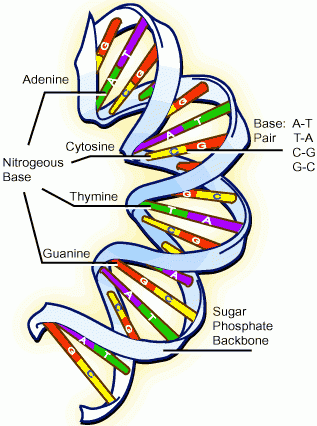
Structure of DNA
Structure of DNA

This video introduction to intelligent design packs a lot of information into a very small video. (H/T Brian Auten from Apologetics 315)

When it comes to the science of DNA, theistic evolutionists and atheists agree: matter, law and chance are sufficient to evolve DNA. No intelligence is needed to sequence the base pairs or the amino acids. That agreement that intelligent causes are not needed to explain DNA is why I call theistic evolution “functional atheism”.

Theistic evolutionists express subjective opinions about God that no one can investigate using science. These untestable opinions about God are similar to the opinions of little children about Santa Claus. And yet they insist that they be taken seriously alongside the people who actually think Christianity is objective knowledge, not subjective opinion.

To defuse a theistic evolutionist, simply ask them for  fully materialistic and naturalistic explanation for the first living organism – the origin of life. And then watch how they avoid answering the question. For even Richard Dawkins has no idea how life could begin, if only purely naturalistic, materialistic causes are allowed in the explanation.

Theistic evolutionists hate talking about evidence. They want to talk their private feelings and beliefs and experiences in order to reassure you that they are just like you. Don’t let them talk about religion – stick to what science can show. Demand evidence that the material processes can do the creating that the theistic evolutionists think that material processes can do.

Here’s an easy article that you can read that explains a bit more about what the video discussed. Here is one is a bit more difficult. These are mentoring articles for Christians.

If you want to read some serious research, then read this post and listen to this interview which are both about the work of Doug Axe.

A simple reponse to theistic evolutionists, by Andrew

This is an e-mail I received from a reader.

I was having dinner the other day with Greg Koukl and friends, when the topic of THEISTIC EVOLUTION came up. Greg Koukl shared the following insight on this view in his usual clear-thinking manner…

Many people like to invoke theistic evolution as an explanation of the origin of life. Theistic evolution refers to the belief that God used evolution as a method of creation; God created life and then stood back and left things to run on their own though the laws of nature. If God intervened at all, it was only when absolutely necessary. While this explanation sounds really nice on the surface, the devil is in the details.

Simply put, theistic evolution is a self-refuting idea. An idea that commits suicide, so to speak. The ‘evolution’ part of theistic evolution is by definition a process that is blind, undirected and left to chance (natural selection). The ‘theistic’ part of theistic evolution, on the other hand, is by definition directed and personal (design). How do you reconcile these two opposing ideas? Clearly you can’t, since they are mutually exclusive. You simply cannot have something that is both undirected and directed.

It’s like asking the question: “How do you boil water?”. Someone could give the response: “Well, you take a pot, fill it with water, put the lid on, put the pot on the stove, turn on the stove, and add a leprechaun”. The question could then be asked: “What happens if I don’t add the leprechaun?”, to which the response would be “well…the water still boils”. The objective can be achieved without adding the leprechaun, which is therefore unnecessary. In the same way, both components of theistic evolution can, in theory at least, provide for the origin of life. In my opinion theistic evolution is a view held by those who have bought into Darwinism but don’t want to let go of God. Therefore, they proclaim both to be true. Unfortunately for them, the manner in which these two processes work (undirected versus directed) are contradictory and cannot both be true. The resulting mixture, theistic evolution, is not even an option, and proponents of this view should be called on this flaw in their thinking.

Below I’ll give my thoughts on theistic evolution.

My thoughts

Theistic evolution is basically atheistic evolution, with an unnecessary fairy tale riding on top. It’s like Santa Claus and Christmas. A child’s parents put the presents under the tree. If you film the tree, you see parents putting presents under the tree – that’s what actually happens, and who actually does the work. Santa Claus is a myth that makes children feel good – the concept of Santa Claus does no work putting presents under the tree in reality. And that’s the same role God plays in theistic evolution – he does no work in reality.

The dividing line between theists and atheists is whether the natural world shows any OBJECTIVE evidence of an intelligent agent at work. If a person claims to be theistic, but states that there is no OBJECTIVE evidence of intelligent causes acting in nature, then that person is actually an atheist. Theism is either real or it is nothing. I am not interested in personal preferences and personal delusions – I only care what is scientifically demonstrable.

The scientific evidence for intelligent design (fine-tuning, origin of DNA, Cambrian explosion, habitability, irreducible complexity, molecular machines, etc.) shows evidence of an intelligent agent causing effects in nature. It’s not up to our opinions to decide if an intelligent agent has acted  – it’s the way the world is, regardless of what we want – or need – to believe.

Lifeway survey of young Christians reveals decline in orthodox faith

Story in USA Today. (H/T Caffeinated Thoughts)

Excerpt:

Most young adults today don’t pray, don’t worship and don’t read the Bible, a major survey by a Christian research firm shows.

If the trends continue, “the Millennial generation will see churches closing as quickly as GM dealerships,” says Thom Rainer, president of LifeWay Christian Resources. In the group’s survey of 1,200 18- to 29-year-olds, 72% say they’re “really more spiritual than religious.”

Among the 65% who call themselves Christian, “many are either mushy Christians or Christians in name only,” Rainer says. “Most are just indifferent. The more precisely you try to measure their Christianity, the fewer you find committed to the faith.”

Key findings in the phone survey, conducted in August and released today:

•65% rarely or never pray with others, and 38% almost never pray by themselves either.

•65% rarely or never attend worship services.

•67% don’t read the Bible or sacred texts.

Many are unsure Jesus is the only path to heaven: Half say yes, half no.

[…]The 2007 LifeWay study found seven in 10 Protestants ages 18 to 30, both evangelical and mainline, who went to church regularly in high school said they quit attending by age 23. And 34% of those had not returned, even sporadically, by age 30.

Michael Snyder writing at Caffeinated Thoughts adds:

According to a recent survey by America’s Research Group, 95 percent of 20 to 29 year old evangelical Christians attended church regularly during their elementary school and middle school years. However, only 55 percent of those young evangelical Christians still attended church regularly during high school, and only 11 percent of them were still regularly attending church when they went to college.

Only 11 percent.

And that was among self-identified evangelical Christians.

But the most recent American Religious Identification Survey conducted by the Institute for the Study of Secularism in Society & Culture at Trinity College was perhaps even more shocking.

According to that survey, 15% of Americans now say they have “no religion” – which is up from 8% in 1990. However, what was much more disturbing was that 46% of Americans between the ages of 18 to 34 indicated that they had no religion in the survey.

Those are the facts.

Here’s what we need to do in Christian churches and seminaries. We need to present Christian theology like people present chemistry. We need to consider alternative hypotheses. We need to survey opposing views. We need to host debates on core doctrines featuring non-Christians. We need to get away from the idea that Christianity is a Santa Claus myth. We need to replace praise hymns with speeches given by distinguished scholars. Apologetics should taught in Sunday school as mandatory for all age groups. Apologetics courses should be made mandatory in all evangelical seminaries.

The culture as a whole has turned more towards hedonism. There are a lot of fun things to do in life other than Christianity. Unless Christianity can provide a reason for people to avoid seeking pleasure, then Christianity’s influence will be diminished down to virtually nothing, as we see today in secular welfare-state countries in Europe. At the end of the day, leaders in the church who are more concerned about fundamentalist fideism and emotional satisfaction will be held accountable for their effectiveness, not their sincerity and good intentions. If the results are bad, then the method needs to change.

Mentoring

Apologetics advocacy