
Tag Archives: Feminism

New study: As Christianity declines, so do stable relationships and marriage

Man and woman working on a computer upgrade
Man and woman working on a computer upgrade together

Mark Regnerus is a sociologist at the University of Texas, Austin. He publishes a lot of his books with Oxford University Press. So, his research methods are generally seen as reliable. I noticed that he had done a survey of views on religion, sexuality and marriage in 2018, and he published a popular level article about it earlier this week. I think it’s worth taking a look at his findings.

He writes:

Let me offer a word about the survey. I call it the American Political and Social Behavior survey, which interviewed 5,285 Americans in November 2018, just days after the midterm election. The data collection was conducted by Ipsos… a research firm with a very strong record of generating high-quality data for academic projects.

Here are his findings:
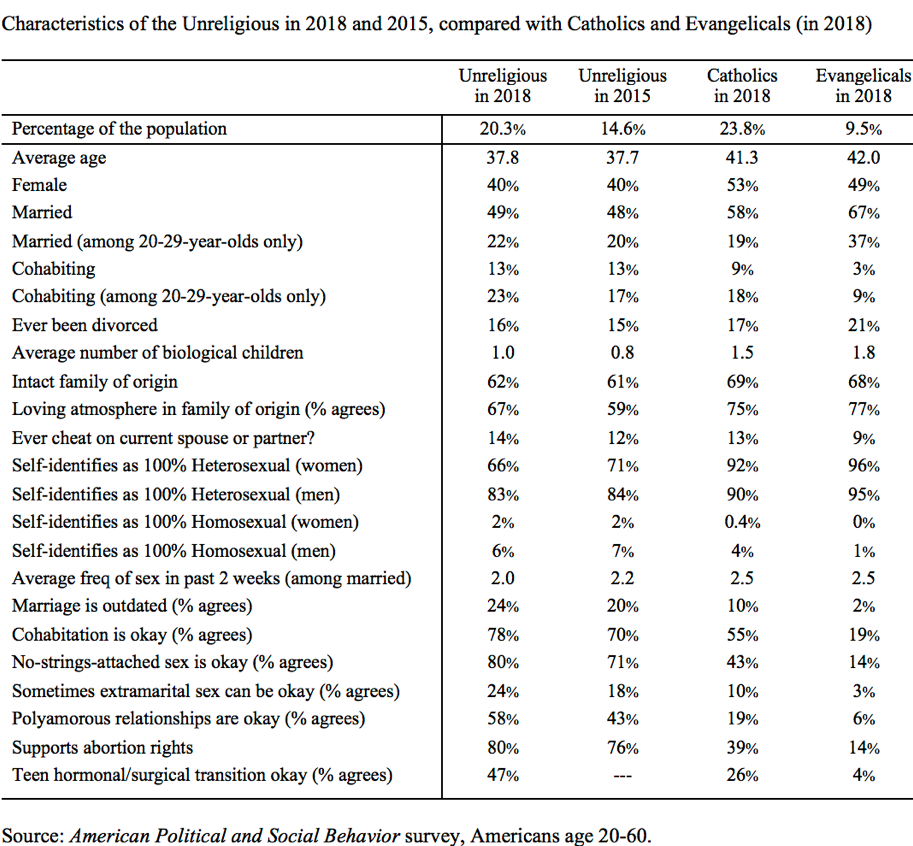
Views of unreligious, Catholic and evangelical Americans
Views of unreligious, Catholic and evangelical Americans (click to expand)

This is interesting:

Even when I limit the group to respondents below age thirty—which is just north of the median age at marriage in the United States—it is notable that 22 percent of the unreligious are married and 23 percent are currently cohabiting, not radically different from the 19 and 18 percent of Catholics that are married and cohabiting, respectively. For comparison, 37 and 9 percent of younger evangelicals are married and cohabiting, respectively. The cohabiting habits of the unreligious, however, have shifted—note the uptick in cohabitation—six percentage points in just under four years. That amounts to a 35 percent increase. Since it’s unlikely that the unreligious have recently changed their minds about the morality or pragmatics of living together, my bet is in the other direction: cohabiting leads many to no longer identify as religious at all.

Got that part in bold? Their attitudes are changing because of their sexual behaviors. So, if you want to reverse the decline of Christianity, we’re going to need to come up with some arguments and evidence to counter the sexual revolution. And on this blog, we’ve done that many times, looking at studies showing the future instability of marriages that occur after cohabitation. I’ve never heard a church preach on that, though. And it’s not something that even many Christian apologists focus on. Most Christian apologists, particularly the women, tend to focus on soft arguments,. They stay away from arguments about morality, because it’s divisive and abrasive to their desired audience. However, if the goal is persuading people that Christianity is a viable worldview, then we need to focus more on sexuality.

More Regnerus:

[O]n each of seven attitude measures I examined, the unreligious are notably more permissive than even the spiritual-but-not-religious (not shown). Nearly 80 percent of unreligious Americans agree (or strongly agree) that cohabitation is okay, no-strings-attached sex is okay, and abortion should be a legal right. This is all unsurprising. But even some of the more radically “progressive” attitudes demonstrate strong support among the unreligious: 24 percent agree that it is “sometimes permissible for a married person to have sex with someone other than his/her spouse.” (I thought perhaps women would differ from men here, but they didn’t—or at least not by much.) Although few Americans are actually in polyamorous living arrangements, the unreligious would support them should someone choose such an arrangement; 58 percent of them agreed that “it is okay for three or more consenting adults to live together in a sexual/romantic relationship,” a percentage that is far more supportive than Catholics or evangelicals. Among the latter, only 6 percent thinks polyamory could be okay.

A more interesting theme, however, is the surge in support for such alternatives. On each statement, note the rise in agreement that has occurred in just under four years. Polyamory tops the list—a 35-percent leap in the share of unreligious who now endorse polyamorous arrangements (from 43 to 58 percent). Even support for extramarital affairs grew by one-third (from 18 to 24 percent). The unreligious aren’t alone here. Catholics, too, have witnessed liberalization in attitudes. Evangelical numbers display a more modest uptick, and from lower starting points.

The non-religious people in my office who were raised Christian like to tell me that the existence of the Christian God isn’t important to them, because they can achieve marriage via cohabitation, and behave like good people without the need for any sort of framework to rationally ground it. They think that you can just pull out God, and the marriage will stay the same. They expect the people they start relationships with to act on Christian morality, even if the worldview was rejected as superstitious nonsense. But as you can see from the data, removing God has an enormous effect on the person’s ability to be stable and faithful.  The truth is that when you take out the vertical relationships with God, then the blueprint for the relationship becomes completely different. Relationships used to be seen as an enterprise where each person’s primary commitment was to lead and protect their spouse before delivering them to God with faith intact. Now, relationships are contingent on continuous happiness.

More Regnerus:

Only 66 percent of unreligious women say they are “100% Despite the permissive reputation of the unreligious, their actual marital sexual frequency is lower than that of Catholic and evangelical couples—at two instances in the past two weeks. As has been documented extensively in the past few years, the frequency of sex among American couples—whether cohabiting or married—has been declining at statistically significant rates. This pattern has not spared the godless.

I think this is interesting. I believe that men are facing an epidemic of sex-withholding from their wives, and I have an idea why that is. Today, women most commonly use sex to “jump start” a relationship with men who they perceive as “high value”, but who refuse to commit to them. This behavior is not focused on men who have commitment abilities, e.g. – provider, moral leader, spiritual leader, accurate worldview rooted in logic and evidence. Instead, most women use sex to get men who have the appearance of high value, e.g. – tall, tattoos, piercings, violent tendencies, exciting, fun, etc. Having established that pattern over and over with no-commitment bad boys, they marry someone who they see as beneath them, and then withhold sex. Commitment isn’t worthy of sex. It’s the man’s appearance and entertainment value that makes him worthy of sex. The comparison of this low-quality man to previous partners makes women more likely to initiate divorce for “unhappiness” later on.


Are you ready for marriage? 10 questions to find out how prepared you are

Marriage and family
Marriage and family

Would you like your marriage to be long-lasting and fulfilling? Well, check out the questions below and see if you are ready for life-long wedded bliss.

1. Are you opposed to no-fault divorce laws?

No-fault divorce laws allow one spouse to leave the marriage at any time, for any reason, or for no reason at all. If you support no-fault divorce, then your view of marriage is that it’s something to be entered into lightly, because it can be exited easily. You’ll be walking down the aisle thinking “oh well, if it doesn’t work out, I can always get a divorce”. If you oppose no-fault divorce laws, then your view of marriage is that there is no escape hatch. You’ll probably be a lot more careful about getting married. Since you are convinced that marriage is built to last forever, you’ll have a courtship of at least 6 months, and involve both sets of parents in the process. If you put commitment above happiness, you’re ready for marriage.

2. Are you opposed to abortion laws?

Abortion laws basically make it easy for two people to have recreational sex, and then get rid of any complications that result quickly and easily. This way, both the people that created the effect can escape the responsibility for what they did, and keep right on pursuing their goals and dreams. If you support abortion laws, you’re really saying that you can engage in recreational sex with people who are unwilling to accept responsibility for any children that result. If you are pro-life, then you’re saying that people should be careful about having sex, and be ready to take responsibility for a child, should one appear. Being responsible is good preparation for marriage.

3. Are you supportive of daycare for young kids?

Daycare services are essential for couples who need both the father and the mother to be working. The advantage of both parents working is that you can afford lots of shiny new stuff – like vacations, boats, shoes and handbags. Studies show that children don’t die during daycare, although if you put a child in daycare, there will be effects on the child’s behavior, such as higher anxiety and aggression. If you oppose daycare, you’re putting the needs of your children above your need for shiny stuff. Putting the needs of children first is a sign that you are ready for the self-sacrifice that marriage requires.

4. Are you in favor of smaller government?

If you’re in favor of smaller government, then you would rather keep taxes low so that more money stays in the family. If you support bigger government, then you think that government knows how to spend your money better than you and your spouse do. Additionally, government usually likes to spend more money than they take in. For example, in  Obama’s 8 years, we added $10 trillion dollars to the debt, which doubled from 10 to 20 trillion under his watch. If you oppose higher taxes and bigger government, then you want government to pass on less debt to your children. Putting your kids’ financial well-being over your own is pro-marriage.

5. Are you in favor of school choice?

If you’re opposed to school choice, then you think that government should decide which schools your children will attend. School choice laws allow parents to give money to the schools they think are best for the children. If a school has excellent teachers and teaches students skills that they can use in their professional lives, then parents can choose that school. Schools have to compete to provide higher quality to parents, for lower cost. If you support giving parents more choice, then you put the needs of children – especially poor, minority children – above the needs of education administrators and teacher unions. Putting kids first is pro-marriage.

6. Are you in favor of premarital sex?

Premarital sex is really fun (so I’m told). You can have sex with people who are just really attractive, even if these people have lousy character. Your friends will be impressed, and you’ll feel more attractive – like you were climbing a ladder of attractiveness with each new partner. If you combine sex with being drunk, then you can’t remember anything after. And you can’t feel guilty if the booze made you do it, right? On the other hand, if you present yourself to your spouse as a virgin, you are telling them that you have self-control, that you take sex as communication rather than recreation, and that they can trust you to be faithful by keeping sex inside the marriage. Trust is important for a good marriage.

7. Are you in favor of welfare for single mothers?

Sometimes, women find themselves pregnant before they are married. If you think that giving taxpayer money to women who have babies before they have husbands is a good idea, then you are rewarding behavior that creates fatherless children. Raising a child without a father causes serious behavioral problems. Boys tend to become more violent, and are more likely to commit crimes. Girls tend to engage in sex at earlier ages. If you oppose encouraging fatherlessness with welfare, you want women to get married before they have kids. Taking the needs of children seriously is pro-marriage.

8. Are you in favor of same-sex marriage?

When a man and a man get married and acquire children, those children will not be raised with their birth mother. Similarly with lesbians, the children will not grow up with their birth father. Studies show that children suffer from not being raised by their biological parents. For example, children of same-sex parents have lower graduation rates than children raised by heterosexual couples. If you think that children have a right to a stable relationship with their biological mother and father, then you place a higher value on the needs of children as opposed to the needs of adults. That’s a good sign you’re ready for marriage.

9. Are you in favor of radical feminism?

Feminism shows that you think the purpose of marriage is to make women happy, and not to work as a team to serve God and raise good children. Indeed. Marriage doesn’t work if the woman approaches it as an accessory. Marriage is about a man and a woman sacrificing their own interests and compromising in order to work together as a team. Husbands and children have needs that women should care about. Feminism teaches women that husbands and children are less important than their careers, hobbies and interests. Feminism is anti-marriage.

10. Are you responsible with earning, budgeting and saving money?

This one comes to us from Bob P. He says that marriages work better when both spouses are “committed to financial planning, budgeting and a renunciation of debt to support a lifestyle. Disagreement about financial issues is one of the greatest causes of marital stress.” If you’re able to choose a college major or a trade that you don’t like, but that pays well, that’s a positive. If you’re able to string together jobs so that your resume is gap-less, that’s a positive. If you’re able to save money even though it means you’re having less fun, that’s a positive. If you’re able to give away money to others to support them, that means you’re able to sacrifice your interests for the benefit of others. That’s pro-marriage.

Well, how did you do? Leave your ideas for more policies and points of view that are marriage-friendly in the comments.

Why do so many Christian musicians, artists, athletes and celebrities leave the faith?

A conflict of worldviews

Several people sent me the story about a former Hillsong worship leader who decided to leave Christianity. Since we’ve had a few high profile departures, I thought it might be worth giving my very controversial view on Christian musicians, artists, athletes and celebrities. I’ve always been suspicious of celebrities claiming to be Christians and there’s a very simple reason why.

Anyway, here is the story sent to me by Tiasunep, published in the Christian Today.

It says:

Hillsong worship leader has reportedly walked away from the Christian faith after posting a – since removed – Instagram update in which he said he was “not in anymore”.

[…]”Time for some real talk… I’m genuinely losing my faith.. and it doesn’t bother me… like, what bothers me now is nothing… I am so happy now, so at peace with the world.. it’s crazy / this is a soapbox moment so here I go xx how many preachers fall? Many. No one talks about it.

“How many miracles happen. Not many. No one talks about it. Why is the Bible full of contradictions? No one talks about it. How can God be love yet send 4 billion people to a place, all coz they don’t believe? No one talks about it.

“Christians can be the most judgemental people on the planet – they can also be some of the most beautiful and loving people… but it’s not for me. I am not in any more.”

[…]Science keeps piercing the truth of every religion,” he writes.

“Lots of things help people change their lives, not just one version of God. Got so much more to say, but for me, I keeping it real.

[…]The news has saddened many in the Christian scene who were still getting over a similar announcement made a few weeks ago by Joshua Harris, author of I Kissed Dating Goodbye.

Within the space of a week, he announced that he was separating from his wife and that he had fallen away from the Christian faith.

It looks to me like no one has ever made the evidential case for a Christian worldview to him, and he’s just crumbling because he doesn’t have answers to basic, ordinary questions.

In modern secular America, authentic Christianity is spelled A-P-O-L-O-G-E-T-I-C-S

In primitive areas of the world, a person could be a sincere Christian without knowing how to answer basic questions about scientific evidence for a creator, historical evidence for the resurrection of Jesus, philosophical defenses to the problems of evil and suffering, etc. But this is modern America, and there are atheists in the universities and in the workplace and just everywhere. If you meet someone in America who claims to be a Christian, it’s guaranteed that this person will have met atheists in these places. If this Christian has not put in any effort to learn how to answer basic questions about God’s existence, the resurrection, the problem of evil, etc, and they are regarded as very pious and spiritual, you should immediately distrust their claim to be a Christian.

1 Peter 3:15-16
1 Peter 3:15-16

Authentic Christians will be appropriately moved by the existence of people who not only do not accept a Creator, but also deny Jesus as Lord and Savior. And since the example of using reason and evidence to respond to skeptics is everywhere in the Bible, then sincere Bible believers will likewise want to find a way to answer people who question the Christian worldview. If you look at a Christian, and you can’t find anything in their writings or words that interacts with Christian scholarship and responds to popular challenges to the Christian worldview, then you’re looking at a fake Christian. Such a person is merely posing as a Christian for feelings, fame and peer approval. Every real Christian is concerned about defending God’s reputation and character. And the way that this is done in the Bible – and today – is with evidential apologetics.

There is no mature Christian worldview that majors in praise hymns, social justice, essential oils, devotional reading, etc. Today, right now, your co-worker is an atheist. Today, right now, your child’s professor is an atheist. If you haven’t put in the time to prepare a defense to the challenges right in front of your face – challenges that affect you and your legacy in Christ – but you have plenty of time to major in the minors for fame and fortune, then that’s a sign that you don’t have a Christian worldview. If all your Christianity is just having feelings, devotional reading and singing praise songs, then you need to ask yourself whether you’re not on the same road as this Hillsong worship leader.

Young people should be learning apologetics from their parents, pastors and other Christian leaders

It’s not surprising to me that the Hillsong worship leader is an apostate. What’s surprising to me is that anyone at all who is raised in any American church is able to preserve their faith for very long after leaving home. The churches in America do a poor job of equipping Christians to answer the most basic questions about the Christian worldview. Questions that could easily be answered after a few Lee Strobel books, or some True U DVDs. But in Christian homes and Christians churches, young people are never exposed to the challenges of non-Christians. They never do any investigations to learn how to respond to them. Then when they get to college, they feel (rightly) as if they’ve been brainwashed and indoctrinated by people in the church who were divorced from reality. And then they quit on Christianity. I see it all the time.

If you’re going to pick someone to look up to as a Christian, then choose people who have put in the time to study the truth claims of the Christian worldview enough to defend them to other scholars, using arguments and evidence. I admire people like William Lane Craig, Stephen C. Meyer, Michael Licona who actually debate non-Christians on university campuses and other public forums. In contrast, an entertainer isn’t usually qualified to defend truth claims.

Positive arguments for Christian theism