
Tag Archives: Feminism

Why would a woman want to participate in the hook-up culture?

Do young women understand how to get to a stable marriage?

Note: in this article, when I refer to women, I mean young, unmarried women who have been influenced by feminism. I do not mean all women, and especially not married women.

My good friend Tom sent me this article from the ultra left-wing Vanity Fair. Tom is a veteran of the brutal New York City dating scene.

The article is contains sex and bad language. Reader discretion is advised.

Excerpt:

It’s a balmy night in Manhattan’s financial district, and at a sports bar called Stout, everyone is Tindering. The tables are filled with young women and men who’ve been chasing money and deals on Wall Street all day, and now they’re out looking for hookups. Everyone is drinking, peering into their screens and swiping on the faces of strangers they may have sex with later that evening.

Tinder is a hook-up app that people use to find people to have sex with, based solely on their photograph.

The article says this:

“Romance is completely dead, and it’s the girls’ fault,” says Alex, 25, a New Yorker who works in the film industry. “They act like all they want is to have sex with you and then they yell at you for not wanting to have a relationship. How are you gonna feel romantic about a girl like that? Oh, and by the way? I met you on Tinder.

“Women do exactly the same things guys do,” said Matt, 26, who works in a New York art gallery. “I’ve had girls sleep with me off OkCupid and then just ghost me”—that is, disappear, in a digital sense, not returning texts. “They play the game the exact same way. They have a bunch of people going at the same time—they’re fielding their options. They’re always looking for somebody better, who has a better job or more money.” A few young women admitted to me that they use dating apps as a way to get free meals. “I call it Tinder food stamps,” one said.

Even the emphasis on looks inherent in a dating game based on swiping on photos is something men complain women are just as guilty of buying into. “They say in their profiles, ‘No shirtless pictures,’ but that’s bulls**t,” says Nick, the same as above. “The day I switched to a shirtless picture with my tattoos, immediately, within a few minutes, I had, like, 15 matches.”

And if women aren’t interested in being treated as sexual objects, why do they self-objectify in their profile pictures? some men ask. “There’s a lot of girls who are just like, Check me out, I’m hot, I’m wearing a bikini,” says Jason…

Men talk about the nudes they receive from women. They show off the nudes. “T*t pics and booty pics,” said Austin, 22, a college student in Indiana. “My phone is full of ‘em.”

Although the article, and the women who are interviewed, try to pass themselves off as victims, it’s very clear that they are full participants in this hook-up culture. It’s “fun” for them to be free and independent – no responsibilities, expectations or obligations from a relationship. They want fun right now, without the leadership of a husband, or the demands of small children.

Feminist writer Hanna Rosin says that this hook-up culture is great:

Some, like Atlantic writer Hanna Rosin, see hookup culture as a boon: “The hookup culture is … bound up with everything that’s fabulous about being a young woman in 2012—the freedom, the confidence.”

The Vanity Fair author comments:

“Short-term mating strategies” seem to work for plenty of women too; some don’t want to be in committed relationships, either, particularly those in their 20s who are focusing on their education and launching careers.

Previously, I quoted a feminist professor writing in the New York Times. She also thought that it was great that women were hooking up with hot guys for fun, but staying focused on their educations and careers.

Here’s Amanda to explain it:

“There is no dating. There’s no relationships,” says Amanda… “They’re rare. You can have a fling that could last like seven, eight months and you could never actually call someone your ‘boyfriend.’ [Hooking up] is a lot easier. No one gets hurt—well, not on the surface.”

Who doesn’t want to have sex? Well, me for one. At least, not till I’m married.

Amanda later explains that she doesn’t want to care, because caring would mean that she “somehow missed the whole memo about third-wave feminism”. She has to be independent – able to dismiss responsibilities, expectations and obligations in order to pursue happiness with education, career, travel and promiscuity.

I know Christian women who think they are fundamentalists who have this exact same attitude. They think that relationships are somehow compatible with doing whatever they want to do – that doing whatever makes them happy each and every moment will somehow turn into life-long married love.

Why don’t women reject the men who use them like kleenexes? Why is the man’s appearance so much more important than his suitability for the marriage roles of husband and father? Well, feminism tells women that gender distinctions are “sexist”, that chivalry is “sexist”, that chastity is “repressive” because it blocks having recreational sex, that marriage is boring and must be delayed, and that having lots of sexual experience makes you more attractive. They measure men by how the man makes them feel and whether he will be impressive physically to their peers. They aren’t looking for a man who can perform tradional male roles like protector or provider or moral and spiritual leader – because male leadership is “sexist”.

As always, should you, as a young Christian man of some means, desire to get married, then I recommend using my checklist to validate your candidate. I know a lot of women who married without any intention of being a wife and mother. Sometimes, they marry just because their friends are all getting married. If you as a man do not check this woman’s reasons for marrying, you may find yourself legally bound to someone who “settled” for you. And who has no intention of respecting you or educating your children.

A lesson about men for marriage-minded women from the movie “High Noon”

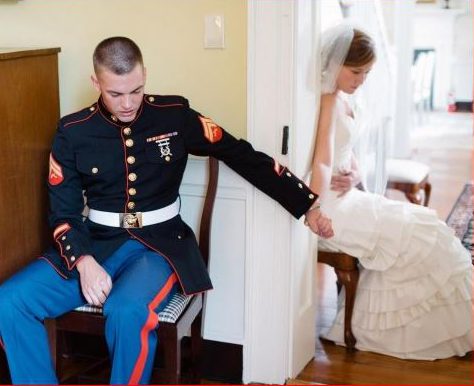
Marine prays with his wife on their wedding day

One of my favorite movies for explaining the differences between men and women is “High Noon” (1952).

Here’s the summary from IMDB:

Former marshal Will Kane (Gary Cooper) is preparing to leave the small town of Hadleyville, New Mexico, with his new bride, Amy (Grace Kelly), when he learns that local criminal Frank Miller has been set free and is coming to seek revenge on the marshal who turned him in. When he starts recruiting deputies to fight Miller, Kane is discouraged to find that the people of Hadleyville turn cowardly when the time comes for a showdown, and he must face Miller and his cronies alone.

The main theme of the film concerns Amy’s decision to break her wedding vows the very day that she makes them. She tells her new husband that he must bow to her will, and give up his male role as protector. When he explains his reasons for standing his ground to her practically (Miller will hunt them down) and morally (he has a duty protect the town), she dismisses both. She tells him that if he doesn’t run away from Miller and his gang with her, that she will get on the train and leave town by herself.

The intro of film shows the member’s of Miller’s gang assembling, and the words of the song explain the central conflict between husband and wife:

Here’s the part of the lyrics we care about:

The noonday train will bring Frank Miller.
If I’m a man I must be brave
And I must face that deadly killer
Or lie a coward, a craven coward,
Or lie a coward in my grave.

O to be torn ‘twixt love and duty!
S’posin’ I lose my fair-haired beauty!
Look at that big hand move along
Nearin’ high noon.

He made a vow while in State’s Prison,
Vow’d it would be my life or his’n
I’m not afraid of death, but O,
What will I do if you leave me?

Do not forsake me O my darlin’
You made that promise when we wed.
Do not forsake me O my darlin’
Although you’re grievin’, I can’t be leavin’
Until I shoot Frank Miller dead.

What’s interesting is that his new wife Amy apparently does not understand the meaning of wedding vows or the natural roles of good men as protectors of the weak, and fighters against evil. Although she vowed to stick by him and help him, the minute anything threatening appears that makes her feel unhappy, she abandons her vows and abandons her man. Let’s break down her mistakes now, using actual conversations from the movie.

First, she doesn’t understand or respect the man she married as a man:

Kane: [while riding out of town] It’s no good. I’ve got to go back, Amy.

Amy: Why?

Kane: This is crazy. I haven’t even got any guns.

Amy: Then let’s go on. Hurry.

Kane: No, that’s what I’ve been thinkin’. They’re making me run. I’ve never run from anybody before.

Amy: I don’t understand any of this.

Kane: [after looking at his vest watch] Well, I haven’t got time to tell ya.

Amy: Then don’t go back, Will.

Kane: I’ve got to. That’s the whole thing. [He turns the buggy around and rides back into town]

Her feelings and her desires for the world to be a happy place for her are so strong that they cloud her judgment.

Second, she doesn’t understand the threat posed by evil men:

More:

Kane: I sent a man up five years ago for murder. He was supposed to hang. But up North, they commuted it to life and now he’s free. I don’t know how. Anyway, it looks like he’s coming back.

Amy: I still don’t understand.

Kane: He was always wild and kind of crazy. He’ll probably make trouble.

Amy: But that’s no concern of yours, not anymore.

Kane: I’m the one who sent him up.

Amy: Well, that was part of your job. That’s finished now. They’ve got a new marshal.

Kane: He won’t be here until tomorrow. Seems to me I’ve got to stay. Anyway, I’m the same man with or without this. [He pins his badge on his vest]

Amy: Oh, that isn’t so.

Kane: I expect he’ll come lookin’ for me. Three of his old bunch are waiting at the depot.

Amy: That’s exactly why we ought to go.

Kane: They’ll just come after us, four of ’em, and we’d be all alone on the prairie.

Amy: We’ve got an hour.

Kane: What’s an hour?…What’s a hundred miles? We’d never be able to keep that store, Amy. They’d come after us and we’d have to run again, as long as we live.

Amy: No we wouldn’t, not if they didn’t know where to find us. Oh Will! Will, I’m begging you, please let’s go.

Kane: I can’t.

Amy: Don’t try to be a hero. You don’t have to be a hero, not for me.

Kane: I’m not trying to be a hero. If you think I like this, you’re crazy.

Instead of recognizing how her feelings are deceiving her about the threat and trusting her husband, she tries to force him to accept her mistaken view of reality by threatening to abandon him.

One of Kane’s ex-girlfriends has a talk with Amy, which helps her to understand who Kane is, and what is expected of her:

Amy: That man downstairs, the clerk, he said things about you and Will. I’ve been trying to understand why he wouldn’t go with me, and now all I can think of is that it’s got to be because of you…Let him go, he still has a chance. Let him go.

Helen: He isn’t staying for me. I haven’t spoken to him for a year – until today. I am leaving on the same train you are…What kind of woman are you? How can you leave him like this? Does the sound of guns frighten you that much?

Amy: I’ve heard guns. My father and my brother were killed by guns. They were on the right side but that didn’t help them any when the shooting started. My brother was nineteen. I watched him die. That’s when I became a Quaker. I don’t care who’s right or who’s wrong. There’s got to be some better way for people to live. Will knows how I feel about it.

Helen: I hate this town. I always hated it – to be a Mexican woman in a town like this.

Amy: I understand.

Helen: You do? That’s good. I don’t understand you. No matter what you say. If Kane was my man, I’d never leave him like this. I’d get a gun. I’d fight.

Amy: Why don’t you?

Helen: He is not my man. He’s yours.

Helen understands the need for a wife to stand by her man. But Amy’s response to evil is to shut her eyes and focus on feeling good and being happy. Notice that her “better way” is unspecified – it’s just a feeling she has that pacificism and no-violence will somehow “work” to stop evil. But in reality, pacifism is not a “better way” of dealing with evil – it does not work. Her pacifist response not only does not make evil go away, it actually encourages more evil. Weakness emboldens evildoers, and laying down your arms provokes them to do more evil. Will Kane knows this, but she won’t listen to him.

You can watch the final gunfight here, as well as Amy’s final decision:

So, this is why I really recommend this movie as a discussion-starter when you like a girl and are thinking of marrying her. It clarifies the essential problem with many young women today not being ready for marriage. To be fair, most women come around to respect their husbands and his different roles after they get married. However, the risk of divorce is so dangerous that it makes sense to bring it up for discussion before the marriage happens. Marriage is supposed to be an engine to serve God, and the success of that enterprise cannot be left to chance. You can’t just rely on the fact that she says the words of the vow, you have to check to see if she has a habit of keeping her promises when it goes against her own self-interest.

Ask yourself: Who are you, as a man? And does your woman accept that you have obligations to stand up to evil and do good ? Will she support you in your battle against evil, or will the marriage just be about her feelings and desires? I would especially beware of women who think that God is speaking to them through their feelings and desires. Look at her friends: are they practical and successful? Or are they irresponsible, unaccountable and reckless? Look at her father: does he have a plan for her, and does he lead her to be practical, frugal and hard-working? If you are not going to get an ally and a supporter in a wife, then you will not be able to serve God well, as a married man. Think about it.

Suzanne Venker interviews Dr. Stephen Baskerville about divorce and its beneficiaries

Marriage and family
Marriage and family

I am just LOVING the Suzanne Venker podcast. You should subscribe if you like discussions with experts about marriage, divorce, feminism, sex and relationships. Recent guests: Christina Hoff Sommers, Rollo Tomassi, Janice Fiamengo, Denise McAllister, Katy Faust, Helen Smith, Joy Pullmann, Heather Mac Donald, Mona Charen, Dr. Laura, Dennis Prager, Allison Armstrong, etc.

You can listen to the episode here.

And it came with a free summary:

Children of divorce are in desperate need of a relationship with both their parents. Sadly, far too many are reduced to having a relationship with only one parent: the mother.

Citing a principle called the “best interest of the child,” family courts award sole or primary custody of most children of divorced parents to mothers, thereby reducing fathers to occasional visitation and zero authority.

The silence on this issue is deafening, and this silence comes just as much from the right as it does from the left. It even comes from churches.

Making matters worse is that divorce is no longer fault-based. Unilateral divorce is now the law of the land, and three-fourths of divorces are initiated by wives. Women don’t have to allege any fault by the husband, and he has no right to oppose the divorce.

To address this monstrous social travesty, I could think of no one better than Stephen Baskerville, former Professor of Government at Patrick Henry College. Stephen is widely recognized as a leading authority on fatherhood, family policy, and sexual politics. He holds a Ph.D. from the London School of Economics and writes on political ideologies with an emphasis on religion, family policy, and sexuality. His books include The New Politics of Sex and Taken Into Custody: The War against Fathers, Marriage, and the Family.

Stephen serves on advisory boards to the Ruth Institute, the Men’s Health Network and other organizations. His website is http://www.stephenbaskerville.com.

IN THIS EPISODE:

5:00-8:00 How Stephen began writing on the “divorce industry,” the political dynamics involved and about no-fault divorce: why it disproportionately affects fathers.

8:00 How women are encouraged to get divorced and take the children, make false accusations against fathers etc.

10:24 How men are less likely to use children as weapons against the other spouse

10:45  The Myth of the Deadbeat Dad

14:00 What is no-fault divorce and why is it wrong, why is it a system of “chaos” and why we need to “enforce the constitution” when it comes to divorce

11:40 – 16:00  How the Bill of Rights is violated in many divorce cases and how basic constitutional rights are being violated.

17:00  How political correctness keeps ups from being able to address it and solve the problems with no-fault divorce and how both the left and right wing media both ignore it

19:00  How even Ronald Reagan admits he was deceived when he signed the first No Fault divorce legislation into action in CA. How there was also no public debate or discussion at the time it was enacted and throughout the years until now

19:45 How these laws have affected the social structure, including crime, fatherlessness in homes, etc.

20:49-22:50  What does Stephen tell and recommend for fathers as recourse for these issues?

24:35-30:30  Why the effects of the sexual revolution have led to the the West to brink of social and economic ruin (this includes sexual chaos, domestic violence, sexual harassment, etc.)

30:45 – Why feminism has not created a “utopia” for a women

33:00 – Stephen discusses single parent homes and the breakdown of the family

36:20 How the church not being involved in marriage has created a vacuum for the lawyers, social workers, judges and therapists to step in

37:45 Stephen talks about the idea of being “offended” and why men are responsible for stepping up and being leaders

For a virgin who has not and probably never will marry, I have had a lifelong interest in how to date and marry the right way – in order to get results and leave a legacy. So I know all these speakers, and have books my many of them (Dr. Laura, Janice Fiamengo, Helen Smith, Dr. Laura, Christina Hoff Sommers, Stephen Baskerville, etc.) in my house. I’m fascinated by these issues and know very much about what does and does not work in a marriage.