Tag Archives: Feminism

If unborn babies don’t have consciousness or don’t feel pain, may we kill them?

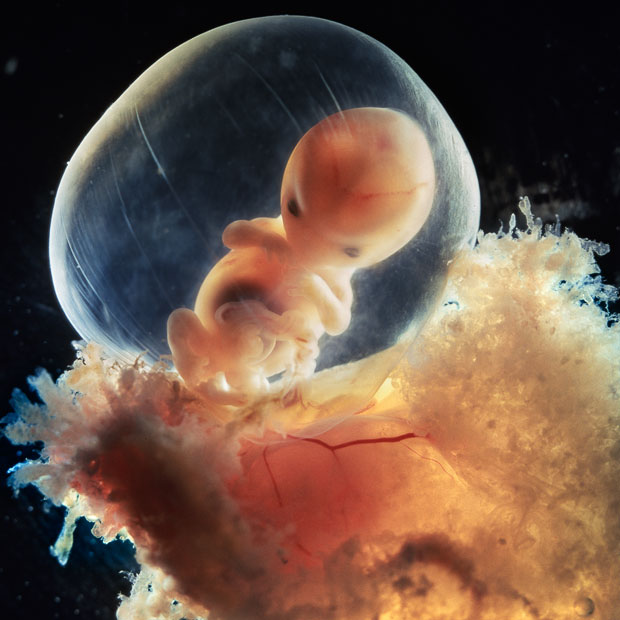
Unborn baby scheming about pro-life apologetics

Was having a conversation by e-mail yesterday with a pro-abortion atheist, and he gave two reasons why he supported abortion in the first and second trimester. First, he said that unborn babies can’t feel pain, so it’s OK to kill them. Second, he said that unborn babies don’t have consciousness, so it’s OK to kill them. I thought it might be useful to link to something that answers both of these objections.

Frank Beckwith is the author of “Defending Life: A Moral and Legal Case Against Abortion Choice“, which was published by Cambridge University Press, a top academic press. But before Cambridge University Press, Beckwith wrote four easy-to-understand essays for the Christian Research Journal. Part IV is the one that has the response to the two questions raised by my atheist friend.

Part I. The Appeal to Pity

Part II. Arguments from Pity, Tolerance, and Ad Hominem

Part III. Is The Unborn Human Less Than Human?

Part IV. When Does a Human Become a Person?

Excerpt:

Some ethicists argue that the unborn becomes fully human sometime after brain development has begun, when it becomes sentient: capable of experiencing sensations such as pain. The reason for choosing sentience as the criterion is that a being that cannot experience anything (i.e., a presentient unborn entity) cannot be harmed. Of course, if this position is correct, then the unborn becomes fully human probably during the second trimester and at least by the third trimester. Therefore, one does not violate anyone’s rights when one aborts a nonsentient unborn entity. [13]

There are several problems with this argument. First, it confuses harm with hurt and the experience of harm with the reality of harm. [14] One can be harmed without experiencing the hurt that sometimes follows from that harm, and which we often mistake for the harm itself. For example, a temporarily comatose person who is suffocated to death “experiences no harm,” but he is nevertheless harmed. Hence, one does not have to experience harm, which is sometimes manifested in hurt, in order to be truly harmed.

Second, if sentience is the criterion of full humanness, then the reversibly comatose, the momentarily unconscious, and the sleeping would all have to be declared nonpersons. Like the presentient unborn, these individuals are all at the moment nonsentient though they have the natural inherent capacity to be sentient. Yet to countenance their executions would be morally reprehensible. Therefore, one cannot countenance the execution of some unborn entities simply because they are not currently sentient.

Someone may reply that while these objections make important points, there is a problem of false analogy in the second objection: the reversibly comatose, the momentarily unconscious, and the sleeping once functioned as sentient beings, though they are now in a temporary state of nonsentience. The presentient unborn, on the other hand, were never sentient. Hence, one is fully human if one was sentient “in the past” and will probably become sentient again in the future, but this cannot be said of the presentient unborn.

There are at least three problems with this response. First, to claim that a person can be sentient, become nonsentient, and then return to sentience is to assume there is some underlying personal unity to this individual that enables us to say that the person who has returned to sentience is the same person who was sentient prior to becoming nonsentient. But this would mean that sentience is not a necessary condition for personhood. (Neither is it a sufficient condition, for that matter, since nonhuman animals are sentient.) Consequently, it does not make sense to say that a person comes into existence when sentience arises, but it does make sense to say that a fully human entity is a person who has the natural inherent capacity to give rise to sentience. A presentient unborn human entity does have this capacity. Therefore, an ordinary unborn human entity is a person, and hence, fully human.

Second, Ray points out that this attempt to exclude many of the unborn from the class of the fully human is “ad hoc and counterintuitive.” He asks us to “consider the treatment of comatose patients. We would not discriminate against one merely for rarely or never having been sentient in the past while another otherwise comparable patient had been sentient….In such cases, potential counts for everything.” [15]

Third, why should sentience “in the past” be the decisive factor in deciding whether an entity is fully human when the presentient human being “is one with a natural, inherent capacity for performing personal acts?” [16] Since we have already seen that one does not have to experience harm in order to be harmed, it seems more consistent with our moral sensibilities to assert that what makes it wrong to kill the reversibly comatose, the sleeping, the momentarily unconscious, and the presentient unborn is that they all possess the natural inherent capacity to perform personal acts. And what makes it morally right to kill plants and to pull the plug on the respirator-dependent brain dead, who were sentient “in the past,” is that their deaths cannot deprive them of their natural inherent capacity to function as persons, since they do not possess such a capacity.

These four essays are a very good introduction to common responses to pro-abortion arguments. I recommend that people get familiar with this, as once you look into it, you will see that the abortion issue can be debated with as much confidence as William Lane Craig defends Christian theism. You will have the same access to scientific evidence and rational arguments on this topic, and so you will have the upper hand. And that’s fun.

The best introductory book on the abortion / right to life issue is “The Case for Life” by pro-life debater Scott Klusendorf. The best comprehensive book is a tie between “The Ethics of Abortion” by Christopher Kaczor, and Frank Beckwith’s “Defending Life: A Moral and Legal Case Against Abortion Choice“.

My conversation about morality with an atheist millennial man

This is one of the memes from the Wintery Knight facebook page
If you define morality as “whatever I want to do” then you’ll always be “moral”

I spent some time talking to an atheist millennial recently. He considers himself a moral person, and he is very helpful to others. I asked him to define morality, and he said that morality was feeling good, and helping other people to feel good. I was trying to think of a way to punch a hole in his feelings-based utilitarianism. How could I show him that happy feelings are not a good basis for morality?

Now, you’re probably thinking that abortion is the most obvious example of something that is morally wrong – it’s just killing a baby because adults don’t want to take responsibility for their foolish pursuit of pleasure. But atheists typically don’t think of unborn children as people. They usually believe in naturalistic evolution, and they are committed to a view of reality where the universe is an accident, human beings are accidents, there are no objective human rights, and biological evolution progresses because the strong survive while the weak die. So you aren’t going to be able to generate a moral standard that includes compassion for weak unborn children on that scenario. If the rule is “let’s do what makes us happy”, and the unborn child can’t voice her opinion, then the selfish grown-ups win.

Instead, I decided to focus on fatherlessness. I asked him whether he thought that fatherlessness harmed children. Surprisingly, he said that it didn’t, and that he had a relative who was doing a great job raising fatherless kids. I asked him if he had ever looked at the research on what father absence does to children. He hadn’t. Then I asked him if a system of sexual rules based on “me feeling good, and other people around me feeling good”, was likely to protect children. He went silent.

Well, that was the end of that conversation. And I think it was a nice window into how millennials – who are absolutely clueless about what research says about sex, dating, marriage and parenting – think about relationships. They’re making decisions based on their feelings, then acting surprised when their “common sense” decisions based on happiness “in the moment” blow up in their faces, and destroy the lives of their children, including their unborn children.

Unfortunately, young people are having children outside of a marriage commitment more and more.

Out-of-wedlocks births rising as cohabitation replaces marriage

Far-left Bloomberg News reports:

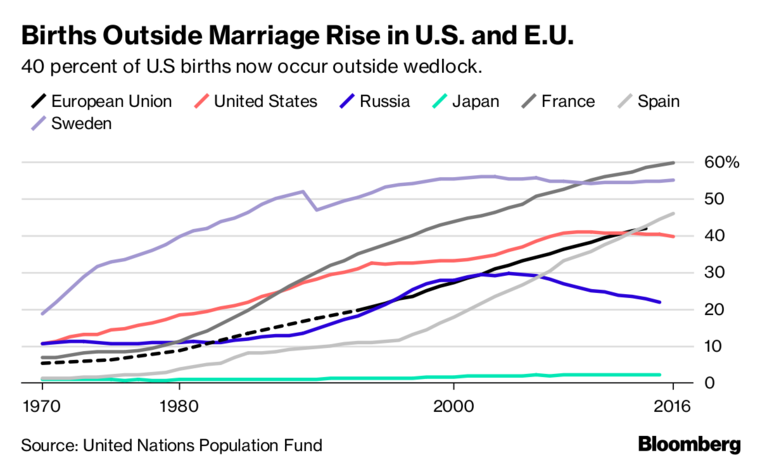
Forty percent of all births in the U.S. now occur outside of wedlock, up from 10 percent in 1970, according to an annual report released on Wednesday by the United Nations Population Fund (UNFPA), the largest international provider of sexual and reproductive health services. That number is even higher in the European Union.

The EU has a higher rate of fatherless births because they have high taxes and big government to allow women to have children without having to commit to a husband:

The EU likely sees more births out of wedlock because many member countries have welfare systems that support gender-balanced child care, said Michael Hermann, UNFPA’s senior adviser on economics and demography, in an interview. Public health care systems, paid paternal leave, early education programs and tax incentives give unwed parents support beyond what a partner can provide.

More welfare and more government services make it easier for women to pursue relationships with men who aren’t interested in marriage. Hot bad boys who give them all the tingles. Big government makes those boring, predictable marriage-ready men dispensable. Big government also makes it much harder for a man who does marry to afford a stay-at-home mother for his kids, because he has to pay higher taxes for big government.

More:

The data show such births in the U.S. and EU are predominantly to unmarried couples living together rather than to single mothers, the report says.

[…]Jones also noted that the rise in births outside of marriage is closely correlated to delays in childbearing. “Women are claiming their ground professionally,” she said. “Delaying motherhood is a rational decision when you consider the impact it can have on your career, and that’s contributing to this trend.”

[….]The traditional progression of Western life “has been reversed,” said John Santelli, a professor in population, family health and pediatrics at Columbia’s Mailman School of Public Health. “Cohabiting partners are having children before getting married. That’s a long-term trend across developing nations.”

Regardless of marital status, more couples are choosing not to have kids at all. The U.S. fertility rate hit a historic 30-year low last year, according to the Centers for Disease Control and Prevention. Hermann said the rise in births outside of wedlock has actually mitigated the decline in fertility, which “would be much steeper if women weren’t having children outside marriage.”

What’s interesting about this anti-marriage article is that they have nothing to say about the research showing that cohabitation – and also marriages that occur after a period of cohabitation – are inferior to no-cohabitation marriages. People who are serious about self-control, and who are serious about committing through thick and thin, tend to have longer lasting marriages. But we don’t prioritize chastity, fidelity and self-sacrificial commitment anymore, because that relationships that require self-denial make us unhappy.

The article concludes: “We can’t go back to the ’50s”. Right. Because if feelings-based “morality” is assumed, then any choice between adult happiness and children’s happiness will favor the adults. Today’s young people carefully AVOID any evidence that contradicts their new “happiness-morality”. They act surprised when their unstable relationships dissolve, leaving children separated from their fathers. Marriage requires that both partners have a system of morality that puts the commitment above happy feelings. People have to be accustomed to doing things that feel bad, just because they are good and moral things to do according to an objective standard of morality. The new atheist morality of happy feelings doesn’t develop the character needed for commitment.

If you ask an atheist millennial, they think they are doing a great job of being “moral”. They don’t see the messes they are making for children as something that they are causing themselves, with their own foolish feelings-based decision-making. They think they know everything about relationships through their feelings. They think that they are exempt from the patterns of cause and effect in the peer-reviewed research.

What the nomination of Amy Coney Barrett communicates to secular left feminists

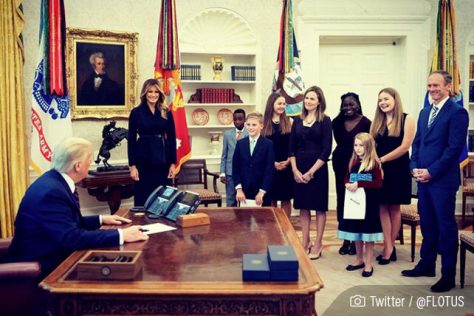
Amy Coney Barrett, her husband and her 7 children
Amy Coney Barrett, her husband and her 7 children in the Oval Office

Here’s an article from The Federalist by my favorite Federalist writer, Joy Pullmann, where she lists 9 feminist lies that were smashed by the nomination of Amy Coney Barrett:

  • Women Need Abortion to Succeed
  • Children Make You Unhappy
  • Women Must Repress Their Fertility to Succeed
  • Religious People and Conservatives Are Anti-Sex
  • Women Don’t Need Men
  • Christianity Oppresses Women
  • Conservatives Hate Women
  • Women Should Prioritize Career Over Family
  • Women Are Oppressed

The article is excellent. I will just focus on the one part that I thought was the most interesting:

Marriage is the epitome of the cooperation of the sexes, yet the left treats it as unnecessary at best and harmful at worst. The Black Lives Matter organization, for example, which has been supported by millions in donations and thousands of endorsements from CEOs and Democrat politicians, in its policy platform openly attacked “heteronormative” “nuclear families.”

Gloria Steinem, the apostle of feminism, popularized the phrase “A woman needs a man like a fish needs a bicycle.” Leftism and feminism pit the sexes against each other, while conservatism and Christianity recognize that the sexes are interdependent. This recognition brings humankind joy instead of hatred.

Fathers are crucial to the happiness and well-being of every child, a need that only intensifies with the addition of each child. Barrett’s husband Jesse is a full partner in their marriage with his own significant career. Barrett recognized her husband’s major contributions to their family and her happiness in her nomination acceptance speech Saturday night.

I couldn’t manage this very full life without the unwavering support of my husband Jesse. At the start of our marriage, I imagined that we would run our household as partners. As it has turned out, Jesse does far more than his share of the work. To my chagrin, I learned at dinner recently that my children consider him to be the better cook. For 21 years, Jesse has asked me every single morning what he can do for me that day. And though I almost always say ‘Nothing,’ he still finds ways to take things off my plate. And that’s not because he has a lot of free time—he has a busy law practice. It’s because he has a superb and generous husband, and I am very fortunate.

Given her description, I think it’s accurate to guess Barrett and her husband’s interdependence is a source of strength and joy to them both, as well as to their children and community. They have undoubtedly achieved much more together than they could have separately, as many highly successful women will also tell you of their marriages. Our husbands are our sometimes-secret weapon.

Feminists don’t like any of Joy’s 9 points, though.

Feminism is what a woman believes after she has smashed herself up by having sex with bad boys. Bad boy failures makes her think that all men are unreliable. She likes abortion because it allows her to chase the bad boys she is attracted to. When she learns how bad boys are unreliable, she intentionally delays marriage to focus on her career and pay off all her student loans. But, if a woman avoids bad boys, and instead chooses a good husband who supports her, she can have 5 kids and adopt 2 more and not have all that bitterness. With a good husband, and a network of supportive relatives, she can even get on the Supreme Court.

I prefer that young women study for a STEM degree, and try to avoid student loans with community college, scholarships, living at home, summer jobs, etc. I recommend they work until their first child arrives. After that, they should stay home with the children, at least for the first 3 years of each child’s life. And obviously, having more children leads to a bigger legacy than fewer children. I’m also a strong supporter of homeschooling. I don’t have much confidence in Christian schools, private schools and especially public schools.

However, in the special case of women like Amy Coney Barrett, who can make a huge difference in the world for the good of conservatives and Christians, then it may be possible, with an excellent husband and many willing relatives, to have a safety net for the children that allows her to do something that will protect us all from the secular left. This is not the ordinary case, of course. This is 1% of the 1% of the 1%. There is no doubt that her children will suffer from her decision to have a career. But if she makes a Supreme Court decision that protects the unborn, or safeguards self-defense rights, or preserves religious liberty, it will be worth it. I don’t think this is the ordinary case. I don’t support mothers of young children having ordinary careers just to make money, because usually the young children have to be placed with strangers.

My goal for my wife was that she be a stay at home wife and mother, at least while we have any children under 3, and preferably under 5. I wouldn’t have liked to have a wife who served on the Supreme Court. I wouldn’t want to share my wife with co-workers, because of the way I was raised. But I can understand why it is a good thing for me (and for conservatives and Christians) that she is the nominee.