Tag Archives: Feminism

If unborn babies don’t have consciousness or don’t feel pain, may we kill them?

Unborn baby scheming about pro-life apologetics

Was having a conversation by e-mail yesterday with a pro-abortion atheist, and he gave two reasons why he supported abortion in the first and second trimester. First, he said that unborn babies can’t feel pain, so it’s OK to kill them. Second, he said that unborn babies don’t have consciousness, so it’s OK to kill them. I thought it might be useful to link to something that answers both of these objections.

Frank Beckwith is the author of “Defending Life: A Moral and Legal Case Against Abortion Choice“. He wrote that book for Cambridge University Press, a top academic press. But before Cambridge University Press, Beckwith wrote four easy-to-understand essays for the Christian Research Journal. Part IV is the one that has the response to the two questions raised by my atheist friend.

Part I. The Appeal to Pity

Part II. Arguments from Pity, Tolerance, and Ad Hominem

Part III. Is The Unborn Human Less Than Human?

Part IV. When Does a Human Become a Person?

Excerpt:

Some ethicists argue that the unborn becomes fully human sometime after brain development has begun, when it becomes sentient: capable of experiencing sensations such as pain. The reason for choosing sentience as the criterion is that a being that cannot experience anything (i.e., a presentient unborn entity) cannot be harmed. Of course, if this position is correct, then the unborn becomes fully human probably during the second trimester and at least by the third trimester. Therefore, one does not violate anyone’s rights when one aborts a nonsentient unborn entity. [13]

There are several problems with this argument. First, it confuses harm with hurt and the experience of harm with the reality of harm. [14] One can be harmed without experiencing the hurt that sometimes follows from that harm, and which we often mistake for the harm itself. For example, a temporarily comatose person who is suffocated to death “experiences no harm,” but he is nevertheless harmed. Hence, one does not have to experience harm, which is sometimes manifested in hurt, in order to be truly harmed.

Second, if sentience is the criterion of full humanness, then the reversibly comatose, the momentarily unconscious, and the sleeping would all have to be declared nonpersons. Like the presentient unborn, these individuals are all at the moment nonsentient though they have the natural inherent capacity to be sentient. Yet to countenance their executions would be morally reprehensible. Therefore, one cannot countenance the execution of some unborn entities simply because they are not currently sentient.

Someone may reply that while these objections make important points, there is a problem of false analogy in the second objection: the reversibly comatose, the momentarily unconscious, and the sleeping once functioned as sentient beings, though they are now in a temporary state of nonsentience. The presentient unborn, on the other hand, were never sentient. Hence, one is fully human if one was sentient “in the past” and will probably become sentient again in the future, but this cannot be said of the presentient unborn.

There are at least three problems with this response. First, to claim that a person can be sentient, become nonsentient, and then return to sentience is to assume there is some underlying personal unity to this individual that enables us to say that the person who has returned to sentience is the same person who was sentient prior to becoming nonsentient. But this would mean that sentience is not a necessary condition for personhood. (Neither is it a sufficient condition, for that matter, since nonhuman animals are sentient.) Consequently, it does not make sense to say that a person comes into existence when sentience arises, but it does make sense to say that a fully human entity is a person who has the natural inherent capacity to give rise to sentience. A presentient unborn human entity does have this capacity. Therefore, an ordinary unborn human entity is a person, and hence, fully human.

Second, Ray points out that this attempt to exclude many of the unborn from the class of the fully human is “ad hoc and counterintuitive.” He asks us to “consider the treatment of comatose patients. We would not discriminate against one merely for rarely or never having been sentient in the past while another otherwise comparable patient had been sentient….In such cases, potential counts for everything.” [15]

Third, why should sentience “in the past” be the decisive factor in deciding whether an entity is fully human when the presentient human being “is one with a natural, inherent capacity for performing personal acts?” [16] Since we have already seen that one does not have to experience harm in order to be harmed, it seems more consistent with our moral sensibilities to assert that what makes it wrong to kill the reversibly comatose, the sleeping, the momentarily unconscious, and the presentient unborn is that they all possess the natural inherent capacity to perform personal acts. And what makes it morally right to kill plants and to pull the plug on the respirator-dependent brain dead, who were sentient “in the past,” is that their deaths cannot deprive them of their natural inherent capacity to function as persons, since they do not possess such a capacity.

These four essays are a very good introduction to common responses to pro-abortion arguments. I recommend that people get familiar with this, as once you look into it, you will see that the abortion issue can be debated with as much confidence as William Lane Craig defends Christian theism. You will have the same access to scientific evidence and rational arguments on this topic, and so you will have the upper hand. And that’s fun.

The best introductory book on the abortion / right to life issue is “The Case for Life” by pro-life debater Scott Klusendorf. The best comprehensive book is a tie between “The Ethics of Abortion” by Christopher Kaczor, and Frank Beckwith’s “Defending Life: A Moral and Legal Case Against Abortion Choice“.

Study: remaining a virgin longer leads to more satisfying relationships

Boys and girls playing the famous co-operative board game
Boys and girls playing the famous co-operative board game “Pandemic”

OK, so this week I got to be a facilitator between a man and a woman in a relationship. I got to hear a bit about what they thought was appropriate in the area of physical touching. These two had made great decisions, and it protected them both. Anyway, thinking about them caused me to think about the studies I had posted about boundaries in sexual matters a few years back. So I’m going to re-post them to remind everyone not to be in a rush to say yes to premarital sex.

The first article from the UK Daily Mail is about study showing the benefits of abstinence for relationship quality.

Excerpt:

People who lose their virginity later than their teenage years are more likely to enjoy satisfying relationships later in life, according to a new study.

Researchers found that people who didn’t have sex until they turned 20 or even later are more likely to end up in a happy relationship.

[…]Previous research suggests that there may be cause for concern, as timing of sexual development can have significant immediate consequences for adolescents’ physical and mental health.

However, until now little had been done to study long-term outcomes, and how early sexual initiation might affect romantic relationships in adulthood.

Psychological scientist Paige Harden, of the University of Texas in the United States, set about changing this.

She wanted to investigate whether the timing of sexual initiation in adolescence might predict romantic outcomes – such as whether people get married or live with their partners, how many romantic partners they’ve had, and whether they’re satisfied with their relationship – later in adulthood.

Doctor Harden used data from the National Longitudinal Study on Adolescent Health to look at 1,659 same-sex sibling pairs who were followed from around the age of 16 to about the age of 29.

Each sibling was classified as having an ‘early’ (younger than 15), ‘on-time’ (age 15 to 19), or ‘late’ (older than 19) first experience with sexual intercourse.

Those who lost their virginity later on in life were more likely to have a well-paid job.

They found, as expected, later timing of first sexual experience was associated with higher educational attainment and higher household income in adulthood when compared with the early and on-time groups.

People who had a later first sexual experience were also less likely to be married and they had fewer romantic partners in adulthood.

Among the participants who were married or living with a partner, later sexual initiation was linked with significantly lower levels of relationship dissatisfaction in adulthood.

This sounds a lot like the results from the previous studies that were featured in this UK Daily Mail article.

Excerpt:

“Courtship is a time for exploration and decision-making about the relationship, when partners assess compatibility, make commitments and build on emotional and physical intimacy.”

“The rapid entry into sexual relationships may, however, cut short this process, setting the stage for “sliding” rather than “deciding” to enter co-habiting unions.”

“Around a third of the men and women said they’d had sex within the first month of dating, while about 28 per cent waited at least six months, the Journal of Marriage and Family reported.”

“Analysis of the data clearly showed the women who had waited to have sex to be happier. And those who waited at least six months scored more highly in every category measured than those who got intimate within the first month. Even their sex lives were better.”

“The link was weaker for men. However, those who waited to get physically involved had fewer rows.

[…]‘A strong sexual desire may thwart the development of other key ingredients of a healthy relationship such as commitment, mutual understanding or shared values,’ the report said. ‘Good sex is sometimes confused with love; some couples overlook problematic aspects of their relationship that ultimately matter more in the long run.’”

So, it looks like you lose some stability if you push too hard on the premarital sex. Is stability important to you? Well, divorce is a financial disaster for men and women – so that’s one reason to care about stability. If your plan for marriage is to provide a stable environment for your kids, then that’s another good reason to care about stability. If you are getting married in part to advance your cause through effective children, then you have to control yourself now in order to be the person who can give them what they need later. This is not out of your control, this is not unpredictable. There are best practices.

If you keep rushing into things and experiencing painful break-ups, you will naturally stop the behaviors that allow you commit out of self-preservation. You will begin to resent having to care for that other person, except maybe when it makes you feel good. When you invest a lot and break up, you become less willing to invest in that other person. You retreat into your shell. You resent having responsibilities and obligations to that other person. You expect things to work on their own, apart from your efforts to make them work, because that’s how you avoid getting hurt. You try not to invest too much, because you imagine that things will fall apart and you’ll get hurt again. You focus on just feeling good now, so that when the relationship fails, you come out “ahead”. But this is not the way to make a stable marriage.

Marriage requires you to give 100% and regardless of how you feel. That’s what a commitment is – it’s a decision to perform regardless of feelings. To get stability, you want to be comfortable with investing in that other person – taking on responsibilities, satisfying expectations, performing obligations. Both of you have to be comfortable with the selflessness of commitment, and be ruled by your own decisions, instead of your feelings. And your goal here is not to find someone who gives you good feelings right now. Your goal is to find someone who will not hurt you the more that you give of yourself, up to an including marriage. It’s not good feelings that you are looking for, it’s the safety to commit everything you have to this other person, and not get hurt. The real joy of a relationship is not fun and thrills, it’s giving everything you have to another person, and knowing that if you fall, they will catch you.

If you choose candidates carefully, involve wise mentors, and set proper boundaries, you’ll find that relationships are a lot less painful, and that when you really want to commit, then you will be able to commit with your whole heart, and to be content with the commitment. There are plenty of ways to love and serve another person other than sex, as you both get to know each other and size each other up for a life-long commitment. Premarital sex is counterproductive… it’s speaking in a language that is designed for two people who have already made a lifelong commitment to have a common plan and a common purpose. Sex makes sense when you have that commitment, but it undermines communication and objective evaluation if it’s done before that commitment commitment is in place.

New study: adopted kids struggle, even with well-educated, wealthy parents

I’ll explain why I am posting this below, but for now, let’s take a look at the study, which is discussed at Family Studies. (H/T Brad Wilcox tweet)

Excerpt:

To expand what we know about adopted students, for this Institute for Family Studies research brief, I carried out a fresh analysis of data from a large longitudinal study of 19,000 kindergarten students that was conducted by the National Center for Education Statistics beginning in 1998.

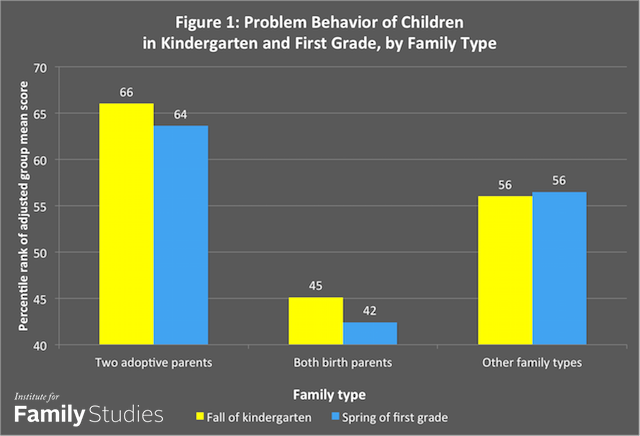
[…]Kindergarten and first-grade teachers were asked to rate the classroom behavior of children in the ECLS-K sample—how well they got along with other children in a group situation. In both the fall of kindergarten and the spring of first grade, adopted children were more likely than biological ones to be reported to get angry easily and often argue or fight with other students.

Here’s the first chart:

Adopted kids struggle in school
Adopted kids more likely to engage in problem behaviors

And more results:

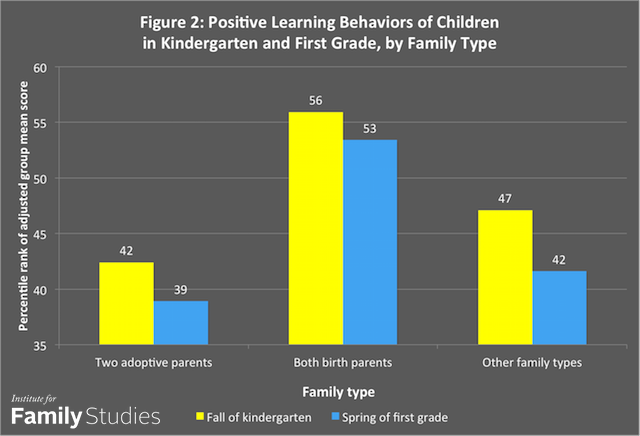
Children in the ECLS-K were also rated by their teachers on how well they paid attention in class, whether they seemed eager to learn new things, and whether they persisted at challenging learning tasks. Scores on these measures have proven to be predictive of later academic performance and career success beyond elementary school.5 Adopted children were rated less highly with respect to such positive approaches to learning than were children being raised by both birth parents.

Here’s the second chart:

Adopted kids struggle to pay attention in class

And even more results:

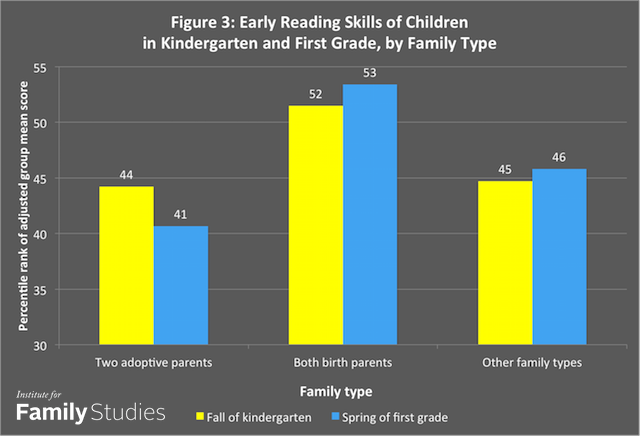
As the participating children began kindergarten, the ECLS-K assessed their pre-reading skills, such as recognizing letters by name, associating sounds with letters, identifying simple words by sight.

Here’s the third chart:

Adopted kids struggle with reading skills

And now math results:

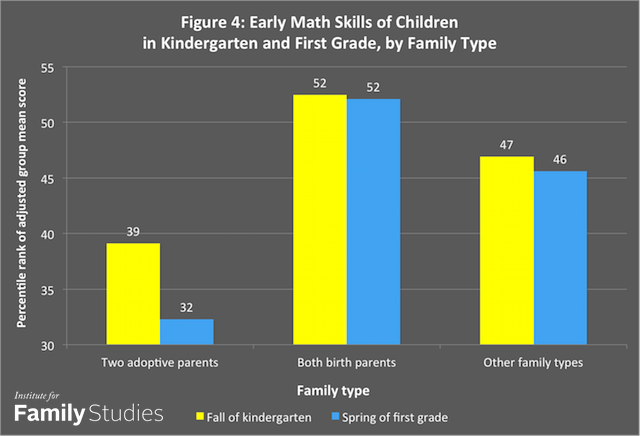
In the fall of their kindergarten year, the ECLS-K assessed children’s pre-arithmetic skills like counting by rote, recognizing written numerals, and understanding greater, lesser, and equal relationships.

Here’s the fourth chart:

Adopted kids struggle with math skills

The article concludes:

Attachment theory holds that a warm, intimate, and continuous relationship with at least one adult, usually the mother, is essential for the mental health of infants and young children. Children who do not develop a stable and secure bond during early childhood, or have the bond disrupted, are subject to both short-term distress reactions and longer-term abnormalities in their feelings and behavior toward other people. Not having a stable maternal bond is apt to produce long-lasting deficits in the child’s social development, deficiencies that are not easily remedied by a new home environment, no matter how favorable.

Some adopted children experienced neglect, abuse, or other stressful events prior to their adoption. According to traumatic stress theory, the likelihood of long-term emotional scars depends on the intensity and duration of the stress. Severe or prolonged early stress can have long-lasting effects on a child’s development, effects that a supportive adoptive family may only partly ameliorate.

So what do I want to say about this? I want to warn young women, especially young Christian women, that children work best when grown-ups plan their lives in such a way that they can provide for what the children need, at the time they need it. And if you miss the window of opportunity to have your own kids and raise them yourself, then you can’t just fix it at the last minute with ad hoc alternatives.

But for some reason, I get a lot of kickback from young women when I tell them what studies say about things like marriage, premarital sex, cohabitation, infertility, day care, and on and on and on. The Christian women in particular dismiss all the facts with stuff like:

God is leading me to choose fun and thrills now. That’s what my feelings say (and all my friends and family tell me that my feelings are God speaking to me). Tingles and peer-approval rationalize my choice to delay marriage and child-bearing. Who cares about stuff evidence? I don’t like to hear about constraints and deadlines. So I’ll just keep up this plan to run up debts, go on missionary trips, and have fun traveling till I’m 90 years old. God always calls people to do what feels good. I’m going on an adventure! And it will be easy to find a good husband and raise happy and effective kids later – whenever I feel like it. Er, I mean when God leads me to feel like it. Yeah.

So even though all of these studies show the need for timings, pre-conditions, best practices, and so on, that can all be dismissed because the feelings are God speaking to her, and God can somehow magically make all the data not apply to her. One of my married friends once wrote to a young, single fun-seeking feminist telling her about the risks of delaying marriage and child-bearing for too long, and the fun-seeker came back to me dismissing the whole letter because “I don’t like the feeling that I am being constrained”. So, the advice of old Christian women (Titus 2:4) can be dismissed because the young adventurous feminist didn’t like the feeling of being confronted by reality by someone who had more wisdom and experience than she did.

What young children need is their mom, and a Dad who can provide for her to stay home during the crucial first 5 years of their lives. That is more important than pursuing fun and thrills, then grabbing for children as if they were handbags at the last second after natural child-bearing becomes impossible. The right thing to do is to use your 20s preparing financially and otherwise to have kids when you are young, and to be financially set up to stay home with them during the critical years. Choosing a man who can provide, and who understands the best practices for having and raising children is vital, if you want your children to be effective and influential for Christ and his kingdom.

I do think that if a couple is intentionally adopting because they want the challenge and want to help a child who really needs it, then it’s praiseworthy to do that. I just don’t want someone who isn’t ready for the challenge thinking that adoption is the same, so they can delay marriage and children.I know that I am lazy, and I always want to do things the easy way. E.g. – I buy new cars, not used cars. I will buy hand-fed birds, not rescue birds. I would buy a new house, not a fixer-upper. I’m just not cut out for doing things that are hard. I have no ability to struggle through when there is resistance. When I face rejection or resistance to trying to grow or lead someone, I just give up. I think what I was saying to young women was – don’t delay marriage and child-bearing, you’ll get better results with less work.

Related posts