Women who lost their virginity as young teenagers are more likely to divorce – especially if it was unwanted, according to new research.
The University of Iowa study shows that 31 per cent of women who had sex for the first time as teens divorced within five years, and 47 per cent within 10 years.
Among women who delayed sex until adulthood, 15 per cent divorced at five years, compared to 27 per cent at 10 years.
The findings were published in the April issue of the Journal of Marriage and Family.
Author Anthony Paik, associate professor of sociology in the university’s College of Liberal Arts and Sciences, examined the responses of 3,793 married and divorced women to the 2002 National Survey of Family Growth.
The study showed, however, that if a young woman made the choice to lose her virginity as a teenager, there was no direct link to a marital split later in life.
If the sexual act took place before the age of 16 women were shown more likely to divorce, even if it was wanted.
Thirty-one percent of women who lost their virginity during adolescence had premarital sex with multiple partners, compared to 24 per cent of those who waited.
Twenty-nine percent experienced premarital conceptions, versus 15 percent who waited.
One in four women who had sex as a teen had a baby before they were married, compared to only one in ten who waited until adulthood.
Only one per cent of women surveyed said they chose to have sex at age 13 or younger, compared to five per cent at age 14 or 15, and 10 per cent at age 16 or 17.
Forty two per cent reported that their first sexual intercourse before age 18 that was not completely wanted.
Fifty eight per cent of the group waited until age 18 or older to have sex. Of those, 22 per cent said it was unwanted, compared to 21 per cent who said it was wanted.
Researchers concluded sex itself may not increase the probability of divorce, while factors such as a higher number of sexual partners, pregnancy, or out-of-wedlock birth increased the risk for some.
If you want a stable marriage, then you don’t have sex before you’re married. There are tons of virgins out there, and there is a huge difference in the quality of romantic relationships when both parties exercise self-control with physical touching. Don’t let it go too far – you lose some of what love and marriage can be.
This is the most thorough study that I have ever seen evaluating the effectiveness of pre-K programs. The study was done by researchers at Vanderbilt University.
The study was reported on by the well-respected but leftist Brookings Institute.
They write:
State investments in center-based school readiness programs for preschoolers (pre-K), whether targeted for poor children or universally implemented, have expanded more rapidly than evaluations of their effects. Given the current interest and continuing expansion of state funded pre-K, it is especially important to be clear about the nature of the available evidence for the effectiveness of such programs. Despite widespread claims about proven benefits from pre-K, there is actually strikingly little credible research about the effectiveness of public pre-K programs scaled for statewide implementation.
Like many states that became interested in scaling up a state funded pre-K program in the early 2000’s, voluntary pre-K (TNVPK) was introduced in Tennessee in 1996 as a way to provide academic enhancement to economically disadvantaged children. It expanded in 2005 to an $85 million-plus statewide investment serving 18,000 Tennessee income-eligible children in 935 classrooms across all 95 counties.
Launched in 2009, the TNVPK Effectiveness Study, a coordinated effort between Vanderbilt’s Peabody Research Institute and the Tennessee Department of Education, is a five-year evaluation study funded by the US Department of Education, Institute for Education Sciences. It includes the first randomized control trial of a scaled up state funded pre-K program and the first well-controlled comparison group study of the effects of program participation as children progress through elementary school..
Policymakers and proponents often cite some of the famous early studies of pre-K programs that have shown long term benefits extending into adulthood for the participating children. But those were studies of especially complex programs that are unlike scaled-up public pre-K in many ways. The Vanderbilt study is the first rigorous controlled longitudinal study to be conducted on a large-scale state-funded pre-K program.
And here is a summary of the results:
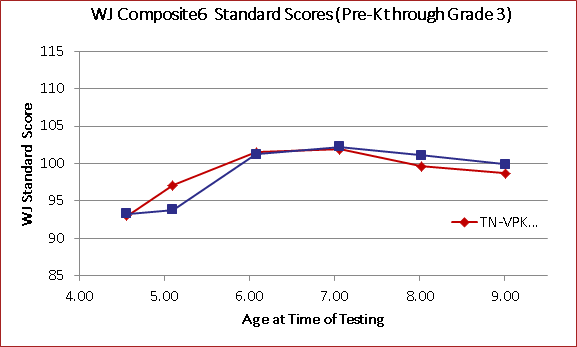
Standard score results from pre-K through 3rd grade on a composite measure that averaged the six achievement subtests are presented from baseline forward in the graph below.
As is evident, pre-K and control children started the pre-K year at virtually identical levels. The TNVPK children were substantially ahead of the control group children at the end of the pre-K year (age 5 in the graph). By the end of kindergarten (age 6 in the graph), the control children had caught up to the TNVPK children, and there were no longer significant differences between them on any achievement measures. The same result was obtained at the end of first grade using two composite achievement measures (the second created with the addition of two more WJIII subtests appropriate for the later grades). In second grade, however, the groups began to diverge with the TNVPK children scoring lower than the control children on most of the measures. The differences were significant on both achievement composite measures and on the math subtests. Differences favoring the control persisted through the end of third grade.
In terms of behavioral effects, in the spring the first grade teachers reversed the fall kindergarten teacher ratings. First grade teachers rated the TNVPK children as less well prepared for school, having poorer work skills in the classrooms, and feeling more negative about school. It is notable that these ratings preceded the downward achievement trend we found for VPK children in second and third grades. The second and third grade teachers rated the behaviors and feelings of children in the two groups as the same; there was a small positive finding for peer relations favoring the TNVPK children by third grade teachers, which did not meet traditional levels of statistical significance.
Results graph:
TNVPK data: pre-K program is in red, baseline is in blue
We are already seeing that cheap daycare in high-tax, big government provinces like Quebec cost a lot, and produce negative results. And of course Hillary Clinton is a longstanding advocate of universal pre-K. As a Senator of New York, she introduced a universal pre-K plan that would cost $10 billion over 5 years. President Barack Obama’s own Preschool for All plan would cost $75 billion over 10 years. This Vanderbilt study should cause us to question whether the policies of the secular left, pushed largely because of emotions and ideology, are worth the tens of billions of dollars they want to take from us. And if you take tens of billions of dollars out of families, then families on the margin will have to give their children to the state to raise. And that includes Christian families, who would no longer be able to afford a stay-at-home mother.
Now, taking children away from parents so that their mothers can work is seen as a worthy goal by those on the secular left. First, communally raising the children is “good” because it removes inequalities between single mothers and traditional working-husband homes. Second, making it easier for women to “go fatherless” is “good” because fathers are not to be trusted to teach their children about morality and religion. That is best left to secular government workers. Third, mothers who choose to marry good providers pay less in taxes if they choose to stay home with their kids and not work. That is “bad” because the government wants more taxes, so they can spend it on vote-buying social programs. Fourth, children who form stable bonds with their parents are less likely to become dependent on the government, meaning their allegiance cannot be bought with government handouts. That is also “bad”. Fifth, it is also “bad” that children who grow up with stay-at-home mothers are more likely to develop empathy and morality, which gives them an independent standard by which to judge the government’s actions.
Man helping a woman with proper handgun marksmanship
Brad Wilcox tweeted this article from Family Studies that talks about how the number of pre-marital sex partners that a woman has increases her risk of divorce.
It says:
American sexual behavior is much different than it used to be. Today, most Americans think premarital sex is okay, and will have three or more sexual partners before marrying. What, if anything, does premarital sex have to do with marital stability?
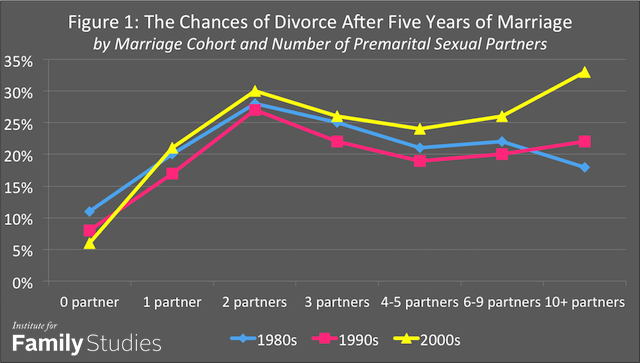
This research brief shows that the relationship between divorce and the number of sexual partners women have prior to marriage is complex. I explore this relationship using data from the three most recent waves of the National Survey of Family Growth (NSFG) collected in 2002, 2006-2010, and 2011-2013. For women marrying since the start of the new millennium:
Women with 10 or more partners were the most likely to divorce, but this only became true in recent years;
Women with 3-9 partners were less likely to divorce than women with 2 partners; and,
Women with 0-1 partners were the least likely to divorce.
Earlier research found that having multiple sex partners prior to marriage could lead to less happy marriages, and often increased the odds of divorce.
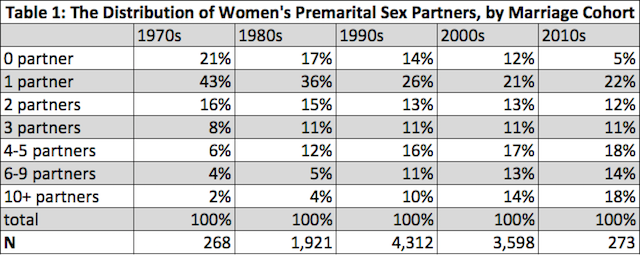
[…]Even more noteworthy has been the decline in the proportion of women who get married having had only one sex partner (in most cases, their future husbands). Forty-three percent of women had just one premarital sex partner in the 1970s.
[…]By the 2010s, only 5 percent of new brides were virgins. At the other end of the distribution, the number of future wives who had ten or more sex partners increased from 2 percent in the 1970s to 14 percent in the 2000s, and then to 18 percent in the 2010s. Overall, American women are far more likely to have had multiple premarital sex partners in recent years (unfortunately, the NSFG doesn’t have full data on men’s premarital sexual behavior, and in any event they recall their own marital histories less reliably than do women).
Here’s the change:
Women have freely chosen to dismiss the Bible and the moral law
And the problem with this, of course, is that more premarital sex partners means a higher risk of divorce:
Even one non-husband premarital sex partner raises risk of divorce
Why is the 2-partner number so high?
In most cases, a woman’s two premarital sex partners include her future husband and one other man. That second sex partner is first-hand proof of a sexual alternative to one’s husband. These sexual experiences convince women that sex outside of wedlock is indeed a possibility. The man involved was likely to have become a partner in the course of a serious relationship—women inclined to hook up will have had more than two premarital partners—thereby emphasizing the seriousness of the alternative.
The woman has an alternative, the woman makes comparisons, the woman has firsthand experience of sex with someone other than her eventual husband. This is not trivial, it should not be dismissed by men who are evaluating marriage candidates.
I was really glad to see Dr. Wilcox tweet this article, because a lot of men’s rights people judge him unfairly for being blindly pro-marriage, as if he doesn’t see the risks to men. No, he sees those risks, and he warns men about them, and he holds women accountable. He is saying to women: if you want your marriage to last, you are responsible to study this research, to say no to your heart, to resist the culture, and to make wise decisions to protect your future husband and children.
Now, many traditional marriage people will tell young men “feminism and the sexual revolution change nothing, go out there and get married to these women anyway”. No one condemns women for their unilateral decision to believe in radical feminism, and their decisions to act against the moral laws by having premarital sex. It’s like the Bible has no authority for men – it can only be used to tell men what to do. I have met pastors and parents who have this double standard that excuses women from everything, and blames and shames men for everything. Even if the men are virgins, they are blamed and shamed by pastors and parents when the woman’s poor choices do not “work out” for her.
The culture is filled with voices who rationalize women who choose to get drunk and hook up with good-looking men, including from the pulpits of churches. Few people are aware of the logical consequences of selfish actions. There is just this view that it is a terrible, horrible thing to stifle the freedom of women to “follow their hearts”. Pastors and Christian parents feel that it is wrong to tell young women that the Bible somehow should act as a brake on their desires to have feelings with a man, and to show off a boyfriend to their friends, and to have fun – to have a good time now, in the moment. I have seen these conversations happening, where grown-ups who claim to be Bible believing Christians condemn men for not manning-up to rescue women in one breath, and then admit that those women should not be shamed or judged for not having any moral compass. It’s enough that the women look pretty – that makes them “Christian”, regardless of their past selfishness. No one cares about the risks that a man will face by having to take on that damage.
Previously, I blogged about how most divorces are initiated by women. If you are a man who has made good decisions with his education and finances, you need to be aware of this research. Although you may think that it’s harmless that the woman you want to marry has had multiple premarital sex partners, it’s not. It will affect her ability to be attracted to you, and to be satisfied by you. According to my friend Dina, previous cohabitations should be treated by men as a previous divorce. And previous divorces make a woman more unstable for marriage – that’s a fact. And divorce is risky for men financially and emotionally – another fact. Men didn’t ask to live in a world where they can lose all their savings, future income, and access to their children should their wives become unhappy and decide to divorce them – but that is the world that men live in.
I would like to see women make better decisions with men before they marry, rather than be influenced by their peers and culture to give themselves to men who are not marriage-minded. Maybe a little skepticism should be shown to “follow your heart”? Women need to understand what they are losing when they choose to have premarital sex.
In my group of friends, the men are aware of the Biblical prohibition on premarital sex. My friends know about the research on marriage, and what it takes to make a marriage work. We don’t follow our hearts, because we do what we know will work to achieve the results we want. We don’t listen to the culture, and we don’t listen to radical feminists. Men generally take an engineering approach to marriage – we want to know what the best practices and tradeoffs are, and then we plan and act to succeed.



 WINTERY KNIGHT