Tag Archives: Feminism

Study: government-run pre-school programs fail to produce expected results

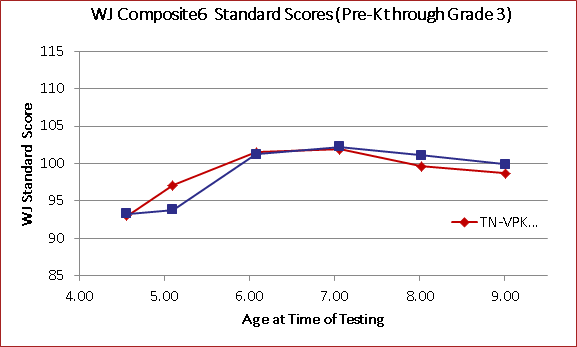
TNVPK data: pre-K program is in red, baseline is in blue

The Heritage Foundation talks about three recent studies on government-run pre-K programs.

The Head Start Impact Study. In late 2012, the Department of Health and Human Services released the Head Start Impact Study, a scientifically rigorous evaluation that tracked 5,000 three-year-old and four-year-old children through the end of third grade. The study found little to no impact on the parenting practices or the cognitive, social-emotional, and health outcomes of participants. Notably, on a few measures, access to Head Start had harmful effects on participating children.[7] For both the three-year-old and four-year-old cohorts, access to Head Start had no statistically measurable effects on any measure of cognitive ability, including reading, language, and math.[8] In other words, by the time they finished third grade, there was no difference between those children who attended Head Start and the control group of their peers who did not.

Vanderbilt Tennessee Voluntary Pre-K Study. In 2015, a team of researchers from Vanderbilt University released an evaluation of Tennessee’s Voluntary Pre-K (VPK) Program, a state-subsidized preschool program open to low-income children in the state. Some 18,000 children participate in the program, which was introduced in 1996. Proponents have long claimed Tennessee’s VPK program is a model state-based preschool program, with standards aligned to the Obama Administration’s Preschool for All initiative.[9] Teachers must be licensed, the child-adult ratio is limited to 10:1, and a structured “age-appropriate” curriculum must be used in classrooms. The program is available first to children from low-income Tennessee families, and then, space permitting, to children with special needs and children with limited English proficiency, among other children deemed “at-risk.” An earlier evaluation found that gains made by participating four-year-olds had faded by kindergarten. In a follow-up evaluation released in September 2015, Mark Lipsey, Dale Farrar, and Kerry Hofer reported that there were no sustained benefits for the same children through the end of third grade.[10]

[…]The authors analyzed the VPK program’s impact on children’s math skills, emergent literacy, and language skills, as well as the program’s impact on non-cognitive measures, such as behavior. “By the end of kindergarten, the control children had caught up to the TN-VPK children and there were no longer significant differences between them on any achievement measures. The same result was obtained at the end of first grade using both composite achievement measures.” And notably, by second grade, “the groups began to diverge with the TN-VPK children scoring lower than the control children on most of the measures. The differences were significant on both achievement composite measures and on the math subtests.” “Pre-K was generally thought to be better than Head Start, but that doesn’t seem to be the case in Tennessee,” stated University of California, Berkeley professor David L. Kirp in The New York Times.[11]

The findings of the TN-VPK program were not limited to academic outcomes. As Lipsey et al. explain:

In terms of behavioral effects, in the spring the first grade teachers reversed the fall kindergarten teacher ratings. First grade teachers rated the TN-VPK children as less well prepared for school, having poorer work skills in the classrooms, and feeling more negative about school. It is notable that these ratings preceded the downward achievement trend we found for VPK children in second and third grades.[12]

Quebec’s Negative Non-cognitive Results. The province of Quebec introduced universal low-cost day care for children through age four beginning in 1997. The program has had a large impact: privately funded child care arrangements have almost disappeared, and Quebec has the highest rate of subsidized child care in Canada, at 58 percent in 2011.[13] The program caused a 14.5 percent increase in the share of mothers of young children working outside the home.[14] The Quebec experience offers more guidance for the potential introduction of universal child care than small, targeted programs, because it implicitly includes indirect effects on non-participants and any general equilibrium effects due to the drastic shift in the way child care was funded and conducted.

Regrettably, new research has found that children who became eligible for the program in Quebec were more anxious as children and have committed more crimes as teenagers. The availability of day care clearly worsened children’s non-cognitive “soft” skills.

Michael Baker, Jonathan Gruber, and Kevin Milligan found that children exposed to the program were 4.6 percent more likely to be convicted of a crime and 17 percent more likely to commit a drug crime. Their health and life satisfaction were worse.

The programs are sold as a way of improving children’s abilities, but the studies show that it doesn’t work that way. So why do we have these programs?

Democrats like these programs because they transfer wealth from taxpayers to government, hire more government workers, and get children away from the “harmful” influence of their parents. It allows the government workers to push the agenda of the wealthy donors who back the Democrat politicians, e.g. – the abortion providers, the gay rights activists, the terrorism apologists, the global warming alarmists, the radical feminists, the socialist wealth redistributors, etc.

New study: working longer hours harms women, but protects men

My favorite painting: "Godspeed" by Edmund Blair Leighton, 1900
My favorite painting: “Godspeed” by Edmund Blair Leighton, 1900

This is from the UK Telegraph, and it’s a nice confirmation of sex differences.

Excerpt:

Women who put in long hours in their careers greatly increase their risk of developing life-threatening illnesses, including heart disease and cancer, a new study has shown.

Work weeks that averaged 60 hours per week or more over three decades were found to triple the risk of diabetes, cancer, heart trouble and arthritis, according to new research from The Ohio State University.

The risk begins to climb when women put in more than 40 hours and takes a decidedly bad turn above 50 hours, researchers found.

Crucially the same pattern was not seen in men. In fact, they got healthier the longer they worked.

[…]Men who worked long hours had a higher incidence of arthritis, but none of the other chronic diseases.

Surprisingly, those men who worked moderately long hours, 41 to 50 hours weekly,  had lower risk of heart disease, lung disease and depression than those who worked 40 hours or fewer.

[…]The research was published in the Journal of Occupational and Environmental Medicine.

Recently, I was very much in love with a woman I’ll call Gertrude and I can remember thinking often about how much I wanted to work so that she wouldn’t have to work. I wanted to go out there every day and make money for us both, so that she wouldn’t have to face the world and all the pressures and difficulties of a job. I wanted her to stay safe at home and make the home comfortable and raise children who would respect their father and know and serve the Lord. There is something inside a man that translates love into “wanting to take away trouble from his woman”, and that was a very strong feeling for me at the time. I did not mind that she worked before we married and before children arrived. I did not mind that she pursued advanced degrees after marriage, did things in the community, or organized Christian events at the university. I just didn’t want her to have to face work. I wanted to protect and provide for her, and rescue her from work.

I think more women are expected to work today because government is so big that more taxes and more debt are needed to fund all the programs. That makes marriage and family harder to do on one man’s salary. This also might be one reason why men are reluctant to marry. Every man knows for certain that a woman who does not work makes a gentler and more faithful wife and mother. A woman who works is inevitably going to have more stress, which makes being a good wife and mother harder. Women who work also cheat on their husbands more than women who don’t work. My friend Dina tells me that about 90% of the women she works with withhold sex from their husbands, and many of those husbands have tuned out of the marriage, as a result of not getting their needs met. Some have gone on to have affairs, and that’s to be expected, especially if the woman chose a man who had recreational premarital sex before she married him.

The bottom line is that through their voting and life decisions, women often create the very problems that they later blame on men. A little wisdom would go a long way.

Study of elementary school children finds entrenched discrimination against boys

The study is here (PDF), and Susan Walsh writes about the study on her blog.

Excerpt:

A new study of nearly 6,000 elementary school children has found that boys are discriminated against beginning in kindergarten. Christopher Cornwell, an economics professor at the University of Georgia, says that ”gender disparities in teacher grades start early and uniformly favor girls.”

Despite having higher scores on standardized tests, boys get lower grades than girls. Why? Because teachers are basing grades at least partly on classroom behavior, and the standards are very much geared to female norms.

[…]Here’s what the disparity looks like for kindergarten boys:

Std. Deviation Test Scores Grades
Reading -.017 -.27
Math +.02 -.15
Science +.035 -.14

(Note: Values are approx., gauged visually from study graphic.)

Another interesting finding was that boys who adhere to female norms on non-cognitive skills were not penalized. Effectively, the more female behavior was rewarded with a grade “bonus” for males.

The implications of this are obvious. Masculinity, even normal maleness, is being punished in schools from a very young age. Only the most female-acting boys are rewarded with a fair assessment.

I found this story on Stuart Schnederman’s blog, and this is what he had to say about it:

The results demonstrated that schoolteachers are prejudiced against boys. When teachers do not just grade on performance, but include a number of intangible qualities that girls are more likely to possess, they are acting as bigots.

I recommend that everyone pick up a copy of “The War Against Boys” by AEI scholar Christina Hoff Sommers to learn more about this anti-male discrimination problem.

I see a lot of people raving at men to “man up” these days. Many of those people are pastors who remain ignorant about the real, systemic causes of male underachievement. Even very obvious factors – like the dominance of female teachers and administrators in schools – are ignored by the blame-men crowd. Boys generally learn better when they learn from male teachers in all-male classrooms. But unfortunately for boys, there are people who don’t want to do what works for men, especially when it doesn’t fit with feminist ideology.