
Tag Archives: Feelings

New study: children of working single mothers are 25% more likely to be obese

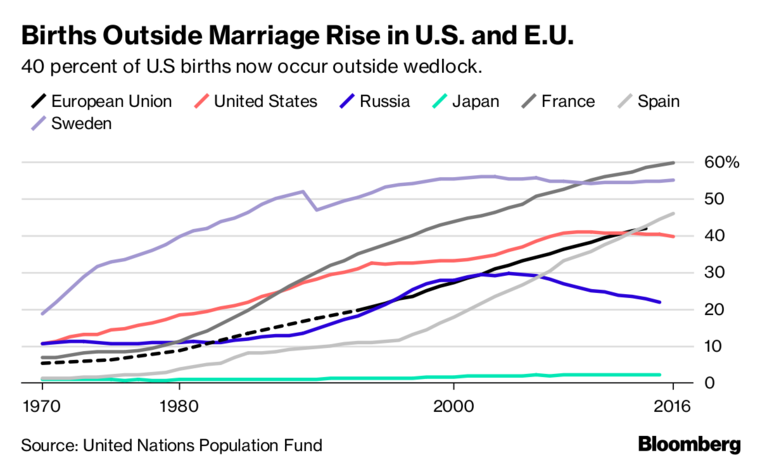
Out-of-wedlocks births rising as cohabitation replaces marriage

It’s getting to be very common for women to have children out of wedlock, especially since many countries increase welfare programs design to encourage single motherhood. That’s because of feminism, which encourages women to ignore the traditional male virtues, like commitment, and tradional commitment itself (because marriage is “sexist”). But do children do well in the fatherless homes created by feminism and welfare?

Here’s a recent study reported in the UK Sun. (H/T Thomas)

Excerpt:

SCIENTISTS have laid the blame for Britain’s childhood obesity epidemic at the door of working mothers, in a new study.

The shocking findings also claim the kids of mums who work are negatively affected – whereas the father’s employment appears to have no “significant effect”.

A study carried out by University College London looked at 20,000 families, and is the first to link mums who work to the weight of their children.

Professor Emla Fitzsimons told The Sunday Times: “We find that children whose mothers work are more likely to have increased sedentary behaviour and poorer dietary habits.”

Researchers said the bizarre findings were more obvious for single mums who work full-time, but also revealed a pattern with mums who work and have a partner.

But the study added it doesn’t matter if mums work full-time or part-time, their child is still more likely to be fatter than that of a non working mum.

It describes obesity as “the most common chronic disease of childhood and likely to persist into adulthood with far-reaching effects”.

And found teens and children have gained weight over the past four decades along with a rise in working mums – with kids of single working mothers 25 per cent more likely to be overweight.

It suggested kids of mums who work full time are 29 per cent less likely to eat a regular breakfast and 19 per cent more likely to watch TV for more than three hours a day.

The UK is one of the countries that most strongly embraced feminism, and sought to encourage fatherlessness with unfair divorce laws, unfair divorce courts, and generous benefits for women who divorced with kids or never bothered to even marry before having kids. It’s common now for UK single mothers to just have sex with the hottest guys they can find, knock out babies with all the different “fathers”, and sit back and collect welfare. Welfare funded by the ever-shrinking supply of working husbands, who typically earn the most, and therefore pay the most in taxes.

But’s not just working SINGLE mothers who have problems.

The UK Daily Mail (reporting on the same study) notes that the increase in obese children mirrors the growth in women working part-time or full-time outside the home:

[…][T]he dramatic increase in the numbers of obese children and teenagers over the past four decades had been accompanied by a similarly sharp rise in the employment of mothers.

In the UK, the proportion of working mothers with children under the age of five rose from 31 per cent in 1980 to 58 per cent in 2008.

The UK prioritized getting women out of the home and working, and handing children off to day cares and public schools. Even the conservative party refused to give women a tax incentive to raise their young children. They gave the tax credit to working mothers instead, encouraging more women to abandon their children for work.

The Root Cause of the Problem

We really need to discourage women from starting up relationships with men who aren’t interested in commitment. When women treat relationships as a source of “fun” instead of as an enterprise aimed at commitment and stability, they often end up raising fatherless kids. The problems begin with the woman’s choice of man, and her purpose for the relationship. If she expects the relationship to be about entertaining her, then she will choose an entertaining man. One who doesn’t expect her to do anything she doesn’t feel like doing, and has no particular plan for her, or raising children well.

Many women today, even Christian women, love to laugh and scorn the idea that there are any “best practices” for relationships. They know everything there is to know – without having to read any studies that might force them to control their desires and make plans to succeed that involve self-denial and wisdom. But if you ignore the studies, you can be certain that you and your children will pay the price. There’s no sense expect hunky fun bad boys to “man up” after you’ve already given them premarital sex. The time to get men to act like a man is when the woman chooses who to have a relationship with. If you choose a MAN, who protects, provides and leads on moral and spiritual issues, then you get a REAL MAN who is already MANNED UP.

The solution to problems like abortion and fatherless children is to encourage young women to make better decisions when choosing men for relationships – and to prioritize marriage as the goal of their relationships, too. It would be nice if pastors preached a little self-control, chastity and anti-feminism to women in churches. So far, though, I’ve never seen it. The Christian church approach to the problems caused by fatherlessness seems to be “let women make poor choices, then tell them it’s not their fault, then blame men”.


Study: women seeking to have a child should start before age 32

Brain vs Heart, from: theawkwardyeti.com

Dina sent me this sobering piece of research from the New Scientist which is perfect for all the young feminists who have been taught in college that marriage should be put off, and women can easily get pregnant after age 40.

Excerpt:

It’s a question many people will ask themselves at some point in their lives: when should I start a family? If you know how many children you’d like, and whether or not you would consider, or could afford, IVF, a computer model can suggest when to start trying for your first child.

Happy with just one? The model recommends you get started by age 32 to have a 90 per cent chance of realising your dream without IVF. A brood of three would mean starting by age 23 to have the same chance of success. Wait until 35 and the odds are 50:50 (see “When to get started”).

The suggestions are based on averages pulled from a swathe of data so don’t give a personal prediction. And of course, things aren’t this simple in real life – if only family size and feelings about IVF were the only factors to consider when planning a family. But the idea behind the model is to help people make a decision by condensing all the information out there into an accessible form.

“We have tried to fill a missing link in the decision-making process,” says Dik Habbema at Erasmus University in Rotterdam, the Netherlands, one of the creators of the model. “My son is 35 and many of his friends have a problem deciding when to have children because there are so many things they want to do.”

It’s a scenario that will be familiar to many; the age at which people have their first child has been creeping up over the last 40 or so years. For example, the average age at which a woman has her first child is 28 in the UK and has reached 30 in Italy, Spain and Switzerland. In the US, the birth rate for women in their 20s has hit a record low, while the figures for those over 35 have increased over the last few decades.

The decision is more pressing for women thanks to their limited supply of eggs, which steadily drop in quantity and quality with age. Female fertility is thought to start declining at 30, with a more significant fall after the age of 35.

[…]The new model incorporates data from studies that assess how fertility naturally declines with age. The team took information on natural fertility from population data collected over 300 years up to the 1970s, which includes data on 58,000 women.

I have often tried to talk to young women about the need to get their lives in gear. I advise them to work summers during high school, obtain a STEM degree in university, minimize borrowing money by going to community college for the generic prerequisites, don’t have premarital sex, get a job related to their STEM field straight out of college, pay off their debts, move out of their parents’ house, start investing from the first paycheck, marry between age 25-30, and then start having children after the first two “stabilizing” years of marriage. This is sound advice, rooted in my careful reconnaissance of the things that human beings care about and need in their old age. This advice is not bullying, it comes from reading many, many relevant papers. It comes from putting the knowledge gained from reading the papers into practice, and seeing results where appropriate.

I am giving you the numbers. Straight out of a peer-reviewed study. Don’t follow your heart. Don’t listen to your friends. Follow the science. Make your decisions within the boundaries of reality. God will not save you from foolish decisions.

Related posts

Why don’t men go to church anymore? The decline of male church attendance

Church sucks, that's why men are bored there
Church sucks, that’s why men are bored there

I most recently spent half a year at a PCA church, and then another half a year at a Southern Baptist church. I attended Sunday services as well as Wednesday night Bible study. I am now looking for a new church. For now, I just look around for a sermon I like and listen to that. In this post, I’ll explain why I think men don’t like church.

There are three areas where churches fail to attract men:

    1. Apologetics
    2. Feminism, sex and marriage
    3. Policy and current events

Apologetics

The PCA church discouraged me from becoming a member of the church because they said that conversion to Christianity due to reason and evidence was contrary to their teachings, and a “red flag”. Their words. I didn’t try to fight them on it, because they are Reformed Presbyterian, and this is their actual view. Their approach to apologetics was “pre-suppositional”, which is to say, they try to convince people to become Christians by asking them to assume that the Bible is infallible, without any argumentation or evidence. Naturally, this doesn’t work, so they aren’t trained to answer any serious questions from non-Christians. (1 Pet 3:15-16)

The Reformed Baptist SBC church is led by people like Russell Moore and Al Mohler, who take the “magic words” approach to evangelism. I.e. – they think that people become Christians just by speaking Bible verses out of context to them. So, when the atheist asks “do you have any evidence for God’s existence?” or “do you have any evidence for Jesus’ resurrection?”, their response is to quote Bible verses to the atheist, which have nothing to do with those topics. Christianity has lost so much influence in the culture under their approach, which is not even Biblical. (Mat 12:38–41)

These approaches to evangelism are not used in any other area of human endeavor. No one replies to questions about auto mechanics, or software engineering, or gardening, or cooking, by spouting Bible verses. In literally every other area of human endeavor, the laws of logic and supporting evidence are seen as assets when making claims to know something about the world to someone who disagrees with you.

Feminism, Sex and Marriage

First wave feminism simply asked for women to be given the same liberty and opportunity as men. That was good. But later versions of destroyed all distinctions between men and women. By destroying femininity, feminism directed women away from the traditional life plan of marriage, children and home-making.

Feminism changed how women voted. Today, about 75% of young, unmarried women vote for policies like taxpayer-funded birth control, taxpayer-funded abortion, no-fault divorce, affirmative action for women in schools and in the workplace, taxpayer-funded daycare, public schools, single-mother welfare, social security, etc. These policies and programs raised tax rates, and grew government, making it easier for women to have children without having to choose a marriage-ready man she wasn’t attracted to. Instead, she could choose men she was attracted to, and just use government programs as a substitute provider if it didn’t “work out”. Thanks to feminism, we have a 42% out-of-wedlock birth rate, and it’s rising. Few female college graduates are debt-free. About 5% of women emerge from college as virgins.

Under feminism, the traditional male roles and virtues were deemed “sexist”. Women were shamed for choosing early marriage, large families, and stable men who were good at being husbands and fathers. Instead, women today chose men based on appearance. They spend their 20s and early 30s giving men who will not commit to them premarital sex. The men who are getting sex thrown at them have no interest in Judeo-Christian values, chastity, fidelity, commitment or raising children. Women mistake the men’s willingness to have sex and cohabitate as signs that they are close to marriage. But in fact, chasing the hot bad boys just eats up the chastity, youth and beauty that could have made them interesting to the marriage-minded men they scorned. Later on, they realize that they’ve wasted their 20s on bad boys, but by then they are not attractive for marriage.

What has the response been to feminism from pastors and churches? They accept the anti-male, anti-marriage policies, that came out of feminism. They accept the promiscuity, and the marriage-delaying that came from feminism. Today, pastors just try to bully the men who were passed over to marry the women who had previously rejected them, despite the higher risk of divorce caused by the women’s past behavior.

Policy and current events

Most pastors are anti-intellectual, and they believe that this is a virtue, since they are focused narrowly on what the Bible explicitly says. Because of this, they aren’t able to understand which laws and policies allow Christianity and Christian families to flourish. I agree that what the Bible speaks about is of the highest importance. But we need to understand how to achieve the goals that the Bible states, as well as how to counter the forces that threaten the achievement of those goals.

For example, Christianity thrives when marriage thrives. Christianity is passed on from parents to children. Anything that threatens marriage, or interferes with parental authority, weakens the influence of Christianity. So, policies like higher taxes, no-fault divorce, SOGI laws, all harm the Christian family, while policies like lower taxes, protections for Christian businesses, protection for Christian schools (statements of faith, moral codes), etc. are all good for Christian families. But most pastors never talk about policies or laws, because they don’t think about how to defend the Christian worldview, how to educate Christian children, how to promote marriage, how promote Christian moral values in the public square. Even protecting the right to life of unborn children is ignored.

As the churches lose relevance, it becomes tempting for pastors to accept what the secular left promotes as good and true and beautiful. The big one is pastors pushing for redistribution of wealth by the secular government as a solution to “poverty”, even though the Bible only sanctions voluntary charity. This diminishes the cultural relevance of the church and elevates the secular government. SBC leaders like Russell Moore champion amnesty for refugees and unskilled illegal immigrants, not realizing how it will harm Christian institutions and values down the road to import large numbers of people who will eventually vote for policies like higher taxes, bigger government, etc.