Tag Archives: Faith

New study on tidal heating strengthens stellar habitability argument

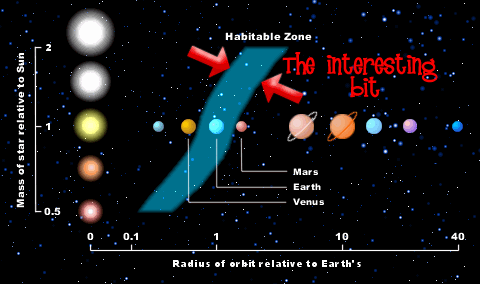
Circumstellar Habitable Zone

Note: If you need a refresher on the habitability argument, click here.

Here’s an article entitled “Tidal heating shrinks the ‘goldilocks zone’: Overlooked factor suggests fewer habitable planets than thought”. It appeared in Nature, the most prestigious peer-reviewed science journal.

The gist of it is that tidal forces can alter orbits so that planets don’t spend all of their orbit in the habitable zone. If planets go outside the habitable zone, it damages their supply of liquid water, and any life chemistry going on in there is disrupted.

Excerpt:

A previously little-considered heating effect could shrink estimates of the habitable zone of the Milky Way’s most numerous class of stars — ‘M’ or red dwarfs — by up to one half, says Rory Barnes, an astrobiologist at the University of Washington in Seattle. That factor — gravitational heating via tides — suggests a menagerie of previously undreamt-of planets, on which tidal heating is a major source of internal heat. Barnes presented the work yesterday at a meeting of the American Astronomical Society’s Division on Dynamical Astronomy in Timberline Lodge, Oregon.

The habitable zone is the orbital region close enough to a star for a planet to have liquid water, but not so close that all of the water evaporates. For our Sun, the zone extends roughly from the inner edge of the orbit of Mars to the outer edge of that of Venus. For smaller, cooler stars, such as M-class dwarfs, the zone can be considerably closer to the star than Mercury is to the Sun. And because close-in planets are easier to spot than more distant ones, such stars have been a major target for planet hunters seeking Earth-like worlds.

There’s just one problem with finding habitable planets around such stars, says Barnes. Because tidal forces vary dramatically with the distance between a planet and its star, closer orbits also result in massively larger tidal forces.

Since planets do not have perfectly circular orbits, these tidal forces cause the planet to flex and unflex each time it moves closer to or further from its star; kneading its interior to produce massive quantities of frictional heat. Substantial heat can be produced, he added, with even slight deviations from a perfectly circular orbit. And, Barnes notes, other factors — such as the rate of the planet’s rotation and its axial tilt — can also influence heat production.

A similar tidal process makes Jupiter’s moon Io the most volcanic body in the Solar System. “I’m just scaling that Io–Jupiter system up by a factor of 1,000 in mass,” Barnes said at the meeting. “It’s the same process, on steroids.”

So, stars that are smaller and cooler will have a habitable zone that is closer to the star, exposing them to more tidal forces. More tidal forces makes their orbits less likely to stay circular – within the habitable zone around the star. These variations cause an increase in heat production on the planet. Too much heat means that the planet is unable to support liquid water on the surface, making it inhospitable for life. Therefore, solar systems with less massive stars can be ruled out as possible sites for life, because of these tidal forces.

Lawrence Krauss debates “A Universe From Nothing” with an astrophysicist

Dina sent me news of Saturday’s episode of Unbelievable, which features Lawrence Krauss, who debated William Lane Craig. Krauss’ book was also reviewed in the New York Times.

The MP3 file is here.

Details:

Lawrence Krauss is a Cosmologist at Arizona State University who describes himself as an “anti-theist”. His latest book “A Universe From Nothing” has received both acclaim and criticism for its attempt to answer the question “Why is there something rather than nothing?” Debating the issue with Krauss is Rodney Holder, Course director at the Faraday Institute, Cambridge. An astrophysicist and priest by background. In a lively exchange they debate whether Krauss’ “nothing” is “nothing”, fine tuning and multiverses, scientific knowledge, miracles and the usefulness of theology and philosophy.

This debate is quite entertaining, and do not be intimidated if your don’t understand science. You can understand pretty easily who is arguing based on facts and who is speculating about unobservable, untestable entities. At one point, Krauss actually denies that there is any fine-tuning in the universe, so please see this link to refute that claim as well as this podcast which explains some examples of fine-tuning. Krauss gets a bit angry at the beginning, but calms down.

Quotation marks are for direct quotes, italics is for made-up snark. See below the summary for more posts that are related to this one.

Summary of the discussion: (picked up at 9:30 when they start talking about the book)

Brierley:

  • explain your theory of how the universe can come into being from nothing

Krauss:

  • the nothing that preceded the universe is “no space, no time, no universe”
  • theists say that God is responsible for creating the universe out of this nothing
  • but the laws of nature can create the universe uncaused out of nothing

Holder:

  • Krauss sometimes writes that the nothing is really a quantum vacuum, but that is not nothing
  • He even acknowledges in his book that a quantum vacuum is not nothing
  • He thinks that the nothing has properties, even though it has no being
  • It has the property of being unstable
  • It has the property of being acted on by quantum fields
  • It has the property of being acted on by gravity

Krauss:

  • But nothing can have the potential to do things inside it
  • For example suppose you have an electron, which is not nothing
  • If it jumps from one level to another, it emits light
  • There was no potential for the light in the electron, but it was there as part of atomic structure

Holder:

  • But in cases like that, there is something physical that has the potential
Krauss:
  • Well, how did God makes the universe then if it had no potential?

Holder:

  • God existed, and the potential for creating the universe in himself

Brierley:

Krauss:
  • It was written by a philosopher, so I dismissed it

Brierley:

Krauss:
  • These book reviewers have not even read my book!

Krauss:

  • Science will be able to figure out how to make something from nothing in the future
  • We are even now speculating about interesting questions, like is there a multiverse?

Brierley:

  • Consider the critical review of your book in the New York Times
  • The author of the review claims that you equivocate on the term “nothing”
  • In order to get things to pop into being, you have to make “nothing” mean “something”
  • Reviewer: none of Krauss’ theories explain how something can come from actual nothingness

Krauss:

  • In physics, something and nothing are not that different
  • The reviewer doesn’t understand the physics
  • He doesn’t understand quantum field theory
  • You could call a quantum vacuum “nothing”, (this is the vacuum fluctuation model, refuted by William Lane Craig in a peer-reviewed publication in an astrophysics journal – get the full text of the article here)
  • Maybe there is an eternally existing multiverse that we can’t observe or test scientifically
  • Maybe it has laws that we don’t know about which allow our universe to pop into being
  • Maybe this popping into being is uncaused
  • (alarmed) Who made God? Who made God?

Holder:

  • God is eternal and necessary

Krauss:

  • (interrupting, angry) What does it mean for something to be necessary?

Holder:

  • Basically, you have to decide whether there is more evidence that the necessary being God or a multiverse

Brierley:

  • So Dr. Krauss are you willing to say that the universe is a brute fact, in some sense, and requires no explanation

Krauss:

  • (angry) Religious people are stupid because they just assume brute facts, not like me and my unobservable, untestable multiverse
  • (angry) Religious people are against the progress of science, they don’t want to figure out how things work

Brierley:

  • But isn’t it possible that naturalists can be opposed to the progress of science?
  • What about the way the Fred Hoyle opposed the Big Bang because he wanted an eternal universe

Krauss:

  • (angry) But naturalists like me let the facts determine our beliefs, like the facts about the eternal unobservable, untestable multiverse
  • (angry, shouting) Philosophers are stupid, they know nothing!

=== Break ===

Brierley:

  • Do you see any evidence of purpose in the universe?

Krauss:

  • Well maybe I would believe if the stars lined up to spell out a message from God

Brierley:

  • Actually no, that wouldn’t be evidence for God on your multiverse view
  • if there an infinite number of universes existing for an infinite amount of time, then anything can happen no matter how unlikely it is
  • therefore, no evidence could convince you that God exists, since the unobservable, untestable, eternal multiverse can make anything it wants

Krauss:

  • That’s a true statement, and very convenient for atheists who don’t want to be accountable to God, don’t you think?
Brierley:
  • Back to the multiverse, how does it solve the fine-tuning?

Krauss:

  • “We have no idea if the universe is fine-tuned for life”, even though the atheist Martin Rees who endorsed Krauss’ book wrote his own book about the fine-tuning of the universe called “Just Six Numbers”
  • Inflationary theory does suggest a way to create multiple universes, (this is the chaotic inflationary model, refuted by William Lane Craig in a peer-reviewed publication in an astrophysics journal – get the full text of the article here)

Brierley:

  • But this theory is still very much a hypothesis, isn’t it? We can’t observe or test this hypothesis can we?

Krauss:

  • “No, and that is really important to state”
  • “I’m an empiricist, so if you can’t falsify it and if you can’t test it then it’s not science”
  • In my book, I speculate about a way that we could test the multiverse theory

Holder:

  • Yes, in principle, the multiverse would be scientific if you could test it through other theories like inflationary theory
  • There are a lot of speculations about multiverse theory, but no evidence from predictions that were validated in the lab

Krauss:

  • “I agree completely with everything you just said”

Brierley:

  • Roger Penrose agrees with Holder that the multiverse theory is too speculative
  • (To Holder) Isn’t the multiverse theory better than positing a completely different kind of being, which is God?

Holder:

  • The multiverse theory is extremely speculative
  • Even if the multiverse were true, you would still need to explain the multiverse

Krauss:

  • People don’t oppose my book because it’s full of self-contradictory speculations
  • People oppose my book because they are stupid and ignorant

Holder:

  • There are things that exist that science cannot measure, like objective morality
  • It’s possible to give explanations for moral behavior by appealing to evolution
  • But that does not ground self-sacrificial morality, such as what occurs in the Christian life

Brierley:

  • Dawkins says there is no purpose or morality in in the universe, do you agree?

Krauss:

  • “There is certainly no evidence of any of that”

Brierley:

  • In the book, you talk about how we live in a special time in the universe’s history to be able to do science, (i.e. – The Privileged Planet hypothesis)
  • You also write about how all the discoveries were are making will not be communicated to anyone in other places in the universe
  • So what is the meaning of doing science on your view? And why are you sad at the knowledge that will not be available to people in the future?
  • Are you longing for some kind of purpose?

Krauss:

  • No, I just get enjoyment from studying the universe with science to gain understanding

Holder:

  • What do you make of Einstein’s statement about the unexpected comprehensibility of the universe
  • Theists would say that this is because God wanted us to study and understand and gain knowledge

Krauss:

  • “It is remarkable that the universe is comprehensible”

Brierley:

  • Why is the universe comprehensible?

Krauss:

  • Well, maybe the universe just has to be that way

Brierley:

  • What do you make of the heat death of the universe, when all life in the universe will die out?

Krauss:

  • That’s the way the universe is
=== BREAK ===

Krauss:

  • I wouldn’t want to live in a universe where there was a God
  • God is a cosmic Saddam Hussein
  • “Religious people turn their minds off” and believe in God for consolation

Holder:

  • First, Jesus is the revelation of God and he is no Saddam Hussein
  • Second, the Christian life is anything but easy, we are facing some persecution already in the UK
  • Third, there is also the problem of being accountable to God when we die
  • It’s very much like science – Christianity is the way it is, not the way we want it to be

Krauss:

  • “If you don’t believe in him, you don’t get any of the benefits, so you have to believe”
  • “And then if you’ve done something wrong, you’re going to be judged for it”
  • “So I don’t want to be judged by God, I want to be… that’s the bottom line”

Holder:

  • Well, Jesus has died to pay the price for those things we’ve done wrong
  • Although we will have to face the charges for what we’ve done, believers will ultimately be forgiven

UPDATE: Peter Sean Bradley note that Krauss is now walking back his rhetoric in response to criticisms from people like atheist John Horgan.

Related posts

Stephen C. Meyer and Keith Fox debate intelligent design and evolution

From Justin Brierley’s “Unbelievable” podcast.

Details:

Stephen Meyer is a leading proponent of Intelligent Design who directs the Centre for Science and Culture at the Discovery Institute in Seattle. His most recent book “Signature in the Cell” claims to show that the DNA code is the product of intelligent mind, not naturalistic processes. Keith Fox is Professor of Biochemistry at Southampton University. He chairs the UK Christians in Science network but disagrees strongly with ID. They debate how life could have originated and whether design is allowed as an explanation in science.

The MP3 file is here.

Summary: (stuff in italics is my snarky paraphrase)

Meyer:

  • background and how he got interested in intelligent design
  • his research focus is on the origin of life – the first replicator
  • summarizes the history of origin of life studies
  • authored the book “Signature in the Cell”
  • the DNA enigma: where did the information in DNA come from?
  • naturalistic explanations of the DNA information have failed
  • but intelligent agents are known to be able to produce information
  • the best explanation of the information in DNA is that an intelligent agent authored it
  • Meyer’s book was named by atheist philosopher of science Thomas Nagel as a Times Literary Supplement Book of the Year in 2010
  • why is design so controversial? Many people think that Darwin explained why nature appears design
  • the Darwinian view is that nature can create the appearance of design using mutation and selection
  • however, Darwinian mechanisms cannot explain the origin of the first living cell, it assumes replication, and the origin of life is about where the first replicator comes from

Fox:

  • Meyer’s argument is not about the evolution of life after the first cell
  • Meyer’s case for design is about the origin of life
  • naturalists do not know a naturalistic explanation for the origin of life
  • there are a number of naturalistic hypotheses for the origin of life, like the RNA-first hypothesis
  • maybe in a few years one of them will turn out to be correct
  • what intelligent design is arguing from a gap in our current naturalistic knowledge to infer that God intervened in nature

Meyer:

  • that’s not what intelligent design is at all
  • the approach ID theorists use is the inference to best explanation
  • you evaluate all explanations, non-intelligent causes and intelligent causes
  • you prefer the best possible explanation
  • we know that minds are capable of producing information just like the information we find in DNA

Fox:

  • living cells replicate, so they have the ability to introduce mutations as they replicate and then some of those mutations can be selected
  • so maybe the process of replicating that living cells do created the first living cell
  • maybe the first living cell created itself, X brought X into being, self-creation, what’s irrational about that?

Meyer:

  • the issue is the origin of life – where did the first living cell come from?
  • you cannot appeal to the operations that a living cell can perform to explain the origin of the first living cell
  • there was no first living cell operating before the first living cell
  • there was no replication, mutation or selection before the first living cell
  • in fact, in my book I show that there is no known naturalistic mechanism that is able to produce the information needed for the first living cell
  • nothing can create itself, that is self-contradictory
Fox:
  • Well, you are just saying that because something is complex that God did it
Meyer:
  • Sadly, no. What I actually said needed to be explained was the information, not complexity
  • And we know from software engineering that the process of adding information to code is performed by programmers
  • in the absence of any adequate naturalistic explanation for information, we are justified in taking the explanation that we are familiar with – namely, intelligent agency – based on our uniform, universal experience of what causes information
Fox:
  • well, maybe we can appeal to the mutation and selection in existing living cells to explain the origin of the first living cell
  • maybe there were living cells before the first living cell, and then these other living cells created the first living cell
Meyer:
  • we can’t keep invoking mutation and selection when those processes are not operating prior to the origin of the first living cell
Fox:
  • well maybe some bare-bones self-replication molecule was a precursor to the first living cell
Meyer:
  • even to generate very limited replicator would require a large amount of information
  • the argument I am making is – where does the evolution come from?
Fox:
  • well, maybe we will think of an explanation for information that is naturalistic in 20 years
  • we’ve thought of explanations to things that were NOT information before
  • so maybe we will be able to think of something to explain information based on our ability to explain NOT information before

Moderator: Change topics: the Dover decision

Meyer:

  • the Discovery Institute opposed the policy that causes the trial
  • the wording of the statute was poor
  • the judge was completely wrong in his decision
  • young earth creationists used the phrase “intelligent design” to cover their agenda
  • intelligent design is an inference using the normal methods of science
Fox:
  • intelligent design is a science stopper because it stops looking for a naturalistic explanation
  • everything in nature must have a naturalistic explanation
  • everything has to be explained using matter and time and chance
  • it just has to be that way!!!!
Meyer:
  • well, what luck would you have explaining an effect like Mt. Rushmore?
  • can you explain that using matter,time and chance?
  • Mt. Rushmore was the product of intelligence, not wind and erosion
  • similarly, there is information in the cell, and we know that intelligence causes information
Fox:
  • So you are saying that we don’t understand and therefore an intelligence is necessary?

Meyer:

  • no I am saying we DO understand and we are making an inference based on that understanding
  • you are the one who is insisting on a material explanation because you pre-suppose materialism
  • we know that minds have causal powers, and we can infer mind as an explanation from information
Fox:
  • well nature is a seamless chain of material causes and effects
Meyer:
  • agents can act without violating the laws of nature
  • even humans can act as intelligent agents to create information in books, and they don’t violate the laws of nature
  • intelligent causes are real, and they explain effects in nature
Fox:
  • you’re trying to impose on science something to do with meaning and purpose
Meyer:
  • no that’s not what we’re doing, we’re inferring from from the fact that we ourselves are known causes of information to the fact that an intelligence cause is the best explanation for information in the cell
Fox:
  • but I am a materialist, I need a materialist explanation
Meyer:
  • mind IS an answer to the how question
  • we infer to mind in many other scientific disciplines, like cryptography, archaeology, etc.
  • a materialist might accuse an archaeologist of engaging in a “scribe-of-the-gaps” argument, but the best explanation of an artifact with information is a scribe
  • we are inferring that mind is the cause from the nature of the effect: information
Moderator: is it appropriate to call DNA “information”

Fox:

  • well DNA is just a molecular polymer, any reference to information is just by analogy
Meyer:
  • DNA is a molecular polymer, but it also exhibits the property of specified complexity
  • the arrangement of bases, which function as machine instructions in a software program, for performings task in the cell
  • we have observed that the property of specified complexity always comes from an intelligence
Fox:
  • well, maybe there are other sequences that would work, so maybe it’s really not uncommon to develop functioning sequences by chance alone, without an intelligence
Meyer:
  • you can measure how precise the functional specificity is in DNA and proteins

Moderator: is Shannon information the same as functional information

Meyer:

  • Shannon information refers to the sequences of digits or symbols that do not necessarily have any function, i.e. – a four character string QSZX has as much Shannon information as WORD. However, only the latter is functional against the pattern of the English language. There are arrangements of DNA bases and amino acids that have the same number of symbols/characters as a functional sequence would have, but they have no biological function – they do not exhibit specified complexity
Fox:
  • Well, maybe there are lots and lots of sequences of DNA and proteins so that it is fairly easy to get a functional one by chance

Meyer:

  • DNA sequences that are functional are extremely rare, protein sequences are even more rare
  • this is not my opinion, this is what the research shows – functional protein sequences are rare
Fox:
  • well maybe there are other functional sequences that are occur before the first functional sequence that are precursors to the first functional sequence
  • maybe there are billions of years of replication, mutation and selection before the first replication, mutation and selection

Meyer:

  • you can’t get to the first selectable functional sequence by appealing to precursor selectable functional sequences – there are no selectable functional sequences before the FIRST one
  • you have to get the first selectable functional sequence by chance alone, because there is nothing to mutate or select before the first replicator
  • the chance hypothesis has been rejected because the minimal amount of information for the simplest replicator is too high to get by chance alone, given the resources, including time, that are available

Moderator: Keith are you confident that naturalism will be able to substantiate these naturalism-of-the-gap speculations that you offer in response to Meyer’s actual science that we have today? 

Fox:

  • well, it is hard to know for sure because it was just a fluke event
  • but there’s nothing irrational or unscientific or miraculous about it – the fluke would have a material explanation
  • there is nothing that we can detect that would implicate God, my speculations about a fluke which I cannot observe or measure or test would all be compatible with an atheistic worldview that omits God as a causal entity

Meyer:

  • where are those material processes that could account for this fluke then?
  • the whole point of this argument is that the information in DNA transcends the material components in the sequence
  • it’s the arrangement of the material parts/letters/characters/symbols/instructions that needs to be explained
Fox:
  • Well, I just have a different philosophy of science that rules out intelligent causation a priori

Meyer:

  • Yes, that’s the difference between us – you pre-suppose that all explanations of natural phenomena must exclude intelligent causes

There is a bit more where Meyer talks about how parts of the cell are implementations of various design patterns (Gang of Four design patterns) that are used by software architects who design software.

Find more posts on Stephen C. Meyer here.