
Tag Archives: Evolution

Peer-reviewed paper: Michael Behe’s “First Rule of Adaptive Evolution”

Apologetics and the progress of science

JoeCoder was writing some JavaScript code last night and he ran into a problem where a 3rd-party open source library was not performing as expected. So he got the non-minified version of the library and commented out two lines to get the behavior he wanted. He said this to me “Michael Behe’s first rule of adaptive evolution has been confirmed once again.” So, let’s take a look at Mike Behe’s first rule of adaptive evolution.

The paper was published in the Quarterly Review of Biology. I found it on PubMed.

Abstract:

Adaptive evolution can cause a species to gain, lose, or modify a function; therefore, it is of basic interest to determine whether any of these modes dominates the evolutionary process under particular circumstances. Because mutation occurs at the molecular level, it is necessary to examine the molecular changes produced by the underlying mutation in order to assess whether a given adaptation is best considered as a gain, loss, or modification of function. Although that was once impossible, the advance of molecular biology in the past half century has made it feasible. In this paper, I review molecular changes underlying some adaptations, with a particular emphasis on evolutionary experiments with microbes conducted over the past four decades. I show that by far the most common adaptive changes seen in those examples are due to the loss or modification of a pre-existing molecular function, and I discuss the possible reasons for the prominence of such mutations.

By far the most common adaptive changes in the examples we have are due to loss of function or modification of pre-existing function?

Evolution News has a post up about the paper.

Excerpt:

After reviewing the effects of mutations upon Functional Coding ElemenTs (FCTs), Michael Behe’s recent review article in Quarterly Review of Biology, “Experimental Evolution, Loss-of-Function Mutations and ‘The First Rule of Adaptive Evolution’,” offers some conclusions. In particular, as the title suggests, Behe introduces a rule of thumb he calls the “The First Rule of Adaptive Evolution”: “Break or blunt any functional coded element whose loss would yield a net fitness gain.” In essence, what Behe means is that mutations that cause loss-of-FCT are going to be far more likely and thus far more common than those which gain a functional coding element. In fact, he writes: “the rate of appearance of an adaptive mutation that would arise from the diminishment or elimination of the activity of a protein is expected to be 100-1000 times the rate of appearance of an adaptive mutation that requires specific changes to a gene.” Since organisms will tend to evolve along the most likely pathway, they will tend to break or lose an FCT before gaining a new one. He explains:

It is called the “first” rule because the rate of mutations that diminish the function of a feature is expected to be much higher than the rate of appearance of a new feature, so adaptive loss-of-FCT or modification-of-function mutations that decrease activity are expected to appear first, by far, in a population under selective pressure.(Michael J. Behe, “Experimental Evolution, Loss-of-Function Mutations and ‘The First Rule of Adaptive Evolution’,” Quarterly Review of Biology, Vol. 85(4) (December, 2010).)

Behe argues that this point is empirically supported by the research reviews in the paper. He writes:

As seen in Tables 2 through 4, the large majority of experimental adaptive mutations are loss-of-FCT or modification-of-function mutations. In fact, leaving out those experiments with viruses in which specific genetic elements were intentionally deleted and then restored by subsequent evolution, only two gain-of-FCT events have been reported

After asking “Why is this the case?” Behe states, “One important factor is undoubtedly that the rate of appearance of loss-of-FCT mutations is much greater than the rate of construction of new functional coded elements.” He draws sound and defensible conclusions from the observed data:

Leaving aside gain-of-FCT for the moment, the work reviewed here shows that organisms do indeed adapt quickly in the laboratory–by loss-of-FCT and modification-of-function mutations. If such adaptive mutations also arrive first in the wild, as they of course would be expected to, then those will also be the kinds of mutations that are first available to selection in nature. … In general, if a sequence of genomic DNA is initially only one nucleotide removed from coding for an adaptive functional element, then a single simple point mutation could yield a gain-of-FCT. As seen in Table 5, several laboratory studies have achieved thousand to million-fold saturations of their test organisms with point mutations, and most of the studies reviewed here have at least single-fold saturation. Thus, one would expect to have observed simple gain-of-FCT adaptive mutations that had sufficient selective value to outcompete more numerous loss-of- FCT or modification-of-function mutations in most experimental evolutionary studies, if they had indeed been available.

But this stark lack of examples of gain-of-functional coding elements can have important implications:

A tentative conclusion suggested by these results is that the complex genetic systems that are cells will often be able to adapt to selective pressure by effectively removing or diminishing one or more of their many functional coded elements.

Behe doesn’t claim that gain-of-function mutations will never occur, but the clear implication is that neo-Darwinists cannot forever rely on examples of loss or modification-of-FCT mutations to explain molecular evolution. At some point, there must be gain of function.

Now, there was a response to this paper from Jerry Coyne on his blog, and then a rebuttal from Mike Behe in a separate article on Evolution News.
Convergence detected in the genetic structure of bats and dolphins

Apologetics and the progress of science

We have to start this post with the definition of convergence in biology.

In evolutionary biology, convergent evolution is the process whereby organisms not closely related (not monophyletic), independently evolve similar traits as a result of having to adapt to similar environments or ecological niches.

It is the opposite of divergent evolution, where related species evolve different traits.

On a molecular level, this can happen due to random mutation unrelated to adaptive changes; see long branch attraction. In cultural evolution, convergent evolution is the development of similar cultural adaptations to similar environmental conditions by different peoples with different ancestral cultures. An example of convergent evolution is the similar nature of the flight/wings of insects, birds, pterosaurs, and bats.

All four serve the same function and are similar in structure, but each evolved independently.

Jonathan Wells explains the problem that convergence poses for naturalistic evolution:

Human designers reuse designs that work well. Life forms also reuse certain structures (the camera eye, for example, appears in humans and octopuses). How well does this evidence support Darwinian evolution? Does it support intelligent design more strongly?

Evolutionary biologists attribute similar biological structures to either common descent or convergence. Structures are said to result from convergence if they evolved independently from distinct lines of organisms. Darwinian explanations of convergence strain credulity because they must account for how trial-and-error tinkering (natural selection acting on random variations) could produce strikingly similar structures in widely different organisms and environments. It’s one thing for evolution to explain similarity by common descent—the same structure is then just carried along in different lineages. It’s another to explain it as the result of blind tinkering that happened to hit on the same structure multiple times. Design proponents attribute such similar structures to common design (just as an engineer may use the same parts in different machines). If human designers frequently reuse successful designs, the designer of nature can surely do the same.

I’m a software engineer, and we re-use components all the time for different programs that have no “common ancestor”. E.g. – I can develop my String function library and use it in my web application and my Eclipse IDE plug-in, and those two Java programs have nothing in common. So you find the same bits in two different programs because I am the developer of both programs. But the two programs don’t extend from a common program that was used for some other purpose – they have no “common ancestor” program.

Now with that in mind, take a look at this recent article from Science Daily, which Mysterious Micah sent me.

Excerpt:

The evolution of similar traits in different species, a process known as convergent evolution, is widespread not only at the physical level, but also at the genetic level, according to new research led by scientists at Queen Mary University of London and published in Nature this week.

The scientists investigated the genomic basis for echolocation, one of the most well-known examples of convergent evolution to examine the frequency of the process at a genomic level.

Echolocation is a complex physical trait that involves the production, reception and auditory processing of ultrasonic pulses for detecting unseen obstacles or tracking down prey, and has evolved separately in different groups of bats and cetaceans (including dolphins).

The scientists carried out one of the largest genome-wide surveys of its type to discover the extent to which convergent evolution of a physical feature involves the same genes.

They compared genomic sequences of 22 mammals, including the genomes of bats and dolphins, which independently evolved echolocation, and found genetic signatures consistent with convergence in nearly 200 different genomic regions concentrated in several ‘hearing genes’.

[…]Consistent with an involvement in echolocation, signs of convergence among bats and the bottlenose dolphin were seen in many genes previously implicated in hearing or deafness.

“We had expected to find identical changes in maybe a dozen or so genes but to see nearly 200 is incredible,” explains Dr Joe Parker, from Queen Mary’s School of Biological and Chemical Sciences and first author on the paper.

“We know natural selection is a potent driver of gene sequence evolution, but identifying so many examples where it produces nearly identical results in the genetic sequences of totally unrelated animals is astonishing.”

Nature is the most prestigious peer-reviewed science journal. This is solid material.

There is an earlier article from 2010 in New Scientist that talked about one of the previous genes that matched for hearing capability.

Excerpt:

Bats and dolphins trod an identical genetic path to evolve a vital component of the complex sonar systems they use to pursue and catch prey.

The finding is unusual, because although many creatures have independently evolved characteristics such as eyes, tusks or wings, they usually took diverse genetic routes to get there.

Analysis of a specific gene has now demonstrated that although bats live in air and dolphins in water, where sound travels five times faster, they independently evolved a near-identical gene that allows them to accept high-frequency sound in the ear – vital for sonar.

The gene makes prestin, a protein in hair cells of the cochlea, which is the organ in the inner ear where sonar signals are accepted and amplified. Prestin changes shape when exposed to high-frequency sound, and this in turn deforms the fine hair cells, setting off an electrical impulse to the brain. So the protein has the important jobs of detecting and selecting high-frequency sounds for amplification.

When researchers examined the molecular structure of the prestin gene from a range of animals, they found that the variants in echolocating bats and dolphins were virtually indistinguishable.

Indistinguishable genes in animals that don’t share a common ancestor? Maybe a better explanation for the evidence we have is – common designer.

Information Enigma: 21-minute video explains intelligent design

Can random mutation and natural selection create new functional information?

The video is here:

I have read and listened and watched a lot of material on intelligent design, but I have never seen so much value packed into such a short lecture. I really hope you’ll watch this and that it’s helpful to you.

Summary:

  • the big question when discussing the origin of life: where did the information in living systems come from?
  • Until 530 million years ago, the oceans were largely devoid of life
  • In a 10 million year period, many new forms of animal life emerged
  • New biological forms of life require new information
  • the discovery of DNA shows that living systems work because cells have information that allows them to build the components of molecular machines: cell types, proteins, etc.
  • can random mutation and natural selection create new functional information?
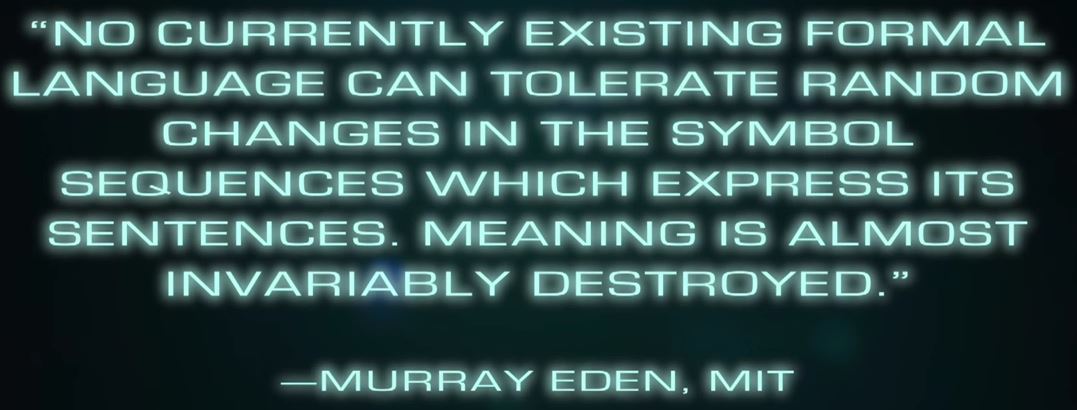
  • normally, random mutations tend to degrade the functionality of information, e.g. – randomly changing symbols in an applications code does not usually introduce useful new functions, it usually renders what is there non-functional
  • the majority of possible sequences will NOT have functions, so random mutations will more likely give you non-functional code, rather than functional code
  • example: a bicycle lock  with 4 numbers has many possible sequences for the 4 numbers, and only one of them has unlock functionality, the rest have no functionality
  • if you have lots of time, then you might be able to guess the combination, but if the lock as has 10 billion numbers, and only one combination that unlocks, you can spend your whole life trying to unlock it and won’t succeed
  • how likely is it to arrive at a functional protein or gene by chance? Is it more like the 4-dial lock (can be done with lots of time) or the 10 billion dial lock (amount of time required exceeds the time available)?
  • the probability is LOW because there is only one sequence of numbers that has unlock function
  • consider a short protein of 150 amino acids has 10 to the 195th power possible sequences
  • if many of these sequences of amino acides had biological function, then it might be easier to get to one by random mutation and selection than it is with a lock that only unlocks for ONE sequence
  • how many of the possible sequences have biological function?
  • Thanks to research done by Douglas Axe, we now know that the number of functional amino acid sequences for even a short protein is incredibly small…
  • Axe found that the odds of getting a functional sequence of amino acids that will fold and have biological function is 1 in 10 to the 77th power
  • Is that number too improbable to reach by chance? well, there are 10 to 65th atoms in the entire Milky Way galaxy… so yes, this is a very improbable outcome
  • can random genetic mutations search through all the sequences in order to find the one in 10 to the 77th power one that has biological function? It depends on how much guessers we have and how many guesses we get in the time available
  • even with the entire 3.5 billion year history of life on Earth, only about 10 to the 40th organisms have ever lived, which far smaller fraction of the 10 to the 77th total sequences
  • even with a very fast mutation rate, you would not be able to reach a functional protein even with all that time, and even with all those organisms

I was once having a discussion with a woman about the research that Axe did at the Cambridge University lab. He published four articles in the Journal of Molecular Biology. I held out one of the papers to her and showed her the numbers. She said over and over “I hate the Discovery Institute! I hate the Discovery Institute!” Well, yeah, but you can’t make the Journal of Molecular Biology go away with hating the Discovery Institute. JMB is peer-reviewed, and this was experimental evidence – not a theory, not a hypothesis.

We have been blessed by the Creator and Designer of the universe in this time and place with overwhelming evidence – an abundance of riches. For those who have an open mind, this is what you’ve been waiting for to make your decision. For the naturalists who struggle so mightily to block out the progress of experimental science, they’ll need to shout louder and shut their eyes tighter and push harder to block their ears. Maybe if they keep screaming “Star Trek” and “Star Wars” over and over to themselves, they will be able to ignore the real science a little longer.