Tag Archives: Evolution

New book on intelligent design by molecular biologist Douglas Axe

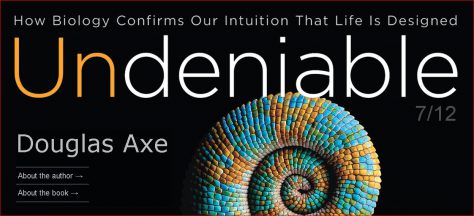
Undeniable: How Biology Confirms Our Intuition That Life Is Designed

It’s not out yet, but the Kindle edition is only $12.99, so I pre-ordered it. That helps to get the book up in the bestseller lists. I’ll add it to my list of books that I am reading for the third quarter later, and maybe feature it in the coveted spot in the right column of the blog.

Anyway, here is the description:

Throughout his distinguished and unconventional career, engineer-turned-molecular-biologist Douglas Axe has been asking the questions that much of the scientific community would rather silence. Now, he presents his conclusions in this brave and pioneering book. Axe argues that the key to understanding our origin is the “design intuition”—the innate belief held by all humans that tasks we would need knowledge to accomplish can only be accomplished by someone who has that knowledge. For the ingenious task of inventing life, this knower can only be God.

Starting with the hallowed halls of academic science, Axe dismantles the widespread belief that Darwin’s theory of evolution is indisputably true, showing instead that a gaping hole has been at its center from the beginning. He then explains in plain English the science that proves our design intuition scientifically valid. Lastly, he uses everyday experience to empower ordinary people to defend their design intuition, giving them the confidence and courage to explain why it has to be true and the vision to imagine what biology will become when people stand up for this truth.

Armed with that confidence, readers will affirm what once seemed obvious to all of us—that living creatures, from single-celled cyanobacteria to orca whales and human beings, are brilliantly conceived, utterly beyond the reach of accident.

Our intuition was right all along.

Trailer is here:

Evolution News has a deal for those who pre-order:

A remarkable thing about evolutionary theory is the way it demands that we deny our intuition at almost every step. Evolutionists then assure us that the science is all figured out, so we needn’t trouble our silly heads about the relevant biology.

In a new book, Douglas Axe of Biologic Institute turns this standard assurance on its head. In Undeniable: How Biology Confirms Our Intuition That Life Is Designed, Dr. Axe restores the place of intuition alongside intellect in considering the question of life’s origins.

Undeniable will be published on July 12 by HarperOne, but you can pre-order before then and participate in an exclusive, private conference call with Dr. Axe and talk- show host Michael Medved. You’ll also receive digital versions of three complete books from Discovery Institute Press: Debating Darwin’s Doubt, The Unofficial Guide to Cosmos, and Science & Human Origins. See here for easy instructions.

And now, I have a secret story to tell you. I met Doug Axe face to face way back in the late 1990s. He told me and some other people about the post-doctoral work he was doing at Cambridge University on the probabilities of getting a functional protein by chance. He made me promise not to tell anyone, and I never did. It was from conversations like that with the intelligent design scholars that I decided to start using an alias.

From his research at Cambrudge, Dr. Axe found that the number of functional amino acid sequences is tiny:

Doug Axe’s research likewise studies genes that it turns out show great evidence of design. Axe studied the sensitivities of protein function to mutations. In these “mutational sensitivity” tests, Dr. Axe mutated certain amino acids in various proteins, or studied the differences between similar proteins, to see how mutations or changes affected their ability to function properly. He found that protein function was highly sensitive to mutation, and that proteins are not very tolerant to changes in their amino acid sequences. In other words, when you mutate, tweak, or change these proteins slightly, they stopped working. In one of his papers, he thus concludes that “functional folds require highly extraordinary sequences,” and that functional protein folds “may be as low as 1 in 10^77.”

The problem of forming DNA by sequencing nucleotides faces similar difficulties. And remember, mutation and selection cannot explain the origin of the first sequence, because mutation and selection require replication, which does not exist until that first living cell is already in place.

He published his findings in four separate publications with the prestigious Journal of Molecular Biology, and got his PhD with it. To get a PhD from Caltech, and then do post-doctoral work at Cambridge, you have to be good. And Dr. Axe is very, very good.

I have used the papers he wrote in many, many conversations with engineers in different companies where I have worked. He hit a home run with that research. You could never look at the evidence for intelligent design the same way again. Christian parents, if you have any children, be sure that you tell them about Doug Axe’s story.


William Lane Craig debates Austin Dacey: Does God Exist?

Two tough rams butt heads, and may the best ram win!

Here is the video and summary of a debate between Christian theist William Lane Craig and Austin Dacey at Purdue University in 2004 about the existence of God.

The debaters:

The video: (2 hours)

The video shows the speakers and powerpoint slides of their arguments. Austin Dacey is one of the top atheist debaters, and I would put him second to Peter Millican alone, with Walter Sinnott-Armstrong in third place. This is the debate to show people who are new to apologetics. The debate with Peter Millican is better for advanced students, and that’s no surprise since he teaches at Oxford University and is familiar with all of Dr. Craig’s work. The Craig-Dacey debate is the one that I give to my co-workers.

By the way, you can get the DVDs and CDs for the first Craig-Dacey debate and the second Craig-Dacey debate and the second Craig-Sinnott-Armstrong debate. The Peter Millican debate is not available on DVD, but the link above (Peter Millican) has the video and my summary.

Dr. Dacey’s 5 arguments below are all good arguments that you find in the academic literature. He is also an effective and engaging speaker, This is a great debate to watch!

SUMMARY of the opening speeches:

Dr. Craig’s opening statement:

Dr. Craig will present six reasons why God exists:

  1. (Contingency argument) God is the best explanation of why something exists rather than nothing
  2. (Cosmological argument)  God’s existence is implied by the origin of the universe
  3. (Fine-tuning argument) The fine-tuning of the universe for intelligent life points to a designer of the cosmos
  4. (Moral argument) God is the best explanation for the existence of objective moral values and objective moral duties
  5. (Miracles argument) The historical facts surrounding the life, death and resurrection of Jesus
  6. (Religious experience) God’s existence is directly knowable even apart from arguments

Dr. Dacey’s opening argument:

There are two ways to disprove God’s existence, by showing that the concept of God is self-contradictory, or by showing that certain facts about ourselves and the world are incompatible with what we would expect to be true if God did exist. Dr. Dacey will focus on the second kind of argument.

  1. The hiddenness of God
  2. The success of science in explaining nature without needing a supernatural agency
  3. The dependence of mind on physical processes in the brain
  4. Naturalistic evolution
  5. The existence of gratuitous / pointless evil and suffering

One final point:

One thing that I have to point out is that Dr. Dacey quotes Brian Greene during the debate to counter Dr. Craig’s cosmological argument. Dr. Craig could not respond because he can’t see the context of the quote. However, Dr. Craig had a rematch with Dr. Dacey where was able to read the context of the quote and defuse Dr. Dacey’s objection. This is what he wrote in his August 2005 newsletter after the re-match:

The following week, I was off an another three-day trip, this time to California State University at Fresno. As part of a week of campus outreach the Veritas Forum scheduled a debate on the existence of God between me and Austin Dacey, whom I had debated last spring at Purdue University. In preparation for the rematch I adopted two strategies: (1) Since Dacey had come to the Purdue debate with prepared speeches, I decided to throw him for a loop by offering a different set of arguments for God, so that his canned objections wouldn’t apply. I chose to focus on the cosmological argument, giving four separate arguments for the beginning of the universe, and on the evidence for Jesus’ resurrection. (2) I reviewed our previous debate carefully, preparing critiques of his five atheistic arguments. In the process I found that he had seriously misunderstood or misrepresented a statement by a scientist on the Big Bang; so I brought along the book itself in case Dacey quoted this source again. I figured he might change his arguments just as I was doing; but I wanted to be ready in case he used his old arguments again.

[…]The auditorium was packed that night for the debate, and I later learned that there were overflow rooms, too. To my surprise Dr. Dacey gave the very same case he had presented at Purdue; so he really got clobbered on those arguments. Because he wasn’t prepared for my new arguments, he didn’t even respond to two of my arguments for the beginning of the universe, though he did a credible job responding to the others. I was pleased when he attacked the Big Bang by quoting the same scientist as before, because I then held up the book, specified the page number, and proceeded to quote the context to show what the scientist really meant.

Dr. Craig is always prepared!

Mark D. Linville: does Darwinian evolution make morality rational?

A conflict of worldviews

Have you ever heard an atheist tell you that naturalistic evolution is an answer to the moral argument? I have. And I found a good reply to this challenge in the book “Contending With Christianity’s Critics“. The chapter that responds to the challenge is authored by Dr. Mark D. Linville. It is only 13 pages long. I have a link to the PDF at the bottom of this post.

First, a bit about the author:

Blog: The Tavern at the End of the World
Current positions:

  • PhD Research Fellow
  • Tutoring Fellow in Philosophy

Education:

  • PhD in Philosophy with a minor in South Asian Studies and a specialization in Philosophy of Religion, University of Wisconsin-Madison
  • MA in Philosophy, University of Wisconsin-Madison
  • MA in Philosophy of Religion, Trinity Evangelical Divinity School
  • MA in Theology, Cincinnati Christian Seminary
  • BA in Biblical Studies, Florida Christian College

Here is his thesis of the essay:

Darwin’s account of the origins of human morality is at once elegant, ingenious, and, I shall argue, woefully inadequate. In particular, that account, on its standard interpretation, does not explain morality, but, rather, explains it away . We learn from Darwin not how there could be objective moral facts, but how we could have come to believe—perhaps erroneously—that there are.

Further, the naturalist, who does not believe that there is such a personal being as God, is in principle committed to Darwinism, including a Darwinian account of the basic contours of human moral psychology. I’ll use the term evolutionary naturalism to refer to this combination of naturalism and Darwinism. And so the naturalist is saddled with a view that explains morality away. Whatever reason we have for believing in moral facts is also a reason for thinking naturalism is false. I conclude the essay with a brief account of a theistic conception of morality, and argue that the theist is in a better position to affirm the objectivity of morality.

And here’s a sample to get your attention:

But even if we are assured that a “normal” person will be prompted by the social instincts and that those instincts are typically flanked and reinforced by a set of moral emotions, we still do not have a truly normative account of moral obligation. There is nothing in Darwin’s own account to indicate that the ensuing sense of guilt—a guilty feeling—is indicative of actual moral guilt resulting from the violation of an objective moral law. The revenge taken by one’s own conscience amounts to a sort of second-order propensity to feel a certain way given one’s past relation to conflicting first-order propensities (e.g., the father’s impulse to save his child versus his impulse to save himself). Unless we import normative considerations from some other source, it seems that, whether it is a first or second-order inclination,one’s being prompted by it is more readily understood as a descriptive feature of one’s own psychology than material for a normative assessment of one’s behavior or character. And, assuming that there is anything to this observation, an ascent into even higher levels of propensities (“I feel guilty for not having felt guilty for not being remorseful over not obeying my social instincts…”) introduces nothing of normative import. Suppose you encounter a man who neither feels the pull of social, paternal or familial instincts nor is in the least bit concerned over his apparent lack of conscience. What, from a strictly Darwinian perspective, can one say to him that is of any serious moral import? “You are not moved to action by the impulses that move most of us.” Right. So?

The problem afflicts contemporary construals of an evolutionary account of human morality. Consider Michael Shermer’s explanation for the evolution of a moral sense—the “science of good and evil.” He explains,

By a moral sense, I mean a moral feeling or emotion generated by actions. For example, positive emotions such as righteousness and pride are experienced as the psychological feeling of doing “good.” These moral emotions likely evolved out of behaviors that were reinforced as being good either for the individual or for the group.2

Shermer goes on to compare such moral emotions to other emotions and sensations that are universally experienced, such as hunger and the sexual urge. He then addresses the question of moral motivation.

In this evolutionary theory of morality, asking “Why should we be moral?” is like asking “Why should we be hungry?” or “Why should we be horny?” For that matter, we could ask, “Why should we be jealous?” or “Why should we fall in love?” The answer is that it is as much a part of human nature to be moral as it is to be hungry, horny, jealous, and in love.3

Thus, according to Shermer, given an evolutionary account, such a question is simply a non-starter. Moral motivation is a given as it is wired in as one of our basic drives. Of course, one might point out that Shermer’s “moral emotions” often do need encouragement in a way that, say, “horniness,” does not. More importantly, Shermer apparently fails to notice that if asking “Why should I be moral?” is like asking, “Why should I be horny?” then asserting, “You ought to be moral” is like asserting, “You ought to be horny.” As goes the interrogative, so goes the imperative. But if the latter seems out of place, then, on Shermer’s view, so is the former.

One might thus observe that if morality is anything at all, it is irreducibly normative in nature. But the Darwinian account winds up reducing morality to descriptive features of human psychology. Like the libido, either the moral sense is present and active or it is not. If it is, then we might expect one to behave accordingly. If not, why, then, as a famous blues man once put it, “the boogie woogie just ain’t in me.” And so the resulting “morality” is that in name only.

In light of such considerations, it is tempting to conclude with C. S. Lewis that, if the naturalist remembered his philosophy out of school, he would recognize that any claim to the effect that “I ought” is on a par with “I itch,” in that it is nothing more than a descriptive piece of autobiography with no essential reference to any actual obligations.

When it comes to morality, we are not interested in mere descriptions of behavior. We want to know about prescriptions of behavior, and whether why we should care about following those prescriptions. We are interested in what grounds our sense of moral obligation in reality. What underwrites our sense of moral obligation? If it is just rooted in feelings, then why should we obey our moral sense when obeying it goes against out self-interest? Feelings are subjective things, and doing the right thing in a real objective state of affairs requires more than just feelings. There has to be a real objective state of affairs that makes it rational for us to do the right thing, even when the right thing is against our own self-interest. That’s what morality is – objective moral obligations overriding subjective feelings. I wouldn’t trust someone to be moral if it were just based on their feelings.

The PDF is right here for downloading, with the permission of the author.