Tag Archives: Evidence

96% of political donations by Cornell University faculty go to Democrats

Donations by Cornell University faculty
Political donations by Cornell University faculty

I’m going to introduce a lecture by Dr. George Yancey by linking to an article from the Cornell University campus newspaper. (H/T Dennis Prager)

It says:

Of the nearly $600,000 Cornell’s faculty donated to political candidates or parties in the past four years, over 96 percent has gone to fund Democratic campaigns, while only 15 of the 323 donors gave to conservative causes.

The Sun’s analysis of Federal Election Committee data reveals that from 2011 to 2014, Cornell’s faculty donated $573,659 to Democrats, $16,360 to Republicans and $2,950 to Independents. Each of Cornell’s 13 schools — both graduate and undergraduate — slanted heavily to the left. In the College of Arts and Sciences, 99 percent of the $183,644 donated went to liberal campaigns.

OK, now with that out of the way, let’s watch a 28-minute lecture from Dr. George Yancey about bias against religion in academia:

If you watch 5 minutes, then you’ll definitely stay and watch the whole thing. It’s fascinating.

Details:

Join Dr. George Yancey in an in depth discussion of the bias taking place within academia against religion in general, but more specifically Christianity. Within the discussion Dr.Yancey uses brief explanations of his previous book, Compromising Scholarship and many other excerpts of his past research as well as his forthcoming research to give us a new viewpoint on academia and religion.

I found a quick description of Dr. Yancey’s work in this New York Times article from July 2011.

It says:

Republican scholars are more likely than Democrats to end up working outside academia,as documented by Daniel Klein, an economist at George Mason University. Dr. Klein, who calls himself a classical liberal (a k a libertarian), says that the university promotes groupthink because its system of “departmental majoritarianism” empowers the dominant faction to keep hiring like-minded colleagues. And when a faculty committee is looking to hire or award tenure, political ideology seems to make a difference, according to a “collegiality survey” conducted by George Yancey.

Dr. Yancey, a professor of sociology at the University of North Texas, asked more than 400 sociologists which nonacademic factors might influence their willingness to vote for hiring a new colleague. You might expect professors to at least claim to be immune to bias in academic hiring decisions.

But as Dr. Yancey reports in his new book, “Compromising Scholarship: Religious and Political Bias in American Higher Education,” more than a quarter of the sociologists said they would be swayed favorably toward a Democrat or an A.C.L.U. member and unfavorably toward a Republican. About 40 percent said they would be less inclined to vote for hiring someone who belonged to the National Rifle Association or who was an evangelical. Similar results were obtained in a subsequent survey of professors in other social sciences and the humanities.

Dr. Yancey, who describes himself as a political independent with traditional Christian beliefs and progressive social values, advises nonliberal graduate students to be discreet during job interviews. “The information in this research,” he wrote, “indicates that revealing one’s political and religious conservatism will, on average, negatively influence about half of the search committee one is attempting to impress.”

Dr. Yancey’s research was a survey, not a field experiment, so it’s impossible to know how many of those academics who confessed to hypothetical bias would let it sway an actual decision. Perhaps they’d try to behave as impartially as the directors of graduate studies in Dr. Gross’s experiment.

The lecture is a real eye-opener. It turns out that in academia, you are likely to be viewed the same way as blacks were viewed by slave-owners, and Jews were viewed by Nazis.

We have a lot of work to do to correct these perceptions, but that’s not going to happen unless churches and Christian parents start to take the life of the mind more seriously.

UPDATE: Papa Giorgio posts the Dennis Prager audio:
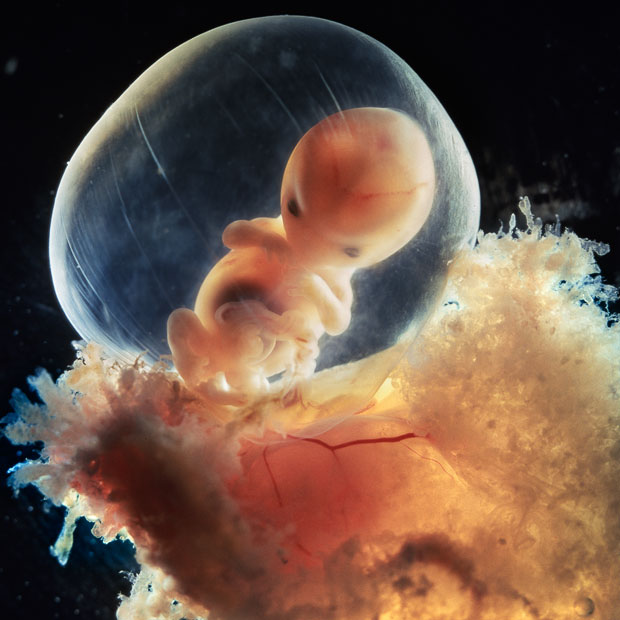
If unborn babies don’t have consciousness or don’t feel pain, may we kill them?

Unborn baby scheming about pro-life apologetics

Was having a conversation by e-mail yesterday with a pro-abortion atheist, and he gave two reasons why he supported abortion in the first and second trimester. First, he said that unborn babies can’t feel pain, so it’s OK to kill them. Second, he said that unborn babies don’t have consciousness, so it’s OK to kill them. I thought it might be useful to link to something that answers both of these objections.

Frank Beckwith is the author of “Defending Life: A Moral and Legal Case Against Abortion Choice“. He wrote that book for Cambridge University Press, a top academic press. But before Cambridge University Press, Beckwith wrote four easy-to-understand essays for the Christian Research Journal. Part IV is the one that has the response to the two questions raised by my atheist friend.

Part I. The Appeal to Pity

Part II. Arguments from Pity, Tolerance, and Ad Hominem

Part III. Is The Unborn Human Less Than Human?

Part IV. When Does a Human Become a Person?

Excerpt:

Some ethicists argue that the unborn becomes fully human sometime after brain development has begun, when it becomes sentient: capable of experiencing sensations such as pain. The reason for choosing sentience as the criterion is that a being that cannot experience anything (i.e., a presentient unborn entity) cannot be harmed. Of course, if this position is correct, then the unborn becomes fully human probably during the second trimester and at least by the third trimester. Therefore, one does not violate anyone’s rights when one aborts a nonsentient unborn entity. [13]

There are several problems with this argument. First, it confuses harm with hurt and the experience of harm with the reality of harm. [14] One can be harmed without experiencing the hurt that sometimes follows from that harm, and which we often mistake for the harm itself. For example, a temporarily comatose person who is suffocated to death “experiences no harm,” but he is nevertheless harmed. Hence, one does not have to experience harm, which is sometimes manifested in hurt, in order to be truly harmed.

Second, if sentience is the criterion of full humanness, then the reversibly comatose, the momentarily unconscious, and the sleeping would all have to be declared nonpersons. Like the presentient unborn, these individuals are all at the moment nonsentient though they have the natural inherent capacity to be sentient. Yet to countenance their executions would be morally reprehensible. Therefore, one cannot countenance the execution of some unborn entities simply because they are not currently sentient.

Someone may reply that while these objections make important points, there is a problem of false analogy in the second objection: the reversibly comatose, the momentarily unconscious, and the sleeping once functioned as sentient beings, though they are now in a temporary state of nonsentience. The presentient unborn, on the other hand, were never sentient. Hence, one is fully human if one was sentient “in the past” and will probably become sentient again in the future, but this cannot be said of the presentient unborn.

There are at least three problems with this response. First, to claim that a person can be sentient, become nonsentient, and then return to sentience is to assume there is some underlying personal unity to this individual that enables us to say that the person who has returned to sentience is the same person who was sentient prior to becoming nonsentient. But this would mean that sentience is not a necessary condition for personhood. (Neither is it a sufficient condition, for that matter, since nonhuman animals are sentient.) Consequently, it does not make sense to say that a person comes into existence when sentience arises, but it does make sense to say that a fully human entity is a person who has the natural inherent capacity to give rise to sentience. A presentient unborn human entity does have this capacity. Therefore, an ordinary unborn human entity is a person, and hence, fully human.

Second, Ray points out that this attempt to exclude many of the unborn from the class of the fully human is “ad hoc and counterintuitive.” He asks us to “consider the treatment of comatose patients. We would not discriminate against one merely for rarely or never having been sentient in the past while another otherwise comparable patient had been sentient….In such cases, potential counts for everything.” [15]

Third, why should sentience “in the past” be the decisive factor in deciding whether an entity is fully human when the presentient human being “is one with a natural, inherent capacity for performing personal acts?” [16] Since we have already seen that one does not have to experience harm in order to be harmed, it seems more consistent with our moral sensibilities to assert that what makes it wrong to kill the reversibly comatose, the sleeping, the momentarily unconscious, and the presentient unborn is that they all possess the natural inherent capacity to perform personal acts. And what makes it morally right to kill plants and to pull the plug on the respirator-dependent brain dead, who were sentient “in the past,” is that their deaths cannot deprive them of their natural inherent capacity to function as persons, since they do not possess such a capacity.

These four essays are a very good introduction to common responses to pro-abortion arguments. I recommend that people get familiar with this, as once you look into it, you will see that the abortion issue can be debated with as much confidence as William Lane Craig defends Christian theism. You will have the same access to scientific evidence and rational arguments on this topic, and so you will have the upper hand. And that’s fun.

The best introductory book on the abortion / right to life issue is “The Case for Life” by pro-life debater Scott Klusendorf. The best comprehensive book is a tie between “The Ethics of Abortion” by Christopher Kaczor, and Frank Beckwith’s “Defending Life: A Moral and Legal Case Against Abortion Choice“.

New study: fracking does not contaminate drinking water

Hydraulic fracturing also known as "fracking"
Hydraulic fracturing also known as “fracking”

The study comes out of Yale University, and was published in PNAS. Pretty good school, pretty good peer-reviewed journal.

Here’s the introduction:

Organic compounds found in drinking water aquifers above the Marcellus Shale and other shale plays could reflect natural geologic transport processes or contamination from anthropogenic activities, including enhanced natural gas production. Using analyses of organic compounds coupled with inorganic geochemical fingerprinting, estimates of groundwater residence time, and geospatial analyses of shale gas wells and disclosed safety violations, we determined that the dominant source of organic compounds to shallow aquifers was consistent with surface spills of disclosed chemical additives. There was no evidence of association with deeper brines or long-range migration of these compounds to the shallow aquifers. Encouragingly, drinking water sources affected by disclosed surface spills could be targeted for treatment and monitoring to protect public health.

So, the fracking – which happens deep below the earth – didn’t introduce any new chemical additives into the water. Basically, fracking involves fracturing rocks using high pressure water, sand and chemicals. The question is whether chemicals and/or the fracking fluid contaminate the water supply used by humans. The answer, according to this study, is no. The distance between the water supply and the shale is simple far, far, far too great for the cracks to traverse. The minor contamination from surface spills is easy to detect and cleanup. This is not what you see on far left web sites and Hollywood movies, but it is what you see in studies down by Yale University scientists published in prestigious peer-reviewed science journals.

Anyway, this study is consistent with a report from the far-left radically environmentalist Environmental Protection Agency.

This is reported in the radically leftist National Public Radio, of all places.

Excerpt:

The Environmental Protection Agency says it finds no evidence that hydraulic fracturing — better known as fracking — has led to widespread pollution of drinking water. The oil industry and its backers welcome the long-awaited study while environmental groups criticize it.

“We found the hydraulic fracturing activities in the United States are carried out in a way that has not led to widespread systemic impacts on drinking water resources,” says Tom Burke, Science Advisor and Deputy Assistant Administrator of EPA’s Office of Research and Development. “In fact, the number of documented impacts to drinking water resources is relatively low when compared to the number of fractured wells,” he adds.

The EPA’s draft assessment was conducted at the request of Congress. “It is the most complete compilation of scientific data to date,” says Burke, “including over 950 sources of information, published papers, numerous technical reports, information from stakeholders and peer-reviewed EPA scientific reports.”

Fracking has allowed drillers to tap oil and natural gas reserves once thought off-limits deep underground. That has led to drilling booms across the country and boosted the country’s oil and natural gas production significantly. But environmental groups have long argued fracking comes with a cost to the environment, especially to water. Those groups have called for stronger regulations and even bans on fracking altogether.

[…]The American Petroleum Institute says the conclusions echo what the oil industry has argued all along. “Hydraulic fracturing is being done safely under the strong environmental stewardship of state regulators and industry best practices,” says Erik Milito, API upstream group director.

Acknowledging the potential vulnerabilities outlined in the EPA report, Milito says, “Continuous safety improvements have been an ongoing part of hydraulic fracturing for 65 years.”

Indeed. This is not the first time that the radically leftist EPA has cleared the fracking industry, either. I blogged about the last one for Dimock, Pennsylvania.

Here’s an excerpt from the EPA press release that exonerates fracking:

 The U.S. Environmental Protection Agency announced today that it has completed its sampling of private drinking water wells in Dimock, Pa. Data previously supplied to the agency by residents, the Pennsylvania Department of Environmental Protection and Cabot Oil and Gas Exploration had indicated the potential for elevated levels of water contaminants in wells, and following requests by residents EPA took steps to sample water in the area to ensure there were not elevated levels of contaminants. Based on the outcome of that sampling, EPA has determined that there are not levels of contaminants present that would require additional action by the Agency.

[…]Overall during the sampling in Dimock, EPA found hazardous substances, specifically arsenic, barium or manganese, all of which are also naturally occurring substances, in well water at five homes at levels that could present a health concern. In all cases the residents have now or will have their own treatment systems that can reduce concentrations of those hazardous substances to acceptable levels at the tap. EPA has provided the residents with all of their sampling results and has no further plans to conduct additional drinking water sampling in Dimock.

So, if you want to worry about fracking, it will have to be because of something other than facts. We have facts piled on facts piled on facts, and they all say that fracking is a great way for us to get cheap, clean energy that doesn’t pollute the environment or contaminate our water supply. You have to be anti-science to doubt this data. Democrats do oppose fracking. They don’t know about the science, they just oppose it because that’s what’s in the popular culture, in Hollywood movies, etc. We have to fight them with the science. Democrats are the anti-science party, so don’t expect this to alter their rhetoric.