This is from Justin Brierley’s Unbelievable radio show.
Details:
The Koran claims that Jesus did not die on the cross.
Mohammed Bahmanpour of the Islamic College in London defends the Koranic view that although “it was made to appear to them” that he died, in fact he was substituted by another.
Jay Smith is a Christian evangelist to Muslims in London and brings to bear Biblical and other historical witnesses to the crucifixion. They debate the issue and whether the Koran or the New Testament is to be trusted as a revelation of God.
Mohammed:
– in Surah 4 (Quran), it says that Jesus didn’t die on a cross
– it only appeared to onlookers as though Jesus died on the cross
– muslims believe that the crucifixion really happened
– but Jesus wasn’t the one who died, it was actually Judas
– most Muslims think that Judas betrayed Jesus
– some Shiites believe that Judas died voluntarily in Jesus’ place
– the gospel of Judas seems to make Judas out to be a hero
Jay:
– the 4 gospels agree that Jesus died on a cross
– John is an eyewitness and it’s in his gospel
– Paul’s writings also echo the gospels (Romans and epistles)
– the gospel of Judas is a fourth century document
– it reflects gnostic theology, which denies that Jesus had a body
– even Surah 19 says that Jesus actually did die and rise after
– so Surah 4 and Surah 19 are internally contradictory
They take calls from callers and debate issues with each other. It’s interesting to hear the role that history and historical methods plays in each religion.
Speaking of Unbelievable, Justin has an Unbelievable conference coming up on May 14th in the UK. Details are here.
My seven year old son, Jeremiah, a first grader, was doing some homework the other day and was thinking out loud. “Two plus two equals four”, I overheard him say. This piqued my interest a bit and I decided to throw him a curveball.
“Son, two plus two equals five”, I said, to which he responded, “No it doesn’t.”
I decided to take things a little further and said, “But Son, I truly and sincerely believe that two plus two equals five. Doesn’t that mean I’m right?”
Without missing a beat, his reply was only a simple, “Nope”.
Although I was beginning to become concerned that I might be teaching him that ‘Dad may not always be right’, I decided to sacrifice that myth on the altar of truth and roll with it. I then asked him, “Son, what if me and a whole lot of other people really believe that two plus two equals five, and that it might offend us and hurt our feelings that other people like you might think that we’re wrong; can’t you just let be true for us and let ‘two plus two equal four’ for you?”
Another “Nope”.
“Why not?” I asked.
“Because two plus two equals four!” He replied with stern conviction. I was now determined to take it even further.
“Son, what if you were the only person in the world who believed that two plus two equals four? Would you still be right?”
He looked up at me from his seat at the table with his trademark big grin and gave me a very confident, “Yes!”
“How come?” I asked?
“Because two plus two equals four!”, he replied again, but this time in a manner which implied that his patience with my line of questioning was wearing thin.
Again, I asked, “How come?”
To which he replied, “Because it just does!”
He goes on to explain that he is getting his child used to the idea that if something is true, then the people who don’t believe it are wrong, and it doesn’t matter how they feel about it. Since the author knows about apologetics, he will be able to give arguments for thinking that Christianity is true as the child grows up. That’s one way to build up your kids – get them used to the idea that truth doesn’t always make everyone like you. And that truth is more important than feelings or community.
I have a friend Andrew who does a fine job of preparing his children for their future roles as effective, influential Christians. One way he does this is by building up their ability to say no to obvious lies. He sits at the table with his kids and points at a glass of milk and then claims that it is a glass of orange juice. The child denies that it is and a fight ensues, with Andrew trying hard to get the child to just go along with his lies, and the child resisting. It’s very important for children to have the sense that if something is true, then they don’t have to change their view to make anyone feel better. This principle is helpful when dealing with aggressive people or offended people.
Last time we saw how the progress of science in the last 30 years has proved that the environment of the early Earth would not have allowed the emergence of the basic building blocks of life. This time, let’s allow the atheist to assume the building blocks were created by the noodly appendage of the Flying Spaghetti Monster, (peas be upon him), and see whether it’s possible for the blocks to chain themselves together to make a living cell withinin a reasonable amount of time (400 million years, say).
For this post, I will be referencing an article by Stephen C. Meyer, which he published in the Catholic journal “First Things”. I chose this article deliberately because it was written at the level of an ordinary layman, so we could all understand everything well enough to feel confident explaining it to our neighbors. All unattributed quotes are from this article.
The combatants
The contest over origins features two opposing points of view:
A Creator and Designer is responsible for the origin of life
Matter, chance and long periods of time are sufficient to explain the origin of life
What’s at stake?
Atheistic Cornell University professor Will Provine explains what logically follows from naturalistic evolution:
There are no gods, no purposes, and no goal-directed forces of any kind. There is no life after death. When I die, I am absolutely certain that I am going to be dead. That’s the end of me. There is no ultimate foundation for ethics, no ultimate meaning in life, and no free will for humans, either. What an unintelligible idea.
So, the stakes are high.
Why doubt the apparent design in nature?
There are two main reasons why atheists doubt the appearance of design in nature:
In order for a living organism to support life, it must be able to perform minimal functions:
store information
transmit information
edit information
use that information to regulate metabolic processes
There must be sufficient information inside the cells of that organism to support those functions. How does this information exist in the cell, and where did it come from?
Atheism is a pre-scientific worldview
Meyer describes the primitive superstitions of tribes of atheists living in primitive, pre-scientific cultures:
…in the 1870s and 1880s scientists assumed that devising an explanation for the origin of life would be fairly easy….they assumed that life was essentially a rather simple substance called protoplasm that could be easily constructed by combining and recombining simple chemicals such as carbon dioxide, oxygen, and nitrogen. …just as salt could be produced spontaneously by adding sodium to chloride, so… could a living cell be produced by adding together several chemical constituents and then allowing spontaneous chemical reactions to produce the simple protoplasmic substance that they assumed to be the essence of life.
Atheists believe in all kinds of primitive pre-scientific myths, like the eternal universe, etc., which the progress of science has falsified. Can the progress of science falsify the atheistic superstitions about the origin of life?
The Oparin-Haldane hypothesis
Atheists began to panic in the early 20th century as discoveries began to pile up confirming the that the entire physical universe, and time itself, was created by a supernatural force that existed transcendentally, independent of matter, energy, space and time. (See here for a listing of 6 of these discoveries from the progress of science). Atheists decided that they’d better get involved in this “science” thing that the Christians had started.
Meyer reports on one of their first groundless speculations:
During the 1920s and 1930s a more sophisticated version of this so–called “chemical evolutionary theory” was proposed by a Russian biochemist named Alexander I. Oparin…. Oparin, like his nineteenth–century predecessors, suggested that life could have first evolved as the result of a series of chemical reactions.
It was hoped that that the Flying Spaghetti Monster would appear to his true believers and ground this blind speculation, allowing atheists to continue in their flight from rationality and moral obligations.
The Miller-Urey experiment
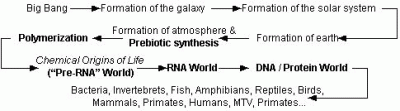
Pre-biotic synthesis (see below) produces amino acids, which are the first step in explaining the origin of the simplest life, on atheism:
How did life begin?
As we saw last time, the Miller-Urey experiments that were designed to produce the building blocks of life (amino acids) were horribly flawed and did not reflect the conditions that would have existed on the early Earth.
I’ll summarize the problems with the experiment:
the gasses were used in the experiment were not those present on the early Earth
molecular oxygen was excluded from the experiment
Harmful UV radiation was filtered out by the experimenter intervention
interfering cross-reactions were prevented by experimenter intervention
Other problems:
extinction events, such as meteorite impacts, were excluded not considered
the chirality problem (left-handed amino acids, right-handed sugars) was not considered
the problem of getting all peptide bonds was not considered
This experiment, though flawed, still exists in biology textbooks today, along side faked photographs of peppered moths and doctored drawings of embryos. All must praise the Flying Spaghetti Monster, and at taxpayer expense!
The problem of biological information
To create life, you need to sequence amino acids into proteins, and sequence the nucleotides on DNA strands.
Meyer explains:
To form a protein, amino acids must link together to form a chain. Yet amino acids form functioning proteins only when they adopt very specific sequential arrangements, rather like properly sequenced letters in an English sentence. Thus, amino acids alone do not make proteins, any more than letters alone make words, sentences, or poetry. In both cases, the sequencing of the constituent parts determines the function (or lack of function) of the whole.
…As it turns out, specific regions of the DNA molecule called coding regions have the same property of “sequence specificity” or “specified complexity” that characterizes written codes, linguistic texts, and protein molecules. Just as the letters in the alphabet of a written language may convey a particular message depending on their arrangement, so too do the sequences of nucleotide bases (the A’s, T’s, G’s, and C’s) inscribed along the spine of a DNA molecule convey a precise set of instructions for building proteins within the cell. The nucleotide bases in DNA function in precisely the same way as symbols in a machine code. In each case, the arrangement of the characters determines the function of the sequence as a whole…. In the case of DNA, the complex but precise sequencing of the four nucleotide bases (A, T, G, and C) stores and transmits the information necessary to build proteins.
…As Bernd–Olaf Kuppers recently stated, “The problem of the origin of life is clearly basically equivalent to the problem of the origin of biological information.”
How do atheists account for this biological information?
Atheistic superstitions about the biological information
Le’s take a look at the atheist’s faith-based explanations of the origin of life: chance, law and self-organization.
For the first one, let’s calculate the odds of building a protein composed of a functional chain of 100 amino acids, by chance. (Think of a meaningful English sentence built with 100 scrabble letters, held together with glue)
1. Chance:
BONDING: You need 99 peptide bonds between the 100 amino acids. The odds of getting a peptide bond is 50%. The probability of building a chain of one hundred amino acids in which all linkages involve peptide bonds is roughly (1/2)^99 or 1 chance in 10^30.
CHIRALITY: You need 100 left-handed amino acids. The odds of getting a left-handed amino acid is 50%. The probability of attaining at random only L–amino acids in a hypothetical peptide chain one hundred amino acids long is (1/2)^100or again roughly 1 chance in 10^30.
SEQUENCE: You need to choose the correct amino acid for each of the 100 links. The odds of getting the right one are 1 in 20. Even if you allow for some variation, the odds of getting a functional sequence is (1/20)^100 or 1 in 10^65.
The final probability of getting a functional protein composed of 100 amino acids is 1 in 10^125. Even if you fill the universe with pre-biotic soup, and react amino acids at Planck time (very fast!) for 14 billion years, you are probably not going to get even 1 such protein. And you need at least 100 of them for minimal life functions, plus DNA and RNA.
Research performed by Doug Axe at Cambridge University, and published in the peer-reviewed Journal of Molecular Biology, has shown that the number of functional amino acid sequences is tiny:
Doug Axe’s research likewise studies genes that it turns out show great evidence of design. Axe studied the sensitivities of protein function to mutations. In these “mutational sensitivity” tests, Dr. Axe mutated certain amino acids in various proteins, or studied the differences between similar proteins, to see how mutations or changes affected their ability to function properly. He found that protein function was highly sensitive to mutation, and that proteins are not very tolerant to changes in their amino acid sequences. In other words, when you mutate, tweak, or change these proteins slightly, they stopped working. In one of his papers, he thus concludes that “functional folds require highly extraordinary sequences,” and that functional protein folds “may be as low as 1 in 10^77.”
The problem of forming DNA by sequencing nucleotides faces similar difficulties. And remember, mutation and selection cannot explain the origin of the first sequence, because mutation and selection require replication, which does not exist until that first living cell is already in place.
2. Law:
The idea here is that components, such as nucleotides, might have special bonding affinities that might cause them to bond together spontaneously into functional sequences. Like if certain SCRABBLE tiles had an affinity for certain other tiles that caused them to bond together whenever they met.
Meyer writes:
Consider what would happen if the individual nucleotide “letters” in a DNA molecule did interact by chemical necessity with each other. Every time adenine (A) occurred in a growing genetic sequence, it would likely drag thymine (T) along with it. Every time cytosine (C) appeared, guanine (G) would follow. As a result, the DNA message text would be peppered with repeating sequences of A’s followed by T’s and C’s followed by G’s.
3. Self-organization:
The idea here is that some spontaneous order might arise due to some physical force, just like rocks sort themselves by size in a rock agitator because of gravity.
Meyer writes:
…just as magnetic letters can be combined and recombined in any way to form various sequences on a metal surface, so too can each of the four bases A, T, G, and C attach to any site on the DNA backbone with equal facility, making all sequences equally probable (or improbable). The same type of chemical bond occurs between the bases and the backbone regardless of which base attaches. All four bases are acceptable; none is preferred. In other words, differential bonding affinities do not account for the sequencing of the bases. Because these same facts hold for RNA molecules, researchers who speculate that life began in an “RNA world” have also failed to solve the sequencing problem…
Understanding what creates information
The bottom line is that in order for software code, or even English letters, to be functional, it needs to defy ordering mechanisms. Biological sequences are functional for the same reason that software code or English text is functional – because some intelligent agent chose an irregular sequence of characters in order to achieve a specific purpose. Look at the letters in this post – they are not ORDERED by physical laws. They are SELECTED by an intelligent agent.
Meyer writes:
To see the distinction between order and information, compare the sequence “ABABABABAB ABAB” to the sequence “Time and tide wait for no man.” The first sequence is repetitive and ordered, but not complex or informative.
What causes specified, complex sequences?
…the information contained in an English sentence or computer software does not derive from the chemistry of the ink or the physics of magnetism, but from a source extrinsic to physics and chemistry altogether. Indeed, in both cases, the message transcends the properties of the medium… Our experience with information–intensive systems (especially codes and languages) indicates that such systems always come from an intelligent source…
And this is what everybody means by “intelligent design”. This design inference came from the progress of science. The more we discovered about the cell, the more nature pointed towards a creative, designing intelligence. The only option left to atheists now is blind faith that the Flying Spaghetti Monster will swoop in and undo the progress of science over the last 100 years. Good luck with that, atheists!
Further study
One of my favorite resources on the origin of life is this interview from the University of California with former atheist and origin of life researcher Dean Kenyon. Kenyon, a professor of Biology at San Francisco State University, wrote the textbook on “chemical evolution”, which is the view that chemicals can arrange themselves in order to create the first living cell, without intervention.
This interview from the University of California with another origin of life researcher, Charles Thaxton, is also one of my favorites.
You’ll need Quicktime to see the videos, or buy the videos from ARN. (Kenyon, Thaxton) I have both of them – they rock!

 WINTERY KNIGHT