Tag Archives: Employment

Why is Obama spending trillions when government spending failed in Japan?

Story here at the UK Telegraph. (H/T Protein Wisdom via ECM)

Excerpt:

Regime-change in Tokyo and the arrival of Yukio Hatoyama’s neophyte Democrats – raising $550bn (£333bn) to help fund their blitz on welfare and the “new social policy” – have concentrated the minds of investors at long last. “Markets are worried that Japan is going to hit a brick wall: the sums are gargantuan,” said Albert Edwards, a Japan-veteran at Société Générale.

The IMF expects Japan’s gross public debt to reach 218pc of gross domestic product (GDP) this year, 227pc next year, and 246pc by 2014

“Can these benign conditions be expected to continue in the face of even-larger increases in public debt? Going forward, the markets capacity to absorb debt is likely to diminish as population ageing reduces saving,” said the IMF.

Japan’s $1.5 trillion state pension fund (the world’s biggest) has become a net seller of government bonds this year, as it must to meet pay-out obligations. The demographic crunch has hit. The workforce has been contracting since 2005.

“The debt situation is irrecoverable,” said Carl Weinberg from High Frequency Economics. “I don’t see any orderly way out of this. They will not be able to fund their deficit. There will be a fiscal shutdown, a pension haircut, and bank failures that will rock the world. It is criminally negligent that rating agencies are not blowing the whistle on this.”

[…]It wasted its immense fiscal firepower, scattering money for 20 years on half-baked spending projects to keep the economy afloat. QE was too little, too late, and this is the lesson for the West. We must cut borrowing drastically over the next decade, and offset this with ultra-easy monetary policy. Does Downing Street understand this? Does the White House? Does the European Central Bank? Clearly not.

And now is the time on the Wintery Knight blog where we teach Economics in One Lesson.

Economics in One Lesson

We are going to have to pay for all this spending on Obama’s favored special interest groups eventually, and that means that taxes will go up, or that the value of the dollar will go down, due to inflation. It has to be one or the other or both. There is no third way.

Perhaps it is time to review Henry Hazlitt’s Economics in One Lesson, chapter 4, entitled “Public Works Mean Taxes”.

Excerpt:

Therefore, for every public job created by the bridge project a private job has been destroyed somewhere else. We can see the men employed on the bridge. We can watch them at work. The employment argument of the government spenders becomes vivid, and probably for most people convincing. But there are other things that we do not see, because, alas, they have never been permitted to come into existence. They are the jobs destroyed by the $10 million taken from the taxpayers. All that has happened, at best, is that there has been a diversion of jobs because of the project. More bridge builders; fewer automobile workers, television technicians, clothing workers, farmers.

And consider Chapter 5 as well, entitled “Taxes Discourage Production”.

In our modern world there is never the same percentage of income tax levied on everybody. The great burden of income taxes is imposed on a minor percentage of the nation’s income; and these income taxes have to be supplemented by taxes of other kinds. These taxes inevitably affect the actions and incentives of those from whom they are taken. When a corporation loses a hundred cents of every dollar it loses, and is permitted to keep only fifty-two cents of every dollar it gains, and when it cannot adequately offset its years of losses against its years of gains, its policies are affected. It does not expand its operations, or it expands only those attended with a minimum of risk. People who recognize this situation are deterred from starting new enterprises. Thus old employers do not give more employment, or not as much more as they might have; and others decide not to become employers at all. Improved machinery and better-equipped factories come into existence much more slowly than they otherwise would. The result in the long run is that consumers are prevented from getting better and cheaper products to the extent that they otherwise would, and that real wages are held down, compared with what they might have been.

There is a similar effect when personal incomes are taxed 50, 60 or 70 percent. People begin to ask themselves why they should work six, eight or nine months of the entire year for the government, and only six, four or three months for themselves and their families. If they lose the whole dollar when they lose, but can keep only a fraction of it when they win, they decide that it is foolish to take risks with their capital. In addition, the capital available for risk-taking itself shrinks enormously. It is being taxed away before it can be accumulated. In brief, capital to provide new private jobs is first prevented from coming into existence, and the part that does come into existence is then discouraged from starting new enterprises. The government spenders create the very problem of unemployment that they profess to solve.

What Obama did, in effect, is to fire all of those millions of private sector people, so that he could reward the people who voted for him. Jobs are created far more efficiently by small businesses than they are by big government. When you take money out of the private sector, which creates jobs easily, and give it to the public sector, which is inefficient and wasteful, you lose jobs.

George W. Bush cut taxes in his first term and created 1 million NEW JOBS. Obama has LOST 3.4 million jobs in a few months with his trillions of dollars of spending that the private sector cannot pay for. Government spending is a job killer. And no amount of charm and teleprompter reading is going to change the laws of economics.

octjobsgap

This is the way the world works. It works that way in Japan, and it works that way here, too.
MUST-READ: Why Obama’s spending took us to 10% unemployment

First, let’s see Obama’s record on economic policy. (H/T ECM)

$1,650,971,205,167 added to the national debt, bringing the total to $7.5 trillion.

99 banks taken over by the Federal Deposit Insurance Company.

684 banks receiving support from the Troubled Asset Relief Program that doesn’t buy troubled assets.

11.2 percent: the percentage of the federal deficit to GDP. This is the highest that ratio has been since Japan surrendered in 1945.

$164 billion spent out of the entire $787 billion in stimulus funding in the American Recovery and Reinvestment Act. Most of this has gone to Medicaid, unemployment and the Making Work Pay Tax Credit.

And, now, Keith Hennessey takes a look at Obama’s record on reducing unemployment.

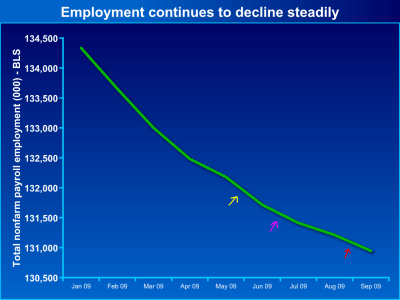
Here’s the graph of total employment since Obama took office:

Employment has declined steadily since Obama took office

Now, you may be hearing Obama say that we’ve turned the corner on unemployment. For instance, look at how the White House is spinning this graph.

Hennessey writes:

Check out the slightly different slopes of the three line segments indicated by arrows.  The purple arrow shows a segment that slopes downward slightly less than the yellow arrow.  A mathematician would say the shift from yellow to purple was an inflection point, shifting the curve from convex to concave.

This is what led the President in early August to say the economy was “pointed in the right direction.”  The red arrow shows the worse news of last Friday’s jobs report, with a line that slopes downward slightly more sharply.  The curve shifted back to a convex shape, in which the slope was more sharply downward than in the prior month.

If you’re saying to yourself, “That’s ridiculous!  They’re all going down, and the differences in slopes are almost too hard to see!” then you’ve got my point.

And below I’m going to explain why Obama’s massive government spending created this worsening unemployment.

Economics in One Lesson

We are going to have to pay for all this spending on Obama’s favored special interest groups eventually, and that means that taxes will go up, or that the value of the dollar will go down, due to inflation. It has to be one or the other or both. There is no third way. When employers see that higher taxes or inflation are coming, they stop hiring people because they know that higher taxes and/or inflation kills the economy.

Perhaps it is time to review Henry Hazlitt’s Economics in One Lesson, chapter 4, entitled “Public Works Mean Taxes”.

Excerpt:

Therefore, for every public job created by the bridge project a private job has been destroyed somewhere else. We can see the men employed on the bridge. We can watch them at work. The employment argument of the government spenders becomes vivid, and probably for most people convincing. But there are other things that we do not see, because, alas, they have never been permitted to come into existence. They are the jobs destroyed by the $10 million taken from the taxpayers. All that has happened, at best, is that there has been a diversion of jobs because of the project. More bridge builders; fewer automobile workers, television technicians, clothing workers, farmers.

And consider Chapter 5 as well, entitled “Taxes Discourage Production”.

In our modern world there is never the same percentage of income tax levied on everybody. The great burden of income taxes is imposed on a minor percentage of the nation’s income; and these income taxes have to be supplemented by taxes of other kinds. These taxes inevitably affect the actions and incentives of those from whom they are taken. When a corporation loses a hundred cents of every dollar it loses, and is permitted to keep only fifty-two cents of every dollar it gains, and when it cannot adequately offset its years of losses against its years of gains, its policies are affected. It does not expand its operations, or it expands only those attended with a minimum of risk. People who recognize this situation are deterred from starting new enterprises. Thus old employers do not give more employment, or not as much more as they might have; and others decide not to become employers at all. Improved machinery and better-equipped factories come into existence much more slowly than they otherwise would. The result in the long run is that consumers are prevented from getting better and cheaper products to the extent that they otherwise would, and that real wages are held down, compared with what they might have been.

There is a similar effect when personal incomes are taxed 50, 60 or 70 percent. People begin to ask themselves why they should work six, eight or nine months of the entire year for the government, and only six, four or three months for themselves and their families. If they lose the whole dollar when they lose, but can keep only a fraction of it when they win, they decide that it is foolish to take risks with their capital. In addition, the capital available for risk-taking itself shrinks enormously. It is being taxed away before it can be accumulated. In brief, capital to provide new private jobs is first prevented from coming into existence, and the part that does come into existence is then discouraged from starting new enterprises. The government spenders create the very problem of unemployment that they profess to solve.

What Obama did, in effect, is to fire all of those millions of private sector people, so that he could reward the people who voted for him. And jobs are created far more efficiently by small businesses than they are by big government. What creates new jobs is entrepreneurs with ideas who hire people. And government spending diverts money away from these efficient entrepreneurs and towards inefficient government bureaucracies.

Twenty-one reasons why marriage matters

From the National Marriage Coalition in New Zealand. (H/T Jennifer Roback Morse)

Summary:

FAMILY

1. Marriage increases the likelihood that fathers have good relationships with their children
2. Cohabitation is not the functional equivalent of marriage
3. Growing up outside an intact marriage increases the likelihood that children themselves divorce or become unwed parents
4. Marriage is a virtually universal human institution.

ECONOMICS

5. Divorce and unmarried childbearing increase poverty for both children and mothers
6. Married couples seem to build more wealth on average than singles or cohabiting couples
7. Married men earn more money than do single men with similar education and job histories
8. Parental divorce (or failure to marry) appears to increase children’s risk of school failure
9. Parental divorce reduces the likelihood that children will graduate from college and achieve high-status jobs

PHYSICAL HEALTH AND LONGEVITY

10.Children who live with their own two married parents enjoy better physical health, on average, than do children in other family forms
11.Parental marriage is associated with a sharply lower risk of infant mortality
12.Marriage is associated with reduced rates of alcohol and substance abuse for both adults and teens
13.Married people, especially married men, have longer life expectancies than do otherwise similar singles
14.Marriage is associated with better health and lower rates of injury, illness, and disability for both men and women

MENTAL HEALTH AND EMOTIONAL WELL-BEING

15.Children whose parents divorce have higher rates of psychological distress and mental illness
16.Divorce appears significantly to increase the risk of suicide
17.Married mothers have lower rates of depression than do single or cohabiting mothers

CRIME AND DOMESTIC VIOLENCE

18.Boys raised in single-parent families are more likely to engage in delinquent and criminal behaviour
19.Marriage appear to reduce the risk that adults will be either perpetrators or victims of crime
20.Married women appear to have a lower risk of experiencing domestic violence than do cohabiting or dating women
21.A child who is not living with his or her own two married parents is at greater risk of child abuse

This is fun to read! You can learn to defend marriage, even if you favor lifelong chastity over marriage like I do.

The full PDF is here.