
Tag Archives: Emotivism

Serial sexual relationships, multi-partner fertility, single motherhood and fatherlessness

A man leading a woman upward

Here’s an article from the policy journal National Affairs (editor is Yuval Levin) that has some statistics about single motherhood by choice. When you are reading the article, keep in mind that most people who lean left are so influenced by feminism that they seem to think that women trip and fall accidentally, and end up pregnant from random men. I don’t think that we should minimize the fact that most women freely choose the men who treat them badly.

Excerpt:

Pew Foundation and Centers for Disease Control and Prevention surveys indicate that, on a range of measures, a very large share of fathers who do not live with their children have virtually no meaningful relationship with their non-custodial children. More than one-half report that they had not shared a meal with their non-custodial children in the last four weeks, while nearly two-thirds had not read to their children and a full three-quarters had not done homework with them. Moreover, these are self-reported figures, so the share of fathers with no relationship to their non-custodial children is most likely even higher.

When fathers form new romantic partnerships, their involvement with children from previous relationships declines. Jo Jones and William Mosher report that, while 39% of fathers in new romantic relationships had shared a meal with their non-custodial 5- to 18-year-old children at least once in the past month, 62% of those not in a new romantic relationship had. While 55% of fathers in a new romantic relationship had spoken with their 5- to 18-year-old non-custodial children, 77% of those not in a new romantic relationship had.

In addition, men with less education are more likely to exhibit absent-father behavior. Whereas 70% of fathers with at least some college had talked to their non-custodial 5- to 18-year-old children at least once in the past month, 59% of those with no more than a high-school degree had done so. While 74% of fathers with at least some college had played with their non-custodial child under 5 years old at least once in the past month, only 53% of those fathers with no more than a high-school degree had.

Multi-partner fertility is not only associated with father abandonment, it also adversely impacts child-maltreatment rates. Women attempting to balance work, the demands of new relationships, and the challenges of raising children are faced with a set of chronic stressors that often lead to child abuse and neglect. The shift from welfare to work increased these stresses. Partially as a result, between 1993 and 2005, the rate of overall abuse, physical abuse, sexual abuse, and serious abuse, respectively, rose by 22%, 14%, 49%, and 34% for children living with single mothers. By contrast, for children living in two-parent households, child-abuse rates fell on each of the four measures (by 42%, 24%, 62%, and 37%, respectively). By 2005, the child-abuse rate was 2.9 per 1,000 for children living with married biological parents but 10.2 for those living with a single parent and no partner, according to the U.S. Department of Health and Human Services. This disparity cannot be explained solely by socioeconomic status since the abuse rate for children in families of all kinds in the lowest socioeconomic group was still lower than that for children living in single-parent households.

Multi-partner fertility also increases child-abuse rates in a second way: the presence of non-biological fathers in the house. Child abuse in households with single mothers triples when they live with a man other than the child’s father. Child-maltreatment rates are actually lower in black than white households when the mother lives alone. But unfortunately, many men bring their job and other frustrations into the home, creating abusive situations. As a result, when a partner is present, the black rates on all three measures of child maltreatment — emotional, physical, and endangerment — are almost double the white rates. In addition, rates of intimate violence are over 12 times higher for single mothers than for married mothers.

Edin and Nelson ignore the subject of abusive behavior in men. Instead, despite the fathers’ caring attitudes, we are told, the mothers kick them out because they don’t earn sufficient income. And on the impact of multi-partner fertility on children, Doing the Best I Can offers one benign sentence: “Kids are amazingly resilient, but the rate of family change among children of unwed fathers has become so rapid, and now leads to such complicated family structures, that kids might have a hard time adjusting.”

Academic studies paint a much grimmer picture. After surveying the evidence, Sara McLanahan and Christopher Jencks concluded earlier this year,

[A] father’s absence increases antisocial behavior [among children], such as aggression, rule breaking, delinquency, and illegal drug use. These antisocial behaviors affect high school completion independent of a child’s verbal and math scores. Thus it appears that a father’s absence lowers children’s educational attainment…by disrupting their social and emotional adjustment and reducing their ability or willingness to exercise self-control.

The effects of growing up without both parents when it comes to aggression, rule breaking, and delinquency are also larger for boys than for girls. Marianne Bertrand and Jessica Pan found in 2011 that the behavior of boys is far more dependent upon good parenting practices — spending time with a child, emotional closeness, and avoiding harsh discipline — than that of girls. Such parenting habits are far more common in two-parent families, which helps to explain why boys with absent fathers are more likely to be suspended and have other behavioral problems than boys who have both parents at home.

The evidence also indicates that the outcomes are most negative when a man other than the biological father is present. Cassandra Dorius and Karen Guzzo found that “adolescents with a half-sibling with a different father are about 65 percent more likely to have used marijuana, uppers, inhalants, cocaine, crack, hallucinogens, sedatives, or other drugs by the time of their 15th birthday than those who have only full siblings.” Cynthia Harper and Sara McLanahan reported in 2004 that, among fatherless boys, those who lived with stepfathers were at an even greater risk of incarceration than those who lived with a single mother.

I think in today’s society, there seems to be a lot of fear and trembling to speak about moral standards. And it seems to be especially true that men are not allowed to tell women about their moral obligations. I know that at least when I speak to young women, they are often very rebellious. The attitude I encounter most often is that they feel that they should be able to trust their feelings and act in the way that their feelings dictate. Any destructiveness that results – which I warned them about – is dismissed as “unexpected”.

I can clearly remember the first time this happened to me, when I was in high school. I was friends with a girl named Tara who would come over and speak to me before morning announcements. She would tell me about her stock car driving boyfriend. One day, she told me that she was moving in with him. I warned her against it, and listed off a bunch of statistics about how this would cause problems. She stopped coming to talk to me, and so did her best female friend. Well, a few years later I ran into her again at one of our local universities where I was an undergraduate. She filled me in on what had happened. He had cheated on her with her best friend in their house. He got her pregnant. She had an abortion. She knew better now, but back in high school I was easily dismissed, and all of her friends sided with her.

Whenever I try to produce evidence to say that something is likely to cause harm, the response is usually “well I know a person who broke the rules and nothing happened”. I produce statistics about some likely consequence of following your heart, and it’s dismissed because some Hollywood celebrity managed to escape the probabilities. “Don’t judge me!” they say. Happiness comes first, and the best way to decide how to be happy in the long-term is apparently to do what makes a person feel happy right now. But statistics are there to tell a story of how the world normally works – dismissing it all with individual cases is bad logic. There are consequences to following your feelings and dismissing moral obligations.
Irish woman explains why she got an abortion: “I wanted to travel”

Abortion lady and her partner

This is from Life News.

Excerpt:

A young Irish woman has spoken of the trauma she endured by travelling to the UK for an abortion.

Cork woman Tara (24) has told how she and her partner Steve felt they had no choice but to travel eight hours – almost 590 kilometres – to an abortion clinic in west London.

Tara, who does not give her surname, appears in a BBC Three documentary “Abortion: Ireland’s Guilty Secret?” to tell her story and why she’s pro-choice.

Under the Protection of Life During Pregnancy Act, it is an offence to “intentionally destroy unborn human life” and those found guilty face a maximum jail term of 14 years.

Tara, who had an abortion because she wanted to travel and she wasn’t yet ready, tells reporter Alys Harte that the Government here is “ignoring” her right to choice.

“I’m really angry. I’m angry that they are ignoring women basically at the moment.”

“They shouldn’t have control over my uterus. I deserve that choice and it was taken away from me by my Government.”

“You deserve to be treated as a human and not as a criminal more than anything else,” she said.

The stress of travelling abroad to have an abortion was “not really pleasant”, Tara added.

“This could’ve been so simple. This could’ve been something I could’ve done two weeks ago basically when I found out.”

“It’s not really pleasant for anyone to have to go through the fact that you have to leave home and fly across the water and do something that is such a simple procedure. It definitely adds to the stress of it.”

Tara is one of around 4,000 Irish women who travel to the UK every year for abortions because it is illegal to do so in Ireland.

The country’s abortion laws will be the subject of a special report this year by Amnesty International.

Ireland is one of five countries chosen by Amnesty as “emblematic of global abuses of sexual and reproductive rights”.

The report aims to include testimonies from Irish women who have had abortions and explore issues such as the “prohibitive” high cost of travel, particularly for young women and socio-economically marginalised groups such as asylum seekers, undocumented migrants and Travellers.

The criminalisation of termination of pregnancy which results from rape, incest or sexual violence will also be reviewed as part of the My Body My Rights Campaign.

Tara claims that Ireland is behind its other Western counterparts on the abortion issue.

“The rest of the world can see that this is wrong but we’re in a western society and yet it hasn’t changed yet.”

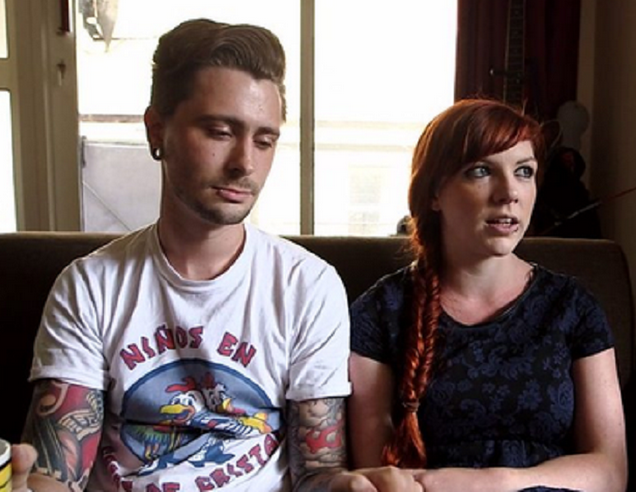
I think the picture that goes with the story is really telling. Look at the man that she chose… hoop earrings, tattoos, piercings. He is her “partner” – not her husband. He is there for recreation, not to provide for her or lead her on moral/spiritual issues. They are having sex, but it’s doubtful that he has the discipline to provide for a family. Yet she is giving him all of herself anyway, because it’s fun to have recreational sex. Marriage isn’t fun though – marriage is boring. Marriage is work. Marriage is self-sacrifice. She is only 24! It’s too early to think of marriage. Now is the time for having fun, seeking thrills and traveling. It’s time for adventures! Not for prudence and caution. And if a child comes along who wants to stop her fun, then that child just has to die. And he is all for it!

I think this story goes very well with the mean post I wrote earlier expressing my frustration with how we as a society seem to have lost the ability to tell young, unmarried women “NO” when they want to act selfishly and/or unwisely. Look at the man she chose! He is not the kind of man who would tell her NO for anything she is doing wrong. He wants the sex, and he is willing to keep his mouth shut to get it. He’s not looking for a competent partner to support him in some enterprise. They are both more interested in recreational sex than they are in marriage and personal responsibility. I sincerely doubt that this man is financially prepared to be a protector and provider – he chose a woman who just killed his child! And she chose him because she could get his attention and acceptance, but without having to be judged or led by him in any way.

Why would she choose this man? A person who understands morality subjectively will try to surround herself with people who will always tell her that she is doing the right thing – no matter what she is doing. “Follow your heart”. She will also seek to silence anyone from telling her that what she is doing is wrong. She will also vote for laws that will punish people who say in public that what she is doing is wrong. With respect to abortion, that means no clinic protesters, no graphic images from protesters, no mandatory ultrasounds, no public expressions of Christianity. Anything that makes her feel that a majority of people are opposed to her has to be tuned out or silenced by force of government. The most important question that a subjective-morality person asks is “what will people think of me if I do this?” And also “I want to do this, how can I make more people agree with me?”

If we want women to stop making poor decisions with their lives, then we have to speak up and be convincing on issues like abortion, and to teach them to be careful about surrounding themselves with people who are using them, and who will agree with any crazy thing they want to do in order to keep using them.

One last point about this woman. When I look at her picture, I think about her future. I think about whether the man she has chosen is wasting her youth, and whether she understands that men like that do not stick around when a woman gets older. In order to get a man to commit to a woman past the time where she is at her peak of physical attraction, she has to do two things. First, she has to be developing her own skills and accomplishments. Second, she has to choose a man who s trying to achieve something that requires those skills and accomplishments. That’s what causes a man to fall in love and remain devoted to one woman into old age. But this woman is not looking to improve her skills and to get achievements that a good man would find valuable. Instead, she is choosing the easy road. Giving her physical beauty to the wrong man, in order to have fun and thrills today – and there’s no plan for tomorrow.

And as she ages, she will probably find herself without a man who is dedicated to providing for her, and will instead vote for government to take that role in her life. That means higher taxes, more government spending and borrowing, more debt for the next generation, and fewer young men who can afford to marry and have kids. That’s why we need to tell the women of today NO when they want to behave selfishly, and be guided by their emotions.

New study: children who grow up with single parents more likely to see domestic violence

Domestic violence least likely in married homes

This is from Family Studies. (H/T Brad Wilcox)

Excerpt:

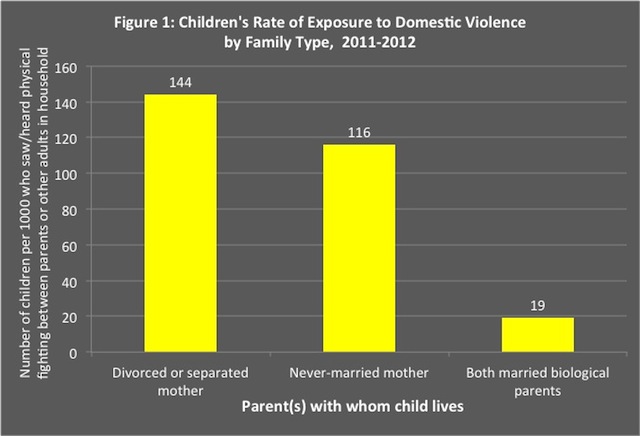
In the 2011-2012 National Survey of Children’s Health, conducted by the U.S. National Center for Health Statistics, parents of 95,677 children aged 17 and under were asked whether their child had ever seen or heard “any parents, guardians, or any other adults in the home slap, hit, kick, punch, or beat each other up.” Among children living with both married biological parents, the rate of exposure to family violence was relatively low: for every 1,000 children in intact families, 19 had witnessed one or more violent struggles between parents or other household members. By comparison, among children living with a divorced or separated mother, the rate of witnessing domestic violence was seven times higher: 144 children per 1,000 had had one or more such experiences. (See Figure 1.) These comparisons are adjusted for differences across groups in the age, sex, and race/ethnicity of the child, family income and poverty status, and the parent’s education level.

One might suppose that women who had never married would be less likely to get into violent arguments with the fathers of their children than separated or divorced mothers. Yet the rate of witnessing domestic violence among children living with never-married mothers was also elevated. It was 116 per 1,000, six times higher than the rate for children in intact families. (Some of these fights involved subsequent partners or boyfriends of the mother, rather than the father of the child.) Even children living with both biological parents who were cohabiting—rather than married—had more than double the risk of domestic violence exposure as those with married birth parents: 45 out of 1,000 of these children had witnessed family fights that became physical. Note also that a child’s family structure was a better predictor of witnessing family violence than was her parents’ education, family income, poverty status, or race.

Experiencing family violence is stressful for children, undercuts their respect and admiration for parents who engage in abusive behavior, and is associated with increased rates of emotional and behavioral problems at home and in school. For example, among children of never-married mothers who had witnessed family violence, 58 percent had conduct or academic problems at school requiring parental contact. The rate of school behavior problems for those who had not been exposed to family fights was significantly lower, though still fairly high (36 percent). Likewise, among children of divorced or separated mothers, nearly half of those exposed to family violence—48 percent—had had conduct or academic problems at school. Even among the small number of children in intact families who had witnessed family violence, just over half—51 percent—presented problems at school. This was twice the rate of school problems among students from intact families who had not witnessed domestic violence. (See Figure 2.) These figures are also adjusted for differences across groups in age, sex, and race/ethnicity of children, family income and poverty, and parent education levels. Children experiencing domestic violence were also more likely to have repeated a grade in school and to have received psychological counseling for emotional or behavioral problems. This was true in intact as well as disrupted families.

A good book to read on this topic is Theodore Dalrymple’s “Life at the Bottom“, which offered this memorable anecdote about about how and why women choose men who abuse them.

Introduction:

The disastrous pattern of human relationships that exists in the underclass is also becoming common higher up the social scale. With increasing frequency I am consulted by nurses, who for the most part come from and were themselves traditionally members of (at least after Florence Nightingale) the respectable lower middle class, who have illegitimate children by men who first abuse and then abandon them. This abuse and later abandonment is usually all too predictable from the man’s previous history and character; but the nurses who have been treated in this way say they refrained from making a judgment about him because it is wrong to make judgments. But if they do not make a judgment about the man with whom they are going to live and by whom they are going to have a child, about what are they ever going to make a judgment?

“It just didn’t work out,” they say, the “it” in question being the relationship that they conceive of having an existence independent of the two people who form it, and that exerts an influence on their on their lives rather like an astral projection. Life is fate.

Chapter one:

All the more surprising is it to me, therefore, that the nurses perceive things differently. They do not see a man’s violence in his face, his gestures, his deportment, and his bodily adornments, even though they have the same experience of the patients as I. They hear the same stories, they see the same signs, but they do not make the same judgments. What’s more, they seem never to learn; for experience—like chance, in the famous dictum of Louis Pasteur—favors only the mind prepared. And when I guess at a glance that a man is an inveterate wife beater (I use the term “wife” loosely), they are appalled at the harshness of my judgment, even when it proves right once more.

This is not a matter of merely theoretical interest to the nurses, for many of them in their private lives have themselves been the compliant victims of violent men. For example, the lover of one of the senior nurses, an attractive and lively young woman, recently held her at gunpoint and threatened her with death, after having repeatedly blacked her eye during the previous months. I met him once when he came looking for her in the hospital: he was just the kind of ferocious young egotist to whom I would give a wide berth in the broadest daylight.

Why are the nurses so reluctant to come to the most inescapable of conclusions? Their training tells them, quite rightly, that it is their duty to care for everyone without regard for personal merit or deserts; but for them, there is no difference between suspending judgment for certain restricted purposes and making no judgment at all in any circumstances whatsoever. It is as if they were more afraid of passing an adverse verdict on someone than of getting a punch in the face—a likely enough consequence, incidentally, of their failure of discernment. Since it is scarcely possible to recognize a wife beater without inwardly condemning him, it is safer not to recognize him as one in the first place.

This failure of recognition is almost universal among my violently abused women patients, but its function for them is somewhat different from what it is for the nurses. The nurses need to retain a certain positive regard for their patients in order to do their job. But for the abused women, the failure to perceive in advance the violence of their chosen men serves to absolve them of all responsibility for whatever happens thereafter, allowing them to think of themselves as victims alone rather than the victims and accomplices they are. Moreover, it licenses them to obey their impulses and whims, allowing them to suppose that sexual attractiveness is the measure of all things and that prudence in the selection of a male companion is neither possible nor desirable.

Often, their imprudence would be laughable, were it not tragic: many times in my ward I’ve watched liaisons form between an abused female patient and an abusing male patient within half an hour of their striking up an acquaintance. By now, I can often predict the formation of such a liaison—and predict that it will as certainly end in violence as that the sun will rise tomorrow.

At first, of course, my female patients deny that the violence of their men was foreseeable. But when I ask them whether they think I would have recognized it in advance, the great majority—nine out of ten—reply, yes, of course. And when asked how they think I would have done so, they enumerate precisely the factors that would have led me to that conclusion. So their blindness is willful.

The blindness is wilful, because the emotions cannot be corrected by evidence. And everything in the culture affirms women in this craziness, even after they fail over and over again with men – cohabitating with the bad ones for years, and then turning away from the good ones. They freely choose the wrong men, and freely pass by the good ones. And almost no one tells them that it’s entirely their fault. Everyone just tells them “follow your heart”. This emotional craziness causes harm to innocent children, and it needs to stop. We have to stop the man-blaming and hold women accountable for making decisions with their emotions and then expecting craziness to “work out”.

You can read the Dalrymple book online for free in this post.