Tag Archives: Economics

GAO: Green River Formation has more oil than the rest of the world combined

Remember when Obama said that we have “2 percent of the world’s oil reserves”?

This is an excerpt from his own speech:

As a country that has 2 percent of the world’s oil reserves, but uses 20 percent of the world’s oil — I’m going to repeat that — we’ve got 2 percent of the world oil reserves; we use 20 percent.  What that means is, as much as we’re doing to increase oil production, we’re not going to be able to just drill our way out of the problem of high gas prices.  Anybody who tells you otherwise either doesn’t know what they’re talking about or they aren’t telling you the truth.

Now let’s find out who doesn’t know what they’re talking about and who isn’t telling the truth.

The Government Accountability Office – a department of the federal government – tells us the facts.

Excerpt:

The Green River Formation, a largely vacant area of mostly federal land that covers the territory where Colorado, Utah and Wyoming come together, contains about as much recoverable oil as all the rest the world’s proven reserves combined, an auditor from the Government Accountability Office told Congress on Thursday.

The GAO testimony said that the federal government was in “a unique position to influence the development of oil shale” because the Green River deposits were mostly beneath federal land.

[…]It also noted that developing the oil would have an environmental impact and pose “socioeconomic challenges,” that included bringing “a sizable influx of workers who along with their families put additional stress on local infrastructure” and “making planning for growth difficult for local governments.”

“The Green River Formation–an assemblage of over 1,000 feet of sedimentary rocks that lie beneath parts of Colorado, Utah, and Wyoming–contains the world’s largest deposits of oil shale,”Anu K. Mittal, the GAO’s director of natural resources and environment said in written testimony submitted to the House Science Subcommittee on Energy and Environment.

“USGS estimates that the Green River Formation contains about 3 trillion barrels of oil, and about half of this may be recoverable, depending on available technology and economic conditions,” Mittal testified.

“The Rand Corporation, a nonprofit research organization, estimates that 30 to 60 percent of the oil shale in the Green River Formation can be recovered,” Mittal told the subcommittee. “At the midpoint of this estimate, almost half of the 3 trillion barrels of oil would be recoverable. This is an amount about equal to the entire world’s proven oil reserves.”

In her oral statement before the subcommittee, Mittal said that developing the shale oil would create wealth and jobs for the country, but also challenges for government.

“Being able to tap this vast amount of oil locked within this formation will go a long way to help to meet our future demands for oil. The U.S. Geological Survey, as you noted, estimates that the formation contains about 3 trillion barrels of oil of which half may be recoverable,” she said.

“As you can imagine having the technology to develop this vast energy resource will lead to a number of important socioeconomic benefits including the creation of jobs, increases in wealth and increases in tax and royalty payments for federal and state governments,” she said.

[…]In her written testimony, Mittal noted that three-fourths of the Green River shale oil is under federal land.

Is Barack Obama a good President? Does he know how to be President? Does he understand economics?

Let’s look at the national debt and the labor force participation rates in Obama’s first term. Recall that the Republicans lost the House and Senate in January of 2007. At the time of the Pelosi/Reid takeover, the national debt was $8 trillion. It is now almost double that at $16 trillion.
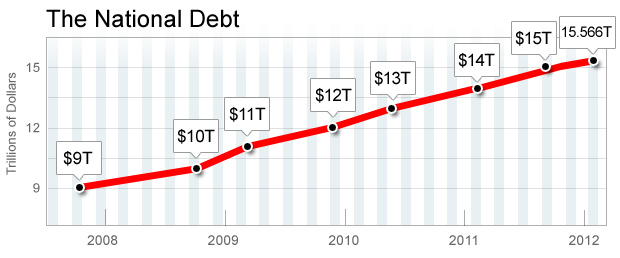
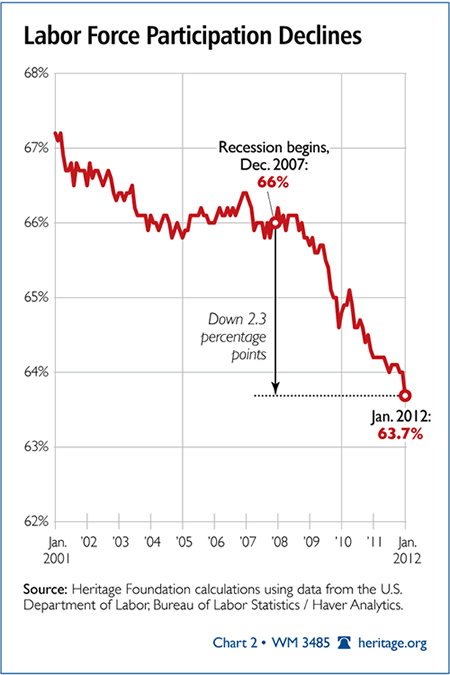
Obama added 5 trillion dollars to the debt since he took office
US Labor Force Participation down 4.9 million people

If these numbers seem bad to you, then I don’t think you should vote for Obama.

Arthur Brooks and the value of earned successs

In the Wall Street Journal.

Excerpt:

Earned success means defining your future as you see fit and achieving that success on the basis of merit and hard work. It allows you to measure your life’s “profit” however you want, be it in money, making beautiful music, or helping people learn English. Earned success is at the root of American exceptionalism.

The link between earned success and life satisfaction is well established by researchers. The University of Chicago’s General Social Survey, for example, reveals that people who say they feel “very successful” or “completely successful” in their work lives are twice as likely to say they are very happy than people who feel “somewhat successful.” It doesn’t matter if they earn more or less income; the differences persist.

The opposite of earned success is “learned helplessness,” a term coined by Martin Seligman, the eminent psychologist at the University of Pennsylvania. It refers to what happens if rewards and punishments are not tied to merit: People simply give up and stop trying to succeed.

During experiments, Mr. Seligman observed that when people realized they were powerless to influence their circumstances, they would become depressed and had difficulty performing even ordinary tasks. In an interview in the New York Times, Mr. Seligman said: “We found that even when good things occurred that weren’t earned, like nickels coming out of slot machines, it did not increase people’s well-being. It produced helplessness. People gave up and became passive.”

Learned helplessness was what my wife and I observed then, and still do today, in social-democratic Spain. The recession, rigid labor markets, and excessive welfare spending have pushed unemployment to 24.4%, with youth joblessness over 50%. Nearly half of adults under 35 live with their parents. Unable to earn their success, Spaniards fight to keep unearned government benefits.

Meanwhile, their collective happiness—already relatively low—has withered. According to the nonprofit World Values Survey, 20% of Spaniards said they were “very happy” about their lives in 1981. This fell to 14% by 2007, even before the economic downturn.

That trajectory should be a cautionary tale to Americans who are watching the U.S. government careen toward a system that is every bit as socially democratic as Spain’s.

Government spending as a percentage of GDP in America is about 36%—roughly the same as in Spain. The Congressional Budget Office tells us it will reach 50% by 2038. The Tax Foundation reports that almost 70% of Americans take more out of the tax system than they pay into it. Meanwhile, politicians foment social division on the basis of income inequality, instead of attempting to improve mobility and opportunity through education reform, pro-growth policies, and an entrepreneur-friendly economy.

These trends do not mean we are doomed to repeat Spain’s unhappy fate. But our system of earned success will not defend itself.

What I find most interesting is that the people who vote for Obama don’t even realize how they are making themselves more and more unhappy by being more and more dependent on government. It’s the bluest states that have seen the lowest income growth, the lowest job growth, lower home prices, and the highest unemployment. All of this talk about taxing the rich and spreading the wealth around through bigger and more intrusive government hasn’t worked. More government means less prosperity, and less prosperity means fewer jobs, and fewer jobs means less happiness. Punishing your successful neighbor and borrowing huge amounts of money from the next generation does not create jobs. And without a job, you’re not going to be happy. Even liberal CNN recognizes that more government intervention during Obama’s first term has caused huge numbers of people to become unemployed.

We need to have a public policy that recognizes that human beings are spiritual creatures, and we aren’t happy unless we chart our own course.

Jennifer Roback Morse lectures on sex and sexuality at Harvard University

Dr. Jennifer Roback Morse

Dr. Morse delivers a talk based on her book “Smart Sex” at Harvard University.

The MP3 file is here. (30 Mb)

Topics:

  • the hook-up culture and its effects on men and women
  • cohabitation and its effect on marriage stability
  • balancing marriage, family and career
  • single motherhood by choice and IVF
  • donor-conceived children
  • modern sex: a sterile, recreation activity
  • the real purposes of sex: procreation and spousal unity
  • the hormone oxytocin: when it is secreted and what it does
  • the hormone vassopressin: when it is secreted and what it does
  • the sexual revolution and the commoditization of sex
  • the consumer view of sex vs the organic view of sex
  • fatherlessness and multi-partner fertility
  • how the “sex-without-relationship” view harms children

52 minutes of lecture, 33 minutes of Q&A from the Harvard students. The Q&A is worth listening to – the first question is from a gay student, and Dr. Morse pulls a William Lane Craig to defeat her objection. It was awesome! I never get tired of listening to her talk, and especially on the topics of marriage and family. She is a debater, as well (see below).

And just so everyone knows, the Wintery Knight is pro-chastity and pro-marriage. I believe in chastity and I am chaste. I recommend chastity to men who are contemplating a stable, effective marriage. The research shows that you will have a better marriage by being chaste before marriage.

Related posts