
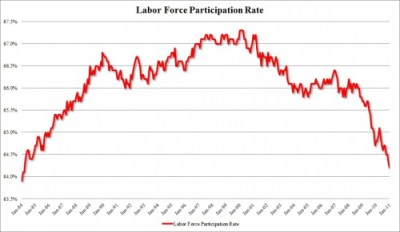
By now, everyone has heard that Marxist Obama has failed to create jobs again, so that the underemployment rate is at 19.2%. (Underemployment is even higher than employment because it takes into account people working part-time who want to work full-time but can’t). That means that 20% of the population either cannot find work, or cannot find full-time work. The labor force participation under Obama’s socialist regime is now at a 26-year low.
Excerpt:
At 64.2%, the labor force participation rate (as a percentage of the total civilian noninstitutional population) is now at a fresh 26 year low, the lowest since March 1984, and is the only reason why the unemployment rate dropped to 9% (labor force declined from 153,690 to 153,186). Those not in the Labor Force has increased from 83.9 million to 86.2 million, or 2.2 million in one year! As for the numerator in the fraction, the number of unemployed, it has plunged from 15 million to 13.9 million in two months! The only reason for this is due to the increasing disenchantment of those who completely fall off the BLS rolls and no longer even try to look for a job. Lastly, we won’t even show what the labor force is as a percentage of total population. It is a vertical plunge.
But these kinds of failures are not unavoidable. For example, look at Canada’s latest unemployment numbers.
Excerpt:
Canada’s job creation in January was more than four times the median forecast, pushing the Canadian dollar to its strongest level since May 2008 and adding to evidence the country’s economic recovery may be accelerating.
Employment rose by 69,200 and the labor force increased by 106,400, Statistics Canada said today in Ottawa. The jobless rate rose to 7.8 percent from December’s 7.6 percent, as more people sought work. Economists forecast 7.6 percent unemployment and job growth of 15,000, according to the median estimates of 25 and 26 economists surveyed by Bloomberg News.
“This adds confidence to the notion we are headed for a better year for growth and growth in the job market,” said Mark Chandler, head of Canadian currency and rates strategy at Royal Bank of Canada’s RBC Capital Markets unit in Toronto. “There isn’t a lot of slack in the labor market in Canada, certainly on a relative basis to other countries.”
Canadian policy makers have been dealing with the impact of a strong currency and a slowdown in growth of household and government spending that crimped the economic recovery in the second half of last year. Bank of Canada Governor Mark Carney stopped raising interest rates after September and Finance Minister Jim Flaherty scaled back plans to exit stimulus.
“It’s one of these reports that’s strong through and through – it’s hard to find any weakness,” said David Tulk, chief Canada macro strategist at Toronto-Dominion Bank’s TD Securities unit.
“The Bank of Canada would likely just see this as a step towards a stronger recovery, but not a point where they would need to respond,” he said. He predicts a July rate increase.
[…]The report restores Canada’s status as having regained all the jobs lost in the recession, after a Jan. 28 revision based on updated census data reduced Statistics Canada’s estimate of total employment.
The Canadian dollar gained 0.4 percent to 98.75 cents per U.S. dollar at 4:30 p.m. in New York from 99.11 cents yesterday, after earlier touching 98.32 cents, the strongest level since May 2008. The benchmark 10-year Canadian government bond yield increased four basis points to 3.46 percent, the highest since May.
[…]“Too many Canadians are still looking for work, the economic recovery is fragile,” Flaherty said today in response to a question in the House of Commons. “We need to continue with our job-creating, low-tax plan.”
Prime Minister Stephen Harper has said reductions in corporate taxes are the best way to boost employment.
[…]Wal-Mart Stores Inc., the world’s largest retailer, said Jan. 26 it will open 40 “supercenters” in Canada by the end of January 2012, creating 9,200 construction and store jobs.
Basically, the Canadians listened to Obama’s speeches, and then decided to do the EXACT OPPOSITE of what he said. They are drilling for more oil, lowering corporate taxes below 20%, (ours is 36%), cutting spending and raising interest rates to encourage people to spend less and invest more, which supports job creation. This is what Hayek would recommend. In order to create jobs, you need to cut corporate taxes to provide businesses with a profit motive. And you need to make sure that there is capital to borrow for risk-taking, which happens when interest rates are higher because people save more money by giving it to banks to lend to businesses. When a business sees that it can keep profits that it makes then that’s what they’ll do. That’s when they start expanding their businesses and taking risks – when there is money to be made. If you keep banning drilling, imposing health care costs and demonizing businesses in speeches, like Obama does, then they WON’T hire anyone.
I hope that all the young people who voted for the first MTV President are happy with their 18% youth unemployment rate. Ideas have consequences.
But the differences between Canada are even more pronounced. Recall that Canada is ONE TENTH the size of the United States, with one-tenth the population, one-tenth the GDP, and one-twentieth the national debt. A 700,000 increase in the number of jobs is really like a 700,000 increase when projected proportionally to the United States. Canada didn’t spend massive amounts of money on “stimulus” spending, because the prime minister is NOT a Keynesian. He’s a Hayekian, like me. He’s not following the socialist, academic playbook – he’s following the capitalist, real-world playbook. He doesn’t believe that lowering interest rates and wasting money of government public works projects is a way out of a recession. And he’s right.
 WINTERY KNIGHT