In the past, public sympathy may well have rested with the court, assuming it was doing its best for the children. But now there is growing evidence that family law has spectacularly failed to keep up with the changing role of men within the home and that children are suffering as a result. Judges are accused of stereotyping, making a legal presumption in favour of the mother and awarding meagre access rights to dads.
With the maturing of the “men’s movement” into more child-centred lobbying and support groups, and with rising numbers of divorce lawyers moving into mediation work and away from adversarial courtrooms, there is a growing understanding of the raw deal many fathers – and children – have been getting from the secretive British family court system.
[…]The government estimates that one in four children has separated or divorced parents. Despite all the evidence that children thrive best when they enjoy the support and love of two parents, only about 11% of children from broken homes will go on to spend equal amounts of time with each parent.
A significant number of fathers, some estimate as many as 40%, will within two years of the split lose all contact with their children. Previously this had been seen as a sign of male fecklessness, but now it is also being recognised that dads are being pushed away, not only by the residual conflict with ex-partners, but also by a legal system that works against them maintaining relationships with their children.
[…]Ian Julian, 49, is one of the tiny percentage of fathers in the UK to have won a shared residency court order for his son, now aged 16. But that was pared away into alternate weekends when his ex-wife sent their son to boarding school against Julian’s wishes. He has had to move four times to follow the house moves of his former wife.
“When I first went to a lawyer, she told me I had no chance of anything, but I was prepared to go to 100 lawyers to find one who would take my case,” he said.
[…]”I’ve heard a judge call a man ‘possessive’ for wanting more than two hours a week, and others make ‘no contact’ orders on hearsay evidence,” he said. “I’ve known mothers taken back to court for ignoring contact orders, but nothing is done. Bad behaviour isn’t just tolerated, it’s encouraged. Some of the judges I have sat in front of have traditional values along the lines of a woman’s place being in the home. But it’s not the experience of the average British family and a father seeing a child once every two weeks isn’t a meaningful relationship.”
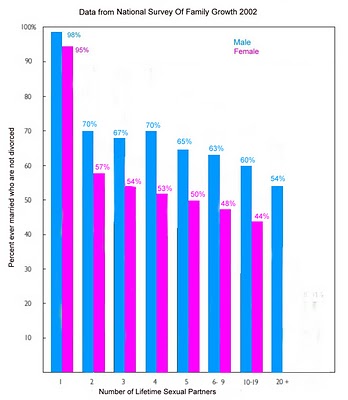
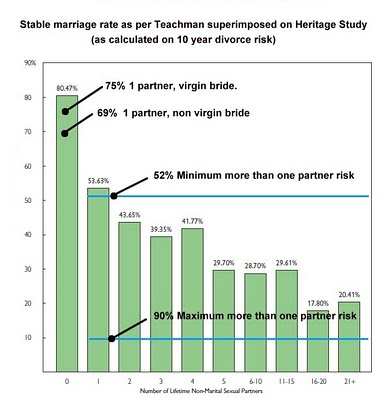
The results presented in this article replicate findings from previous research: Women who cohabit prior to marriage or who have premarital sex have an increased likelihood of marital disruption. Considering the joint effects of premarital cohabitation and premarital sex, as well as histories of premarital relationships, extends previous research. The most salient finding from this analysis is that women whose intimate premarital relationships are limited to their husbands—either premarital sex alone or premarital cohabitation—do not experience an increased risk of divorce. It is only women who have more than one intimate premarital relationship who have an elevated risk of marital disruption. This effect is strongest for women who have multiple premarital coresidental unions. These findings are consistent with the notion that premarital sex and cohabitation have become part of the normal courtship pattern in the United States. They do not indicate selectivity on characteristics linked to the risk of divorce and do not provide couples with experiences that lessen the stability of marriage.
[…]This limitation notwithstanding, the results presented here should shift attention away from research that focuses on the selection of individuals into cohabitation and premarital sex to a focus on the selection of individuals who do not marry the individuals with whom they first cohabit or initiate first sex. It may well be the case that, irrespective of the legal status of the relationship, the relevant distinction to make is between people who form multiple relationships and people who form a single, longer lasting relationship.
The graph:
Published in the Journal of Marriage and Family
(Click for larger image)
The Teachman study was not done by a conservative.
What is the point of a man being a virgin?
OK, I just wrote this part out in one fell swoop, and I am not sure if it is all relevant, but…
I wanted to consider the question of whether women should value the property of virginity in men from a Biblical perspective. Men have specific things they are supposed to do based on the Bible’s specifications. First, they have to be able to provide for the family financially. Second, they have to be able to protect the family from threats, including threats from false worldviews that lead to damage and destruction. Third, they have to be moral and spiritual leaders, nurturing their wives and children in moral values, moral duties, and their relationships with God.
Biblical men make good decisions all along their lives in order to satisfy these Biblical goals. In order to be a good provider, they study math and become engineers, which is hard and requires self-sacrifice. In order to be a good protector, they study science apologetics, philosophy of religion and the historical Jesus, which is hard and requires self-sacrifice. In order to be a good moral and spiritual leader, they guard their chastity and learn how to behave chivalrously, which is hard and requires self-sacrifice.
What women need to do is to do the research on everything including marriage/divorce/parenting, just like the research I talked about above, and generate a seriously Biblical set of criteria for choosing men that seriously satisfies the requirements for Biblical manhood. Women cannot expect good behavior from bad men. And they should actually affirm, approve, and encourage good behaviors in men – and not be resentful about having the obligation to build good men up with words and gifts.
What women need to do is to understand the behaviors that lead to stability and fidelity in a marriage – and that means studying research. Saying “I already know about the damage caused by divorce” is useless – it’s the knowledge of the evidence that changes how a woman makes decisions about men. Personal preferences can be changed at any time, but knowledge doesn’t vary depending on how you feel at any given moment.
For example, to test men for apologetics knowledge, it’s really easy – just ask them what the significance of cosmic microwave background radiation is, what chirality is, what the significance of 1 Corinthians 15:3-7 is, and what is the difference between the deductive and inductive problem of evil. If they can’t answer all four of those then you can’t marry them. Biblical manhood concerns are not check-boxes on the marriage application form – they’re long-form essay questions. Judging the man’s ability to do silly stuff, like get a tattoo or clown around in a bar, is just not relevant to making the marriage serve God. A woman’s personal preferences don’t decide here – evidence decides. (So long as the goal of marriage is to serve God, instead of to make women happy)
Men have a very specific role in marriages. They have to be able to teach the children about theology, apologetics and morality. When it comes to morality, women should not just believe what a man says. Instead, women need to look at what a man does. Specifically, she should look at what a man does representing his worldview, faith and morality to people who disagree with him. Go to his non-Christian co-workers and ask them what the man has told them about theology, apologetics and morality. Ask them for the reasons and evidences that were used in debates with them. That’s how you know what a man really thinks – it’s about what he is willing to say to people who he would rather not upset. Where standing up for the truth is really going to hurt his career and make him less popular. That is the true measure of his faithfulness. Not how well he speaks, sings and prays in church. What matters is whether he puts God above his own selfish needs for advancement and popularity. Is he willing to choose Christ over his own selfish desires? What is number one in his heart?
And finally, if a women chooses a bad man because she knows nothing about how to choose a good one, and hasn’t done any research about what a man has to be able to do to make a marriage stable, then she needs to stop blaming men and taking responsibility for her own poor decision-making. Choosing a man just because he makes you feel happy is not the best way to have achieve a stable marriage. You need to have better criteria than that, because you are going to answer for it later, especially if things go awry.
Evidence creates knowledge and knowledge binds the will
OK now back to the real topic of the post: the use of evidence to support Biblical moral values.
I like having evidence. I hate having to take stands for Biblical morality without evidence. If I can use the evidence for the Big Bang, the fine-tuning, the origin of biological information, the Cambrian explosion, the habitability fine-tuning and irreducible complexity to argue for theism, and then argue for the resurrection based on early sources and minimal facts, then I should have the exact same quality of data when defending moral values. If the Bible says something, I should be able to look at the best research and find that the Bible is correct.
You have to persuade a person during courtship by making them read and write about things, and dump them if they won’t do it. People can say anything during a courtship – make all kinds of promises and then suddenly just turn selfish and break them all. If they haven’t studied and tested these things out, because they think they know everything already, then you really can’t expect good behavior. It’s a crapshoot unless they’ve seen the evidence.
Charges against a Calgary man accused of raping a woman over a 10-hour period nearly two years ago have been unexpectedly stayed.
Crown prosecutor Karuna Ramakrishnan issued the stay after the 44-year-old complainant, who recanted her story under cross-examination by defence lawyer Rebecca Snukal on Wednesday, failed to show up in court on Friday for further questioning.
She had been ordered to do so by Court of Queen’s Bench Justice Sandy Park, so Ramakrishnan could reconsider her position.
John Francis Dionne, 43, had faced charges of sexual assault causing bodily harm, kidnapping, assault causing bodily harm and uttering death threats in connection with the alleged incident on Oct. 28, 2008.
His first trial ended in a mistrial in June, because of an issue with one of the jurors, and was rescheduled for this week.
The woman initially outlined in detail what she says occurred during the ordeal, but when cross-examined, she couldn’t remember specific details.
Then, when asked why she would accept a ride from the man she claimed had raped her for 10 hours she became frustrated and denied it even happened.
“I’m lying about everything,” she told Snukal.
“Hurry along because I’m lying about everything. He’s not a rapist . . . so there, that’s it. End of it . . . he didn’t rape me.
“Let Mr. John Francis go free. He’s not a rapist. It’s over. That’s all I have to say. Let him out.”
Dionne, who had been in custody since his arrest, was to be released some time later on Friday.
Her name has not been released – but his name was released. His life is therefore ruined. And she will probably not be charged, since it is very rare that women are charged for making false accusations. The man spent 2 years of his life in jail. Was there any evidence? She says she was lying about EVERYTHING. How could there be any evidence? And yet he spent two years in jail.
What effect will this have on men? What should men believe about women when things like this happen? What does this tell us about the court system?
Why do women make false accusations of rape?
One recent study listed three reasons why women invent false rape accusations.
Excerpt:
A study of rape allegations in Indiana over a nine-year period revealed that over 40% were shown to be false — not merely unproven. According to the author, “These false allegations appear to serve three major functions for the complainants: providing an alibi, seeking revenge, and obtaining sympathy and attention. False rape allegations are not the consequence of a gender-linked aberration, as frequently claimed, but reflect impulsive and desperate efforts to cope with personal and social stress situations.” ( Kanin EJ. Arch Sex Behav. 1994 Feb;23(1):81-92 False rape allegations. )
In 1985, a study of 556 rape allegations found that 27% accusers recanted when faced with a polygraph (which can be ordered in the military), and independent evaluation showed a false accusation rate of 60%. (McDowell, Charles P., Ph.D. “False Allegations.” Forensic Science Digest, (publication of the U.S. Air Force Office of Special Investigations), Vol. 11, No. 4 (December 1985), p. 64.)
And this also happens in divorce trials in order to get custody.
False accusations in divorce trials
Consider this article from Touchstone magazine, by Stephen Baskerville.
Excerpt:
Today it is not clear that we have learned anything from these miscarriages of justice. If anything, the hysteria has been institutionalized in the divorce courts, where false allegations have become routine.
What is ironic about these witch-hunts is the fact that it is easily demonstrable that the child abuse epidemic—which is very real—is almost entirely the creation of feminism and the welfare bureaucracies themselves. It is well established by scholars that an intact family is the safest place for women and children and that very little abuse takes place in married families. Child abuse overwhelmingly occurs in single-parent homes, homes from which the father has been removed. Domestic violence, too, is far more likely during or after the breakup of a marriage than among married couples.
Yet patently false accusations of both child abuse and domestic violence are rampant in divorce courts, almost always for purposes of breaking up families, securing child custody, and eliminating fathers. “With child abuse and spouse abuse you don’t have to prove anything,” the leader of a legal seminar tells divorcing mothers, according to the Chicago Tribune. “You just have to accuse.”
Among scholars and legal practitioners it is common knowledge that patently trumped-up accusations are routinely used, and virtually never punished, in divorce and custody proceedings. Elaine Epstein, president of the Massachusetts Women’s Bar Association, writes that “allegations of abuse are now used for tactical advantage” in custody cases. The Illinois Bar Journal describes how abuse accusations readily “become part of the gamesmanship of divorce.” The UMKC Law Review reports on a survey of judges and attorneys revealing that disregard for due process and allegations of domestic violence are used as a “litigation strategy.” In the Yale Law Review, Jeannie Suk calls domestic violence accusations a system of “state-imposed de facto divorce” and documents how courts use unsupported accusations to justify evicting Americans from their homes and children.
The multi-billion dollar abuse industry has become “an area of law mired in intellectual dishonesty and injustice” writes David Heleniak in the Rutgers Law Review. Domestic violence has become “a backwater of tautological pseudo-theory,” write Donald Dutton and Kenneth Corvo in the scholarly journal Aggression and Violent Behavior. “No other area of established social welfare, criminal justice, public health, or behavioral intervention has such weak evidence in support of mandated practice.”
If we care about justice for all, then we have to care about this, too.


 WINTERY KNIGHT