Tag Archives: Designer

Convergence detected in the genetic structure of bats and dolphins

Apologetics and the progress of science

We have to start this post with the definition of convergence in biology.

In evolutionary biology, convergent evolution is the process whereby organisms not closely related (not monophyletic), independently evolve similar traits as a result of having to adapt to similar environments or ecological niches.

It is the opposite of divergent evolution, where related species evolve different traits.

On a molecular level, this can happen due to random mutation unrelated to adaptive changes; see long branch attraction. In cultural evolution, convergent evolution is the development of similar cultural adaptations to similar environmental conditions by different peoples with different ancestral cultures. An example of convergent evolution is the similar nature of the flight/wings of insects, birds, pterosaurs, and bats.

All four serve the same function and are similar in structure, but each evolved independently.

Jonathan Wells explains the problem that convergence poses for naturalistic evolution:

Human designers reuse designs that work well. Life forms also reuse certain structures (the camera eye, for example, appears in humans and octopuses). How well does this evidence support Darwinian evolution? Does it support intelligent design more strongly?

Evolutionary biologists attribute similar biological structures to either common descent or convergence. Structures are said to result from convergence if they evolved independently from distinct lines of organisms. Darwinian explanations of convergence strain credulity because they must account for how trial-and-error tinkering (natural selection acting on random variations) could produce strikingly similar structures in widely different organisms and environments. It’s one thing for evolution to explain similarity by common descent—the same structure is then just carried along in different lineages. It’s another to explain it as the result of blind tinkering that happened to hit on the same structure multiple times. Design proponents attribute such similar structures to common design (just as an engineer may use the same parts in different machines). If human designers frequently reuse successful designs, the designer of nature can surely do the same.

I’m a software engineer, and we re-use components all the time for different programs that have no “common ancestor”. E.g. – I can develop my String function library and use it in my web application and my Eclipse IDE plug-in, and those two Java programs have nothing in common. So you find the same bits in two different programs because I am the developer of both programs. But the two programs don’t extend from a common program that was used for some other purpose – they have no “common ancestor” program.

Now with that in mind, take a look at this recent article from Science Daily, which Mysterious Micah sent me.

Excerpt:

The evolution of similar traits in different species, a process known as convergent evolution, is widespread not only at the physical level, but also at the genetic level, according to new research led by scientists at Queen Mary University of London and published in Nature this week.

The scientists investigated the genomic basis for echolocation, one of the most well-known examples of convergent evolution to examine the frequency of the process at a genomic level.

Echolocation is a complex physical trait that involves the production, reception and auditory processing of ultrasonic pulses for detecting unseen obstacles or tracking down prey, and has evolved separately in different groups of bats and cetaceans (including dolphins).

The scientists carried out one of the largest genome-wide surveys of its type to discover the extent to which convergent evolution of a physical feature involves the same genes.

They compared genomic sequences of 22 mammals, including the genomes of bats and dolphins, which independently evolved echolocation, and found genetic signatures consistent with convergence in nearly 200 different genomic regions concentrated in several ‘hearing genes’.

[…]Consistent with an involvement in echolocation, signs of convergence among bats and the bottlenose dolphin were seen in many genes previously implicated in hearing or deafness.

“We had expected to find identical changes in maybe a dozen or so genes but to see nearly 200 is incredible,” explains Dr Joe Parker, from Queen Mary’s School of Biological and Chemical Sciences and first author on the paper.

“We know natural selection is a potent driver of gene sequence evolution, but identifying so many examples where it produces nearly identical results in the genetic sequences of totally unrelated animals is astonishing.”

Nature is the most prestigious peer-reviewed science journal. This is solid material.

There is an earlier article from 2010 in New Scientist that talked about one of the previous genes that matched for hearing capability.

Excerpt:

Bats and dolphins trod an identical genetic path to evolve a vital component of the complex sonar systems they use to pursue and catch prey.

The finding is unusual, because although many creatures have independently evolved characteristics such as eyes, tusks or wings, they usually took diverse genetic routes to get there.

Analysis of a specific gene has now demonstrated that although bats live in air and dolphins in water, where sound travels five times faster, they independently evolved a near-identical gene that allows them to accept high-frequency sound in the ear – vital for sonar.

The gene makes prestin, a protein in hair cells of the cochlea, which is the organ in the inner ear where sonar signals are accepted and amplified. Prestin changes shape when exposed to high-frequency sound, and this in turn deforms the fine hair cells, setting off an electrical impulse to the brain. So the protein has the important jobs of detecting and selecting high-frequency sounds for amplification.

When researchers examined the molecular structure of the prestin gene from a range of animals, they found that the variants in echolocating bats and dolphins were virtually indistinguishable.

Indistinguishable genes in animals that don’t share a common ancestor? Maybe a better explanation for the evidence we have is – common designer.
Michael Strauss lectures on scientific evidence for a Creator at UT Dallas

Apologetics and the progress of science

The lecture: (from 2013)

Note: there is a period of 19 minutes of Q&A at the end of the lecture.

About the speaker:

His full biography is here.

Summary:

  • It used to be true that most of the great scientists were believers in God
  • But now science has advanced and we have better instruments – is it still true?
  • Today, many people believe that science has shows that the universe and Earth are not special
  • We used to believe that the Earth was the center of the universe, and Darwin showed we are not designed
  • The problem with this view is that it is based on old science, not modern science
  • Three topics: origin of the universe, fine-tuning of the universe, the Rare Earth hypothesis

Experimental evidence for the origin of the universe:

  • #1: Hubble discovered that the universe expands because of redshifting of light from distant galaxies
  • #2: Measurements of the cosmic microwave background radiation show the universe had a beginnning
  • #3: Measurements of the light element (hydrogen and helium) abundances confirm an origin of the universe
  • The best explanation for an absolute origin of space, time, matter and energy is a supernatural cause

Experimental evidence for the design of the universe:

  • #1: The amount of matter: a bit less = no stars and galaxies, a bit more = universe recollapses
  • #2: The strong force: a bit more = only hydrogen, a bit more = little or no hydrogen
  • #3: Carbon resonance level: a bit higher = no carbon, a bit lower = no carbon

Experimental evidence for galactic, stellar and planetary habitability:

  • #1: Galaxy: produces high number of heavy elements and low radiation
  • #2: Star: long stable lifetime, burns bright, bachelor star, third generation star (10 billion years must elapsed),
  • #3: Planet: mass of planet, stable orbit, liquid water, tectonic activity, tilt, moon

Naturalistic explanations:

  • Humans evolve to the point where they reach back in time and create finely-tuned universe
  • Eternally existing multiverse

Hawking and Mlodinow response to Rare Earth:

  • There are lots of planets so one must support life
  • Odds of a planet that supports life are low even with 10^22 planets

Hawking and Mlodinow proposal of M-theory multiverse:

  • There is no experimental evidence for M-theory being true
  • M-theory is not testable now and is not likely to be testable in the future
  • But science is about making testable predictions, not about blind speculation

Hawking and Mlodinow no-boundary proposal:

  • This theory requires the laws of physics to exist prior to the universe
  • But where do you get laws of physics before there is any physical world?
  • There is no experimental evidence for no-boundary proposal
  • All the evidence we have now (redshift, CMBR, H-He abundances) is for Big Bang

What science has revealed provide abundant evidence for a transcendent Creator and Designer

Related posts

Robin Collins lectures on fine-tuning for discoverability from particle physics

This lecture is 29 minutes long, the Q&A is 15 minutes. I highly recommend this lecture to all audiences of all levels of ability, for the simple reasons that apart from the content, this lecture is a how-to clinic in the tone, body language, slides and so on for you to use when trying to be persuasive when making your case. Science is king in this lecture. The scientific method is defined and applied in a winsome way. Making science understandable should be the bread and butter approach to Christian apologetics, and this lecture rivals the Mike Strauss lecture at Stanford University and the Mike Strauss lecture at the University of Texas – Dallas as the ideal lectures for showing that. It’s not just the scientific material that makes this lecture by Collins work, it’s the narrative and the style that make the lecture work.

About Robin Collins:

Robin Collins (PhD, University of Notre Dame, 1993), is professor of philosophy at Messiah College, Grantham, PA specializing in the area of science and religion.  He has written over twenty-five articles and book chapters on a wide range of topics, such as the fine-tuning of the cosmos as evidence for the existence of God, evolution and original sin, the Doctrine of Atonement, Asian religions and Christianity, and Bohm’s theory of quantum mechanics.  Some of his most recent articles/book chapters are “Philosophy of Science and Religion” in The Oxford Handbook of Science and Religion, “Divine Action and Evolution” in The Oxford Handbook of Philosophical Theology (2009)  “The Multiverse Hypothesis: A Theistic Perspective,” in Universe or Multiverse? (Cambridge University Press), and “God and the Laws of Nature,” in Theism or Naturalism: New Philosophical Perspectives (Oxford University Press, forthcoming).  He recently received a grant from the John Templeton Foundation to finish a book that presents the case for design based on physics and cosmology,  tentatively entitled The Well-Tempered Universe: God, Cosmic Fine-tuning, and the Laws of Nature.

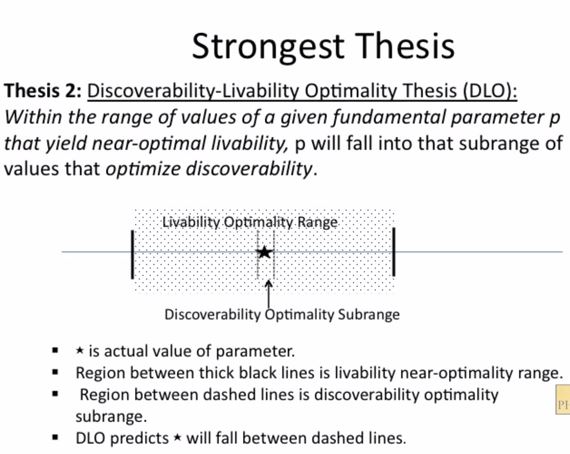
His thesis in one slide:

Fine-tuning for discoverability
Fine-tuning for discoverability – the DLO thesis

Summary:

  • Thesis: the universe is more intelligible than we would expect it by chance
  • The regular fine-tuning argument says that complex embodied observers are very rare
  • But the number of highly-discoverable universes that have complex embodied observers is rarer still
  • Why do we exist in a highly-discoverable universe?
  • Can we quantify and test discoverability?
  • Yes: by varying fundamental parameters and seeing how it affects discoverability
  • Conclusion of his calculations: The Discoverability-Liveability Optimality range is an even smaller range within the Liveablity Optimality range of the standard fine-tuning argument
  • Fine-tuning #1: the fine structure constant, governs the strength of the electro-magnetic force
  • If larger, wood-burning fire becomes impossible because fires won’t stay lit, and therefore forging metals becomes unlikely
  • If smaller, wood-burning fires won’t go out, e.g. – from lightning strikes, so that wood would be less accessible
  • Other constraints: smaller value decreases effectiveness of light microscopes, drastically lowers efficiency of transformers and motors
  • Fine-tuning #2: the cosmic microwave background radiation (CMBR), radiation left over from the Big Bang
  • humans need to discover the CMBR in order to confirm the Big Bang creation out of nothing, and it depends on baryon/pothon ratio
  • his calculations show that the actual value of CMBR is exactly at the peak for detectability by humans
  • if baryon/photon ratio larger, CMBR is less discoverable
  • if baryon/photon ratio smaller, CMBR is less discoverable
  • Fine-tuning #3: parameters related to subatomic particles are fine-tuned for their discovery and usefulness, e.g. – the bottom quark, the charm quark, the tau lepton and the Higgs Boson
  • the lifetime of the particles affects their usefulness to scientists who want to investigate the Standard Model of physics
  • decay rates of these subatomic particles are related to several of the finely-tuned parameters
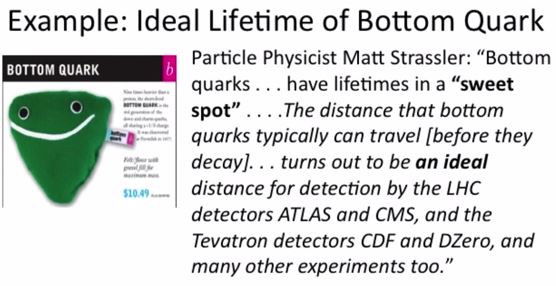
  • for example, the mass of the bottom quark is finely-tuned for its discoverability by scientists
  • the tau lepton and the charm quark are similarly fine-tuned for disoverability
  • the mass of the Higgs boson is finely-tuned for discoverability and for making further discoveries
  • Conclusion: the DLO thesis is strongly confirmed – this is an even greater degree of fine-tuning that the already astonishing probabilities of the fine-tuning for complex, embodied intelligent beings
  • The formalized version of the philosophical argument based on this evidence is impervious with some of the traditional objections to the standard fine-tuning argument
  • #1 multiverse/selection effect: it is not subject to multiverse / observer selection objections
  • #2 normalizeability: it is not subject to the McGrew-Vestrup objection because the range of possible values is finite not infinite
  • #3 falsifiability: it makes falsifiable predictions, and in fact Collins’ earlier calculations of the CMBR discoverability contained an error that falsified the thesis – until he found the error and corrected for it
  • #4 usefulness: it gives clues about the Creator’s purpose for us, namely that the universe was created for us to be able to do science and find evidence of the Creator’s existence – there is no expectation for us to exercise blind faith, trust in God is meant to be a plausible deduction from the progress of experimental science

Sample slide:

Fine-tuning of the bottom quark for discoverability
Bottom quark lifetime is finely-tuned for discoverability

And another:

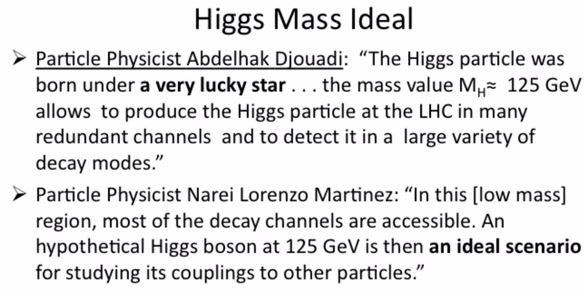
Higgs boson mass is finely-tuned for discoverability

Earlier, I blogged about a Robin Collins lecture on the fine-tuning that allows complex, embodied life to exist. Another must-see lecture. If you are looking for something to study in university, and you have funding, then physics, mathematics and philosophy are the best places to be for a Christian scholar.