
Tag Archives: Critical Thinking

Obama revises contraception mandate but Catholic groups still pay for abortion drugs

Life News explains.

Excerpt:

The Obama administration has revised its controversial mandate that had forced religious employers to pay for health insurance coverage that includes birth control and drugs like Plan B, the morning after pill, and ella that can cause abortions.

Responding to a firestorm of opposition from pro-life organizations, Catholics groups and even some Democrats, the Obama administration has revised the mandate in a way that pro-life advocates are saying is even worse.

The revised Obama mandate will make religious groups contract with insurers to offer birth control and the potentially abortion-causing drugs to women at no cost. The revised mandate will have religious employers refer women to their insurance company for coverage that still violates their moral and religious beliefs. Under this plan, every insurance company will be obligated to provide coverage at no cost.

Essentially, religious groups will still be mandated to offer plans that cover both birth control and the ella abortion drug.

According to Obama administration officials on a conference call this morning, a woman’s insurance company “will be required to reach out directly and offer her contraceptive care free of charge. The religious institutions will not have to pay for it.”

The birth control and abortion-causing drugs will simply be “part of the bundle of services that all insurance companies are required to offer,” White House officials said.

“We are actually more comfortable having the insurance industry offer and market this to women than religious institutions,” the White House said on the conference call LifeNews listened to because they “understand how contraception works” and it “makes sense financially.”

[…]Republican Study Committee Chairman Jim Jordan told LifeNews in response to the revised mandate that it violates the right to religious freedom guaranteed by the First Amendment to the Constitution.

“This ObamaCare rule still tramples on Americans’ First Amendment right to freedom of religion. It’s a fig leaf, not a compromise. Whether they are affiliated with a church or not, employers will still be forced to pay an insurance company for coverage that includes abortion-inducing drugs,” he said. “This is not just a problem for church-affiliated hospitals and charities. Under these rules, a small business owner with religious objections to abortion-inducing drugs and contraception must either violate his religious beliefs or violate the law.”

“The liberal Obama administration thinks its political goals trump the religious faith of American citizens. That isn’t right, fair, or constitutional,” he said.

The abortions will still be paid for by the religious groups. They are going to pay for the drugs through medical insurance premiums. So religious organizations are still being forced to provide abortions for their workers.

Who is to blame for this? I blame Catholic bishops. Catholic bishops do believe in socialism. They do want a secular government to take money from religious people. And they do want government to hand out medical care to people, instead of letting individuals, businesses and charities provide health care.

Rick Santorum agrees with me on this.

Consider this interview with Rick Santorum in which he reacts Obama’s health care mandate.

Excerpt:

HH: Now I want to talk to you about two substantive issues, Senator Santorum. The first are these new regulations from the Obama administration. I read the letter from Archbishop Olmstead of Phoenix on the air. Archbishop Jose Gomez of Los Angeles has written a new article in First Things. It’s shocking, actually, what’s going on. Should this be a centerpiece of whoever the nominee’s campaign is?

RS: I talked about it in every speech I’ve given today. And here’s what I said, though, Hugh. I said that I took issue with the Catholic Bishops Conference, because Hugh, you may remember, they embraced Obamacare.

HH: Yes.

RS: They embraced it and said…here’s what I said to them. Be careful when you have government saying that they can give you rights, that you have a right to health care, and government’s going to give you something, because once you are now dependant on government, they, not only can they take that right away, they can tell you how to exercise that right, and you can either like it or not. And that’s the problem. That’s what the Catholic Bishops Conference didn’t get, that there’s no free lunch here, folks. If you’re going to give people secular power, then they’re going to use it in a secular fashion. And that’s why, you know, I hate to say it, but you know, you had it coming. And it’s time to wake up and realize that government isn’t the answer to the social ills. It’s people of faith, and it’s families, and it’s communities, and it’s charities that need to do this as it has in America so successfully for so long.

HH: Rick Santorum, what do you advise Catholic hospitals, Catholic colleges, Catholic…the centers of poverty assistance, the adoption agencies? What do you advise them to do in the face of, as Archbishop Olmstead said, we cannot comply with this unjust law?

RS: Civil disobedience. This will not stand. There’s no way they can make this stand. The Supreme Court, eventually, this thing’s going to get to the Supreme Court just like the ministerial hiring issue that was just decided by the Supreme Court the other day. And it was a 9-0 decision that said the Obama administration can’t roll over people of faith when it comes to hiring. Yet in the face of that decision, this radical, secular government of Barack Obama continues to have faith be the least important of the 1st Amendment. And I just think they fight. They fight in the courts, and they fight by civil disobedience, and go to war with the federal government over this one.

Evangelical protestants feel comfortable with Catholics like Rick Santorum. He gets it. If the bishops are wrong on socialized medicine and wrong on the death penalty and wrong on other things, then so much the worse for the bishops.

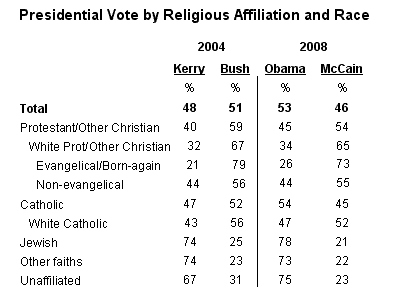
Obama did very well with Catholics in 2008 even though Obama is the most pro-abortion president in the history of the United States. Catholics tend to be more liberal on economic issues than evangelicals, which is why many of them voted for Obama. Evangelicals oppose economic liberalism, because they oppose government taking tax money from workers in order to provide services for other people aren’t trying to be self-sufficient. Evangelicals oppose increasing the dependence of individuals on a secular government. Evangelicals don’t want a secular government to take money from individuals and then use it to push secular leftist ideas like global warming, Darwinism and sex education in government run institutions, e.g. – public schools, public broadcasting, etc. Evangelicals trust individuals to care for the poor, and they don’t want to make it too easy for people to make reckless decisions and then get a check in the mail or a free abortion.

What causes this difference between Catholics and evangelicals? Evangelicals believe in salvation through grace ALONE through faith ALONE in Christ ALONE. Evangelicals put the emphasis on what you believe – it has to be true in order to please God. Catholics, just like Mormons, Jews and other religions, emphasize good works as a requirement for salvation. Many Catholics also support inclusivism, which is the view that you can be saved in other religions like Judaism and Islam. This means that for these Catholics, specific Christian doctrines are not essential for salvation, so long as you have sincerity and good works. On the other hand, evangelicals are exclusivists who emphasize the need for each person to arrive at true beliefs about God in order to be saved, and good works are just natural outworkings of their beliefs.

Evangelicals emphasize the responsibility of the individual to discover truth with their Bibles, reasoning, science and history. This belief in individual responsibility carries over into their approach to charity. Evangelicals believe individuals are responsible for deciding what to do about charity – you earn your own money and then you choose yourself how to share with others. But the responsibility to give away money wisely is an individual responsibility – you share your money in a way that is consistent with your beliefs. Evangelicals don’t generally accept the idea of handing money off to someone else and letting them decide what to do with it. We think that everything is our responsibility, starting with Bible study and theology, and going on through to economics and politics.

And this emphasis on individuals over big government has this effect:
(Source)

Note that this chart puts evangelicals together with born-again Christians. But evangelical Christians differ from born-again Christians, because they are firm on exclusive salvation and evangelism. Evangelicals like to study so that they can discuss their beliefs in public, using reasons and evidence to persuade others. A born-again Christian does not have that same emphasis on study and persuasion, because they don’t focus on evangelism. So, if you separate out the born-agains from that 26%, number for Obama support, then you are likely to get a much lower number for evangelicals who support Obama. We don’t like health care mandates covering abortion. Evangelicals are used to having to puzzle things out for themselves – so they puzzled out what Obama believed and then they voted against him.
Does the Santorum Amendment promote critical thinking in the science classroom?

Here’s a post from Evolution News to explain.

Excerpt: (links removed)

With his near-win in Iowa and his recent rise in the polls, Republican presidential candidate Rick Santorum is facing new scrutiny about his views on intelligent design and evolution. Reporters and others have expressed particular interest in the so-called “Santorum Amendment” authored by Senator Santorum, which was adopted in revised form in the Conference Report of the landmark No Child Left Behind Act. A media backgrounder on Rick Santorum, evolution, and intelligent design is available to download at: http://www.discovery.org/a/18071.

The Santorum Amendment won overwhelming bipartisan support in the United States Senate. In fact, Sen. Ted Kennedy enthusiastically endorsed the Amendment on the Senate floor. Others voting in favor of the Amendment included Sen. Hillary Clinton, Sen. Joe Biden, Sen. Barbara Boxer, Sen. Harry Reid, Senator John McCain, and Senator Sam Brownback. (See Congressional Record, June 13, 2001, p. S6153.)

The Santorum Amendment did not mandate teaching intelligent design, nor did it encourage teaching creationism or religion in the classroom. Instead, it encouraged open discussion and inquiry by teachers and students of the evidence both for and against controversial scientific theories such as Darwin’s theory of evolution.

The approach advocated in the Santorum Amendment is favored by the vast majority of Americans, no matter what their race, gender, or political party. According to a nationwide Zogby poll in 2009, 80 percent of likely voters “agree that teachers and students should have the academic freedom to discuss both the strengths and weaknesses of evolution as a scientific theory.”

“Allowing discussions of all the scientific evidence about evolution in the classroom is good for students and good for science. It’s the mainstream approach supported by most Americans,” says Dr. John West, Associate Director of Discovery Institute’s Center for Science & Culture. “Those who are trying to put a gag order on teachers and students to insulate Darwin’s theory from critical inquiry are the real extremists.”

You can also listen a podcast with David DeWolf on this topic.

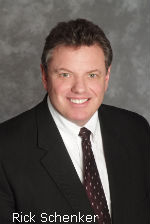
Meet Rick Schenker, head of Ratio Christi, a pro-apologetics campus ministry

Rick Schenker president of Ratio Christi

Here’s an interview with the founder of Ratio Christi, Rick Schenker.

About Rick:

Rick Schenker is president of Ratio Christi, a campus-based, Christian apologetics organization, which he joined in February, 2011. Rick has a visionary leadership style, and has experience in business, government, public and media relations, fundraising, and non-profit management. He has a bachelor’s degree in Bible from Central Bible College, and has done graduate work in public policy at Regent University, along with additional postgraduate work in leadership and public administration. Rick has extensive experience in grass-roots political organization and campaigns in the state of Pennsylvania. As the chief elected official of the County government in Erie, Pennsylvania, he oversaw 1,100 employees and a $300 million budget.

Excerpt:

TBS: Thank you for allowing us to interview you for TheBestSchools.org. Please give our readers an overview of Ratio Christi? What is it? How did it get started? What are its goals?

RSRatio Christi is a global movement that equips university students and faculty to give historical, philosophical, and scientific reasons for following Jesus Christ. Ratio Christi (Latin for “The Reason of Christ”) is placing Christian apologetics clubs at universities both nationally and internationally. Bringing together faith and reason in order to establish the intellectual voice of Christ in the University, Ratio Christi is engaging in the battle for the mind of Christians and skeptics alike. We unashamedly defend the veracity of God, the Bible, and Christ’s resurrection. Ratio Christ started three and a half years ago as a ministry of Southern Evangelical Seminary and became an independent non-profit organization in early 2011. Since that time, Ratio Christi has developed strong partnerships with many other seminaries and organizations, focusing on Christian apologetics and worldview issues. By working together, we now have approximately 60 clubs in various stages of development in universities across the country and around the world.

TBS: Please give us a bit of background about yourself. What were some of the things you were doing before assuming the helm of Ratio Christi? How did the opportunity to head up Ratio Christi present itself?

RS: I am a grass-roots political organizer. I was an elected official, and decided to leave politics to pursue work within Christian ministry. Unfortunately, even though I had run a few nonprofits, and a government with a $300 million budget, I couldn’t find a job. Sometime in 2010, I was considering getting a master’s degree in apologetics, and ran into the Ratio Christi web site. It was a student-run ministry at Southern Evangelical Seminary. In politics, I had become used to spotting trends that could turn into mass movements. As soon as I saw Ratio Christi, I knew it was a mass movement waiting to happen. I called them up and asked them to let me run it. Based on our 500% growth in the last six months, it is apparent that this is something that was not only needed, but ready and waiting to happen in God’s timing.

Here’s more:

TBS: One of the striking claims you make on your web site is that “you are not building an organization, you are building a movement”? Could you please expand on what you see as the difference between the two? What would a Ratio Christi movement look like?

RS: First, Ratio Christi is not the movement. We are simply a grass-roots organization for a greater movement. A movement is usually something that grows beyond the efforts or abilities of the leaders involved in starting it. Ratio Christi is involved in a movement in which apologetics is sweeping through the culture. Because of the rapid growth of neo-atheism in the university, Christian students are under attack. When confronted with intellectual challenges to Christianity, many Christian college students will abandon their faith. You can’t blame them. If the faith of their parents is irrational, then it should be abandoned. In many cases, Christian students are ridiculed and openly humiliated by fellow students and sometimes faculty, for believing in God, the Bible, and Jesus Christ. Then along comes some good apologetics training, and suddenly the students realize that their faith can stand up to intellectual scrutiny. They see that the scientific, historical, and philosophical evidence is on the side of Christianity. They get pumped up about that. The same is true for adults and high school students. Most people didn’t know there was so much evidence that supports the Christian worldview. Ratio Christi wants to help propogate the message that Christianity is not only good, it is true. We want to get the word out, organize cooperation with like-minded ministries, put people and resources in universities and communities, and generally help facilitate what we see as a broader work of God.

TBS: You also say on your web site that you are not in competition with other “full-service” campus ministries, because Ratio Christi is more narrowly focused on “the battle of ideas that permeates the university.” That seems like an admirable goal. But by placing so much emphasis on reasoned discourse, are you concerned at all that Ratio Christi may be raising the bar too high for a truly broad-based campus ministry? After all, you wouldn’t want it seem like undergraduates needed to be philosophy majors in order to participate effectively in their local Ratio Christi chapter, would you?

RS: We do exactly what we say. We go onto a campus to support other Christian ministries. A highly trained apologist is placed on a campus to meet weekly with a small group of students that want to go deeper into the study of the intellectual framework of the Christian faith. RC offers to do training for other student ministries and extends the offer to Christian faculty members. The bar is not too high; this is stuff high school students could and should be learning. Yes, it takes hard work, but loving God with all our mind is part of what it means to be a disciple of Jesus Christ. There is a full range of students involved, from those who have already studied these things deeply to those with no previous exposure. Atheists, agnostics, and those of other belief systems are encouraged to attend. This is a safe place where you can bring your questions. And we do encourage all students to get involved with other campus ministries that do more Bible studies, have worship services, and other fellowship opportunities. RC is simply there to help them deal with the tough questions. Does God exist? Doesn’t science disprove God? Did Jesus really rise from the dead? If God is good and all powerful, why is there evil and suffering? These are the hard questions, and that is what an apologist is trained to handle. Students love it. They love learning the critical-thinking skills necessary to analyze competing worldviews through logical discourse.

TBS: What has been your experience, so far, with the reception of your local Ratio Christi chapters on mainstream secular campuses? Has it been hard to get them recognized? Have there been any noteworthy cases of backlash against students on secular campuses for getting involved with their local Ratio Christi chapter?

RS: Actually it has been surprisingly easy. Since most universities are theoretically all about academic freedom, we approach it from this angle. They should welcome the opportunity to discuss these issues as long as it is done in a civil format. It helps that current case law supports the right of free association on campus. We have been blessed to have the expertise of the Alliance Defense Fund helping guide us in understanding the legal obligations that the universities are under. Since secular thought dominates most educational institutions, the backlash against Christianity is already there. We just try to even the playing field by giving a sound intellectual defense of the faith. Our arguments are appealing to those that are intellectually honest, so there is no need to back down in the face of opposition.

And more:

TBS: One of the most striking things you say on your web site is that you want to make your local Ratio Christi campus chapters welcoming to agnostics and atheists. We certainly see the point of trying to provide a structure for believers and nonbelievers to meet with each other and get to know each other as people, in a nonthreatening environment. But we wonder, given the tensions that exist on college campuses and in American culture generally today, how much success you’ve had so far in this endeavor. Have the chapters had much luck in really engaging with agnostic and atheist students in a constructive way? If not, do you have any thoughts about how you might achieve a better result with this distinctive and important dimension of your work?

RS: Actually, it is fairly normal for our chapters to engage with agnostic and atheist individuals, both in the meetings and around the campus. There has also been a lot of interaction with skeptic/atheist groups, such as co-sponsoring events or setting up discussion forums. Clubs representing other world religions have also been interested in engaging in discussion with our clubs. These interactions are very civil discussions, and our apologists teach Christian students to follow the advice of I Peter 3:15–16, to “always be prepared to give an answer to everyone who asks you to give the reason for the hope that you have. But do this with gentleness and respect, keeping a clear conscience, so that those who speak maliciously against your good behavior in Christ may be ashamed of their slander.” It is easier to do this with gentleness and respect when you are confident in your answers. We have found the reception to a reasoned approach to faith to be quite positive. On the other hand, there are many students among the neo-atheists that have picked up on the tactics of Dawkins and others by practicing a lot of ad hominem arguments against Christians. This is usually some kind of generalized attack like “All Christians are stupid because of X,” but the majority of the discourse on campus is usually quite civil.

Reading this interview was a real encouragement to me. I was very excited by what they are doing on these campuses.

I was in IVCF as an undergraduate and Campus Crusade as a graduate student, and we never did anything with apologetics. Not one thing in six years! They actually blocked every suggestion that the other students and I had to bring in speakers, show debate and lecture DVDs, and organize debates. I didn’t learn one useful thing in 6 years. Everything was always about people sharing their feelings, prayer walks and testimonies. And lots of singing. I know that other IVCF and Crusade groups are different, because I know that some of them do support apologetics, but the ones I attended were really dead set against apologetics.

If any of you are thinking about getting me a Christmas gift because you like the blog, just make a donation to Ratio Christi. Any amount would be great. They take PayPal! (At least – they took my donation through PayPal)

In case you are wondering what they do, here is a sample debate, featuring William Lane Craig and Michael Tooley:

That debate took place at the University of North Carolina.

You can watch another full debate they did (William Lane Craig vs Lawrence Krauss) with this Youtube playlist. That one occurred at North Carolina State University.

Here’s my snarky summary of that debate, in case you don’t want to watch it. The audio is not the best.