Tag Archives: Cosmology

The formation of the elements required for complex embodied life is fine-tuned

Apologetics and the progress of science

Some atheists who don’t understand the fine-tuning argument like to assert that the constants and quantities that are fine-tuned to allow for the existence of complex, embodied life can be changed arbitrarily, and life would still exist as it does now. They say that maybe we would have a ridges in our foreheads like Klingons, or maybe we would have longer ears like Vulcans or maybe green skin like Orions. The evidential support for this view seems to be grounded in Star Trek TV shows, not peer-reviewed evidence. Are atheists right to ground their rejection of a cosmic Designer in science fiction television shows? What does the peer-reviewed research say?

The fine-tuning argument

First, let’s review the structure of the fine-tuning argument.

The argument goes like this:

  1. The fine-tuning of the universe to support life is either due to law, chance or design
  2. It is not due to law or chance
  3. Therefore, the fine-tuning is due to design

Although each permutation of values for the constants and quantities is equally improbable, the vast majority of the permutations will not permit life.

Let’s review:

  • Life has certain minimal requirements; long-term stable source of energy, a large number of different chemical elements, an element that can serve as a hub for joining together other elements into compounds, a universal solvent, etc.
  • In order to meet these minimal requirements, the physical constants, (such as the gravitational constant), and the ratios between physical constants, need to be withing a narrow range of values in order to support the minimal requirements for life of any kind.
  • Slight changes to any of the physical constants, or to the ratios between the constants, will result in a universe inhospitable to life.
  • The range of possible values spans 70 orders of magnitude.
  • The constants are selected by whoever creates the universe. They are not determined by physical laws. And the extreme probabilities involved required put the fine-tuning beyond the reach of chance.
  • Although each individual selection of constants and ratios is as unlikely as any other selection, the vast majority of these possibilities do not support the minimal requirements of life of any kind. (In the same way as any hand of 5 cards that is dealt is as likely as any other, but you are overwhelmingly likely NOT to get a royal flush. In our case, a royal flush is a life-permitting universe).

Now let’s see a specific example: carbon and oxygen formation.

Carbon is that element that can serve as a hub for larger molecules, and oxygen is also a vital element, since it is a component of water, which is required for life (universal solvent). Both are required for complex life of any imaginable kind.

Now for the study.

Here is an article on Science Daily about the fine-tuning argument.

It says:

Life as we know it is based upon the elements of carbon and oxygen. Now a team of physicists, including one from North Carolina State University, is looking at the conditions necessary to the formation of those two elements in the universe. They’ve found that when it comes to supporting life, the universe leaves very little margin for error.

Both carbon and oxygen are produced when helium burns inside of giant red stars. Carbon-12, an essential element we’re all made of, can only form when three alpha particles, or helium-4 nuclei, combine in a very specific way. The key to formation is an excited state of carbon-12 known as the Hoyle state, and it has a very specific energy — measured at 379 keV (or 379,000 electron volts) above the energy of three alpha particles. Oxygen is produced by the combination of another alpha particle and carbon.

NC State physicist Dean Lee and German colleagues Evgeny Epelbaum, Hermann Krebs, Timo Laehde and Ulf-G. Meissner had previously confirmed the existence and structure of the Hoyle state with a numerical lattice that allowed the researchers to simulate how protons and neutrons interact. These protons and neutrons are made up of elementary particles called quarks. The light quark mass is one of the fundamental parameters of nature, and this mass affects particles’ energies.

In new lattice calculations done at the Juelich Supercomputer Centre the physicists found that just a slight variation in the light quark mass will change the energy of the Hoyle state, and this in turn would affect the production of carbon and oxygen in such a way that life as we know it wouldn’t exist.

[…]The researchers’ findings appear in Physical Review Letters.

There are many, many other examples of fine-tuning of the constants and quantities to permit complex, embodied life. And, as we’ll see below, this evidence is admitted by atheists.

Atheists agree: the fine-tuning is a fact

Let me give you a citation from the best one of all, Martin Rees. Martin Rees is an atheist and a qualified astronomer. He wrote a book called “Just Six Numbers: The Deep Forces That Shape The Universe”, (Basic Books: 2001). In it, he discusses 6 numbers that need to be fine-tuned in order to have a life-permitting universe.

In chapter 1, Rees writes:

Mathematical laws underpin the fabric of our universe — not just atoms, but galaxies, stars and people. The properties of atoms — their sizes and masses, how many different kinds there are, and the forces linking them together — determine the chemistry of our everyday world. The very existence of atoms depends on forces and particles deep inside them. The objects that astronomers study — planets, stars and galaxies — are controlled by the force of gravity. And everything takes place in the arena of an expanding universe, whose properties were imprinted into it at the time of the initial Big Bang.

[…]This book describes six numbers that now seem especially significant.

[…]Perhaps there are some connections between these numbers. At the moment, however, we cannot predict any one of them from the values of the others.

[…]These six numbers constitute a ‘recipe’ for a universe. Moreover, the outcome is sensitive to their values: if any one of them were to be ‘untuned’, there would be no stars and no life. Is this tuning just a brute fact, a coincidence? Or is it the providence of a benign Creator?

There are some atheists who deny the fine-tuning, but these atheists are in firm opposition to the progress of science. The more science has progressed, the more constants, ratios and quantities we have discovered that need to be fine-tuned. Science is going in a theistic direction. Next, let’s see how atheists try to account for the fine-tuning.

Atheistic responses to the fine-tuning evidence

There are two common responses among atheists to this argument.

The first is to speculate that there are actually an infinite number of other universes that are not fine-tuned, (i.e. – the gambler’s fallacy). All these other universes don’t support life. We just happen to be in the one universe is fine-tuned for life. The problem is that there is no way of directly observing these other universes and no independent evidence that they exist.

Here is an excerpt from an article in Discover magazine, (which is hostile to theism and Christianity).

Short of invoking a benevolent creator, many physicists see only one possible explanation: Our universe may be but one of perhaps infinitely many universes in an inconceivably vast multiverse. Most of those universes are barren, but some, like ours, have conditions suitable for life.

The idea is controversial. Critics say it doesn’t even qualify as a scientific theory because the existence of other universes cannot be proved or disproved. Advocates argue that, like it or not, the multiverse may well be the only viable non­religious explanation for what is often called the “fine-tuning problem”—the baffling observation that the laws of the universe seem custom-tailored to favor the emergence of life.

The second response by atheists is that the human observers that exist today, 14 billion years after the universe was created out of nothing, actually caused the fine-tuning by going back in time and causing the universe to be fine-tuned. This solution would mean that although humans did not exist at the time the of the big bang, they are going to be able to reach back in time at some point in the future and manually fine-tune the universe.

Here is an excerpt from and article in the New Scientist, (which is hostile to theism and Christianity).

…maybe we should approach cosmic fine-tuning not as a problem but as a clue. Perhaps it is evidence that we somehow endow the universe with certain features by the mere act of observation… observers are creating the universe and its entire history right now. If we in some sense create the universe, it is not surprising that the universe is well suited to us.

So, there are two choices for atheists. Either an infinite number of unobservable universes that are not fine-tuned, or humans go back in time at some future point and fine-tune the beginning of the universe, billions of years in the past. I think I will prefer the design explanation to those alternatives.

Positive arguments for Christian theism

Is the vastness of the universe evidence against God’s existence?

Apologetics and the progress of science

Physicist Hugh Ross writes about it in Salvo Magazine.

First a quick blurb about Hugh Ross:

Hugh Ross launched his career at age seven when he went to the library to find out why stars are hot. Physics and astronomy captured his curiosity and never let go. At age seventeen he became the youngest person ever to serve as director of observations for Vancouver’s Royal Astronomical Society. With the help of a provincial scholarship and a National Research Council (NRC) of Canada fellowship, he completed his undergraduate degree in physics (University of British Columbia) and graduate degrees in astronomy (University of Toronto). The NRC also sent him to the United States for postdoctoral studies. At Caltech he researched quasi-stellar objects, or “quasars,” some of the most distant and ancient objects in the universe.

Now back to the topic “Is the vastness of the universe incompatible with God’s existence?”

Here’s Ross’ introduction:

Scientists seem more difficult to please than the golden-haired girl of fairy-tale fame. While Goldilocks troubled herself over the just-right porridge, chair, and bed, astronomers appear preoccupied with the size of the universe.

In the days before telescopes, when an observer could count a few thousand stars in the night sky, many considered the universe too small and unimpressive to be the work of an almighty, all-knowing Creator. Only an infinite cosmos, they said, would befit an infinite deity. But then, others argued, an infinite cosmos might eliminate the need for a Creator.

Thanks to the Hubble space telescope, scientists now see that the universe contains roughly 200 billion large- and medium-sized galaxies and about a hundred times as many dwarf galaxies. The stars in those galaxies add up to about fifty billion trillion, and they comprise a mere one percent of the mass of the observable universe.

Because of the travel time of light, the universe humans can observe is really the universe of the past. What researchers know about the expansion and geometry of the universe informs us that the universe of today is at least several hundred times more enormous than the universe we can see. The universe is trillions of trillions of times larger and more spectacular than what the earliest astronomers presumed!

And yet, this new knowledge of the vastness of the universe has led to new complaints. In his book, God: The Failed Hypothesis, Victor Stenger says, “If God created the universe as a special place for humanity, he seems to have wasted an awfully large amount of space.” Stephen Hawking, in the best-selling science book of all time, A Brief History of Time, shares Stenger’s view: “Our solar system certainly is a prerequisite for our existence. . . . But there does not seem to be any need for all these other galaxies.” So now the universe is too big to befit the all-wise, all-powerful God of the Bible.

I like how he quotes an atheist physicist to get the challenge right. No sense in caricaturing the claim of your opponent.

I formalized Stenger’s argument like this:

  1. If all things in the universe are not done the way that Victor Stenger likes them, then there is no God.
  2. All things in the universe were not done the way Victor Stenger likes them.
  3. Therefore, there is no God.

I would deny premise 1, there, since there is no reason to believe that’s it’s true.

Anyway, let’s see what Hugh Ross says:

The hot big bang model (now firmly established by observations) tells us that at the moment of cosmic creation, the universe was infinitely or near-infinitely hot and compressed, and all the ordinary matter existed in the form of hydrogen. As the universe expanded, it cooled. The rate at which the universe expanded and cooled depended in large part on its mass—the greater the mass, the slower the expansion and cooling rate. The slower the expansion and cooling rate, the more time the universe would spend in the temperature range (13–150 million degrees Centigrade) at which nuclear fusion can occur.

Because of its mass, the universe spent about twenty seconds in the nuclear fusion temperature range when it was between three and four minutes old. As a result, 24.77 percent of the universe’s hydrogen (by mass) fused into helium. Thus, when stars began to form—about 380,000 years later—they started off composed of about 75 percent hydrogen, 25 percent helium, and trace amounts of deuterium, lithium, and beryllium.

In the nuclear furnaces of the stars themselves, more hydrogen fused into helium, and, in addition to the extra helium, all the rest of the elements that appear in the periodic table were synthesized (created). The capacity of stellar nuclear furnaces to produce an abundance of elements heavier than helium (all but two of the elements) depended critically on how much of the universe’s initial hydrogen was fused into helium and heavier elements during the first several minutes after the cosmic creation event. How much fusion of the universe’s primordial hydrogen actually occurred at this time depended, in turn, on the universe’s mass or mass density.

If the universe’s mass (or cosmic mass density) had been even the slightest bit less than a hundred times the fifty billion trillion stars occupying the observable universe, nuclear fusion during the first several minutes of its existence would have proceeded less efficiently. Thus, the cosmos would have been forever incapable of generating elements heavier than helium—elements such as carbon, nitrogen, oxygen, phosphorus, sodium, and potassium—all of which are essential for any conceivable kind of physical life.

On the other hand, if the universe’s mass had been even the slightest bit greater, nuclear fusion during the first several minutes after its beginning would have been too productive, and all the hydrogen in the universe eventually would have been fused (after just two generations of stars) into elements as heavy as iron or heavier. Again, all the most life-essential elements, including hydrogen itself, would have ceased to exist.

Basically, your body is made up of heavier elements, and if the universe was not as massive as it is (and as old as it is), then there would not be enough heavy elements to make you, or to make massive stars like our Sun which burn steady for long periods of time. We need the heavy elements and we need the steady source of heat.

Dr. Ross has another reason why God would use vast space and long periods of time, and if you want to read that, you can click here. I think that it’s important for us all to get used to the idea that we all need to understand science apologetics. God put these evidences into the universe for us to discover and use.

How the WMAP satellite confirmed nucleosynthesis predictions and falsified atheism

Apologetics and the progress of science

Prior to certain scientific discoveries, most people thought that the universe had always been here, and no need to ask who or what may have caused it. But today, that’s all changed. Today, the standard model of the origin of the universe is that all the matter and energy in the universe came into being in an event scientists call “The Big Bang”. At the creation event, space and time themselves began to exist, and there is no material reality that preceded them.

So a couple of quotes to show that.

An initial cosmological singularity… forms a past temporal extremity to the universe. We cannot continue physical reasoning, or even the concept of spacetime, through such an extremity… On this view the big bang represents the creation event; the creation not only of all the matter and energy in the universe, but also of spacetime itself.

Source: P. C. W. Davies, “Spacetime Singularities in Cosmology,” in The Study of Time III, ed. J. T. Fraser (Berlin: Springer Verlag ).

And another quote:

[A]lmost everyone now believes that the universe, and time itself, had a beginning at the big bang.

Source: Stephen Hawking and Roger Penrose, The Nature of Space and Time, The Isaac Newton Institute Series of Lectures (Princeton, N. J.: Princeton University Press, 1996), p. 20.

So, there are several scientific discoveries that led scientists to accept the creation event, and one of the most interesting and famous is the discovery of how elements heavier than hydrogen were formed.

Nucleosynthesis: forming heavier elements by fusion

Here’s the history of how that discovery happened, from the National Aeronautics and Space Administration (NASA) web site:

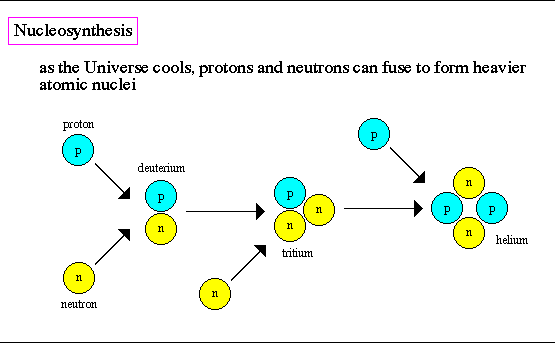
The term nucleosynthesis refers to the formation of heavier elements, atomic nuclei with many protons and neutrons, from the fusion of lighter elements. The Big Bang theory predicts that the early universe was a very hot place. One second after the Big Bang, the temperature of the universe was roughly 10 billion degrees and was filled with a sea of neutrons, protons, electrons, anti-electrons (positrons), photons and neutrinos. As the universe cooled, the neutrons either decayed into protons and electrons or combined with protons to make deuterium (an isotope of hydrogen). During the first three minutes of the universe, most of the deuterium combined to make helium. Trace amounts of lithium were also produced at this time. This process of light element formation in the early universe is called “Big Bang nucleosynthesis” (BBN).

The creation hypothesis predicts that there will be specific amounts of these light elements formed as the universe cools down. Do the predictions match with observations?

Yes they do:

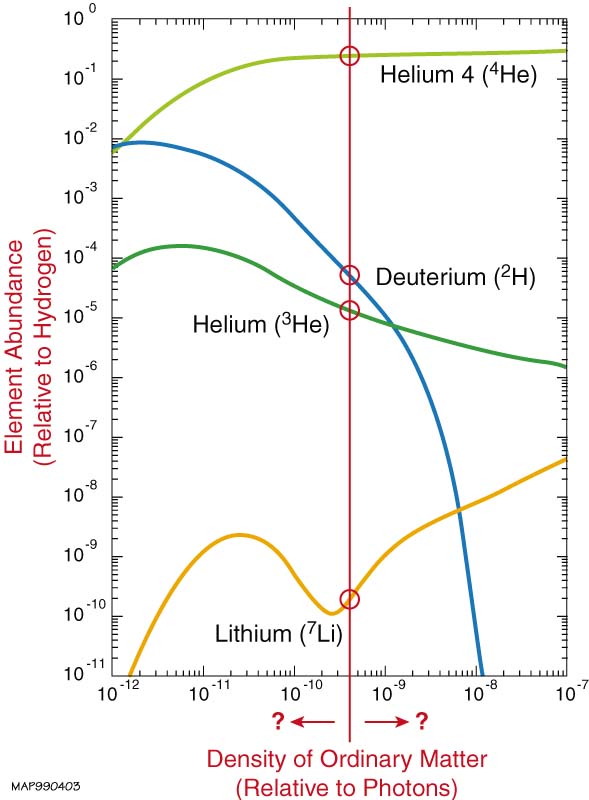
The predicted abundance of deuterium, helium and lithium depends on the density of ordinary matter in the early universe, as shown in the figure at left. These results indicate that the yield of helium is relatively insensitive to the abundance of ordinary matter, above a certain threshold. We generically expect about 24% of the ordinary matter in the universe to be helium produced in the Big Bang. This is in very good agreement with observations and is another major triumph for the Big Bang theory.

Moreover, WMAP satellite measurements of mass density agree with our observations of these light element abundances.

Here are the observations from the WMAP satellite:

Scientific observations match predictions

And here is how those WMAP measurements confirm the Big Bang creation event:

However, the Big Bang model can be tested further. Given a precise measurement of the abundance of ordinary matter, the predicted abundances of the other light elements becomes highly constrained. The WMAP satellite is able to directly measure the ordinary matter density and finds a value of 4.6% (±0.2%), indicated by the vertical red line in the graph. This leads to predicted abundances shown by the circles in the graph, which are in good agreement with observed abundances. This is an important and detailed test of nucleosynthesis and is further evidence in support of the Big Bang theory. 

“An important and detailed test”.

For completeness, we should learn how elements heavier than these light elements are formed:

Elements heavier than lithium are all synthesized in stars. During the late stages of stellar evolution, massive stars burn helium to carbon, oxygen, silicon, sulfur, and iron. Elements heavier than iron are produced in two ways: in the outer envelopes of super-giant stars and in the explosion of a supernovae. All carbon-based life on Earth is literally composed of stardust.

That’s a wonderful thing to tell a young lady when you are on a date: “your body is made of stardust”. In fact, as I have argued before, this star formation, which creates the elements necessary for intelligent life, can only be built if the fundamental constants and quantities in the universe are finely-tuned.

Now, you would think that atheists would be happy to find observations that confirm the origin of the universe out of nothing, but they are not. Actually, they are in denial.

Here’s a statement from the Secular Humanist Manifesto, which explains what atheists believe about the universe:

Religious humanists regard the universe as self-existing and not created.

For a couple of examples of how atheistic scientists respond to the evidence for a cosmic beginning, you can check out this post, where we get responses from cosmologist Lawrence Krauss, and physical chemist Peter Atkins.

You cannot have the creation of the universe be true AND a self-existing, eternal universe ALSO be true. Someone has to be wrong. Either the science is wrong, or the atheist manifesto is wrong. I know where I stand.

Positive arguments for Christian theism