Tag Archives: Cosmology

Video, audio and summary of intelligent design discussion, with Ben Shapiro and Stephen C. Meyer

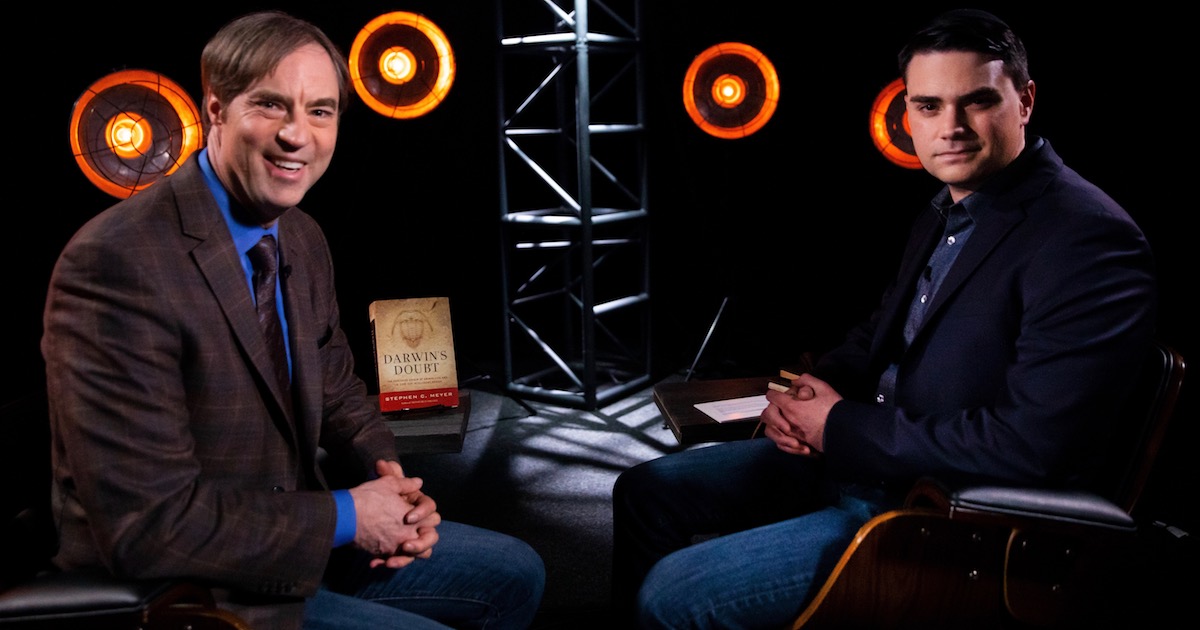
Stephen C. Meyer and Ben Shapiro discuss evolution and intelligent design

(Re-posting this for those who missed it the first time around)

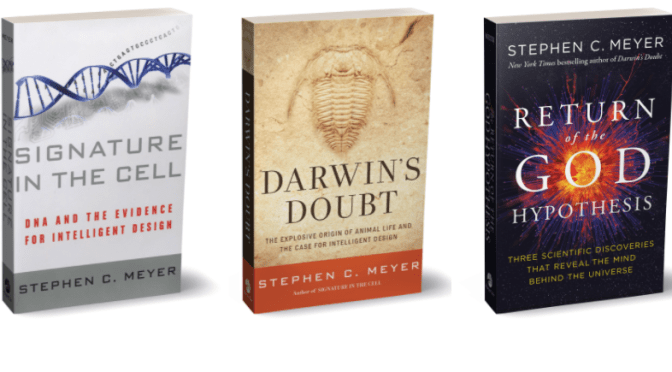
This is a must-see / must-hear conversation. Famous conservative Ben Shapiro discusses evolution and intelligent design with Dr. Stephen C. Meyer, author of “Signature in the Cell” (origin of life) and “Darwin’s Doubt” (fossil record). These are the two best books on intelligent design. Their conversation covers the most important issues in the origins debate.

So to start, here’s the full video:

Someone actually put out an outline on Youtube, with a time-based index, so I’ll just steal that as a base, and add to it:

  • 1:34 What is your scientific background? Science undergraduate degree, professional geologist, later did a PhD in philosophy of science from Cambridge University.
  • 2:39 What is the difference between intelligent design and creationism? Creationism starts from the Bible and posits a shorter history of the universe. ID starts from the data of the natural world and is neutral about the age of the Earth / universe. Meyer accepts the old-Earth.
  • 3:36 How is Intelligent Design a scientific theory? The discovery of DNA reveals that code is central to living systems. Intelligent design uses the method of “inference to the best explanation” in order to argue that the best explanation for the code is an intelligent agent.
  • 6:10 What evidence would have to arise to make Intelligent Design Falsifiable? If a naturalistic mechanism was discovered that could produce biological information using the probabilistic resources of the universe, and the time available, then intelligent design would be falsified.
  • 7:26 Is religion separate from science or intertwined within it? There are three views: science is totally separate from religion, science is in total conflict with religion, science and religion agree on some issues, e.g. – the origin of the universe and Genesis 1:1. There are areas where science and religion overlap.
  • 9:55 Why are the most prominent Darwinians also militant atheists? Evolution is a theory that tries to explain nature using naturalistic mechanisms, so it is compatible with atheism.
  • 10:45 What does the theory of evolution say? The term evolution has multiple meanings, and should be defined before discussions. It can refer to change over time. It can refer to animals changing slightly to adapt to enviromental changes. It can refer to the idea that all animals evolved from simpler life forms, and that there is a tree of life showing how different types of organisms share common ancestors. And it can refer to the idea that purely undirected processes can explain the history of life using purely materialistic forces. It’s that final view that intelligent design challenges.
  • 13:15 Where is the discontinuity in naturalistic processes in the development of life? The first discontinuity is the origin of simple life from non-living components. The second discontinuity is the sudden appearance of different body plans in a very narrow window of time in the Cambrian era.
  • 15:42 Why does information theory suggest that code requires some sort of designer? DNA is a true information-bearing system identical to the software in computers, e.g. – operating system, applications.
  • 19:45 Can information be created by random mutation, and favorable mutations preserved by natural selection? Just as in software code, instructions must be added in order to develop new functionality. Random additions of characters will almost always degrade biological function. The number of possible sequences that do nothing useful is vastly higher than the number of sequences that perform biological functions. Doug Axe did research on this at Cambridge University, and he found that the number of functional sequences of amino acids is 1 in 10 to the 77th power. Given the probabilistic resources (replicating organisms)and the time available, it is extremely unlikely to find sequences that have functional information by chance.
  • 25:05 What about Stephen Jay Gould’s model of punctuated equilibrium – doesn’t it explain the sudden jumps in information? Gould’s mechanism is accurate according to the fossil record, which shows a lot of jumps. But he did not have a naturalistic explanation for sudden jumps in biological function. Darwinian mechanisms work slowly and would (in theory) produce different body plans gradually. But this is not what the fossil record shows.
  • 27:22 What is the mechanism for injecting information in the theory of intelligent design? The information comes in from an intelligence when new major body plans appear, and minor variations within types could be explained by evolution.
  • 29:25 Does the Miller-Urey experiment provide a naturalistic explanation for the building blocks necessary for the origin of life? The MU experiment only produced a few types of amino acids, it doesn’t say anything about how to sequence the amino acids in order to form protein folds that can perform biological functions. The MU experiment also pre-supposes conditions on the early Earth (reducing gases) that do not match what was there (oxidyzing or neutral gases).
  • 32:00 Is the RNA world hypothesis is a good explanation for the origin of life? Evolution requires that replication already be in place, because evolution assumes that mutations appear during the replication. The RNA world hypothesis suggests that sequences contain information, but also catalyze origin of life chemistry. The problem with RNA world is that it starts with self-replicating systems. And those replicating systems require the scientist to inject information into the system to get even the simplest replication started.
  • 34:56 How do scientists respond to the critiques of Darwinism proposed by intelligent design advocates? By and large, they accept them. They think that mutation and selection works once living systems are in place, but they realize it has no explanation for the origin of life or the sudden origin of body plans. (Tells about the  conference of the Royal Society, where problems with Darwinian mechanisms were discussed, and the 2003 MIT Press book by Muller and Newman).
  • 37:16 Why do people hold to Darwinian evolution in the face of these problems? Many scientists presuppose methodological naturalism, which requires that any explanation for the origin of life and the origin of major body plans involve materialist explanations only. No intelligent agents are allowed. The problems occur when assumption of naturalism causes scientists to propose incorrect explanations for what we observe in nature. It’s also not clear how naturalistic mechanisms could produce organisms who are capable of reason and free will.
  • 40:43 Does naturalistic evolution have an answer for conscious minds, reasoning, free will? No, consider the work of atheist scholar Thomas Nagel, who argues in his book “Mind and Cosmos” (Oxford University Press 2012) that the existence of mind is a disproof of the neo-Darwinian explanation for life. Darwinism stops us from accepting the reality of minds.
  • 42:06 So do naturalistic evolutionists have to explain away the mind as an illusion? First, we humans have immediate experience of consciousness, reason and free will. Second, our whole legal system is based on the idea free will, because you can’t hold someone guilty unless they chose to do something they knew was wrong. Third, we have an epidemic of suicide among young people. This is caused by a crisis of meaning. Intelligent design opens up the possibility of their being a mind behind the universe, who we could have a relationships with.
  • 44:53 Why aren’t schools allowed to be honest about the problems with neo-Darwinian evolution? The intellignt design view is to that teachers should be allowed to teach all the vidence for Darwinian evolution, and also discuss some of the problems with the theory. Students learning science should not be told that everything is solved. Students learn science better when they are presented with peer-reviewed evidence for and against a theory, rather than being indoctrinated.
  • 47:37 Is intelligent design theory connected to God? Intelligent design infers from the information content in nature that a mind with capabilities like ours injected information into living systems. Intelligent design is agnostic about the designer, because in principle, embodied or unembodied agents could inject information into living systems. Intelligent design is friendly to theism, because theists will immediately identify the mind as God. Furthermore, the fine-tuning in the initial conditions of the universe is another intelligent design argument. In that case, since the design occurs at the beginning of the universe, the intelligent agent acting prior to the creation of the universe would have to be supernatural, i.e. – God.
  • 50:53 Can naturalists say that the imposition of “function” on a sequence is arbitrary, in the same way that the English language is arbitrary? This won’t work, because biological function is not arbitrary in the same way as language. Biological function is not arbitrary, because sequences can be tested for function objectively by observing whether sequences can perform functions necessary for life, e.g. – replication.
  • 52:43 Doesn’t the multiverse explain away the improbabilities of the fine-tuning, the origin of life, and the development of life? No, because all models of the multiverse require fine-tuning in the mechanism that generates the different universes.
  • 55:42 What about cosmological models that eliminate the beginning of the universe? The standard Big Bang model and the inflationary model both posit a beginning of the universe. There is also the Borde-Guth-Vilenkin theory which proves that any universe that is expanding requires a beginning. The only chance for naturalists is quantum cosmologies, but this doesn’t work because 1) it requires an abstract reality of mathematics to actualize the physical universe, but this presupposes a mind. 2)  The model requires an earlier input of information, which can only have come from a mind.

If you listen to this lecture, or watch the video, and you enjoyed it, then please share. If you have questions, I can try to answer them for you – just leave your question in the comments, or shoot me an e-mail, or message me from the blog’s Facebook page, or direct message me on Twitter. I’ve invested a lot of time in this, and have been studying intelligent design since the late 1990s.
Luke Barnes on the fine-tuning of the strong force and fine structure constant

By now, anyone who has had discussions about scientific evidence for the existence of God knows about the fine-tuning argument. In a nutshell, if the fundamental constants and quantities given in the Big Bang were even slightly other than they are, then the universe itself would not be hospitable for complex, embodied intelligent life.

Here is an article from The New Atlantis written by Australian cosmologist Luke Barnes.

Excerpt:

Today, our deepest understanding of the laws of nature is summarized in a set of equations. Using these equations, we can make very precise calculations of the most elementary physical phenomena, calculations that are confirmed by experimental evidence. But to make these predictions, we have to plug in some numbers that cannot themselves be calculated but are derived from measurements of some of the most basic features of the physical universe. These numbers specify such crucial quantities as the masses of fundamental particles and the strengths of their mutual interactions. After extensive experiments under all manner of conditions, physicists have found that these numbers appear not to change in different times and places, so they are called the fundamental constants of nature.

[…]A universe that has just small tweaks in the fundamental constants might not have any of the chemical bonds that give us molecules, so say farewell to DNA, and also to rocks, water, and planets. Other tweaks could make the formation of stars or even atoms impossible. And with some values for the physical constants, the universe would have flickered out of existence in a fraction of a second. That the constants are all arranged in what is, mathematically speaking, the very improbable combination that makes our grand, complex, life-bearing universe possible is what physicists mean when they talk about the “fine-tuning” of the universe for life.

Let’s look at an example – the strong force. Not only must the strong force be fine-tuned so we have both hydrogen and helium, but the ratio of the strong force must also be fine-tuned with the fine structure constant.

Barnes writes:

The strong nuclear force, for example, is the glue that holds protons and neutrons together in the nuclei of atoms. If, in a hypothetical universe, it is too weak, then nuclei are not stable and the periodic table disappears again. If it is too strong, then the intense heat of the early universe could convert all hydrogen into helium — meaning that there could be no water, and that 99.97 percent of the 24 million carbon compounds we have discovered would be impossible, too. And, as the chart to the right shows, the forces, like the masses, must be in the right balance. If the electromagnetic force, which is responsible for the attraction and repulsion of charged particles, is too strong or too weak compared to the strong nuclear force, anything from stars to chemical compounds would be impossible.

Here’s the chart he’s referencing:

Fine-tuning of the strong nuclear force and the fine structure constant

As you can see from the chart, most of the values that the constants could take would make complex, embodied intelligent life impossible.

We need carbon (carbon-based life) because they form the basis of the components of life chemistry, e.g. proteins, sugars, etc. We need hydrogen for water. We need chemical reactions for obvious reasons. We need the light from the stars to support plant and animal life on the surface of a planet. And so on. In almost every case where you change the values of these constants and quantities and ratios from what they are, you will end up with a universe that does not support life. Not just life as we know it, but life of any conceivable kind under these laws of physics. And we don’t have any alternative laws of physics in this universe.

By the way, just to show you how mainstream these examples of fine-tuning are, I thought I would link to a source that you’re all going to be familiar with: The New Scientist.

The fine-tuning of the force of gravity

So here is an article from the New Scientist about a different constant that also has to be fine-tuned for life: the force of gravity.

Excerpt:

The feebleness of gravity is something we should be grateful for. If it were a tiny bit stronger, none of us would be here to scoff at its puny nature.

The moment of the universe‘s birth created both matter and an expanding space-time in which this matter could exist. While gravity pulled the matter together, the expansion of space drew particles of matter apart – and the further apart they drifted, the weaker their mutual attraction became.

It turns out that the struggle between these two was balanced on a knife-edge. If the expansion of space had overwhelmed the pull of gravity in the newborn universe, stars, galaxies and humans would never have been able to form. If, on the other hand, gravity had been much stronger, stars and galaxies might have formed, but they would have quickly collapsed in on themselves and each other. What’s more, the gravitational distortion of space-time would have folded up the universe in a big crunch. Our cosmic history could have been over by now.

Only the middle ground, where the expansion and the gravitational strength balance to within 1 part in 1015 at 1 second after the big bang, allows life to form.

Notice how the article also mentioned “the universe’s birth”, which is part of mainstream science.

When I’m writing to you about things like the origin of the universe, or the cosmic fine-tuning, I’m not talking to you about things that pastors found in the Bible. These discoveries are known and accepted by mainstream scientists. It’s amazing that people are constructing their worldviews without having to account for the birth of the universe and this cosmic fine-tuning. We all, as rational individuals, have to bound our view of the universe with the findings of science. Right now, those findings support the existence of a Creator and a Designer. So why am I seeing so many atheists who are just plain ignorant about these facts? Maybe we should tell them about this evidence. Maybe we should ask them why they don’t account for scientific evidence when forming their beliefs.

Positive arguments for Christian theism

William Lane Craig debates Alex Rosenberg: Does God Exist? Video, audio and summary

Here is the video of the debate:

Here is my summary of the Craig-Rosenberg debate, which occurred on February 1st, 2013 at Purdue University.

The debaters

Below is the summary.

Dr. Craig’s opening speech:

The topic: What are the arguments that make belief in God reasonable or unreasonable?
First speech: arguments for reasonableness of belief in God
Second speech: respond to arguments against reasonableness of belief in God

Eight arguments:

  1. Contingency argument: God – a transcendent, personal being – is the explanation of why a contingent universe exists.
  2. Cosmological argument: God is the cause of the beginning of the universe, which is attested by physics and cosmology.
  3. Applicability of mathematics to nature: God is the best explanation for the applicability of mathematics to nature.
  4. Fine-tuning argument: God is the best explanation of the fine-tuning of the universe to permit life.
  5. Intentionality of conscious states: God is the best explanation of the intentionality of our mental states.
  6. The moral argument: God is the best explanation for the existence of objective moral values and duties.
  7. The resurrection of Jesus: God is the best explanation for the core of historical facts accepted by most ancient historians across the ideological spectrum.
  8. Religious experience: God is the best explanation of our immediate experience and knowledge of his existence.

Dr. Rosenberg’s opening speech

First argument: The fallacy of ad hominem

  • I don’t know whether to laugh or to cry
  • Dr. Craig has said all of that before in other debates
  • You didn’t need to come out on this cold night
  • Craig’s arguments have all been refuted
  • Dr. Craig just doesn’t listen
  • Dr. Craig is not interested in getting at the truth
  • Dr. Craig is just interested in scoring debate points
  • The adversarial system is the wrong approach to decide truth
  • Dr. Craig is very confident about his take of physics

Second argument: The fallacy of arguing from authority

  • 95% of members of the NAS are atheists
  • Therefore Dr. Craig cannot use science

Third argument: Effects don’t require causes

  • I am going to pretend that Craig said that “every effect requires a cause”
  • Quantum mechanics shows that some effects occur without causes
  • A particle of uranium (which is not nothing, it is something) decays without a cause
  • This uncaused effect is the same as the universe coming into being out of nothing uncaused
  • Therefore the principle of sufficient reason is false

Fourth argument: Silicon-based life and the multiverse

  • If these constants had been different, maybe we would have other kinds of intelligent life, like silicon-based life
  • Carbon-based life is not the only kind of life, maybe you can have other kinds of life, none of which have been observed
  • There could be different kinds of life in other areas of the universe that we can’t see
  • There are things we can’t see that disprove the current physics that we can see
  • Quantum foam is evidence that a multiverse exists
  • The multiverse would solve the problem of fine-tuning

Fifth argument: The Euthyphro dilemma

  • The moral argument is refuted by Euthyphro dilemma
  • Dr. Craig is such a moron that he has never heard of the Euthyphro dilemma ever before
  • This is found in the first and simplest of Plato’s dialogs
  • Why is Dr. Craig so stupid that he has not read this simple dialog ever before?
  • Evolution explains why humans evolve arbitrary customs and conventions that vary by time and place
  • Alternative moral theories: utilitarianism, social contract, etc. that don’t require God

Sixth argument: Mormonism undermines Dr. Craig’s three minimal facts about Jesus

  • Why is Dr. Craig so stupid and ignorant to persist in pushing such an ignorant, stupid argument?
  • Mormonism is a silly religion that is not historically well founded
  • Therefore, Jesus was not buried
  • Islam is a silly religion that is not historically grounded
  • Therefore, the tomb was not found empty
  • Scientology is a silly religion that is not historically grounded
  • Therefore, the eyewitnesses didn’t have post-mortem appearances
  • Eyewitness testimony is unreliable in some cases
  • Therefore, eyewitness testimony was unreliable in this case
  • Apparitions of Mary are bizarre
  • Therefore, the majority of historians are wrong to think that the disciples saw post-mortem appearances

Seventh argument: Deductive problem of evil

  • Evil and suffering are logically incompatible with an all good, all powerful God

Eight argument: God is not just to allow evil and suffering

  • God cannot make the evils of this life right in the afterlife

Dr. Craig’s first rebuttal

Dr. Rosenberg sketched the deductive argument from evil.

Dr. Rosenberg presupposes naturalism. Naturalism is a false theory of knowledge:

1. It’s too restrictive: There are truths that cannot be proved by natural science.
2. It’s self-refuting: no scientific proof for naturalism exists.

That’s why epistemological naturalism is considered false by most philosophers of science.

But more importantly than that: Epistemological naturalism does not imply metaphysical naturalism. (E.g. – W. Quine)

Dr. Rosenberg has to present arguments in favor of (metaphysical) naturalism, not just assume that (metaphysical) naturalism is true.

Dr. Craig presented eight arguments against metaphysical naturalism taken from Rosenberg’s own book:

1. The argument from the intentionality (aboutness) of mental states implies non-physical minds (dualism), which is incompatible with naturalism
2. The existence of meaning in language is incompatible with naturalism, Rosenberg even says that all the sentences in his own book are meaningless
3. The existence of truth is incompatible with naturalism
4. The argument from moral praise and blame is incompatible with naturalism
5. Libertarian freedom (free will) is incompatible with naturalism
6. Purpose is incompatible with naturalism
7. The enduring concept of self is incompatible with naturalism
8. The experience of first-person subjectivity (“I”) is incompatible with naturalism

Metaphysical naturalism is false: it is irrational and it contradicts our experience of ourselves.

And epistemological naturalism is compatible with theism.

Rebutting Dr. Rosenberg’s responses:

1. Contingency: no response

2. Cosmological: he mis-states the first premise to say every effect… when it is whatever begins to exist…, the origin of the universe was not from a vacuum, virtual particles come from a vacuum not nothing, there are interpretations of QM that are compatible with determinism. Rosenberg has to believe that the entire universe popped into being from non-being.

3. Mathematics: no response

4. Fine-tuning: the multiverse is refuted by empirical observations of the universe. Without fine-tuning, it’s not that we still have silicon to make life out of. It’s that we lose basic minimal things like chemical diversity, matter, stars, planets, etc. No life of any kind, not just no carbon-based life.

5. Intentionality: no response.

6. Moral argument: the answer to the dilemma is that you split the dilemma: God is the standard of good, and the commands flow from his unchanging moral nature. The commands are not arbitrary, and the standard is not external to God. Dr. Rosenberg is a nihilist and he cannot ground good and evil on his nihilistic view.

7. Resurrection: The Gospels are early eyewitness testimony. Mormonism and Islam have nothing to do with the minimal set of historical facts about Jesus agreed to by the majority of ancient historians across the ideological spectrum, general statements against eyewitnesses do not refute the specific eyewitness testimony in this case.

8. Religious experience: No response.

Dr. Rosenberg’s first rebuttal

I wrote a book and you should buy it, because it got me invited to this debate. Let me repeat the title a few times for you. Please buy it.

Dr. Craig is right, there are multiple interpretations of QM, not just the one I presented, including deterministic ones.

All the disturbing implications of naturalism that Dr. Craig stated follow from metaphysical naturalism, and metaphysical naturalism is true. (Note: he equates science with metaphysical naturalism)

Science proves that metaphysical naturalism is true, but I won’t say what specific scientific tests prove my philosophical assumption of metaphysical naturalism.

I’ll pretend that the Big Bang (science) doesn’t disprove naturalism, like Dr. Craig said. Again. (covers ears) La la la, there is no Big Bang.

We didn’t come here to debate epistemological naturalism and metaphysical naturalism.

Let me explain the problem of intentionality since I’m so smart and no one knows what it means.

There are many answers to this problem of intentionality.

My answer is that most scientists are naturalists, therefore naturalism is true, regardless of the argument from intentionality of mental states.

That’s how I would respond to one of the eight problems with naturalism that Dr. Craig raised. I won’t answer the other seven problems.

It is an argument from ignorance to argue that the applicability of mathematics to the universe requires a designer, because there are non-Euclidean geometries. Craig’s argument, which he gets from people like respected physicists like Eugene Wigner, is bizarre. It is bizarre, therefore I refute Eugene Wigner and all the other scholars who make that argument. It is bizarre! Bizarre!

Deductive problem of evil: there is no response to this argument, certainly not Alvin Plantinga’s free will defense. The deductive argument from evil has not been entirely abandoned at all! It’s not like arch-atheist J.L. Mackie himself admits that the deductive problem of evil doesn’t lead to a logical inconsistency between evil and God.

Dr. Craig has to tell me why God allows evil or God doesn’t exist.

It is offensive that Dr. Craig cannot tell me why God allows every evil and suffering that occurs.

He literally said this: “I will become a Christian if Dr. Craig can tell me why God allowed EVERY EVIL THAT OCCURRED IN THE LAST 3.5 BILLION YEARS”

Dr. Craig’s second rebuttal

We are not in a position to know why God allows specific instances of evil and suffering.

God cannot force people to freely do anything – freedom is not compatible with determinism. Freedom is a good, but freedom opens up the possibility of moral evil. You cannot have the good of free will without allowing people to choose to do morally evil things.

God can permit evil and suffering in order to bring more people into a relationship with him.

The atheist has to show that God could allow less evil and achieve more knowledge of God in order to say there is too much evil.

The purpose of life is not happiness, but knowledge of God.

Dr. Craig quotes agnostic Paul Draper (Purdue) and Peter Van Inwagen (Notre Dame) to state that the deductive problem of evil is dead because of free will and morally sufficient reasons for permitting evil.

1. Contingency: no response.

2. Cosmological: QM does not apply, because the universe came from nothing, not a vacuum, and QM only works in a vacuum.

3. Mathematics: He mentions alternatives like non-Euclidean geometry, but we have to explain the structure of THIS universe.

4. Fine-tuning: ???

5. Intentional states: intentional mental states proves that minds exist, which fits with theism better than it fits with atheism.

6. Moral argument: You need God to ground morality, and Dr. Rosenberg believes in morality. He needs God to ground objective moral values and duties.

7. Historical argument: He has to respond to the minimal facts supported by the consensus of ancient historians across the ideological spectrum.

8. The problems of naturalism: He says that you can’t have science without naturalism, but you can have science with EPISTEMOLOGICAL NATURALISM, and theists accept science and methodological naturalism. We don’t accept METAPHYSCIAL NATURALISM because of the eight problems Craig presented, like intentionality, first-person, persistence of self, etc. You can believe in both science and theism, by embracing epistemological naturalism, while rejecting methaphysical naturalism.

Dr. Rosenberg’s second rebuttal

Dr. Craig hasn’t answered many of my points, I won’t say which ones though.

Debates don’t work as a way of deciding what’s true, so we should overturn the entire criminal justice system.

The principle of sufficient reason is false because it is disconfirmed by quantum mechanics. And quantum mechanics (vacuum and virtual particles that exist for a short time) is similar to the origin of the universe (nothing and entire universe and 14 billion years).

We know that alpha particles come into being without cause all the time from a quantum vacuum for a tiny sub-second duration before going out of existence, so we can say that the entire physical universe came into being for 14 billion years from absolute nothing which is not a quantum vacuum.

Peter Van Inwagen is the best metaphysician working today, and he says that my deductive argument from evil is not decisive, it’s not a successful argument. (Why is he undermining his own problem of evil argument????!)

Dr. Craig invoked Plantinga’s free will defense to the deductive POE. Freedom allows us to do evil. God could have given us free will without evil and suffering. I won’t show how, but I’ll just assert it, because debates are such a bad forum for supplying evidence for my speculative assertions.

If you answer the question 3 + 5 as being 8, then you don’t have free will – you are biologically determined if you answer 8, because everyone answers 8, and that means everyone is biologically determined with no free will.

Why can’t God give us free will and then prevent us from making a free choice?

No scholars date the gospels earlier than 60-70 AD, especially not atheists like James Crossley who dates Mark to 40 AD. Therefore Jesus’ burial isn’t historical, like the majority of scholars across the broad spectrum of scholarship agree it is.

The original New Testament documents were written in Aramaic.

All New Testament scholars are orthodox Christians, like atheist Robert Funk for example.

Dr. Craig’s concluding speech

In order to sustain the deductive argument from evil, Dr. Rosenberg must show that God could create a world of free creatures with less evil.

Principle of Sufficient Reason: not using the general principle of sufficient reason, but a more modest version of this states that contingent things should have an explanation for their existence. And we know that the universe is a contingent.

The New Testament was not written in Aramaic, they were written in Greek. Dr. Rosenberg is wrong there too.

(Dr. Craig spends the rest of his concluding speech giving his testimony and urging people to investigate the New testament).

Dr. Rosenberg’s concluding speech

Some long-dead French guy named Laplace said that he has no need of that (God) hypothesis. He did not know about any of Dr. Craig’s arguments made in this debate tonight when he said that, though.

There is no need to explain how the universe began or how the universe is finely-tuned if you just assume metaphysical naturalism on faith.

The Easter Bunny, therefore atheism.

Most scientists are atheists, therefore atheism.

You can do a lot of science without God, just don’t look at the origin of the universe, the fine-tuning of the universe, or the other parts of science that Craig mentioned, as well as the origin of life, the Cambrian explosion, the habitability argument, and so on.

You can be a Christian, but good Christians should not use arguments and evidence.

Good Christians should be irrational and ignorant. Bad Christians look for arguments and evidence from science and history.

Good Christians should embrace the absurd. Bad Christians want to search for truth and use logic and evidence.