Tag Archives: Conservative

Fascism: Canadian Supreme Court overturns right to religious liberty

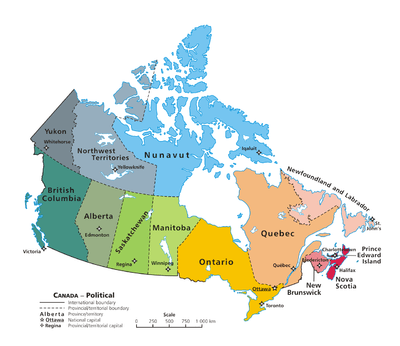
Map of Canadian Provinces

UPDATE: Please vote “no” in this poll if you think tthat the Supreme Court is wrong.

Life Site News announces the death of religious liberty in Canada.

Excerpt:

In what’s sure to come down as a devastating blow to parental freedom, the Supreme Court of Canada unanimously rejected this morning the pleas of a Christian family to have their child exempted from the Quebec government’s mandatory ethics and religious culture course.

“Exposing children to a comprehensive presentation of various religions without forcing the children to join them does not constitute an indoctrination of students that would infringe the freedom of religion of L and J,” the justices wrote in the majority decision.

The high court’s ruling, released at 9:45 Friday morning, comes in the case of S.L. et al. v. Commission scolare des Chênes et al., which involved a Catholic family who took their school board to court after it refused to grant their child an exemption from the province’s controversial ethics and religious culture course (ERC).

The course, which seeks to present the spectrum of world religions and lifestyle choices from a “neutral” stance, was introduced by the province in 2008 and has been widely criticized by the religious and a-religious alike. Moral conservatives and people of faith have criticized its relativistic approach to moral issues, teaching even at the earliest grades, for instance, that homosexuality is a normal choice for family life.

Despite provincial legislation allowing for exemptions from school curriculum, the Ministry of Education has turned down over 1,700 requests, and had even moved to impose the course on private schools and homeschoolers.

Critics warned that a ruling against the family would have frightening consequences for parental authority and risked emboldening provincial governments across the country as they move to impose their own versions of “diversity” education.

To me, what this means is that in Canada, the state decides what children will believe, not the parents. The state will tax parents in order to pay for government workers and government programs. And the state will use these government entities to make the children believe in the state’s values.

What is ironic to me is that Canadians likely voted to grow government. There are a lot of people in Canada who think that it is a good thing for government to help the poor. Many, many economically illiterate Christians also voted to grow the size of government over the last few decades. They voted to empty their own pockets by raising tax rates. They voted to entrust secular leftist bureaucrats with more and more power. They voted to let the state educate their children with public schools and government-run day care. They voted to let government provide health care instead of letting individuals earn and save to pay for it themselves. They voted for taxes that are so high that women cannot afford to stay at home and homeschool their children – they have to work and hand their children off to strangers.

It is very important for Christians to understand that if they believe that it is government’s job to redistribute wealth from rich to poor, then they voted for this. If you believe in “social justice” then you are opposed to religious liberty – and the free practice of Christianity itself. Many, many Christians who don’t study economics and don’t get their economic views from the Bible think that it is a good thing to vote for bigger and bigger government funded by higher and higher taxes. Christians in Canada seem to be proud of their self-inflicted secularism. They think that taxpayer-funded abortions and taxpayer-funded sex changes are a great idea – because “health care is a right”.  They think that taxpayer-funded abortion and taxpayer-funded sex changes are authentic Christianity, supported by the Bible.

I have had Christians in Ontario tell me on Facebook that they are pro-life, pro-marriage and pro-family but that they favor allowing a secular government to force all taxpayers to pay for abortions and sex changes. That is what Canadian Christianity amounts to, in many cases – because they don’t understand economics, and what economic policies promote and secure rights – including the right to religious liberty. The right to religious liberty is only guaranteed when government is limited and the free enterprise system is strong. We need to stop deciding our views of politics and economics based on feelings and peer pressure and the desire to appear “compassionate”. We need to ask what the Bible says, and study economics in order to find out what guarantees the liberty we need to live out authentic Christian lives.

I think it’s time for Christians in Canada to get serious about applying the Bible to all of life – including economics.

Fact check: Mitt Romney’s claim that Rick Santorum was a big spender

The Weekly Standard evaluates Mitt Romney’s claim that Rick Santorum is fiscally liberal. (H/T Shane)

Excerpt:

The National Taxpayers Union (NTU) has been rating members of Congress for 20 years.  NTU is an independent, non-partisan organization that — per its mission statement — “mobilizes elected officials and the general public on behalf of tax relief and reform, lower and less wasteful spending, individual liberty, and free enterprise.”  Steve Forbes serves on its board of directors.

For each session of Congress, NTU scores each member on an A-to-F scale.  NTU weights members’ votes based on those votes’ perceived effect on both the immediate and future size of the federal budget.  Those who get A’s are among “the strongest supporters of responsible tax and spending policies”; they receive NTU’s “Taxpayers’ Friend Award.”  B’s are “good” scores, C’s are “minimally acceptable” scores, D’s are “poor” scores, and F’s earn their recipients membership in the “Big Spender” category.  There is no grade inflation whatsoever, as we shall see.

NTU’s scoring paints a radically different picture of Santorum’s 12-year tenure in the Senate (1995 through 2006) than one would glean from the rhetoric of the Romney campaign.  Fifty senators served throughout Santorum’s two terms:  25 Republicans, 24 Democrats, and 1 Republican/Independent.  On a 4-point scale (awarding 4 for an A, 3.3 for a B+, 3 for a B, 2.7 for a B-, etc.), those 50 senators’ collective grade point average (GPA) across the 12 years was 1.69 — which amounts to a C-.  Meanwhile, Santorum’s GPA was 3.66 — or an A-.  Santorum’s GPA placed him in the top 10 percent of senators, as he ranked 5th out of 50.

Across the 12 years in question, only 6 of the 50 senators got A’s in more than half the years.  Santorum was one of them.  He was also one of only 7 senators who never got less than a B.  (Jim Talent served only during Santorum’s final four years, but he always got less than a B, earning a B- every year and a GPA of 2.7.)  Moreover, while much of the Republican party lost its fiscal footing after George W. Bush took office — although it would be erroneous to say that the Republicans were nearly as profligate as the Democrats — Santorum was the only senator who got A’s in every year of Bush’s first term.  None of the other 49 senators could match Santorum’s 4.0 GPA over that span.

This much alone would paint an impressive portrait of fiscal conservatism on Santorum’s part.  Yet it doesn’t even take into account a crucial point:  Santorum was representing Pennsylvania.

Based on how each state voted in the three presidential elections over that period (1996, 2000, and 2004), nearly two-thirds of senators represented states that were to the right of Pennsylvania.  In those three presidential elections, Pennsylvania was, on average, 3 points to the left of the nation as a whole.  Pennsylvanians backed the Democratic presidential nominee each time, while the nation as a whole chose the Republican in two out of three contests.

Among the roughly one-third of senators (18 out of 50) who represented states that — based on this measure — were at least as far to the left as Pennsylvania, Santorum was the most fiscally conservative.  Even more telling was the canyon between him and the rest.  After Santorum’s overall 3.66 GPA, the runner-up GPA among this group was 2.07, registered by Olympia Snowe (R., Maine).  Arlen Specter, Santorum’s fellow Pennsylvania Republican, was next, with a GPA of 1.98.  The average GPA among senators who represented states at least as far left as Pennsylvania was 0.52 — or barely a D-.

But Santorum also crushed the senators in the other states.  Those 32 senators, representing states that on average were 16 points to the right of Pennsylvania in the presidential elections, had an average GPA of 2.35 — a C+.

In fact, considering the state he was representing, one could certainly make the case that Santorum was the most fiscally conservative senator during his tenure.  The only four senators whose GPAs beat Santorum’s represented states that were 2 points (Republican Judd Gregg of New Hampshire), 10 points (Republican Jon Kyl of Arizona), 25 points (Republican James Inhofe of Oklahoma), and 36 points (Republican Craig Thomas of Wyoming) to the right of Pennsylvania in the presidential elections.  Moreover, of these four, only Kyl (with a GPA of 3.94) beat Santorum by as much as a tenth of a point.  It’s an open question whether a 3.94 from Arizona is more impressive than a 3.66 from Pennsylvania.

Do you know who is a big tax and spend fiscal liberal, though? MITT ROMNEY.

So, why is liberal Mitt Romney telling lies about conservative Rick Santorum?

New national Rasmussen poll: Santorum leads Romney 39-27

From Newsmax. (H/T Doug)

Excerpt:

Building on his triple play of victories in Minnesota, Colorado and Missouri, former Sen. Rick Santorum has now surged to a 12-point lead over Mitt Romney in the race for the GOP presidential nomination heading into a key battle in Romney’s home state of Michigan.

Political analyst and Democratic pollster Doug Schoen tells Newsmax that Romney’s presidential bid is in “deep trouble” and his campaign badly needs a win in the Great Lakes State before heading into the do-or-die Super Tuesday contests on March 6, where voters in 10 states will pick their candidate to become the GOP presidential nominee.

“Romney is in deep trouble. He’s out of arguments. People don’t buy the central premise of his candidacy that he’s a businessman who can get things moving again,” Schoen said in an exclusive interview on Wednesday. “He’s entirely negative — whether it’s about President Obama, Newt Gingrich and now Rick Santorum. And Rick Santorum’s ad basically sums up the case against Mitt Romney: He’s a serial attacker who offers nothing other than negative ads, super PACs, bundlers and special interest money. It’s a recipe for failure.”

The latest Rasmussen Reports national telephone survey of likely Republican primary voters released on Wednesday shows Santorum leading with 39 percent support, compared with 27 percent for Romney nationwide.

The two latest polls in Michigan, a state where Mitt Romney grew up and where his father was governor, show Rick Santorum with a 10 point lead and a 9 point lead.

Mitt Romney

Rick Santorum

Senator Marco Rubio’s speech at the conservative CPAC 2012 conference

If I had to choose one Republican who gives great speeches on what it means to be a conservative, I would pick Marco Rubio. (25 minutes)

Here’s an article from Human Events about the speech, for those who can’t watch it or listen to it.

Excerpt:

Rubio ranked the strength of the American people alongside the importance of economic and military strength, for it is our people – not our government – who have made us great.  He sees critical institutions of society, which contribute to the strength of citizens and families, under assault by the Obama Administration.  “We have a President who, just a few days ago, issued a mandate ordering religious institutions to follow his ideals… telling religious-based organizations that they must, by mandate of the federal government, pay for things that religion teaches is wrong.  You may not agree with that religion’s teachings, but that’s not the point.  The point is that the First Amendment still applies.  Religious freedom still exists.”

He confessed he isn’t sure what the foreign constitutions Justice Ginsburg admires might have to say on the matter, but he knows what the United States Constitution says: “The federal government does not have the power to force religious organizations to pay for things that organization thinks is wrong!”

On the scale of history, only a “moment” has passed since world wars were fought against totalitarian evil.  What followed could hardly be described as “world peace,” and cleaning the blood from the edge of the statist hammer has not softened its essential nature.  “Today millions of people around the world are part of the middle class because of the rise of democracy and free enterprise.  Did that happen on its own?  Is that the natural state of man?”  Rubio suggested a study of humanity’s long history beneath the boots of oppressors answers that question.

Democracy and free enterprise spread, not because they are humanity’s default condition, but because “the most powerful nation in the world believed in these things, fought for these things, spoke out for these things… and most importantly, was an example of these things.”  The power of the American example transcends military and political force, because “all around the world, there are people who know there is someone just like them, living here, doing things they cannot.”

“What happens if we diminish, because we can no longer afford to be the leader of the free world?” Rubio asked.  “What happens if we diminish because our leaders decide they don’twant to be the leaders of the free world anymore?  What happens if we retreat?  What happens is that we’ll leave a space, and that space will be filled by someone else.”  The likely candidates for our successor as global hyperpower are totalitarian states like Russia and China… whose measure Rubio took by noting that they’ve vetoed United Nations efforts to rein in Syria’s dictator, Bashar Assad, because they reserve the right to use such brutal tactics against their own people.

Rubio understands that the clash of civilizations cannot be won from an easy chair, or a death bed.  “The greatest thing we can do for the people of the world is be America,” he concluded.  “That’s what’s at stake here.  That’s what November will be about.”

It would be a shame if all the people who flee to America, to escape from socialist decay and totalitarian repression, found the very things they fled awaiting them on our shores.  It pays to take a moment and see our exceptional nation through the eyes of those tired, poor, huddled masses, as Marco Rubio has done.

You can listen to an MP3 of the speech here. (12 Mb)

He’s only 40 years old. We have a deep, deep bullpen.