
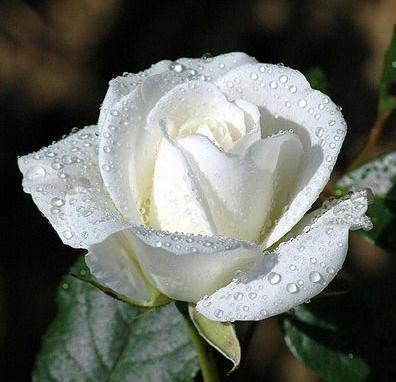
I wrote this post to encourage Christian men to find faithful Christian women and support them with a gift of white roses. If you know a woman who is faithful but neglected, then white roses are the perfect gift. And in the rest of the post, I want to explain why.
I’ll start with a couple of articles that explain the message I am trying to send a woman with white roses. One you understand what the meaning of white roses is, then you’ll get ideas on how to communicate to a woman by giving them to her.
Excerpt:
The meaning of shimmering white roses is not very hard to decipher if you go by their appearance. The color white has always been synonymous with purity and virtue. And so, sincerity, purity, and chastity are some of the obvious meanings of a white rose. When you need to convince that your affections are straight from the heart and are as pure as virgin snow, use a white rose. But there are more hidden meanings in a white rose than meets the eye.
White has ever been a symbol of innocence, of a world unspoiled and untarnished. The meaning of a bunch of glowing white roses is innocence and spiritual love. The white rose glorifies a love that is unaware of the temptations of the flesh and resides only in the soul. As opposed to the red rose that speaks of passionate promises, the meaning of a white rose is in its simplicity and pristine purity.
That’s the standard mainstream meaning of white roses. I normally give three of them, to symbolize the Trinity. (My banner is a pure black field with 3 narrow horizontal pure white stripes)
But there’s more – there’s a meaning to white roses that is much higher than mere feelings.
How about this?
It has also come to mean loyalty and faith, which can be strongly linked to purity. In true love, faithfulness and loyalty are implicit, despite distance or time. For these symbols, white roses are a perfect gift to a beloved who is far away, as they will display not only your love, but also your fidelity. White roses are also the perfect gift to send to a platonic friend, for a similar reason: constant, faithful love, mixed with the symbolism of innocence, is a wonderful way to show your love for a dear friend.
[…]At the same time, as the uses throughout history have shown, the white rose is also a symbol of strong resistance and the will to stand for one’s beliefs at any cost. Giving a white rose as a gift is a very strong gift. It is not fleeting passion or romance, which is too often what the red rose conveys. The white rose is a strong and consistent love, which is pure, faithful and sacrificial. Not many flowers have such a powerful meaning to their name. And this meaning comes to the rose not only through folklore and stories, but through true histories of brave people fighting for their cause. The white rose is a beautiful flower, with beautiful symbolism, and a friend or lover should be proud to give this flower as a gift to those they love steadily and faithfully.
White roses also stand for humility, reverence, honor and secrecy.
Desert Rose by White Heart
I like this old song by the Christian band White Heart a lot.
Desert Rose Lyrics:
Lost in a windswept land
In a world of shifting sand
A fragile flower stands apartThere in that barren ground
Feel like the only one
Trying to serve Him with all your heartAnd you wonder, wonder
Can you last much longer?
This cloud you are under
Will it cover you?Desert rose, desert rose
Don’t you worry, don’t be lonely
Heaven knows, Heaven knows
In a dry and weary land a flower grows
His desert rose, desert roseSometimes holiness
Can seem like emptiness
When you feel the whole world’s laughing eyesIf it’s a lonely day
Know you’re on the Father’s way
He will hear you when you cryAnd He will hold you, hold you
Your Father will hold you
He will love you, love you
For the things you doDesert rose, desert rose
Don’t you worry, don’t be lonely
Heaven knows, Heaven knows
In a dry and weary land a flower grows
His desert rose, desert roseDesert rose, desert rose
Don’t you worry, don’t be lonely
Heaven knows, Heaven knows
In a dry and weary land a flower grows
His desert rose, desert roseDesert rose, don’t be lonely, don’t be lonely
Desert rose, ooh, don’t you worry
Desert rose, don’t you know He’ll be with you
Heaven knows, Heaven knows
He will call your tattered heart on
Desert rose
One of the nice things about giving a good woman white roses is that you don’t have to worry about being rejected by her. You’re not trying to start a relationship, necessarily. You just pick the woman who has the best developed Christian worldview, and then give her white roses to support her in her efforts. Has she been reading a good apologetics book? Then give her white roses. Has she been lecturing on the pro-life view in her church? Then give her white roses. Has she been explaining what’s wrong with gay marriage? Then give her white roses. Is she volunteering or donating to help a conservative political candidate? And so on.
I know women who are doing everything in that list, so they can’t be too hard to find. Don’t pick the ones that you like. Don’t pick the ones that meets cultural standards. Don’t pick the ones that your friends approve of. Pick the one who serves God self-sacrificially. The one who has put God first, and her own happiness second.
Consider John 13:34-35:
34 “A new command I give you: Love one another. As I have loved you, so you must love one another.
35 By this everyone will know that you are my disciples, if you love one another.”
Jesus is speaking there – and he’s saying that it matters how you treat other Christians.
One word of caution: you don’t want to try this on anyone who is not a serious Christian. Pick one who likes apologetics, is conservative on fiscal policy, social policy and foreign policy, and who has a solid Christian worldview. If you link the white roses to specific good actions that the woman is doing, then there really is nothing to worry about. Just explain to her what the roses mean and the specific things that she has done to impress you. That takes the pressure off of her to have to do anything back.
Here’s an e-mail I got from a regular commenter whom I met recently:
I recently had the priviledge not only of visiting the USA, but of meeting WK himself in person. He gave me 3 white roses on 2 occasions.
How did it make me feel? Very blessed, appreciated, encouraged. I have a number of decent, Christian male friends. But this gesture stood out because of the thought that went into it and the meaning that stands behind these flowers. I took a whole lot of photos of the flowers he gave me. Whenever I see them, I smile.
It also made me appreciate the sort of man that we have in WK in regard to how he treats women. Bad men take advantage of women, regular men don’t take advantage of them, but good men appreciate them and build them up. WK is one of the good guys, one of the honorable guys. There is a nobility of character in his approach to women. I felt cared for as a Christian sister, not only with the flowers, but with the concern he has shown for my growth, and with the fantastic books he has sent me (and to others who frequent this blog) – the sort of books that improve my knowledge and my ability to live as a Christian in all spheres of life.
This is my favourite line in this post:
“It’s your job as a Christian man to put her hand in God’s hand and hold them together.”
I feel quite emotional (in a girly, but good way!) reading that line.Thank you, Sir Knight. [curtseys] :)
Now is your chance to do the same! By the way, I usually give 3 in a vase, to symbolize the Trinity.
Related posts
- Courting rules: how to tell if a woman is a committed Christian
- Courting rules: how men use self-control to make relationships count for God
- Are feminized churches preparing women to choose real men for husbands?
- What is the meaning and purpose of white roses?
- Does being a virgin before marriage affect marital stability?
- How to communicate requirements to a Christian woman during courtship
- What has Michele Bachmann got that third-wave feminists haven’t got?
- How Christian women can make Christian men marry without using sex appeal
- John Piper’s questions to ask before you get married
- The rules for friendship and courtship between Christians
- What Christian men want from Christian women… in paintings!
- Should Christians marry non-Christians?
 WINTERY KNIGHT