Tag Archives: Christianity

Are pious pastors preparing young Christians to defend their moral values?

Younger evangelicals more liberal than older evangelicals... is it just ignorance?
Voting for Obama means abortion, gay marriage and end of religious liberty

You might expect Christians to advocate for values like chastity, life-long natural marriage, protection for unborn and born children, right to work, low taxes, limited government, free speech, religious liberty, and so on. But today, many young evangelicals are embracing  higher taxes, more spending, socialism, retreat from just wars against evil forces, abortion, gay marriage, global warming alarmism, etc.

Why is this happening?

Christianity should make me feel happy and be liked by others?

Here is the first problem. When you advocate for moral causes like protecting the unborn, or school choice, or freeing the slaves, a bunch of people are not going to like you. Christians in the time of Jesus knew that being bold about their Christian convictions would make a lot of people think bad things about them – they expected it. But young evangelicals have gotten the idea that being a Christian should not involve any sort of unhappiness and unpopularity. They’ve been told that God has a wonderful plan for their lives, and that plan involves happiness, fulfillment, travel and adventure. They wouldn’t have learned this from the Bible, because the Bible emphasizes suffering and unpopularity as part of the normal Christian life. Christianity has always been opposed to abortion and homosexuality, but these things are not fun and popular today. Since these young Christians believe in a God of love – a cosmic butler who leads them to happiness through their feelings – of course they are going to find defending traditional Christian values too difficult.

Christianity should be about my private experience of belief?

What young evangelicals learn in many churches is that religion is something that is centered on the Bible and the church building – it is not something that flows into real life. This is actually the goal of the most pious, orthodox pastors, with the exception of people like Pastor Wayne Grudem or Pastor Matt Rawlings who can integrate the Bible with real-world how-to knowledge. Pastors want to protect God from being “judged” by evidence, because they regard evidence as dirty, and unworthy of being allowed to confirm or deny blind faith / tradition. Pastors instead teach young people that you can’t find out anything about God from things like the Big Bang, the DNA, the fossil record, or even from the peer-reviewed research on abortion, divorce, or gay marriage. And they don’t respond to arguments and evidence from non-Christian skeptics, either. Their goal is to insulate belief from evidence. If the Bible says “do this” then they don’t even want to study the way the world works in order to know the best way to do what the Bible asks.

For example, when it comes to politics and social activism, young evangelicals learn in church about helping the poor. But pastors never tell them anything about economics, which shows that the free enterprise system is the best at helping the poor. (Just compare the USA to North Korea or Venezuela or Argentina). Instead, young evangelicals blissfully accept the left’s narrative that free markets and charity don’t work, and that  government must step in to redistribute wealth. Most pastors they never pick up an economic textbook to see which economic system really helps the poor. And that ignorance is passed on to gullible and sentimental young people, who jump on any slick politician who promises to help the poor through redistribution rather than economic growth and innovation. What you learn about in church is that religion is private and has no connection to reality whatsoever., so there is no point in learning anything – science, economics, philosophy. Pious pastors put Christianity outside the realm of truth.

The (young) people perish for lack of knowledge

What follows from having a view that Christianity only lives in the Bible and church, and not out there in the real world of telescopes and microscopes? Well, most young evangelicals will interpret what their pastor is telling them as “our flavor of ice cream” or “our cultural custom”. They don’t link Christianity to the real world, they don’t think that it’s true for everyone. They think that “people in church” just accept what the Bible says on faith, and that’s all. So what happens when topics like abortion, marrige, economics, war, etc. come up in their daily conversations? Well, all the pastors have equipped them with is “the Bible says”, and that’s not enough to be persuasive with non-Christians. They have no way of speaking about their beliefs and values with anyone who doesn’t already believe in the Bible. And that’s why they go left… it’s much easier to just go along with their secular left peers, professors and cultural heroes. And that’s exactly what they do. Without facts and evidence – which they never taught  or even mentioned in church – how can they be expected to stand up for Biblical Christianity? They can’t.

If young Christians never learn how to present a case for traditional values and beliefs apart from the Bible for concepts like pro-life or natural marriage or religious liberty, then they will cave to the secular left culture. And this is exactly what the pious pastors have facilitated by “rescuing” the God and the Bible and the historical Jesus from evidence and knowledge. Young people lack courage to take Biblical positions, because they first lack knowledge. They don’t know how to make the case using evidence that their opponents will accept – mainstream evidence from publicly accessible sources. And that’s how the pastors want it – piety, not evidence.

Christianity is a knowledge tradition

No young evangelical is going to lift a finger to take bold moral stands if they think their worldview is just one option among many – like the flavors of ice cream in the frozen section of the grocery store. They have to know that what they are saying is true – then they will be bold. Boldness is easy when you are aware of facts and evidence for your view. Not just what the pastors and choirs accept, but facts and evidence that are widely accepted.

Positive arguments for Christian theism

Tad Hopp accumulates six figures of college debt, wants taxpayer bailout

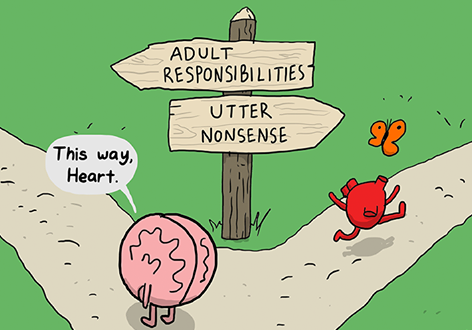
Brain vs Heart, from: theawkwardyeti.com

Here’s an interesting editorial from a “Christian” left blog. (H/T Acton Institute via Lindsay)

The author, Tad Hopp is graduating a PCUSA seminary – an extremely liberal, left-wing denomination.

He writes:

I graduated college in 2007.

[…] I majored in English, not exactly what most people consider a ‘marketable’ or ‘practical’ degree…

[…]I went to a somewhat expensive private school…

[…]I did what many students in their last year of high school do: I went to the school where I felt I was being called…

[…]I do not regret my four years at my undergraduate institution one bit.

[….]When I graduated college, I owed nearly $50,000 in student loan debt and was unemployed for almost six months before I finally found a low-paying office job.

[…]“Can’t find a job? Well, you should have majored in something more ‘practical’, like economics or business or medicine.” Yeah, that would be great…if those were the subjects where my skills and passions lie. They’re not.

[…]I felt called to go to seminary.

[…]I will graduate seminary with close to six figures worth of student loan debt.

Let’s take stock of what he’s said so far:

  • he studied English, a language that he already spoke, which has one of the lowest employment rates
  • he was warned by people who knew something about earning and saving money not to study English
  • he went to a school he couldn’t afford to go to, and he graduated with $50,000 in debt
  • he went to seminary, another subject that doesn’t pay, and added another $50,000 or so of debt
  • he says that he doesn’t have to study subjects that lead to a career because he isn’t “passionate” about them
  • he “followed his heart” by going to the school that he had mystical, emotional, intuitions about = “calling”

My advice to Tad at this point would be for him to take the Bible seriously when it says this:

2 Thessalonians 3:10:

10 For even when we were with you, we used to give you this order: if anyone is not willing to work, then he is not to eat, either.

And 1 Timothy 5:8:

8 But if anyone does not provide for his own, and especially for those of his household, he has denied the faith and is worse than an unbeliever.

Now, for a Bible-believing Christian, these are inerrant and cannot be denied. But we have to go outside the Bible and learn how the world really works in order to figure out how to achieve those stated goals. Why should anyone hire us? What is working really about?

But even before looking at economics, Tad needs to push away all his friends who tell him to “follow his heart” and stick close by his friends who understand economics, who have jobs already, who have savings already, and so on. Don’t look for advice from dreamers, you look to advice from doers – people who can read the times, run the numbers and who have demonstrated the ability to create plans that work to achieve results that please God. When it comes to planning about the future, look at the past accomplishments. Weaving a happy narrative sounds nice, but judge future predictions based on past performance.

I would recommend that Tad read an economist like Thomas Sowell, especially on work, prices, etc., and realize that work means providing value to others. It then follows that he is obligated by the Bible to NOT “follow his heart”, but to instead do something that offers value to his fellow man. Prices are a way of determining what is most valued by your fellow man. And we know what careers have the highest starting salaries and mid-career salaries:

Starting and Mid-Career salaries by profession (click for larger image)

(Source)

Keep in mind that you also have to check to see what the unemployment rate for these fields is, but I think they are all very much in demand, hence the salaries.

I don’t mind if a woman studies English and seminary, but Tad is a man – he has the Biblical obligation to be the primary provider, as we saw in the verses above.

More Tad:

Is the PCUSA doing anything to address this crisis?

[…]What has our government done to address this issue?

[…]I, like so many in my generation, voted for Obama…

[…]It seems to me that we’ve bought into the lie that student loan debt is brought on by the individual person…

[…]You know what I think might stimulate the economy? Automatically cancelling every single outstanding student loan!

[…]If we can spend $640 billion dollars on defense spending, why can’t we find the money to better support public education?

It’s important to understand that an English degree and a seminary degree do not prepare a person to make statements on economics and government. Tad has never studied these things, has no experience in them. He cannot state what the impact of his suggestions would be to all groups, i.e. – he cannot answer “and then what happens?” for every impacted group. Thinking economically is a valuable skill, but as Tad’s personal life shows, it’s not an area he is really knowledgeable about. But he wants to shift money from defense spending (which he knows nothing about) so that he can have a personal bailout. I personally doubt that taxpayers would be better served by paying for his English degree and liberal seminary degree than they would be if a peace-loving democracy could project power abroad to deter aggression from countries like North Korea, Iran, Russia, China and Syria.

Here is the solution to Tad’s problems:

  • we need to put Tad to work in a minimum wage job and confiscate his entire salary, until his loans are paid off.
  • we need to put Tad on a watch list such that he is never allowed to borrow money from anyone ever again.
  • once Tad’s loans are paid off, he should be taxed on his future earnings at the top tax rate for the rest of his life. The money we tax from him can fund education – that’s what he said he wanted.
  • Tad and his household should all be barred from collecting any money for unemployment, welfare or other social programs.

That’s the only bailout Tad should get. It would actually be in his best interest that he encounter real life as quickly as possible, because the longer he waits, the harder it’s going to be for him to recover to independence. He needs to stop his crazy retreat from adult responsibilities, and start working and saving now. I would say that at this point, marriage and parenting is out of the question for him (in another post, he comes out as gay, so that also complicates things). And he can thank the politics of the secular left for marriage and family being less affordable now, thanks to laws like Obamacare, which raised the cost of health care by thousands of dollars. I found it interesting that he actually did work at some point but he mocked the job as a “dead-end job” – as if it was beneath him.

I know some of you will be thinking, “but God called him things and so of course God is going to bail him out with $100,000 for his student loans”. But the thing is, God doesn’t usually work like that. First, I don’t accept that he is a Christian at all. Second, just because you have feelings that your plan will work, that isn’t a calling. The truth is that you certainly can assess the feasibility of things that you feel “called” to do, and if the plan looks crazy, then don’t do it. If you find yourself at odds with wise, practical people when explaining your calling to them, then you’re probably doing it wrong.

Does God pose an authority problem for you?

I have a key that will unlock a puzzling mystery

I’m going to steal this entire post from Tough Questions Answered to get a conversation started:

Many of the people I know who reject God or who have crafted a God that makes no demands on them have a fundamental problem with authority.  They don’t want anybody telling them what to do.

For a person who wants complete autonomy, who chafes at the thought of anyone having authority over them, a creator God who makes demands is way inconvenient.

Many people who believe in God, but also have this authority hang-up, create their own version of God.  This God gives them what they want when they want it.  He approves of everything they do, as long as they are just trying to be happy.  He encourages them to follow their desires, wherever they lead.  C. S. Lewis compared this God to a senile, old grandfather who never says “no” to his grandchildren.  You want chocolate for breakfast, lunch, and dinner?  No problem!

Is this the Christian God?  Philosopher Paul Moser answers the question:

It would be a strange, defective God who didn’t pose a serious cosmic authority problem for humans.  Part of the status of being God, after all, is that God has a unique authority, or lordship, over humans.  Since we humans aren’t God, the true God would have authority over us and would seek to correct our profoundly selfish ways.

If you are “worshiping” a God who makes no demands on you, you’re worshiping no God at all.  You’re just trying to find a deity to make you feel good about your selfish choices.  What’s the point?

I’m posting this because I’m looking for comments. Do you know anyone like this? I’ll help by getting you started with some sample atheists.

Famous atheists agree: God is not the boss of them

Consider the words of Thomas Nagel, a famous atheist philosopher:

“In speaking of the fear of religion, I don’t mean to refer to the entirely reasonable hostility toward certain established religions and religious institutions, in virtue of their objectionable moral doctrines, social policies, and political influence. Nor am I referring to the association of many religious beliefs with superstition and the acceptance of evident empirical falsehoods. I am talking about something much deeper–namely, the fear of religion itself. I speak from experience, being strongly subject to this fear myself: I want atheism to be true and am made uneasy by the fact that some of the most intelligent and well-informed people I know are religious believers.

I want atheism to be true and am made uneasy by the fact that some of the most intelligent and well-informed people I know are religious believers. It isn’t just that I don’t believe in God and, naturally, hope that I’m right in my belief. It’s that I hope there is no God! I don’t want there to be a God; I don’t want the universe to be like that.”(”The Last Word” by Thomas Nagel, Oxford University Press: 1997)”

And what about atheist Richard Lewontin: (and when he says “science” below, he means “naturalistic science”)

“Our willingness to accept scientific claims that are against common sense is the key to an understanding of the real struggle between science and the supernatural. We take the side of science in spite of the patent absurdity of some of its constructs, in spite of its failure to fulfill many of its extravagant promises of health and life, in spite of the tolerance of the scientific community for unsubstantiated just-so stories, because we have a prior commitment, a commitment to materialism. It is not that the methods and institutions of science somehow compel us to accept a material explanation of the phenomenal world but, on the contrary, that we are forced by our own a priori adherence to material causes to create an apparatus of investigation and a set of concepts that produce material explanations, not matter how counterintuitive, no matter how mystifying to the uninitiated. Moreover, that materialism is absolute, for we cannot allow a divine foot in the door.” (Richard Lewontin in New York Review of Books, January 9, 1997, p. 28)

Interesting. He’s willing to tell people lies to keep the Divine Foot outside the door.

And one last one from Aldous Huxley:

“I had motives for not wanting the world to have a meaning; consequently assumed that it had none, and was able without any difficulty to find satisfying reasons for this assumption. The philosopher who finds no meaning in the world is not concerned exclusively with a problem in metaphysics, he is also concerned to prove that there is no valid reason why he personally should not do as he wants to do, or why his friends should not seize political power and govern in the way that they find most advantegous to themselves… For myself, the philosophy of meaningless was essentially an instrument of liberation, sexual and political.” — Aldous Huxley in Ends and Means, 1937

So this is pretty widespread among famous atheists. How about among ordinary atheists?

Survey says

Arthur Brooks’ survey showed that atheists certainly give less in charity and do less community service as religious people on the right and left.

Quote:

Drawing on some ten data sets, Brooks finds that religiosity is among the best predictors of charitable giving. Religious Americans are not only much more likely to give money and volunteer their time to religious and secular institutions, they are also more likely to provide aid to family members, return incorrect change, help a homeless person, and donate blood. In fact, despite expecting to find just the opposite, Brooks concluded: “I have never found a measurable way in which secularists are more charitable than religious people.”

Consider some examples. Religious citizens who make $49,000 gave away about 3.5 times as much money as secular citizens with the same income. They also volunteered twice as often, are 57 percent more likely to help homeless persons, and two-thirds more likely to give blood at their workplace. Meanwhile, those who insist that “beliefs don’t matter as long as you’re a good person” are not as good as those who do think beliefs matter. The former group gave and volunteered at much lower rates.

Yet even these findings tend to obscure the impact of religion on charity. This is because some of the survey respondents that Brooks classified as secular are indirectly affected by religion if they were raised in a religious household.

Keeping the Divine Foot outside the door has advantages – you don’t have to worry about giving away your own stuff to others.

Atheists also divorce more than committed Christians:

Quote:

It’s a number that is trumpeted from the rooftops — and the pulpit: Half of marriages among Christians and non-Christians alike end in divorce.

But the reality is that Christians who attend church regularly get divorced at a much lower rate.

Professor Bradley Wright, a sociologist at the University of Connecticut, found that among people who identify as Christians but rarely attend church, 60 percent have been divorced. Of those who attend church regularly, 38 percent have been divorced.

W. Bradford Wilcox, a leading sociologist at the University of Virginia and director of the National Marriage Project, found a nearly identical spread between “active conservative Protestants” who regularly attend church and people with no religious affiliation.

Professor Scott Stanley from the University of Denver, who is working on the Oklahoma Marriage Initiative, said couples with a vibrant religious faith have more and higher levels of the qualities that marriages need to avoid divorce.

“Whether young or old, male or female, low-income or not, those who said that they were more religious reported higher average levels of commitment to their partners, higher levels of marital satisfaction, less thinking and talking about divorce and lower levels of negative interaction,” he said. “These patterns held true when controlling for such important variables as income, education and age at first marriage.”

Again, keeping the Divine Foot outside the door has advantages. You don’t have to make a commitment that goes against your self-interest. When you don’t feel good in a relationship, you can get out.

I have found that atheists think that even if Christianity were true, atheists have no intention of changing the way they live. Even if they don’t personally engage in tons of obvious immorality, they frequently advocate for a society where Judeo-Christian values have disappeared completely, e.g. – abortion, same-sex marriage. Atheism, if it means anything, means that the strong should be allowed to pursue their own pleasure at the expense of the weak. And God has to go, because he gets in the way of that unrestrained pursuit of pleasure.

I hope that more atheists look in the mirror and are honest with themselves about what’s really going on. Is it really such a terrible thing to have a relationship with the person who cares the most about you and wants the best for you? Is fun really that important that people have to push away the Creator of the universe just because he requires self-denial? You can’t get the experience of choosing to imitate God in order to be in solidarity with him if you shut him out because you want your autonomy. And that’s what we are all here to do – to know him, to be his friend, to act in a way that allows us to feel what he feels, and to have sympathy with him.