Tag Archives: Christian Apologetics

Why won’t Christians defend their faith in public?

I would like to describe a situation that arises frequently that concerns me. The situation I describe below brings out a flaw I see in the way that rank-and-file Christians respond to criticisms of Christianity in the public square.

Here is the situation

Eve is busy programming away at her desk, rushing to check in her unit tests so she can spend her lunch hour reading the latest Stephenie Meyer novel, or check on the schedule for her local sports team, “the Vicariouses” (she has tickets for Thursday). Suddenly Eve hears Alice talking to Bob on the other side of her cubicle. She stops typing to listen to the following unencrypted conversation.

Alice: I was watching a documentary on the Discovery Channel last night that said that the universe has always existed, so there is no God!

Bob: I was watching a documentary on PBS last night showing simulations of how the first life started on Earth! God didn’t do it!

Alice: I saw “Inherit the Spin” on the weekend! The only reason people oppose evolution is because of the Bible! Not because of science!

Bob: I’m going to see “The Va Dinci Code” this weekend! It says that the Gospels are unreliable and that Jesus didn’t even die on the cross!

Alice: I just bought the latest Dichard Rawkins book “Christians Should Be Fed to Lions and the Bible Should Be Burned”!

Bob: I will read that as soon as I finish Histopher Chritchens’ book “Why God is the Evilest, Stupidest Person in the World”!

Eve double-majored in business and computer science at the Indian Institute of Technology, and has an MBA from the London School of Economics. She has spent a ton of time, effort and money studying very difficult subjects for her job, and she even publishes research papers. She works full-time and runs her own business part-time, and teaches night classes for a well-known university. She earns about 200K per year. She lives in a huge house, drives an expensive car, and goes on vacation abroad to all the best vacation spots.

Eve thinks she is a Christian. She has attended church since childhood, her husband is a church elder and she sings in the church choir. She reads the Bible and prays every night, because it helps her to get sleepy before bed. She gives lots of money to the poor. She teaches Sunday school to very small children.  She has even read all of the Narnia novels five times! She even has a calendar filled with nature scenes and itsy-bitsy, teeny-weeny Bible verses posted on her office wall at work! Judging from all of these facts, you might expect Eve to get in on that conversation with Alice and Bob, and set them straight.

But she won’t. Why not?

Why won’t Eve stand?

I am wondering if anyone can explain to me why it is that most church Christians are not able or not willing to make a public defense when God’s reputation is called into question. It seems to me that there are two bad effects that follow from Eve’s unwillingness to stand up and invite Alice and Bob to lunch so that she can address their questions and concerns.

  1. God’s reputation is being trashed by Alice and Bob on the basis of lies they’ve swallowed from pop culture. These lies about God’s existence and character could be easily corrected with a minimal amount of study, which Eve is capable of – she is a genius and has amazing entrepreneurial skills.  If someone said similar lies about her husband or children, she would speak up, but she won’t speak up for God.
  2. Alice and Bob are bound for Hell unless someone cares enough to correct their mistaken beliefs, which, along with their sinfulness, is what is keeping them from a relationship with God that would go on in Heaven. If Eve’s husband or children were mistakenly about to drink poison thinking it was Aspirin, then Eve would speak up. But to save her co-workers from Hell, she won’t speak up.

Eve is capable of studying to defend the faith, because of her great success in other areas where so much time and effort were required to master difficult material. So why has she not applied herself to answering public challenges to her Christian faith from her professors, teachers, actors, the media, politicians, scientists, historians, etc.? She’s heard these questions about God’s existence and character all through high school and into university and then now in her career. Doesn’t she believe the Bible when it says to prepare a defense? Doesn’t she believe the Bible when it says to acknowledge God before men? Doesn’t she believe the Bible when it says that all authentic believers in Jesus will suffer a little for their faith?

It seems to me that if she did spend some time studying, and then made her defense to her co-workers, then two good things would follow:

  1. Eve would be demonstrating her love for God and her friendship with God by protecting his reputation when it is called into question by unbelievers in public settings. That’s what friends do – if Eve wanted to be God’s friend, she would care that no one believed lies about him and told lies about him in public settings.
  2. Eve would be demonstrating her love for her neighbor if she was able to correct some of these false beliefs, such as that the universe is eternal, or that a historical case cannot be made for the resurrection, or that evil is not compatible with theism. It’s important for Alice and Bob to know that Christianity is not stupid.

So why is it that Eve is able to go to church for 20 years, sing in the choir, read the Bible, read the Narnia stories, pray on her knees, and yet still be unwilling to do the best thing for God and the best thing for her neighbor?

Questions for my readers

Can anyone help me to understand why Christians are willing to accept this? Why is this not being addressed by churches?

Do you have an experience where a Christian group stifled apologetics? Tell me about that, and why do you think they would do that, in view of the situation I outlined above? My experience is that atheists (as much as I tease them) are FAR more interested in apologetics than church Christians – they are the ones who borrow books and debates, and try to get their atheist wives to go to church after they becomes interested in going to church. Why is that?

I’m not saying we all have to be geniuses. I am just saying that we should put as much effort into learning apologetics as we put into learning school stuff and work stuff.

Note: I picked these names because there is a running gag in computer network security where these names are used to describe the actors. Eve is the eavesdropping hacker, get it?


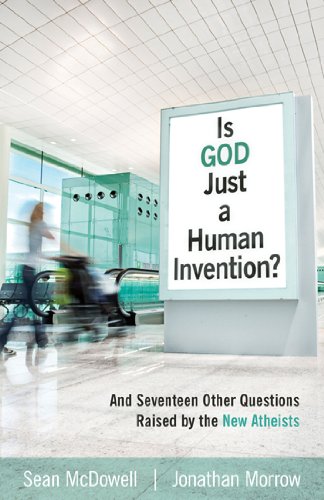
Kindle edition of “Is God Just a Human Invention?” on sale for $2.99

Is God Just A Human Invention?

Here’s the link to the Kindle edition of the book. I consider this book to be my favorite introduction to Christian apologetics. I give this book to everyone and one of my friends even started teaching it to a group of women in her church.

The thorough, chapter-by-chapter review of the book is here at Apologetics 315. The book is also a former read-along selection by Apologetics 315.

Excerpt:

One of the brashest challenges that religious truth has experienced over the past several decades is the remarkable rise of the pugnacious New Atheists. Sean McDowell and Jonathan Marrow, new generation Christian apologists, have undertaken the task of contesting this anti-theistic upsurge. And in Is God Just a Human Invention? And Seventeen Other Questions Raised by the New Atheists the authors have pulled together a wide range of research that powerfully critiques the arguments from the combative non-theists.

[…]The authors deal with the scientific and philosophical challenges to Christian theism in a reasoned and respectful manner.

[…]Is God Just a Human Invention? is loaded with exceptional quotes from Christian and non-Christian thinkers. Additionally, the book furnishes very short essays at the back of each chapter from various erudite Christian scholars that augment the thesis of what was advanced by the authors.

This volume combines simplicity and applicability without forfeiting precision. The authors lead the reader into the full girth of the many contemporary discussions concerning the defense of Christianity. They offer several of the leading arguments for Christian theism while toppling some of the most belligerent of the objections promoted by the New Atheists. They have written, with abundant care, to attain a thoroughness that is not often established in popular books. The wisdom and excellence with which each chapter is written makes this a crucial volume for the budding apologist’s library.

Here are the 18 topics, and after each topic a Christian scholar discusses the relevance of each topic.

  1. Is Faith Irrational? (Commentary by: Gregory Koukl)
  2. Are Science and Christianity at Odds? (Commentary by: John Warwick Montgomery)
  3. Are Miracles Possible? (Commentary by: Gary R. Habermas)
  4. Is Darwinian Evolution the Only Game in Town? (Commentary by: William A. Dembski)
  5. How Did the Universe Begin? (Commentary by: R. Douglas Geivett)
  6. How Did Life Begin? (Commentary by: Fazale R. Rana)
  7. Why Is the Universe Just Right for Life? (Commentary by: Jay W. Richards)
  8. Has Science Shown There Is No Soul? (Commentary by: Dale Fincher and Jonalyn Fincher)
  9. Is God Just a Human Invention? (Commentary by: Garry DeWeese)
  10. Is Religion Dangerous? (Commentary by: Douglas Groothuis)
  11. Does God Intend for Us to Keep Slaves? (Commentary by: Paul Copan)
  12. Is Hell a Divine Torture Chamber? (Commentary by: Frank Turek)
  13. Is God a Genocidal Bully? (Commentary by: Clay Jones)
  14. Is Christianity the Cause of Dangerous Sexual Repression? (Commentary by: Kerby Anderson)
  15. Can People Be Good Without God? (Commentary by: Mark D. Linville)
  16. Is Evil Only a Problem for Christians? (Commentary by: Randy Alcorn)
  17. What Good Is Christianity? (Commentary by: Glenn S. Sunshine)
  18. Why Jesus Instead of the Flying Spaghetti Monster? (Commentary by: Darrell L. Bock)

If you’re looking for a good book on Christian apologetics for beginners, this is a great choice. My Dad read it and he liked it, and he’s not an expert in apologetics.

William Lane Craig debates Austin Dacey: Does God Exist?

Here is the video and summary of a debate between Christian theist William Lane Craig and Austin Dacey at Purdue University in 2004 about the existence of God.

The debaters:

The video: (2 hours)

The video shows the speakers and powerpoint slides of their arguments. Austin Dacey is one of the top atheist debaters, and I would put him second to Peter Millican alone, with Walter Sinnott-Armstrong in third place. This is the debate to show people who are new to apologetics. The debate with Peter Millican is better for advanced students, and that’s no surprise since he teaches at Oxford University and is familiar with all of Dr. Craig’s work. The Craig-Dacey debate is the one that I give to my co-workers.

By the way, you can get the DVDs and CDs for the first Craig-Dacey debate and the second Craig-Dacey debate and the second Craig-Sinnott-Armstrong debate. The Peter Millican debate is not available on DVD, but the link above (Peter Millican) has the video and my summary.

Dr. Dacey’s 5 arguments below are all good arguments that you find in the academic literature. He is also an effective and engaging speaker, This is a great debate to watch!

SUMMARY of the opening speeches:

Dr. Craig’s opening statement:

Dr. Craig will present six reasons why God exists:

  1. (Contingency argument) God is the best explanation of why something exists rather than nothing
  2. (Cosmological argument)  God’s existence is implied by the origin of the universe
  3. (Fine-tuning argument) The fine-tuning of the universe for intelligent life points to a designer of the cosmos
  4. (Moral argument) God is the best explanation for the existence of objective moral values and objective moral duties
  5. (Miracles argument) The historical facts surrounding the life, death and resurrection of Jesus
  6. (Religious experience) God’s existence is directly knowable even apart from arguments

Dr. Dacey’s opening argument:

There are two ways to disprove God’s existence, by showing that the concept of God is self-contradictory, or by showing that certain facts about ourselves and the world are incompatible with what we would expect to be true if God did exist. Dr. Dacey will focus on the second kind of argument.

  1. The hiddenness of God
  2. The success of science in explaining nature without needing a supernatural agency
  3. The dependence of mind on physical processes in the brain
  4. Naturalistic evolution
  5. The existence of gratuitous / pointless evil and suffering

One final point:

One thing that I have to point out is that Dr. Dacey quotes Brian Greene during the debate to counter Dr. Craig’s cosmological argument. Dr. Craig could not respond because he can’t see the context of the quote. However, Dr. Craig had a rematch with Dr. Dacey where was able to read the context of the quote and defuse Dr. Dacey’s objection. This is what he wrote in his August 2005 newsletter after the re-match:

The following week, I was off an another three-day trip, this time to California State University at Fresno. As part of a week of campus outreach the Veritas Forum scheduled a debate on the existence of God between me and Austin Dacey, whom I had debated last spring at Purdue University. In preparation for the rematch I adopted two strategies: (1) Since Dacey had come to the Purdue debate with prepared speeches, I decided to throw him for a loop by offering a different set of arguments for God, so that his canned objections wouldn’t apply. I chose to focus on the cosmological argument, giving four separate arguments for the beginning of the universe, and on the evidence for Jesus’ resurrection. (2) I reviewed our previous debate carefully, preparing critiques of his five atheistic arguments. In the process I found that he had seriously misunderstood or misrepresented a statement by a scientist on the Big Bang; so I brought along the book itself in case Dacey quoted this source again. I figured he might change his arguments just as I was doing; but I wanted to be ready in case he used his old arguments again.

[…]The auditorium was packed that night for the debate, and I later learned that there were overflow rooms, too. To my surprise Dr. Dacey gave the very same case he had presented at Purdue; so he really got clobbered on those arguments. Because he wasn’t prepared for my new arguments, he didn’t even respond to two of my arguments for the beginning of the universe, though he did a credible job responding to the others. I was pleased when he attacked the Big Bang by quoting the same scientist as before, because I then held up the book, specified the page number, and proceeded to quote the context to show what the scientist really meant.

If you want to hear Dr. Craig correct Dr. Dacey on the misquote during their second debate, you can click here for the audio.