Tag Archives: Children

Barack Obama proclaims June as LGBT rights month

Here’s the proclamation.

Excerpt:

Much work remains to fulfill our Nation’s promise of equal justice under law for LGBT Americans.  That is why we must give committed gay couples the same rights and responsibilities afforded to any married couple, and repeal the Defense of Marriage Act.  We must protect the rights of LGBT families by securing their adoption rights, ending employment discrimination against LGBT Americans, and ensuring Federal employees receive equal benefits.  We must create safer schools so all our children may learn in a supportive environment.  I am also committed to ending “Don’t Ask, Don’t Tell” so patriotic LGBT Americans can serve openly in our military, and I am working with the Congress and our military leadership to accomplish that goal.

And of course there is the bill he signed criminalizing speech critical of homosexuality.

And it’s not just gay rights that he is focused on, it’s abortion. If that link doesn’t prove that he is the most pro-abortion president ever to hold the office, then nothing will. Whether intentionally or not, everyone who voted for Obama voted against the rights of the unborn and against the norm of traditional marriage, where children are raised by a mother and a father.

Remember, we Christians helped to elect Obama:
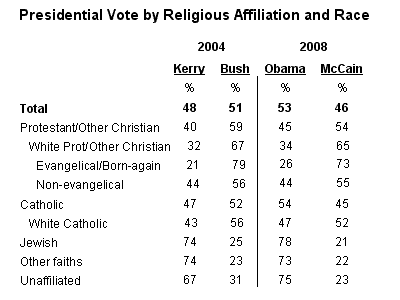
Because we thought that just wars to deter terrorists were expensive, and that we should have more of our neighbor’s money for bailing out Wall Street bankers, unions and failing public schools.

It’s sometimes funny to remember the days when Bush was proclaiming Sanctity of Human Life day. But then he was the most pro-life president ever, and solid on traditional marriage, too.


Why parenting is different now than when my parents were growing up

I had a talk with my parents about what it was like for them growing up in a very very poor country before coming here, and I found out some interesting challenges that I wanted to share with you. My Dad grew up in a small village and he had to walk a mile to his farm which had lots of trees and plants that his family picked to sell the produce in the market. And they hunted for animals at night with a lantern. That’s how they grew up.

So, I wanted to ask them to tell me how things have changed for raising children from that environment compared to here in the affluent West. And below is the list of some of the challenges.

Education

  • My grandparents were not really focused on monitoring my parents education in school, they were more worried about passing on skills that would help them to tend the land so they could pass it on
  • The teachers in that country were mostly males and they were focused on academic achievement and competition, especially since intelligence and scholastic aptitude was a ticket out of poverty
  • There was NO emphasis on self-esteem, compassion, sex education, drug education, leftist politics or other secular leftist ideologies in the schools – and nobody wrote to politicians or attended marches for extra credit
  • The headmaster and the vice principal (both males) lived next door and they would come over to talk to my grandfather about my father, and to play cards while talking about politics in front of the children
  • Teachers were allowed to punish children in class with spankings
  • Teachers would inspect the students for dirty fingernails, messy hair, dirty uniform, or minimum decency clothing standards, etc. and you got rapped on the knuckles with a ruler if you were bad
  • My Dad attended a Presbyterian school and all the teachers attended church on Sundays
  • There was intense competition and last-man-standing contests for prizes, and all the sports were competitive with winners and losers – some people put a lot of effort into contests to get better so they could win
  • The teachers were not unionized and there was a free choice of which school to attend
  • none of the children had money for alcohol, drugs, contraceptives, etc.

Family and Community

  • My Dad grew up with a stay-at-home mother who monitored them, and they came home for lunch
  • There was no TV or video games, so family interaction was more common – like working together on things and doing chores to help make ends meet
  • my Dad’s chore was to fetch water in the morning from half-a mile away (several times)
  • No TV and no video games also means more sports and activities with the neighbor kids
  • Food was scarce, and there was no processed food or fast food – so kids were less obese
  • Neighbors came over more to play cards and discuss things so that children learned about adult stuff by listening and watching them debate and discuss ideas, instead of from watching mainstream news media, which is somewhere to the left of Satan, politically, on social, fiscal and foreign policy
  • My grandfather would make my father volunteer in a store in order for my grandfather to get credit at the store, and he was able to work because there were no regulations on children working to help to support the family as long as they also went to school
  • My father was earning money for the family at an early age – he saw his parents working hard and that was all the motivation he needed to want to contribute – not like today when it is difficult to make children do anything
  • My father used to volunteer to help other neighborhood children learn mathematics (I later did the same thing, but for money)
  • My father learned to hunt and fish so that he could help the family to survive
  • My father had 6 young siblings so he had experience raising children and learning to cook by watching my grandmother cook

If you’re wondering how I got into this long conversation with my parents, it’s because the woman I am performing acts of love on inquired repeatedly about my parents, and I got into a long discussion with them, touching on this topic and many other things related to parenting. The net effect of this on me was to make me a little more tolerant of my parents. They came from a simpler culture where they had more support from teachers and neighbors, while facing fewer challenges from the culture and secular leftist elites. My Dad worked 3 jobs when he got here. My Mom worked too. We were incredibly poor.

New talks on marrriage by Jennifer Roback Morse and Maggie Gallagher

I listened to these several times each, and they are really good. Even better than the ones I posted earlier. If you only have time for one and you’re new, listen to the Dr. Morse lecture. If you have time for both or you’ve heard Dr. Morse before, listen to the Maggie Gallagher lecture.

Cloning her would solve the marriage problem
She can teach you to defend marriage

Jennifer Roback Morse

First, this is Dr. Morse’s well-known lecture on “The Institute Formerly Known As Marriage”. She takes a look at the decline of marriage using her skills as an economist. She talks about the importance of a mother being present during the first 18 months of the child’s development, and the purpose of marriage.

The MP3 file is here.

Topics covered include children’s needs, no-fault divorce, single motherhood and same-sex marriage.

Maggie Gallagher

Maggie Gallagher

Second, here is a very Catholic talk given by Maggie Gallagher. But Maggie is one of the best known voices defending marriage and you can even learn a little bit about her background here – she had an out of wedlock child and saw firsthand the effects of having no father in the home on her son.

The MP3 file is here.

Topics covered include children’s needs, single motherhood, same-sex marriage and the marriage movement.