Tag Archives: Cambrian

The Cambrian explosion is getting more explosive

A story on the Cambrian explosion from the radically pro-evolution BBC. (H/T Evolution News)

Excerpt:

In a new study, Canadian researchers identified a previously unclassifiable fossil that was long believed to belong perhaps to the shrimp family.

They called it Nectocaris pteryx – a small soft-bodied cephalopod with two tentacles rather than the eight or 10 seen in today’s octopuses.

The new survey’s results were presented in the journal Nature.

The findings make the ancestors of modern squid and octopuses at least 30 million years older.

Evolutionary biologist Martin Smith, the main author of the study, told PA news agency that the findings bring cephalopods much closer to the first appearance of complex animals.

“We go from very simple pre-Cambrian life-forms to something as complex as a cephalopod in the geological blink of an eye, which illustrates just how quickly evolution can produce complexity,” said Mr Smith.

Yes, isn’t it amazing how naturalistic mechanisms like “evolution” can create brand new complex body plans out of nothing, in the blink of an eye? And isn’t it amazing that this evidence doesn’t falsify naturalism at all! Oh, no no no no no no, it doesn’t – because naturalism is a blind faith commitment. Evidence is irrelevant to a blind faith commitment. The entire physical universe can pop into being out of nothing, but naturalism is still true – because they want it to be true. All praise the Flying Spaghetti Monster!

The more body plans that appear suddenly, the less plausible evolution becomes. You can’t have a massive infusion of biological information appearing out of nowhere without an intelligent agent to sequence the individual characters. New software requires a software engineer.

Related posts

Does God exist? Is there any scientific evidence to prove that God exists?

Since I haven’t talked about science in a while, I thought that now would be a good time to list some of the more common arguments for a Creator and Designer of the universe and/or intelligent life. I like to use arguments drawn from mainstream science that do not assume the Bible or inerrancy or anything specifically religious. The arguments below all show that the reality we live in exhibits effects in nature that are not explained by particles in motion, chance and the operation of natural laws.

First, here’s the list of a few of the better-known arguments:

The average knuckle-dragging atheist will not be familiar with any of these arguments, will have never seen them used in academic debates, and will not even click through to read about them. That’s atheism these days – it’s non-cognitive. Atheism is all about escaping from moral values and moral obligations, which are not even rationally grounded by atheism.

The point of being familiar with these arguments is to show that religion and science are virtually identical. Both are trying to explain the external world. Both are bound by the laws of logic. Both use evidence to verify and falsify claims. For example, the discovery of the origin of the universe falsifies Hinduism, Buddhism and Mormonism, but it leaves Christianity, Islam and Judaism unscathed. All religions make truth claims and those claims can be tested against what science tells us about the world.

What is the significance of scientific progress for Christians?

Some general points to know when presenting these arguments.

1. You need to emphasize that atheism is in full flight away from the progress of science. Each of these arguments has gotten stronger as the evidence grew and grew. For example, scientists had to be forced to turn away from the eternal universe as new discoveries arrived, such as the cosmic microwave background radiation measurements. Scientists had to turn away from the view that the cosmological constants are nothing special, as more and more fine-tuned quantities were discovered.

2. Christians need to pay attention in school and score top grades in mathematics and experimental sciences. Science is God-friendly, and we need to have Christians doing cutting edge research in the best labs at the universities. Think of the work done by Doug Axe at Cambridge University in which he was able to publish research showing that very few sequences of amino acids have biological function, so getting functional sequences at random is virtually impossible. One of Doug’s papers is here. We need more people like him.

3. Each of these arguments needs to be studied in the context of polemics and debates. The best way to present each of these arguments is by presenting them as a struggle against opposing forces. For example, when talking about the big bang, emphasize how atheists kept trying to come up with eternal universe speculations. When talking about the fine-tuning, talk about the unobservable multiverse. When talking about irreducible complexity, talk about the co-option fallacy. Don’t preach – teach the controversy.

4. Don’t make lazy excuses about how scientific evidence doesn’t persuade non-Christians. Science is absolutely the core of any argument for Christianity, along with the case for the resurrection of Jesus. Christianity is about knowledge. Christians who refuse to subject their faith to science are probably just trying to make sure that Christianity isn’t so true that it dictates how they should live. They like the uncertainty of blind faith, because it preserves their autonomy to disregard Christian moral teachings when it suits them.

5. The purpose of linking your Christian faith to scientific arguments is to demonstrate to non-Christians that Christianity is real. It is not a personal preference. It is not something you grew up with. It is not something you inherited from your parents. When you link your Christian faith with scientific facts in the external world, you are declaring to non-Christians that Christianity is testable and binding on everyone who shares the objective reality we live in. You can’t expect people to act Christianly without showing that Christianity is objectively true.

6. Scientific arguments are tremendously useful even for believing Christians, because sometimes it is difficult to act in a Christian way when your emotions are telling you not to. When your feelings make it hard for you to behave Christianly, that is when scientific evidence can come into play in order to rationally justify acts of self-denial and self-sacrifice. For example, scientific evidence for the existence of God is a helpful counterbalance to the problem of apparently gratuitous evil, which often discourages Christians.

My complete index of arguments for and against Christian theism is here.

UPDATE: I notice that in the popular culture, people are not really aware of these arguments, and are still arguing for religious faith based on pragmatism and personal experience, not on evidence. Using reason and evidence is much better, and it’s what the Bible teaches, too.

Is opposition to evolution based on ignorance of the scientific data?

Consider this article by Jonathan Wells.

First, let’s re-cap the challenge to evolution from the phenomenon of the Cambrian explosion.

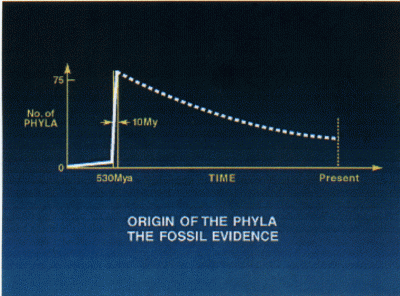
The newly released film “Darwin’s Dilemma” argues that the geologically abrupt appearance of the major groups of animals (the “phyla”) in the Cambrian Explosion posed a serious problem for Charles Darwin’s theory of evolution (as he himself knew), and that subsequent fossil discoveries—far from solving the problem—have made it worse.

Basically, all the major body plans we have today appear in the fossil record in a 2-3 million period about 543 million years ago. There are no precursors in the fossil record showing the gradual evolution of these major body plans.

The Cambrian Explosion: 0 to 60 in a few million years

Darwin expected to discover lots and lots of fossils leading up to the Cambrian explosion period that would show how all these phyla came into existence slowly over time. Unfortunately for the naturalistic evolutionists, the discoveries we’ve been making haven’t shown any hint of precursor fossils leading up the Cambrian explosion.

Since 1859, however, many Precambrian fossils have been found, including microfossils of single-celled bacteria in rocks more than three billion years old. In addition, multicellular Precambrian fossils have been found in the Ediacara Hills of Australia, though there is continuing debate over whether any—or how many—of the Ediacaran fossils were animals, or what relationship—if any—they had to the Cambrian phyla. In 1998, Cambridge University paleobiologist Simon Conway Morris (who is featured in the film “Darwin’s Dilemma”) wrote, “Apart from the few Ediacaran survivors… there seems to be a sharp demarcation between the strange world of Ediacaran life and the relatively familiar Cambrian fossils” (Crucible of Creation, 30).

But wait! Maybe we can’t find the precusor fossils required by Darwinism because they are too small or too soft to have survived for so long?

Since 1859, however, many Precambrian fossils have been found, including microfossils of single-celled bacteria in rocks more than three billion years old. In addition, multicellular Precambrian fossils have been found in the Ediacara Hills of Australia… In 1998, Cambridge University paleobiologist Simon Conway Morris… wrote, “Apart from the few Ediacaran survivors… there seems to be a sharp demarcation between the strange world of Ediacaran life and the relatively familiar Cambrian fossils” (Crucible of Creation, 30).

So there is now no shortage of Precambrian fossils. Not only do we have fossils of bacteria, but we also have many fossils of soft-bodied Multicellular organisms. “In the Ediacaran organisms there is no evidence for any skeletal hard parts,” wrote Conway Morris in 1998. “Ediacaran fossils look as if they were effectively soft-bodied” (Crucible of Creation, 28). The same is true of many of the organisms fossilized in the Cambrian explosion.

But wait! Scientists have discovered lots of exceptionally preserved microbes just before the Cambrian explosion. Don’t microbes count as precursors to the Cambrian explosion phyla?

Richard Callow and Martin Brasier reported in the January 2009 issue of the Journal of the Geological Society, London “a variety of exceptionally preserved microbes” from late Precambrian rocks in England that address “the paradox known as ‘“Darwin’s dilemma’.”

[…]Callow and Brasier didn’t solve Darwin’s dilemma. Instead, they put one more nail in the coffin of Darwin’s attempt to salvage his theory from it. The truth is that “exceptionally preserved microbes” from the late Precambrian actually deepen Darwin’s dilemma, because they suggest that if there had been ancestors to the Cambrian phyla they would have been preserved.

I am willing to believe in evolution. But in order to get me to believe it, I insist on seeing a fossil record that shows the gradual emergence of phyla, one or two at a time, over hundreds of millions of years. That is what Darwinism predicts. We now have a solid record of what came before the Cambrian explosion. So where are the precursors? Where is the record of gradual emergence? Where is my evidence?

More on the Cambrian explosion

The origin of life and biological information

Videos on intelligent design