Tag Archives: Big Government

Can the negative effects of fatherlessness be attributed to other factors, like poverty?

Marriage and family
Marriage and family

Here’s a blog post from the Institute for Family Studies to answer that question.

Introduction:

Growing up without a father—whether that’s due to divorce, a nonmarital birth, or a father’s death—is associated with a host of negative effects. But given that children from low-income families, for instance, are more likely to live apart from their father in the first place, it can be hard to tell to what extent an absent father causes the problems that father absence is associated with, and to what extent other factors related to both family structure and child outcomes (like household income) are to blame.

Researchers Sara McLanahan, Laura Tach, and Daniel Schneider published a paper last year on exactly this problem. They reviewed 47 studies that used a variety of methods designed to uncover the causal effects of father absence, such as lagged dependent variable models, natural experiments, and individual fixed effects models.

Here’s one of the findings:

Labor Force: McLanahan and her colleagues found few studies on how father absence affects children’s employment and income in adulthood. The handful of analyses they did find are not entirely comparable; however, some of their findings were consistent. “Divorce was associated with lower levels of employment” in two studies, and in two other studies there were “higher levels of labor force inactivity among those who experienced divorce in early childhood.” In a fifth study, growing up with stepparents and with a single divorced mother had negative effects on occupational status, while growing up with a single widowed mother was not a disadvantage relative to growing up with stably married parents.

Here is Dr. Robert Rector of the Heritage Foundation to add some more evidence for this view.

He writes:

Census data and the Fragile Families survey show that marriage can be extremely effective in reducing child poverty. But the positive effects of married fathers are not limited to income alone. Children raised by married parents have substantially better life outcomes compared to similar children raised in single-parent homes.

When compared to children in intact married homes, children raised by single parents are more likely to have emotional and behavioral problems; be physically abused; smoke, drink, and use drugs; be aggressive; engage in violent, delinquent, and criminal behavior; have poor school performance; be expelled from school; and drop out of high school.[19] Many of these negative outcomes are associated with the higher poverty rates of single mothers. In many cases, however, the improvements in child well-being that are associated with marriage persist even after adjusting for differences in family income. This indicates that the father brings more to his home than just a paycheck.

The effect of married fathers on child outcomes can be quite pronounced. For example, examination of families with the same race and same parental education shows that, when compared to intact married families, children from single-parent homes are:

  • More than twice as likely to be arrested for a juvenile crime;[20]
  • Twice as likely to be treated for emotional and behavioral problems;[21]
  • Roughly twice as likely to be suspended or expelled from school;[22] and
  • A third more likely to drop out before completing high school.[23]

The effects of being raised in a single-parent home continue into adulthood. Comparing families of the same race and similar incomes, children from broken and single-parent homes are three times more likely to end up in jail by the time they reach age 30 than are children raised in intact married families. [24] Compared to girls raised in similar married families, girls from single-parent homes are more than twice as likely to have a child without being married, thereby repeating the negative cycle for another generation.[25]

Finally, the decline of marriage generates poverty in future generations. Children living in single-parent homes are 50 percent more likely to experience poverty as adults when compared to children from intact married homes. This intergenerational poverty effect persists even after adjusting for the original differences in family income and poverty during childhood.[26]

Yesterday, on the Dennis Prager show, Dennis was discussing this article and this article during the male – female hour. He made the point that children raised by single mothers and divorced mothers don’t have the experience of growing up and seeing their mother love her husband and act like a wife towards him. No government program can provide that. It is important that boys and girls have that experience of seeing a woman love her husband, and seeing a man love his wife. Of seeing them in a committed, stable, purposeful relationship, trying to provide for and raise their children.

Today, a lot of women are watching Hollywood movies and TV shows where men are portrayed in a very negative way, e.g. – Mad Men. These shows are often written by people on the hard left – radical feminists and/or gay activists. A girl growing up in this environment is just not going to have access to a positive view of how men and women get along in a marriage, making them less marry-able. Less safe to marry. That example of man and wife would act as a counter to Hollywood, but too many boys and girls are growing up without it.

So what’s the take-home lesson? The take-home lesson is that we need to be more careful about choosing partners and having children. It’s probably a good idea to be less driven by emotions, peer approval and hormones, and more driven by rational thought and studies. Choose wisely, and test well.

UK survey: nearly 60% of working moms would cut their work hours if they could afford to

Dina tweeted this UK Daily Mail article that made me think about how women vote.

Excerpt:

More than a third of working mothers would like to give up their jobs completely and stay at home with their children, a major Government survey has found.

It showed that millions of mothers of young children who go out to work do so only because they need to work to pay the bills.

The research for the Department for Education found that, far from being anxious to get out of their homes and into employment, the great majority of mothers are only reluctant workers.

Nearly six out of ten of all working mothers would cut down their hours to spend more time with their families if they could afford to, it said.

The yearning among mothers to leave their jobs and look after their children instead is even more pronounced among the highest achieving women, the  survey indicated.

More than two-thirds of those in senior and middle management roles would spend fewer hours in the office and devote more time to their children if they had enough money, it said.

[…]Yesterday’s survey also undermines the claims that prejudice and discrimination against women in male-dominated companies is the reason why women are heavily outnumbered in the boardroom.

Rather, it suggests that many women who could get to the top in business choose instead to put their children before their careers.

The problem is that when government gives people free stuff, people who work have to work more to pay for it. And the strangest thing is that even though women seem to want to stay home with their kids (which is good), when it comes time to vote, they actually vote NOT to stay home with their kids. How? By growing the size of government, which results in higher taxes. To find out what women really think about staying home with their kids, we can look at how they vote. 

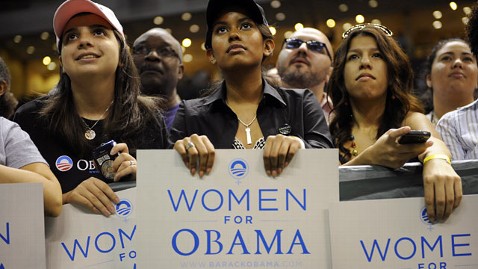
Women voted 55 to 44 for Obama
Women voted 56-44 for more government spending in 2012

CNN reports on how women voted in the 2012 election:

According to CNN’s exit polls, 55% of women and 45% of men voted for Obama and 44% of women and 52% of men voted for Romney. That level of female support for the president made an especially big impact in swing states like Ohio where the gender breakdown mirrored the national figures.

[…]There are some indications that social issues directly impacting women might have helped sway votes in some states.

Tuesday’s early exit polls showed 51% of Missouri voters said they believed abortion should be legal all or most of the time. Of those voters, exit polls showed 76% supported Democratic incumbent Claire McCaskill, who won Tuesday night, while 19% voted for Akin.

Forty-seven percent of Missouri’s voters said abortion should be illegal. Exit polls showed Akin netted 67% of this group’s votes while 27% of people who think abortion should be illegal supported McCaskill.

But much more than social issues, pocketbook economic issues most concerned women voters, exit polling showed.

“Women like all voters felt the economics were most important,” Swers said. “Women tend to be more supportive of government spending… than men are … so they were less responsive to Romney in that way and more responsive to Obama’s message on empathy and helping the middle class.”

Gallup reported that the gender gap in the 2012 election was actually 20 points. That was the largest ever measured in a Presidential election. The actual vote for Obama among women, according to Gallup, was 56-44.

More government means higher taxes
Women are also more pro-abortion more than men

Here is a peer-reviewed research paper that shows the problem that we need to warn women about, so that they vote smarter.

The abstract reads:

This paper examines the growth of government during this century as a result of giving women the right to vote. Using cross‐sectional time‐series data for 1870–1940, we examine state government expenditures and revenue as well as voting by U.S. House and Senate state delegations and the passage of a wide range of different state laws. Suffrage coincided with immediate increases in state government expenditures and revenue and more liberal voting patterns for federal representatives, and these effects continued growing over time as more women took advantage of the franchise. Contrary to many recent suggestions, the gender gap is not something that has arisen since the 1970s, and it helps explain why American government started growing when it did.

When people vote for government to do more for everyone else, then men who work have to pay more in taxes.

Women for bigger government, higher taxes
Women vote for higher taxes, so they have to work more

If women want to stay home with their children more, then they need to vote for their husbands (present or future) to pay less in taxes when they work. That means voting for smaller government, more liberty and more personal responsibility. Until women get to the point of connecting their future plans (marriage and parenting) for their lives with their current voting, this situation is not going to change. Marriages run on money. It’s no good to urge men to “man-up” and then take away their ability to provide by taxing more of their earnings to pay for Sandra Fluke’s birth control pills and abortions. Keep the money in the family, and then you can stay home with the kids more.

How well are Democrat economic policies working in Venezuela and Argentina?

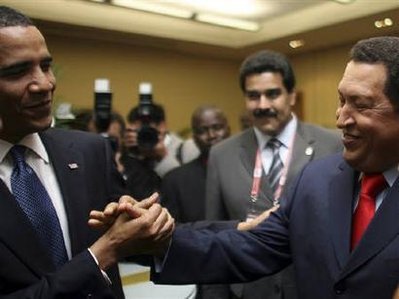
Are Barack Obama and Hugo Chavez very different?

I have been reflecting sorrowfully on some of the outright lies spoken by the President in his recent State of the Union address. I am thinking specifically of lies that are almost universally rejected by economists across the ideological spectrum – lies so obvious that you would have to be an illiterate peasant living in a village in Venezuela or Argentina in order to believe it.

Three of his lies stand out – the minimum wage lie, the global warming lie and women pay gap lie. Each of these lies is as false as saying that the Sun goes around the Earth, or that the Earth is flat. What bothers me is not that the President spoke them, because I expect someone with no scientific background and no private sector experience to say things that are not true. But what bothers me is that the American electorate is now incapable of identifying such obvious lies.

Let’s take a look at this article from the leftist Washington Post.

Excerpt:

On aisle seven, among the diapers and fabric softener, the socialist dreams of the late Venezuelan president Hugo Chávez looked as ragged as the toilet paper display.

Employees at the Excelsior Gama supermarket had set out a load of extra-soft six-roll packs so large that it nearly blocked the aisle. To stock the shelves with it would have been pointless. Soon word spread that the long-awaited rolls had arrived, and despite a government-imposed limit of one package per person, the checkout lines stretched all the way to the decimated dairy case in the back of the store.

[…]Pathetic, in a country with the world’s largest petroleum reserves and oil prices at nearly $95 a barrel, yet unable to supply basic goods because of its crumbling local currency and a shortage of U.S. dollars.

[…]Nearly a year after Chávez’s death of complications from cancer at age 58, his hand­picked successor, Nicolás Maduro, is struggling to contain food shortages, spiraling inflation and rampant crime.

The arrival of basic staples such as cooking oil, chicken, flour or milk brings Venezuelans running to supermarkets and touches off surreal mob scenes, even as the government imposes price caps and rationing to prevent hoarding.

Maduro squeaked past opposition candidate Henrique Capriles in April’s presidential election, and Maduro’s United Socialist Party won enough races in Dec. 8 local elections to push back against perceptions that Chávez loyalists were deserting him. Just before the vote, with television cameras rolling, he sent soldiers into an appliance store accused of price gouging and ordered huge markdowns on televisions and microwaves. Apparently it gave his party a final boost at the polls.

There’s not a dime worth of difference in terms of vision between the Democrats in the USA and the socialists in Venezuela. The same people who think that sending armed troops to nationalize industry in Venezuela are nationalizing health care in this country right now. We will eventually see the same lines for health care that form in Canada and the UK. When you tax, regulate, and even attack those who provide services and products, you get shortages. Period. And yet big government redistribution of wealth seems to be winning over low-information voters in Venezuela and in the United States.

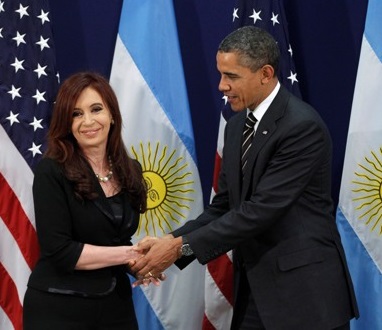
Are Barack Obama and Cristina Kirchner very different?

Venezuela has 56% currency inflation right now thanks to “stimulus” spending, but that is not the only place where Democrat policies are in force. Consider this article from the leftist Guardian about Argentina, where Democrat “stimulus” spending policies have led to rising prices of consumer goods.

Excerpt:

Every morning around 8am, the stern-faced cabinet chief Jorge Capitanich stands behind a podium at the Casa Rosada presidential palace for a televised verbal blast at the perceived enemies of the “victorious decade” presided over by the current president and her husband, the late Nestor Kirchner. Without naming them, Capitanich lashes out against the “visible and invisible” politicians, labour representatives, businessmen and journalists he blames for the sudden collapse of the peso and the explosive price increases that followed the forced devaluation.

Argentina’s economic earthquake has placed a huge question mark over the political future of the stateswoman so powerful she is referred to as Queen Cristina by both the opposition press and her supporters. In the past week, Capitanich has attempted to pin the price lurch on faceless foreign speculators, whom he accuses of a “strategy of domination” to gain control of Argentina’s oil and freshwater reserves, pandering to the widespread belief here, often underlined by the president in her speeches, that “vultures” of the leading industrial countries harbour secret plans to siphon off natural reserves from this resource-rich South American nation.

Capitanich has also blamed “anti-patriotic” farmers and large retailers, allegedly in league with independent, corruption-probing journalists, of fuelling price rises by “generating psychological action of permanent destabilisation” against Fernández de Kirchner.

But critics of the government point to inept administration and populist spending by a government that considers itself to be leading a revolution against Argentina’s erstwhile oligarchy.

Just like Obama, the socialists in Argentina are always looking to blame others for the problems they cause with their own policies. The problem is never bad policies that attack job creating businesses, it’s always a lack of loyalty and patriotism. We are disloyal to our economically-illiterate elites who only want to help us, they say. Leftist economic policies can work if we just believe in the leader, they say. And many ignorant peasants believe that, even when the failure is right in front of them.

Not just in Venezuela and Argentina

Of course in America, we have a different kind of policy failure. We have Obamacare. Conservatives warned the public about it for years, but our peasants went ahead and voted for it anyway when we re-elected a know-nothing in 2012. He said that we could keep our health care plans and that we could keep our doctors. He said he would reduce the cost of health care. And we believed him. We believed him because the uneducated stand-up comedians we watched on the Comedy Channel made us believe him.

Take a look at the peasants realizing that not every piece of happy talk read from a teleprompter by a celebrity is automatically true:

Human Events explains the story behind that video.

Excerpt:

All of Barack Obama’s phony rhetoric about how wonderfully the Affordable Care Act is chugging along means less than nothing compared to the cold reality that awaited the employees of a Pennsylvania company, as a local news station captured their stunned reactions to ObamaCare price hikes in real time.

[…][They] learned they’d be facing premium hikes of over 30 percent, with higher deductibles.  Even their co-payments for doctor visits have doubled.  And the numbers hitting these good people aren’t as bad as the premiums and deductibles slamming into other ObamaCare victims around the country.  The great second wave of damage in the larger group insurance market is about to get under way.

“I don’t know how President Obama thinks he’s helping us,” one employee sighs, “because we can’t afford this, we can’t afford to pay these co-pays, to pay these deductibles on what we’re making.”

Another repeats the sarcastic but accurate observation made by ObamaCare critics since day one: “there’s nothing affordable” about the Affordable Care Act.  It is observed that average people can’t just cough up three hundred dollars a month, because that’s a big chunk of a rent check or mortgage payment.  One shell-shocked woman, looking at a $400 monthly premium increase plus a $4000 deductible, confesses she has no idea how she’s going to pay it.

[…]Needless to say, none of these people will be invited to come on stage with President Obama and talk about their ACA experiences.  They’re learning the hard way that political control of an industry means distant commissars picking winners and losers.  You can do everything right and still get socked by the biggest middle-class tax increase in history, because the imperial President and his court have decided other people need lower premiums, and you must be squeezed to pay for it.

We have a generation of people who have been educated to value rhetoric from celebrities over the Constitution and sound economics in general. We must not think that we can be as ignorant as South American peasants now and avoid the consequences of that ignorance. We need to turn off the TV and pick up the Thomas Sowell book.

Related posts