Tag Archives: Big Bang Theory

Stephen C. Meyer: does the Big Bang cosmology support God or atheism?

Here’s the 66-minute video featuring Dr. Stephen C. Meyer, who holds the Ph.D in philosophy of science from Cambridge University, and other degrees in the hard sciences. (H/T UK Apologetics)

The lecture starts really, really slowly. You can just fast-forward to the 12 minute mark, or you might die of boredom.

Topics:

  • Up until the the last 100 years or so, everyone agreed that the universe was eternal
  • This is at odds with the traditional Christian view that God created the universe
  • Materialism, the view that matter is all there is, requires eternally existing matter
  • Discovery #1: Hubble discovers that the universe is expanding (redshift observation)
  • The expanding universe was resisted by proponents of the eternal universe, like Einstein
  • Some naturalists even proposed speculative static models like the steady-state model
  • However, not of the speculative models fit with observations and experimental results
  • Discovery #2: Penzias and Wilson discover the cosmic microwave background radiation
  • Measurements of this background radiation confirmed a prediction of the Big Bang theory
  • The steady-state theory was falsified of by the discovery of this background radiation
  • The oscillating model was proposed to prevent the need for an absolute beginning
  • But the oscillating model is not eternal, it loses energy on each “bounce”
  • A paper by Alan Guth and Marc Sher from 1982 proved that our universe will not bounce
  • In addition, experiments reveal that the universe will expand forever, and not contract
  • The beginning of the universe is more at home in a theistic worldview than an atheistic one
  • The beginning of the universe fits in well with the Bible, e.g. – Genesis 1, Titus 1, etc.

In case you are wondering about what the evidence is for the Big Bang, here are 3 of the evidences that are most commonly offered:

Three main observational results over the past century led astronomers to become certain that the universe began with the big bang. First, they found out that the universe is expanding—meaning that the separations between galaxies are becoming larger and larger. This led them to deduce that everything used to be extremely close together before some kind of explosion. Second, the big bang perfectly explains the abundance of helium and other nuclei like deuterium (an isotope of hydrogen) in the universe. A hot, dense, and expanding environment at the beginning could produce these nuclei in the abundance we observe today. Third, astronomers could actually observe the cosmic background radiation—the afterglow of the explosion—from every direction in the universe. This last evidence so conclusively confirmed the theory of the universe’s beginning that Stephen Hawking said, “It is the discovery of the century, if not of all time.”

This is a good article to send to atheists who are not comfortable with what the progress of science has revealed about the beginning of the universe, and of time itself. If you look in agnostic astronomer Robert Jastrow’s book “God and the Astronomers” (2nd edition), you’ll find 6 evidences.

By the way, Dr. Meyer also does a great job of explaining the problem of proteins, DNA and the origin of life in this lecture. And you can hear him defend his views in this debate podcast with Keith Fox and in this debate podcast with Peter Atkins. He does a great job in these debates.
Frank Turek explains the kalam argument and some objections to it

His latest show focus on three of the better known scientific arguments for the existence of God. The argument from the origin of the universe, the argument from the cosmic fine-tuning, and the argument from biological information. He is especially focused on the first argument. He answers about a half-dozen objections raised by university students during his most recent speaking engagements on secular college campuses.

If you need a refresher on the kalam argument, read this first.

The MP3 file is here.

Topics:

Atheist dogma
– they pre-suppose natural causation and no evidence can overturn the assumption
– they rule out intelligent causes before they look at the evidence
– they rule out supernatural causes before they look at the evidence
– the assumption of naturalism is just a philosophical assumption
– the assumption is not subject to debate – they just believe it on faith
– the view that all truth must be detected with scientific methods is self-refuting

How atheists oppose the origin of the universe:
– that’s a god of the gaps argument
– you have to find an answer to problems that fits with my assumption of naturalism
– who made God?
– quantum mechanics shows that things can pop into being uncaused – maybe the universe did too
– given enough time, the universe will pop into being out of nothing

Responses:
– the cause of nature’s coming into existence cannot be inside of nature
– if nature has a beginning, then the cause of the beginning cannot be natural
– nature is the effect, the cause cannot be natural – it must be supernatural
– the only objection to the origin of the universe is the pre-supposition of naturalism
– but naturalism is not science – it’s a faith commitment to an unproven assumption
– only an agent with free will can cause an effect when/where there is no physical cause
– the inference to a supernatural cause is not based on ignorance, but on what we know
– the scientific evidence for the origin of the universe is the foundation of the argument
– the scientific evidence has gotten strong as more discoveries emerged
– regarding quantum mechanics, the particles do not come into being from nothing
– the virtual particles come into being from a vaccuum, which is not nothing
– to say that events occur without causes is to deny the scientific method itself

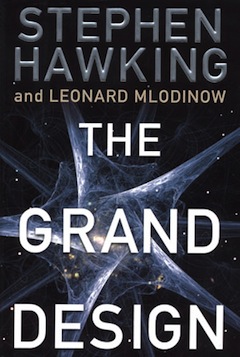
Book review of Stephen Hawking’s “The Grand Design” by Edgar Andrews

First, who is Edgar Andrews?

Professor Edgar H. Andrews (BSc, PhD, DSc, FInstP, FIMMM, CEng, CPhys.) is Emeritus Professor of Materials at the University of London and an international expert on the science of large molecules. In 1967 he set up the Department of Materials at Queen Mary College, University of London, and served both as its Head and later as Dean of Engineering. He has published well over 100 scientific research papers and books, together with two Bible Commentaries and various works on science and religion and on theology. His book From Nothing to Nature has been translated into ten languages.

Edgar Andrews was an international consultant to the Dow Chemical Company (USA) for over thirty years and to the 3M Company (USA) for twenty years. He was a non-executive director of Denbyware PLC throughout the 1970s and for five years a member of the Scientific Advisory Board of Neste Oy, the national oil company of Finland.

And now an excerpt from the book review: (H/T Apologetics 315)

Hawking and Mlodinow declare: ‘According to M-theory, ours is not the only universe. Instead, M-theory predicts that a great many universes were created out of nothing. Their creation does not require the intervention of some supernatural being or god. Rather, these multiple universes arise naturally from physical law. They are a prediction of science’ (p.9).

So what is this magical M-theory? The authors are rather coy about it. ‘M-theory’, they say, ‘Is not a theory in the usual sense. It is a whole family of different theories, each of which is a good description of observations only in some range of physical situations’ (p.8). Theoretical physicist Lee Smolin is more explicit: ‘… we still do not know what M-theory is, or whether there is any theory deserving of the name’ (The trouble with physics, Allen Lane, 2007, p.146).

The fact is that M-theory is an untestable mathematical construction which many scientists believe has no bearing on physical reality. But that doesn’t deter our authors because they don’t believe in ‘objective reality’ anyway. What we think is ‘real’, they say, is simply a model assembled in our brains from raw data input by our senses. But, confusingly, the authors then claim that the best models are those that reflect the way things really do happen in the real world — appealing to the very objective reality they say does not exist! Confused? Me too.

But it gets worse. They claim that M-theory (whatever it might be) predicts not one universe but a multiverse — a vast collection of universes which cannot be observed or known to us in any way. On their own criterion, this makes M-theory a very bad model indeed. So it’s hardly a useful replacement for God.

Here’s a better book to read if you want to understand how belief in God relates to experimental science.

My Dad just finished reading his book “Who Made God?” and called me up to tell me how much he liked the book. My Dad is not a scientist, yet he read the whole thing and learned a lot about science. This is the book for people who haven’t read a thing about science and religion. It’s easy to understand because he explains the same thing over and other giving more and more detail. Even a child can understand the first explanation, and then he keeps layering on details until he gets up to the state-of-the-art.

Remember Brian Auten of Apologetics 315 picked this book as his favorite of 2010. You can’t go wrong!

My Dad is now reading my copy of “Is God Just a Human Invention?” by Jonathan Morrow and Sean McDowell. I’m working on “Is God a Moral Monster?” by Paul Copan. I like books where difficult questions are asked and then careful answers are given. Then when people ask me the same questions, I can answer them using what I’ve learned – and often phrase the question even more clearly and forcefully than they did when they asked me.