
First, the straight story on the scientific discovery, as reported in Bioscience Technology.
Excerpt:
520 million years ago, the first known animal heart was formed.
It was the heart of an ancient shrimp, and quite a heart it was. For it, and its vascular system, have been found to be more complex than that of modern shrimp, researchers reported in a recent Nature Communications. Its cardiovascular system was apparently one of evolution’s first templates for modern cardiovascular systems. Significant streamlining has occurred since.
The find comes on the heels of an equally important one by the same group: that of a stunningly intact nervous system from the same breed of primordial shrimp: Fuxianhuia protensa.
“This is only the second case of the description of a cardiovascular system in a Cambrian arthropod, the first one being that of the inch-long Marrella from Burgess Shale,” emailed Diego Garcia-Bellido of the University of Adelaide, who co-discovered that first arthropod while at the University of Cambridge. Garcia-Bellido was not involved in the new study. “This new finding of a cardiovascular system in a larger animal (Fuxianhuia is about two to three times as large, thus more detail), together with a fantastically preserved, and very complex, nervous system, unknown in Marrella, and the gut, make it probably the most complete arthropod internal anatomy known in the fossil record.”
The main conclusion drawn, said Garcia-Bellido: “The level of complexity of the Fuxianhuia was extremely high, considering that we are studying some of the oldest animals on Earth.”
Now, if you’re like me, you’re skeptical that soft tissues can be preserved in the fossil record, but:
Said the paleontologist via email: “As we know, most soft tissue of animals tends to decay away once the animals died, so often only the hard parts of animal body (bones, shells, teeth, etc.) are preserved in fossils. However, under very exceptional circumstances, soft tissue and anatomical organ system can also be preserved in fossils.”
Keep in mind that 520 mya is right after the Cambrian explosion that intelligent design people like me love to talk about. I mean you are going from single-celled life to complex organ types in a few million years. Fine if you are an ID proponent, but devastating if you are a Darwinian naturalist.
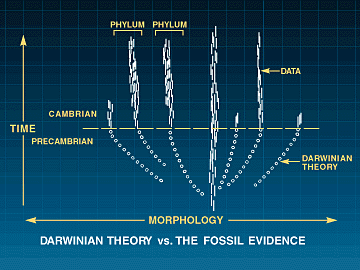
If you are a naturalist, then you need the fossil record to go from simple to complex. The trouble is that all the simple to complex in that image is pure speculation at this point – and not for lack of trying, either.
You know, I am writing this on Saturday night, and in a happier world, this discovery would be discussed tomorrow in every Christian church in the land. This is the kind of data that Christians should be familiar with to check the presupposition of naturalism which is lethal to rational thought. If only we were more focused on truth than on signing and feelings in church. If only we were not so scared of traditional dating of fossils. Maybe then we would be getting somewhere in the culture wars.

