
Tag Archives: Atheism

Where the action is: Frank Turek speaks to U of M college students

So, Bible-believing Christians are doing lots of things in the world these days, and some are more useful than others. In my opinion, the most significant thing that a Christian can do is produce original research that leads to the development or improvement of arguments for the truth of Christianity. So, Douglas Axe’s work showing that protein sequences that have biological function was significant. However, that kind of contribution going to be out of reach for most of us, because who has 6 years to waste on a PhD? But there is a next best thing, and that’s sending scholars to the universities to speak to the college students.

Here’s an account of Frank Turek speaking at the prestigious University of Michigan from The College Fix.

Excerpt:

It’s rare that college students are told on a university campus by someone holding a PhD that the universe is no accident, but rather designed by a loving creator.

Perhaps that is why a visit to the University of Michigan by popular Christian apologist Dr. Frank Turek drew a standing room only crowd of about 500 students, filling the school’s largest ballroom to capacity.

Turek, a former aviator in the U.S. Navy who holds a master’s degree from the George Washington University and doctorate from Southern Evangelical Seminary, offered students his blunt reasoning on why he believes Christianity is supported by science, not just faith, but the event last Thursday also delved into subjects such as radical Islam and homosexuality as well.

Turek gave straight answers to touchy questions that flew in the face of political correctness and the academe. On the topic of homosexuality – which he says is the biggest question he gets – he maintained homosexual acts are sinful, per the Bible. On the topic of evolution, he denied “macro-evolution” in support of intelligent design.

“You can breed all kinds of dogs from dogs,” he said, “but can you can’t get something that isn’t a dog from a dog.”

In case you’re wondering about his being a naval aviator, what I heard is that he used to fly navigator and bombardier on the P-3C Orion. I use those to hunt Russian subs in the military simulator I play. Anyway, I digress.

More:

The bedrock of Turek’s lecture was one that many religious people can appreciate, that people must hold themselves to God’s moral law. Turek attacked the materialistic determinism (the belief that there is no higher meaning to life) of scientists like Francis Crick. He attacked the way scientists deny there are such things as miracles.

“People don’t want morality and accountability,” he said. “I was in college, too.”

“The greatest miracle in the Bible has already occurred and there’s scientific evidence for it,” he said, referring to the creation of the heavens and the Earth. “God is the unmoved mover, the one who is contingent for all his creation.”

It’s very important for Christians to be familiar with scientific arguments for God’s existence. Here is a list for those who have not looked into it, so you can get a bird’s eye view:

Turek also nails what the problem is with students abandoning their faith and having no curiosity about ultimate questions:

Turek also asked students if they thought religion was being marginalized on campus, to which a senior named Alexander answered that “university culture has become more hostile to religion and to the idea of faith.”

After the speech, Turek was asked by The College Fix about why the younger generation is leaving religion. As of two years ago, the largest religious denomination on campus is now the “nones” – people who do not identify with any religion at all.

“It’s the church’s fault,” Truck said bluntly. “If the church doesn’t know how to defend itself, then people will leave.”

“Sex,” he added, “is the new religion.”

Right. No atheist in college is examining the claims of theism against the evidence rationally. The college students are seeking their own pleasure first and foremost, and to use others for that end. They adopt the lifestyle and worldview that allows them to feel good about pursuing fun and thrills above all. But I do think that confronting them with the evidence for God’s existence and character is the right move. At least then when they find out that pure selfish hedonism is a dead end, they will remember that there was another truth-focused approach that they never looked into.

In the meantime, we can help them along by writing and speaking about the harm caused by the Sexual Revolution. It never hurts to be familiar with studies that show what happens when people dump the Bible’s approach to sex, and go their own way. On this blog, I try to post lots of studies about the perils of premarital sex, rapid relationship tempo, cohabitation, no-fault divorce, abortion, etc. It’s important to share this research with young people so they can detect the threat before they walk blindly into it.
Stephen C. Meyer and Peter Atkins debate intelligent design

This dialog occurred in 2010 on the Unbelievable radio show.

I made a rough transcript, so please see below for that.

The MP3 file is here. (60 minutes)

Details:

The documentary film “Expelled” is presented by US Actor Ben Stein and makes the case that scientists who question Darwinian orthodoxy and support Intelligent Design are being “expelled” from academia.

As the UK edition of the DVD is released we ask “Is freedom of thought at stake or is Intelligent Design out of bounds when it comes to biological science?”

Stephen C Meyer is co founder of the Discovery Institute in the USA and a major proponent of Intelligent Design.

Peter Atkins is Professor of Chemistry at Oxford University and an outspoken atheist.

They both feature in “Expelled” and join Justin to debate the pros and cons of Intelligent Design theory.

Mark Haville who is bringing the film to the UK also joins the discussion.

Note: The transcript below is quite snarky and may include paraphrases of Dr. Atkins for the sake of humor.

My rough transcript of the Meyer-Atkins debate

Stephen Meyer:
– started researching on ID while doing his PhD at Cambridge
– the question is whether the information-bearing properties in DNA require a designer
– what cause is adequate to explain the digital code that in the simplest living cell
– alternative explanations like self-organization and RNA-first have failed
– so the best explanation for functional sequences of parts is an intelligent designer
– Darwinists have responded to this argument with insults and suppression of dissent

Peter Atkins:
– intelligent design is creationism
– there is no science at all in it
– information can emerge without an intelligent designer
– structures emerge spontaneously, no agent is needed to generate the structure
– information in DNA is also a structure

Stephen Meyer:
– structure and information are two different things
– many structures emerge spontaneously
– structure may be like the vortex that occurs when water goes down a drain

Peter Atkins:
– the vortex is information

Stephen Meyer:
– structures are different from functionally-specified digital information
– in DNA, there is a 4-digit alphabet that is used to create code sequences
– the thing to be explained is where do the functional sequences come from

Peter Atkins:
– information can grow without an agent
– the second law of thermodynamics
– the universe is falling into disorder
– but there are local abatements of chaos that create information
– evolution can cause the amount of information to grow

Stephen Meyer:
– that’s just an assertion
– I agree that energy flow through a system can produce spontaneous order
– but spontaneous order is not the same thing as information

Peter Atkins:
– spontaneous order is the same as information

Stephen Meyer:
– it’s not order that needs to be explained it’s specified complexity

Peter Atkins:
– what do you mean by specified complexity?

Stephen Meyer:
– the chemical bonds that connect to each letter do not determine the letter
– the chemical bonding sites will accept any letter as easily as any other
– any one of the 4 bases (letters) can attach at any place along the backbone

Peter Atkins:
– the selection of which letter comes next is determined by evolution

Stephen Meyer:
– that is just an assertion
– there is no physical process that sequences the letters to have a function

Peter Atkins:
– do you believe in evolution? YES OR NO!

Mark Haville:
– for him to answer the question you have to define the word
– do you mean macro or micro? biological or stellar? directed or undirected?

Peter Atkins:
– undirected molecules to man evolution by natural processes

Stephen Meyer:
– but even Dawkins doesn’t believe in evolution then
– you’re including the origin of life from non-living matter in evolution
– Dawkins says that there is no known naturalistic explanation for that

Mark Haville:
– you need to define your terms

[They discuss of the movie Expelled and the case of Richard Sternberg]

Stephen Meyer:
– the problem is people don’t want to talk about the science
– they denounce dissent as unscientific
– they will not debate about whther natural causes can explain the information
– I want to talk about the science

Peter Atkins:
– ID people raise interesting questions for naturalists to work on
– but you want to tell us what the answer is (intelligence) before we begin
– you start from the idea that an intelligence was involved

Justin Brierley:
– but you start with the idea that natural mechanisms can explain everything!

Stephen Meyer:
– for Dr. Atkins, only explanations based on material processes are valid

Peter Atkins:
– that is correct

Stephen Meyer:
– but we think that the activities of mind can explain some effects
– e.g. – the best explanation of the Rosetta stone is a mind

Peter Atkins:
– but we naturalists think of minds as material as well

Stephen Meyer:
– that’s a materialist pre-supposition on your part
– we would have to have a debate about mind and body

Mark Haville:
– I think that the materialist position is socially dangerous
– the problem with naturalism is that it is an ideology
– the ideology pushes absurdities, e.g. – the universe came from nothing uncaused
– and naturalists exert power over others to force them to believe nonsense

Stephen Meyer:
– science progresses as the result of scientists disagreeing
– both sides agree to the facts
– the debate is about the interpretation of those facts
– and one side is being ruled out a priori based on the pre-supposition of materialism

Peter Atkins:
– why do you say that an intelligence is involved in DNA but not general relativity

Stephen Meyer:
– it is always logically possible that intelligence can be invlved in any effect
– the main thing is that explanations based on intelligence should not be ruled out

Peter Atkins:
= well you can’t appeal to any non-material process in expaining anything
– those are the rules

Moderator:
– what does intelligent design have to do with religion?

Stephen Meyer:
– creationism is about understanding the istory of life using the Bible
– intelligent design is about using the same method of inquiry as Darwin
– we know that information arises from intelligent causes
– humans create information all the time by using intelligence to sequence parts

Moderator:
– are intelligent design proponents disreputable?

Stephen Meyer:
– what’s disreputable is shutting down debate by setting arbitrary rules

Peter Atkins:
– we are both interested in the same questions

Moderator:
– why won’t you let Stephen publish his papers then?

Peter Atkins:
– because it breaks the pre-suppositions of naturalism and materialism

Stephen Meyer:
– you’re shutting down inquiry by using an arbitrary definition of science

Mark Haville:
– we need to define the word science
– science should be based on what we can observe empirically
– we can observe micro-evolution empirically
– but Darwinism goes beyond what is observable to postulate macro-evolution

Peter Atkins:
– but paleobiology is replete with evidence

Stephen Meyer:
– paleobiology uses a method of inference that I think is valid
– but intelligent design uses the same mode of reasoning which is also valid

Peter Atkins:
= you’re intellectually lazy
– we’re smart, we’re using our brains

Moderator:
– you’re saying that appeals to intelligent causes ends science?
– is ID the view that some things are too complex to be explained with naturalism?

Peter Atkins:
– yes, and to teach children that materialism is false is child abuse

Stephen Meyer:
– let’s drop the insults and the rhetoric and focus on the arguments
– the ID argument is not based on what we don’t know, it’s based on what we DO know
– first, we can ask what undirected natural processes can and cannot do
– second, we can ask what we know about intelligent causes from our own experience
– what we do know seems to me to require an intelligent agent as a cause

Peter Atkins:
– GOD! Do you mean God!? Do you mean God!?

Stephen Meyer:
– I personally mean God, but all that the arguments proves is a generic intelligent cause
– and I am using the same method of investigation that Darwin used to get there
– what we know from our experience is that a mind is needed to create information

Peter Atkins:
– NONSENSE! ABSOLUTE NONSENSE!

Stephen Meyer:
– in my book, I list 10 predictions made by ID, so it’s not a science-stopper
– furthermore, the enterprise of science began with th goal of understanding God
– consider the earliest scientists, people like James Boyler and Johannes Kepler

Peter Atkins:
– that was 300 years ago, we’ve moved on

Mark Haville:
– what about Max Planck then?

Stephen Meyer:
– how about James Clark Maxwell?

Mark Haville:
– we need to focus on the facts

Peter Atkins:
– what do you mean by the facts?

Mark Haville:
– well the fact is that Darwinism has no mechanism to produce new information

Peter Atkins:
– well copying errors introduces beneficial mutations

Stephen Meyer:
– let’s focus on where we get the first information from the simplest organism
– you can’t account for the first organism by appealing to copying errors
– to add functionality to a program, you need new lines codes from an intelligence
– once you have life, you can generate some new information
– but you can’t generate macro-evolution either

Peter Atkins:
– if we give you your explanation for teh origin of life, will you give this up

Stephen Meyer:
– of course! I’m a former theistic evolutionist
– but right now the evidence is not there for it
– we have to decide these questions based on what we see with our own eyes today

Peter Atkins:
– but I pre-suppose materialism as the starting point of all explanations
– you’re just intellectually lazy to abandon my pre-supposition

Stephen Meyer:
– why is it is less intellectually lazy to insist that materialism is true
– we are making plenty of predictions, and isn’t that what science is about?
– consider Junk DNA – you guys said it had no use
– now we know it has a use

Peter Atkins:
– naturalists were open to the idea that junk DNA might have a use before ID

Moderator:
– Dr. Meyer, what about the wall that locks out intelligence as an explanation?

Stephen Meyer:
– if these are interesting questions, then we should allow freedom of inquiry
– that’s how science advances

Peter Atkins:
– for all their science-talk really they are just saying God did it
– people who don’t agree with me are not using their brains, like I do
– to give up on my pre-supposition of materialism is a denial of humanity

Mark Haville:
– there are important issues that are affected by our view of origins
– everyone who hasn’t seen Expelled movie should definitely see it

Sean Carroll debates William Lane Craig on cosmology and God’s existence

Here’s the video of the debate:

Carroll was as good of a speaker as Craig in terms of style. Very easy to listen to, very quick on his feet, very civil. There was no clear winner on style.

It was difficult to assess the truth value of scientific points being made, especially for the layperson. I explained a few of them in my posts earlier this week, but I think laypeople might struggle with them if they are hearing about these things for the first time.

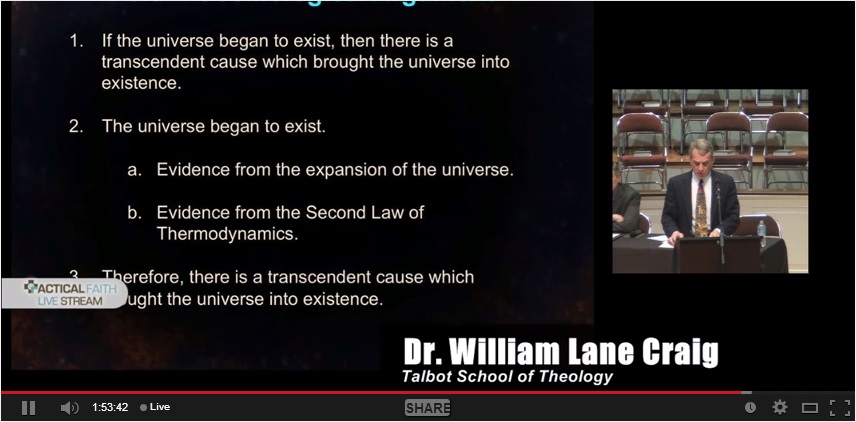
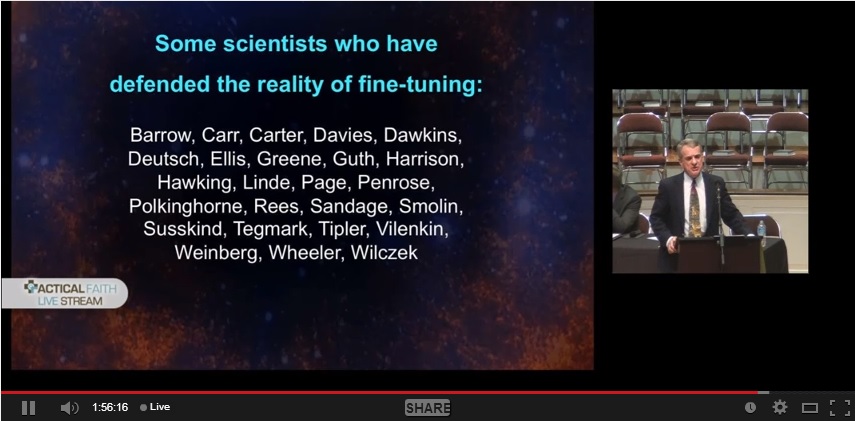
A couple of Craig’s slides: (click for larger images)

Slide 1 of 2:

Dr. Craig slide #1 of 2

Slide 2 of 2:

Dr. Craig slide #2 of 2

Quick summary: (this is not complete, because I couldn’t get everything they were saying noted)

Dr. Craig defended two arguments: 1) the kalam cosmological argument and the fine-tuning argument.

Dr. Craig supported the origin of the universe with 1) the expansion of the universe and 2) the second law of thermodynamics.

Dr. Craig said that the BGV theorem supports a beginning for the universe.

Dr. Craig said that the consensus of scientists did not accept Carroll’s naturalistic cosmology, quoting Stephen Hawking in support.

Dr. Craig said that multiverse models fall victim to the Boltzmann brain problem, where we should observe Boltzmann brains coming into existence and then phasing out again far more probably than embodied minds. But we observe embodied minds, and no Boltzmann brains.

Dr. Carroll said that science cannot study metaphysical questions.

Dr. Carroll said that science is about making models that may or may not be consistent with the experimental data.

Dr. Carroll said that the BGV theorem does not support a beginning for the universe.

Dr. Carroll proposed 17 alternative cosmologies, but did not provide a shred of scientific evidence for any of them, the way that Craig did for the standard model.

Dr. Carroll refuted Dr. Craig’s citation of Stephen Hawking, and Craig yielded the point.

Dr. Carroll speculated that science might progress to the point where the fine-tuning can be explained without an intelligent cause, and he gave an example of where that happened (inflation).

Dr. Craig argued that all 17 of the models suggested by Carroll either conflicted with evidence, had serious problems or did require a beginning.

Dr. Craig argued that Carroll’s own model required a beginning.

Dr. Craig argued that Carroll’s own model fell victim to the Boltzmann brain problem.

Dr. Craig argued that Carroll’s own model violated the second law of thermodynamics.

Dr. Craig re-stated his point that the baby universe spawning in Carroll’s model was speculative and incomplete, and cited Christopher Weaver’s work.

Dr. Carroll denied that things that pop into being out of nothing require a transcendent cause.

Dr. Carroll reiterated that science can only make naturalistic models, and that he did not have to answer questions about ultimate causes.

Dr. Carroll showed a photo of Alan Guth expressing his opinion that the universe is “probably” eternal. No evidence was given for this assertion.

Dr. Carroll said that the fine-tuning was not done in an optimal way, because one fine-tuned value was lower than it needed to be, and it should be exactly what it needed to be if God did it.

Dr. Carroll said that a finely-tuned universe is more probably in naturalism than in theism, because God can do anything he wants and doesn’t need a fine-tuned universe.

Dr. Carroll said he would stop defending his model now, and would instead defend Aguirre-Gratton.

Dr. Craig gave three reasons why the universe popping into being out of nothing requires a transcendent cause.

First, he said that nothing cannot cause anything to happen, because nothing is nothing.

Second, he said that if things pop into being out of nothing, then why don’t we see it happening all the time with other things.

Third, he said that we have no reason to dismiss the causal principle, especially when it is the basis of scientific inquiry and has been so fruitful in the progress of science.

Dr. Craig reiterated that baby universes in Carroll’s model would be dominated by Boltzmann brains, and we don’t observe that.

Dr. Craig said that even on the quantum gravity models that Carroll mentioned, there would still be a beginning.

Dr. Carroll said that Craig mustn’t say “popped into being” but instead that “there was a first moment of time”.

Dr. Carroll said that his model does indeed violate the second law of thermodynamics “YES!”.

At this point Carroll stopped talking about the topic of the debate and started expressing personal opinions about religion. It’s funny how often atheists do this in debates.

Dr. Carroll said that most theists don’t believe in God because of cosmology, but because of community and feelings.

Dr. Carroll said that science had learned a lot in the last 2000 years, so theism was false.

Dr. Carroll said that most philosophers don’t think that God exists, so theism was false.

Dr. Carroll said microscopes and telescopes were absent 2000 years ago, so theism was false.

Dr. Carroll said that religion should be about community and feelings, not about what is true.

Conclusion:

My conclusion was that Carroll lost because he is just satisfied to throw theories out and not to argue that they are true by citing evidence. Carroll never seemed to be interested in finding out what is true, but instead he just wanted to tell a story that didn’t include God, and assert that by Occam’s Razor, his story was a better explanation. I am not impressed with theoretical speculations, although the layperson might be. I kept waiting for him to respond to Craig’s points about how his model was falsified by experimental evidence and observations, e.g. – the Boltzmann brains or the baby universe generation, and he never cited the evidence I wanted him to cite. Craig did have some evidence for his views, but he could have been stronger in making his case. He could have shown the e-mail from Vilenkin that stated that he had understood the BGV theorem, and was using it correctly, for example.

For me the winning side comes down to evidence. The standard model is the standard model because of scientific evidence. Until that evidence is overturned, then speculative models are of no interest to anyone who is evidence-driven. Speculations are not science. A philosophical presupposition of metaphysical naturalism is not science.

If you want to see a good lecture on scientific evidence related to cosmology, then there is the particle physicist Michael Strauss lecture on cosmology and fine-tuning at Stanford University and his more recent lecture at the University of Texas. Note that Strauss is an experimental physicist, not a theoretical physicist like Carroll.

Here’s another review of the debate by Randy Everist of Possible Worlds blog. He explains the back-and-forth over Boltzmann brains and the BGV theorem in more detail.