
Tag Archives: Asian-American

Can blacks and Hispanics blame their troubles on racism by whites?

Does government provide incentives for people to get married?
The success of children is due to their parents’ choices, not from outside racism

If the underperformance of blacks and Hispanics in America were caused by racism by whites, then it follows that Asian-Americans would be underperforming as well. But Asian-Americans are outperforming whites. Let’s look at three reasons why, and see if blacks and Hispanics can learn how to succeed by looking at the Asian example.

Here is the summary of this post:

  1. Asian Americans marry before they have children
  2. Asian Americans save more of what they earn
  3. Asian Americans monitor their children’s educational progress

Now let’s take a look at each of these in order.
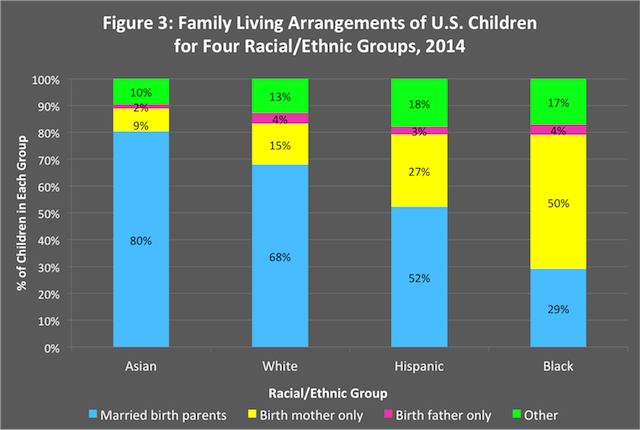
Asians marry before they have children, so the kids have two parents

1. Asian Americans marry before they have children

This article is from Family Studies.

It says:

Eight in ten Asian-American kids live with married birth parents, compared with about seven in ten European-American kids, five in ten Hispanic-American kids, and only about three in ten African-American kids. Half of black children live with their mothers only, compared to three in ten Hispanic children, less than two in ten white children and less than one in ten Asian children.

Naturally, children who have two parents to look after them do better, because one parent alone cannot work and do household chores and monitor the children as easily as two parents can. The decision about whether to have sex before marriage is entirely under the control of the grown-ups. It cannot be blamed on racism, poverty and other non-moral pre-occupations of the secular left. Marriage is a moral issue, and Asian-Americans do the moral thing, and marry before they have children.
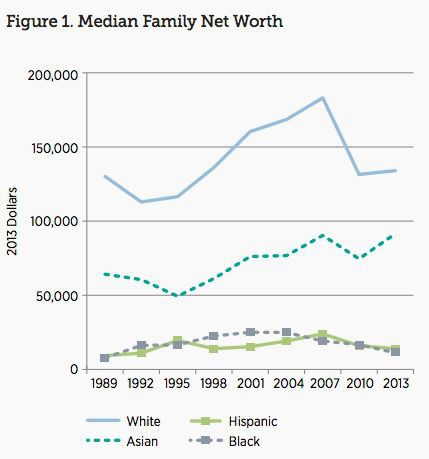
Asian household wealth set to surpass whites

2. Asian Americans save more of what they earn

This article from CNN Money explains:

Asians have had higher median incomes than their white counterparts, according to a new study by the Federal Reserve Bank of St. Louis. The typical Asian family has brought home more money for most of the past two decades.

[…][Asians] will surpass whites in net worth in the next decade or two, Fed researchers said.

[…]In 1989, the median Asian family had about half the net worth of its white peer. By 2013, they had more than two-thirds.

The gap between whites and blacks and Hispanics, meanwhile, remained little changed over that time period.

Asians have similar financial habits to whites, in terms of investing and borrowing. Both groups are more likely than blacks and Hispanics to invest in stocks and privately-owned businesses and to have more liquid assets, which serves as a buffer against financial shocks. And, on average, the former have about half as much debt as the later.

As a result, Asians and whites have more financial stability than blacks and Hispanics, which also allows the former to build more wealth.

Everyone has to earn and save money, but in some cultures, it becomes normal to not save part of what you earn. That needs to stop. But it has nothing to do with discrimination due to skin color. In Asian culture, there is no glorification of consumer spending on sparkles, bling and other ostentatious wealth. Asians don’t want to appear to be wealthy, they want to actually be wealthy – by saving money.
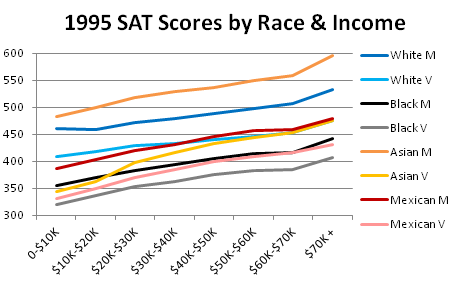
Composite SAT scores by race and income levels
Composite SAT scores by race and income levels: Asians outperform at every income level

3. Asian Americans monitor their children’s educational progress

This article from Investors Business Daily explains how Asian parents don’t just make demands on their kids to learn, they actively monitor their progress and talk to their kids’ teachers:

Asian-American parents tend to oversee their children’s homework, hold them accountable for grades and demand hard work as the ticket to a better life. And it pays off: Their children are soaring academically.

[…]As a group, Americans need to take a page from the Asian parents’ playbook. American teens rank a dismal 28th in math and science knowledge, compared with teens in other countries, even poor countries.

Singapore, Hong Kong, South Korea, Japan and Taiwan are at the top. We’ve slumped. For the first time in 25 years, U.S. scores on the main test for elementary and middle school education (NAEP) fell. And SAT scores for college-bound students dropped significantly.

[…]Many [Asian students]from poor or immigrant families, but they outscore all other students by large margins on both tests, and their lead keeps widening.

In New York City, where Asian-Americans make up 13% of overall students, they win more than 50% of the coveted places each year at the city’s eight selective public high schools, such as Bronx Science and Stuyvesant.

What’s at work here? It’s not a difference in IQ. It’s parenting. That’s confirmed by sociologists from City University of New York and the University of Michigan. Their study showed that parental oversight enabled Asian-American students to far outperform the others.

No wonder many successful charter schools require parents to sign a contract that they will supervise their children’s homework and inculcate a work ethic.

You can see an updated image with the latest scores here.

It’s not enough to just outsource the education of your children to a bunch of non-STEM education-degree-holding teachers. Teachers can be good, and some work very hard. But the Democrat teacher unions prevent the firing of teachers who underperform. This is especially true in non-right-to-work states (Democrat states). So, you cannot depend on teachers to educate your children, and Asian parents don’t. That’s why their kids learn. Performance of children in school is not affected by discrimination against skin color, it’s affected by the level of involvement of parents.

Conclusion

We have learned that the success of Asian-Americans in America is all earned. And this proves that there is no such thing as “racism” that holds back non-whites. If blacks and Hispanics imitated the behaviors of Asians (not whites, but Asians), then they would achieve just as well as Asians do. It’s not a race problem, it’s a behavior problem. It’s not a “racism” problem, it’s a behavior problem. It’s an us problem, it’s not a them problem.
Can blacks and Hispanics blame their troubles on racism by whites?

Does government provide incentives for people to get married?
The success of children is due to their parents’ choices, not from outside racism

If the underperformance of blacks and Hispanics in America were caused by racism by whites, then it follows that Asian-Americans would be underperforming as well. But Asian-Americans are outperforming whites. Let’s look at three reasons why, and see if blacks and Hispanics can learn how to succeed by looking at the Asian example.

Here is the summary of this post:

  1. Asian Americans marry before they have children
  2. Asian Americans save more of what they earn
  3. Asian Americans monitor their children’s educational progress

Now let’s take a look at each of these in order.

Asians marry before they have children, so the kids have two parents

1. Asian Americans marry before they have children

This article is from Family Studies.

It says:

Eight in ten Asian-American kids live with married birth parents, compared with about seven in ten European-American kids, five in ten Hispanic-American kids, and only about three in ten African-American kids. Half of black children live with their mothers only, compared to three in ten Hispanic children, less than two in ten white children and less than one in ten Asian children.

Naturally, children who have two parents to look after them do better, because one parent alone cannot work and do household chores and monitor the children as easily as two parents can. The decision about whether to have sex before marriage is entirely under the control of the grown-ups. It cannot be blamed on racism, poverty and other non-moral pre-occupations of the secular left. Marriage is a moral issue, and Asian-Americans do the moral thing, and marry before they have children.

Asian household wealth set to surpass whites

2. Asian Americans save more of what they earn

This article from CNN Money explains:

Asians have had higher median incomes than their white counterparts, according to a new study by the Federal Reserve Bank of St. Louis. The typical Asian family has brought home more money for most of the past two decades.

[…][Asians] will surpass whites in net worth in the next decade or two, Fed researchers said.

[…]In 1989, the median Asian family had about half the net worth of its white peer. By 2013, they had more than two-thirds.

The gap between whites and blacks and Hispanics, meanwhile, remained little changed over that time period.

Asians have similar financial habits to whites, in terms of investing and borrowing. Both groups are more likely than blacks and Hispanics to invest in stocks and privately-owned businesses and to have more liquid assets, which serves as a buffer against financial shocks. And, on average, the former have about half as much debt as the later.

As a result, Asians and whites have more financial stability than blacks and Hispanics, which also allows the former to build more wealth.

Everyone has to earn and save money, but in some cultures, it becomes normal to not save part of what you earn. That needs to stop. But it has nothing to do with discrimination due to skin color. In Asian culture, there is no glorification of consumer spending on sparkles, bling and other ostentatious wealth. Asians don’t want to appear to be wealthy, they want to actually be wealthy – by saving money.

Composite SAT scores by race and income levels
Composite SAT scores by race and income levels: Asians outperform at every income level

3. Asian Americans monitor their children’s educational progress

This article from Investors Business Daily explains how Asian parents don’t just make demands on their kids to learn, they actively monitor their progress and talk to their kids’ teachers:

Asian-American parents tend to oversee their children’s homework, hold them accountable for grades and demand hard work as the ticket to a better life. And it pays off: Their children are soaring academically.

[…]As a group, Americans need to take a page from the Asian parents’ playbook. American teens rank a dismal 28th in math and science knowledge, compared with teens in other countries, even poor countries.

Singapore, Hong Kong, South Korea, Japan and Taiwan are at the top. We’ve slumped. For the first time in 25 years, U.S. scores on the main test for elementary and middle school education (NAEP) fell. And SAT scores for college-bound students dropped significantly.

[…]Many [Asian students]from poor or immigrant families, but they outscore all other students by large margins on both tests, and their lead keeps widening.

In New York City, where Asian-Americans make up 13% of overall students, they win more than 50% of the coveted places each year at the city’s eight selective public high schools, such as Bronx Science and Stuyvesant.

What’s at work here? It’s not a difference in IQ. It’s parenting. That’s confirmed by sociologists from City University of New York and the University of Michigan. Their study showed that parental oversight enabled Asian-American students to far outperform the others.

No wonder many successful charter schools require parents to sign a contract that they will supervise their children’s homework and inculcate a work ethic.

You can see an updated image with the latest scores here.

It’s not enough to just outsource the education of your children to a bunch of non-STEM education-degree-holding teachers. Teachers can be good, and some work very hard. But the Democrat teacher unions prevent the firing of teachers who underperform. This is especially true in non-right-to-work states (Democrat states). So, you cannot depend on teachers to educate your children, and Asian parents don’t. That’s why their kids learn. Performance of children in school is not affected by discrimination against skin color, it’s affected by the level of involvement of parents.

Conclusion

We have learned that the success of Asian-Americans in America is all earned. And this proves that there is no such thing as “racism” that holds back non-whites. If blacks and Hispanics imitated the behaviors of Asians (not whites, but Asians), then they would achieve just as well as Asians do. It’s not a race problem, it’s a behavior problem. It’s not a “racism” problem, it’s a behavior problem. It’s an us problem, it’s not a them problem.

Asian-Americans being discriminated against by the secular left in academia

Now for some of you, this post is going to be a surprise. Most of you will have learned in school that whites are racist against blacks, and that’s why blacks underperform in education. What you probably didn’t know is that Asians outperform in education, so that “racism” cannot possibly be what is holding back blacks. However, there is real racism and discrimination in education. It comes from the university admissions people, who want to punish Asian-Americans for their academic success. They want to keep them out of the best universities, because there are too many of them, and it threatens “diversity”.

According to this very popular article in ultra-leftist The Economist, the Asian-Americans are pushing back against the progressive racists in academia.

The article says:

MICHAEL WANG, a young Californian, came second in his class of 1,002 students; his ACT score was 36, the maximum possible; he sang at Barack Obama’s inauguration; he got third place in a national piano contest; he was in the top 150 of a national maths competition; he was in several national debating-competition finals. But when it came to his university application he faced a serious disappointment for the first time in his glittering career. He was rejected by six of the seven Ivy League colleges to which he applied.

“I saw people less qualified than me get better offers,” says Mr Wang. “At first I was just angry. Then I decided to turn that anger to productive use.” He wrote to the universities concerned. “I asked: what more could I have done to get into your college? Was it based on race, or what was it based on?” He got vague responses—or none. So he complained to the Department of Education. Nothing came of it. “The department said they needed a smoking gun.”

In May this year Mr Wang joined a group of 64 Asian-American organisations that made a joint complaint to the Department of Education against Harvard, alleging racial discrimination. That follows a lawsuit filed last year against Harvard and the University of North Carolina by a group of Asian-American students making similar charges. The department rejected the claim in July, but another two complaints have since been filed by Asian-Americans, one against Harvard and one against nine other universities.

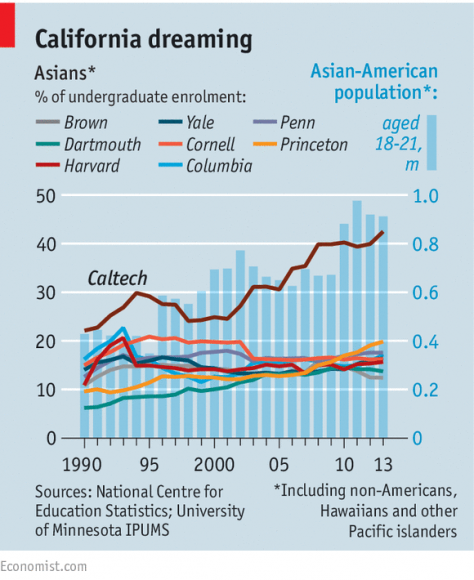
The article points out that Ivy League universities are allowed to discriminate against Asians by race. So Asian admissions are flat. But at the California Institute of Technology (Caltech), which is the top experimental science university in the United States, Asian admissions have been soaring. Why? California does not allow discrimination by race in admissions.

Here’s the graph:

Admissions of Asian-Americans at Caltech compared to Ivy League

Read this:

Some Asians allege that the Ivy Leagues have put an implicit limit on the number of Asians they will admit. They point to Asians’ soaring academic achievements and to the work of Thomas Espenshade and Alexandria Walton Radford of Princeton, who looked at the data on admissions and concluded that Asian-Americans need 140 SAT points out of 1,600 more than whites to get a place at a private university, and that blacks need 310 fewer points. Yet in California, where public universities are allowed to use economic but not racial criteria in admissions, 41% of Berkeley’s enrolments in 2014 were Asian-Americans and at the California Institute of Technology 44% were (see chart).

[…]For the moment the court has taken the view that universities may take race into account, but racial quotas are not on. The Ivies deny running a racial quota. But in its comment on the Asian groups’ complaint, Harvard defends the use of race as a criterion in admission—“a class that is diverse on multiple dimensions, including on race, transforms the educational experience of students from every background and prepares our graduates for an increasingly pluralistic world”—and describes its admissions process as “holistic”, meaning it takes into account considerations wider than mere test scores.

Many Asian parents think this is wrong. They woke up a long time ago to the need to counter the stereotype of the maths-nerd Asian who does nothing but work, and encouraged their children to diversify—into music, debating, charity work, sports, everything that is supposed to increase students’ chances of admission. But many who have excelled in those areas, including Mr Wang and Irene Liu, a student from Massachusetts with a similarly stellar CV, were rejected by the Ivy League. Ms Liu’s mother, Tricia, says, “I feel angry about it. We came for the American dream: you work hard, you do well. This just doesn’t add up.” Irene has accepted a place at a top Canadian university, and is happy about it. Her mother isn’t: “It breaks my heart that she’s going abroad. If she had gone to Harvard, I could have brought her dumplings.”

I often blog about depressing and negative things on this blog because there is so much going wrong in a world run by the secular left, especially because church pastors and Christian parents seem to be so committed to the idea that Christianity has nothing to do with anything outside of the church walls. But this topic is a big win for us. We should be open to presenting conservative ideas and values to Asian-Americans. We have BOTH of the Asian-American governors (Bobby Jindal and Nikki Haley) as conservative Republicans. We also favor more choice and competition in education. There is an opportunity for new alliances here. I am hopeful.

UPDATE: Asian friend writes this to me:

I sounded the alarm on this years ago. But what has come of it? The lesson I have learned is that Asians don’t count. Asians don’t count as a minority, even though we are the smallest minority. Asians don’t count as non-whites, even though liberals in particular are sexually aroused by the fantasy of the exotic in Asian culture, particularly women. Asians don’t count as a governmentally oppressed group, even though the first racially specific legislation passed in Congress was the Chinese Exclusion act of 1882 and were targeted for internment camps during WWII. Asians don’t count, because despite all hardships, Asians do not waste time trying to rectify the past but make a better lives for themselves. And in so doing, they make a better lives for their children and their community. The successes of Asians in America is a big negative pull on the narrative of the Left, but it has no effect. Why not? Because flouting the narrative renders Asians as a people group irrelevant, to be ignored over #blacklivesmatter or whatever.

Asian woes have been more recent than slavery, yet they seem to be doing fine. Maybe their strong views of marriage and family have something to do with it?